Will AI Replace Jobs?
Impact analysis • Risk assessment • Career adaptation strategies
AI Job Impact Overview:
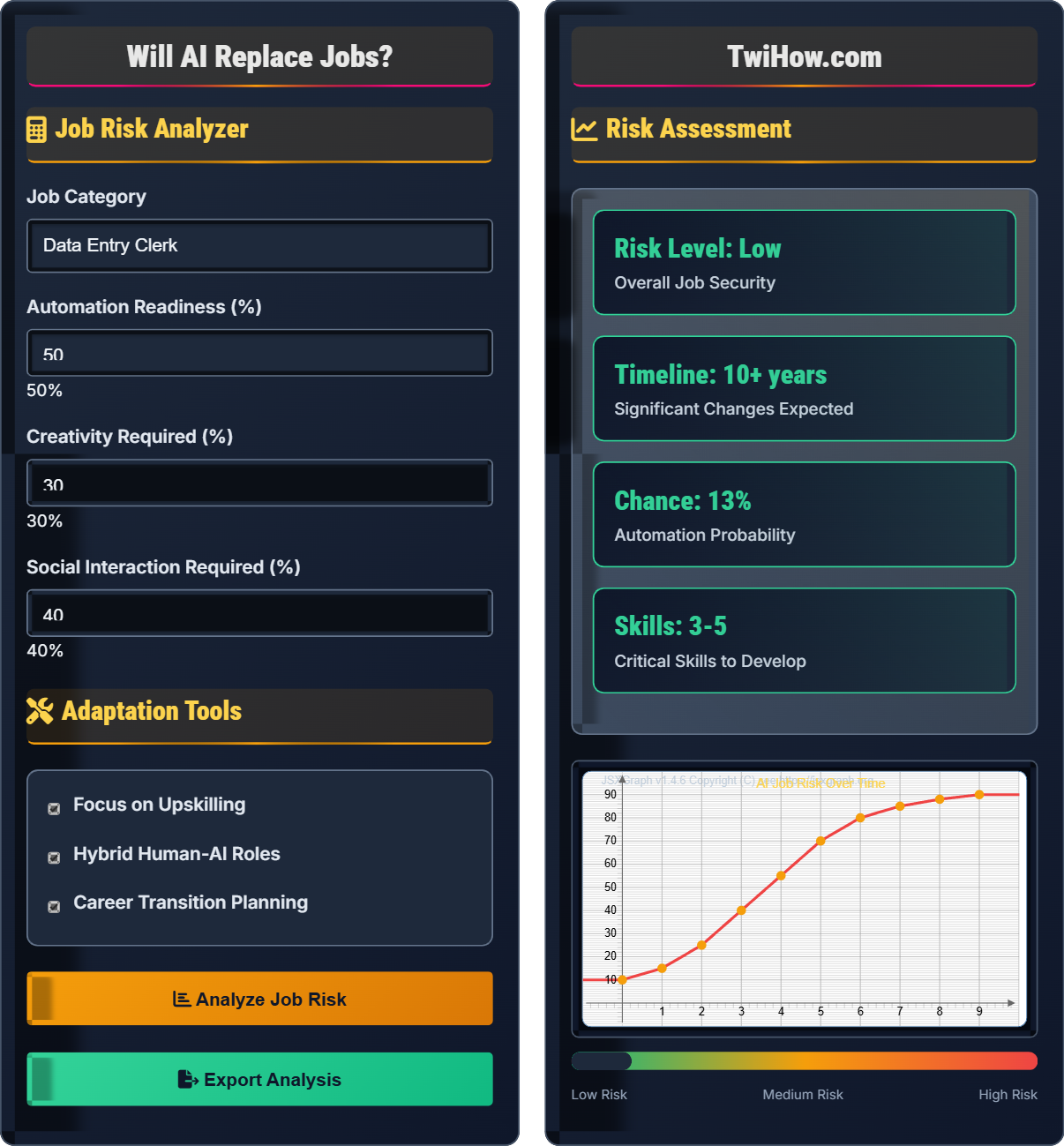
Analyze Your Job RiskAI's impact on employment is nuanced: while some jobs face automation risk, others remain safe and new opportunities emerge. The key lies in understanding which tasks are automatable versus those requiring human creativity, empathy, and complex decision-making.
Jobs at highest risk involve routine, predictable tasks with clear rules. Jobs requiring creativity, emotional intelligence, complex problem-solving, and interpersonal skills are more resilient to automation.
Historical precedent suggests that while technology eliminates some jobs, it creates new categories of work. The current AI revolution follows this pattern but at an accelerated pace, requiring proactive adaptation.
Job Risk Analyzer
Adaptation Tools
Risk Assessment
- Emotional intelligence and interpersonal skills
- Creative problem-solving
- Data analysis and interpretation
- Digital literacy and AI tools
- Complex decision-making
- Continuous learning mindset
- Build human-centered skills
- Stay updated on industry trends
- Develop hybrid skills (tech + human)
- Create unique value proposition
Job Risk Categories
AI Impact Timeline
Survival Strategies
Focus on uniquely human skills that complement AI: creativity, emotional intelligence, complex problem-solving, and ethical decision-making.
Position yourself as an AI-human collaboration specialist. Learn to work with AI tools to enhance productivity while maintaining human oversight.
- Continuous learning is essential
- Human touch remains irreplaceable
- Adaptability beats specialization
- Build AI-human partnerships
AI Job Impact Quiz
Which combination of factors makes a job most susceptible to AI automation?
Jobs with routine tasks, clear rules, and predictable outcomes are most vulnerable to automation. AI excels at pattern recognition and rule-following but struggles with creativity, emotional nuance, and complex decision-making.
The answer is B) Routine tasks with clear rules and predictable outcomes.
Understanding the nature of automation risk helps workers anticipate changes in their field. Jobs involving repetitive, predictable tasks are prime targets for AI because these activities follow clear patterns that can be codified into algorithms. Conversely, roles requiring creativity, emotional intelligence, and complex problem-solving remain difficult to automate.
Automatable Tasks: Activities that follow predictable patterns and can be codified
Human-Centric Tasks: Activities requiring creativity, empathy, or complex judgment
Pattern Recognition: AI's strength in identifying regularities in data
• Predictable = Automatable
• Creative = Resilient to automation
• Human interaction = Lower risk
• Focus on uniquely human skills
• Combine technical and soft skills
• Stay ahead of automation trends
• Underestimating AI capabilities
• Overvaluing routine tasks
• Ignoring skill development
How has technological advancement historically affected employment, and what lessons can we draw for the AI era?
Historical Pattern: Previous technological revolutions (Industrial Revolution, computer age) initially displaced workers but ultimately created new job categories and increased overall employment. The Luddite fallacy describes the incorrect assumption that technology permanently reduces employment.
Current Differences: AI advances faster than previous technologies and affects both blue-collar and white-collar jobs simultaneously. However, new roles emerge in AI development, maintenance, ethics, and human-AI collaboration.
Key Lesson: Adaptability and continuous learning have been crucial for workers to thrive during technological transitions.
History provides perspective on technological change. While the Industrial Revolution displaced artisans, it created factory jobs and eventually led to higher living standards. Similarly, computers eliminated some clerical positions but created IT jobs. The AI era follows this pattern but requires faster adaptation due to the rapid pace of change.
Luddite Fallacy: Assumption that technology permanently reduces employment
Technological Unemployment: Job loss due to technological advancement
Productivity Gains: Efficiency improvements from technology
• Technology creates new job categories
• Skills evolve with technology
• Adaptation is essential
• Study historical transitions
• Anticipate emerging needs
• Invest in transferable skills
• Assuming permanent job losses
• Ignoring new opportunities
• Resisting technological change
A 45-year-old accountant with 20 years of experience realizes that AI will likely automate much of their current role within the next decade. Develop a strategic plan for career transition that maximizes their existing strengths while preparing for an AI-integrated workplace.
Phase 1 (Years 1-2): Augment current role with AI tools. Learn to use AI for data analysis, report generation, and audit processes. Position as AI-accounting hybrid specialist.
Phase 2 (Years 2-4): Expand into advisory roles requiring human judgment. Develop expertise in tax strategy, business consulting, and financial planning where AI cannot replace human insight.
Phase 3 (Years 4-6): Transition to strategic finance roles or specialize in AI auditing and compliance. Consider teaching or mentoring others in AI-assisted accounting.
Key Skills: AI tool proficiency, business strategy, client relationship management, and ethical decision-making.
Mid-career transitions require leveraging existing expertise while acquiring new skills. Accountants have valuable domain knowledge and analytical skills that can be enhanced with AI rather than replaced. The key is moving from routine tasks to strategic advisory roles that require human judgment and relationship management.
Hybrid Role: Position combining human skills with AI tools
Domain Expertise: Industry-specific knowledge and experience
Strategic Advisory: Role requiring judgment beyond data analysis
• Leverage existing expertise
• Combine technical and human skills
• Focus on irreplaceable abilities
• Start early with AI integration
• Build relationships with clients
• Pursue relevant certifications
• Waiting until too late to adapt
• Resisting AI tool adoption
• Ignoring soft skill development
A major hospital is implementing AI diagnostic tools that can interpret medical images with 95% accuracy compared to radiologists. As a hospital administrator, how would you approach staff restructuring while maintaining quality care and employee morale?
Repositioning Strategy: Transform radiologists from image interpreters to patient consultants and complex case specialists. Use AI for routine screenings while having radiologists verify critical findings and communicate results.
Workflow Redesign: Implement AI for preliminary analysis, with radiologists focusing on complex cases, treatment planning, and patient interaction. This increases efficiency while maintaining human oversight.
Staff Development: Offer retraining programs for radiologists to specialize in AI integration, quality assurance, and patient communication. Some staff may transition to AI training and validation roles.
Communication Plan: Emphasize AI as a tool to enhance radiologist capabilities, not replace them entirely.
Successful AI integration in sensitive fields like healthcare requires careful balance between efficiency gains and human oversight. Rather than wholesale replacement, organizations achieve better outcomes by redefining roles to leverage both AI capabilities and human expertise. This approach preserves jobs while improving service quality.
Human-in-the-Loop: System where humans oversee AI decisions
Augmented Intelligence: AI that enhances rather than replaces human capabilities
Quality Assurance: Verification of AI-generated results
• Preserve human oversight in critical areas
• Redefine roles rather than eliminate them
• Maintain trust in human expertise
• Involve employees in transition planning
• Emphasize AI as productivity tool
• Focus on complementary skills
• Immediate job cuts without alternatives
• Poor communication about changes
• Ignoring patient trust factors
Which skill set is most valuable for workers to develop in an AI-integrated workplace?
Emotional intelligence and creative problem-solving are uniquely human capabilities that complement AI. While AI handles data processing and pattern recognition, humans excel at empathy, innovation, and complex decision-making requiring ethical considerations.
The answer is C) Emotional intelligence and creative problem-solving.
Future-proof careers will combine AI efficiency with human qualities that machines cannot replicate. Workers who develop emotional intelligence, creativity, ethical reasoning, and interpersonal skills will find their value increasing alongside AI capabilities. This creates a symbiotic relationship rather than competition.
Emotional Intelligence: Ability to understand and manage emotions
Creative Problem-Solving: Innovation in addressing challenges
Human-AI Symbiosis: Cooperative relationship between humans and AI
• Develop irreplaceable human skills
• Combine AI efficiency with human insight
• Focus on relationship-building abilities
• Cultivate empathy and communication
• Practice innovative thinking
• Build collaborative relationships
• Competing with AI on its strengths
• Neglecting soft skill development
• Ignoring AI-human collaboration
FAQ
Q: Will AI completely eliminate the need for human workers in the future?
A: Most economists and technologists believe AI will transform rather than eliminate most jobs. While AI excels at pattern recognition, data processing, and routine tasks, it struggles with creativity, emotional intelligence, complex problem-solving, and ethical decision-making. The future likely involves human-AI collaboration where AI handles routine aspects while humans focus on higher-level tasks requiring judgment, creativity, and interpersonal skills. However, some jobs will disappear, and new ones will emerge, requiring workers to adapt their skills continuously.
Q: What should I study now to ensure job security in an AI-dominated future?
A: Focus on interdisciplinary skills that combine technical knowledge with human-centered abilities. Study fields like AI ethics, human-computer interaction, data science with business applications, or psychology with technology. Develop skills in creative problem-solving, emotional intelligence, complex systems thinking, and ethical reasoning. Learn to work with AI tools rather than compete against them. Consider careers in education, healthcare, creative industries, law, and management where human judgment remains irreplaceable. Most importantly, cultivate a mindset of continuous learning to adapt as technologies evolve.