What is AI Hallucination?
Complete guide • AI misinformation
AI Hallucination Fundamentals:
Detection SimulatorAI hallucination refers to the phenomenon where artificial intelligence systems generate false, inaccurate, or misleading information that appears plausible but is factually incorrect. This occurs when AI models create content based on patterns they've learned rather than verifiable facts.
Common types of AI hallucinations include:
- Fabricated Facts: Creating non-existent information
- Confident Falsehoods: Providing incorrect information with high confidence
- Pattern Extrapolation: Extending patterns beyond valid ranges
- Memory Confusion: Mixing information from different sources
- Logical Inconsistencies: Contradicting statements
- Context Errors: Misunderstanding situational context
Understanding and mitigating AI hallucinations is crucial for reliable AI deployment.
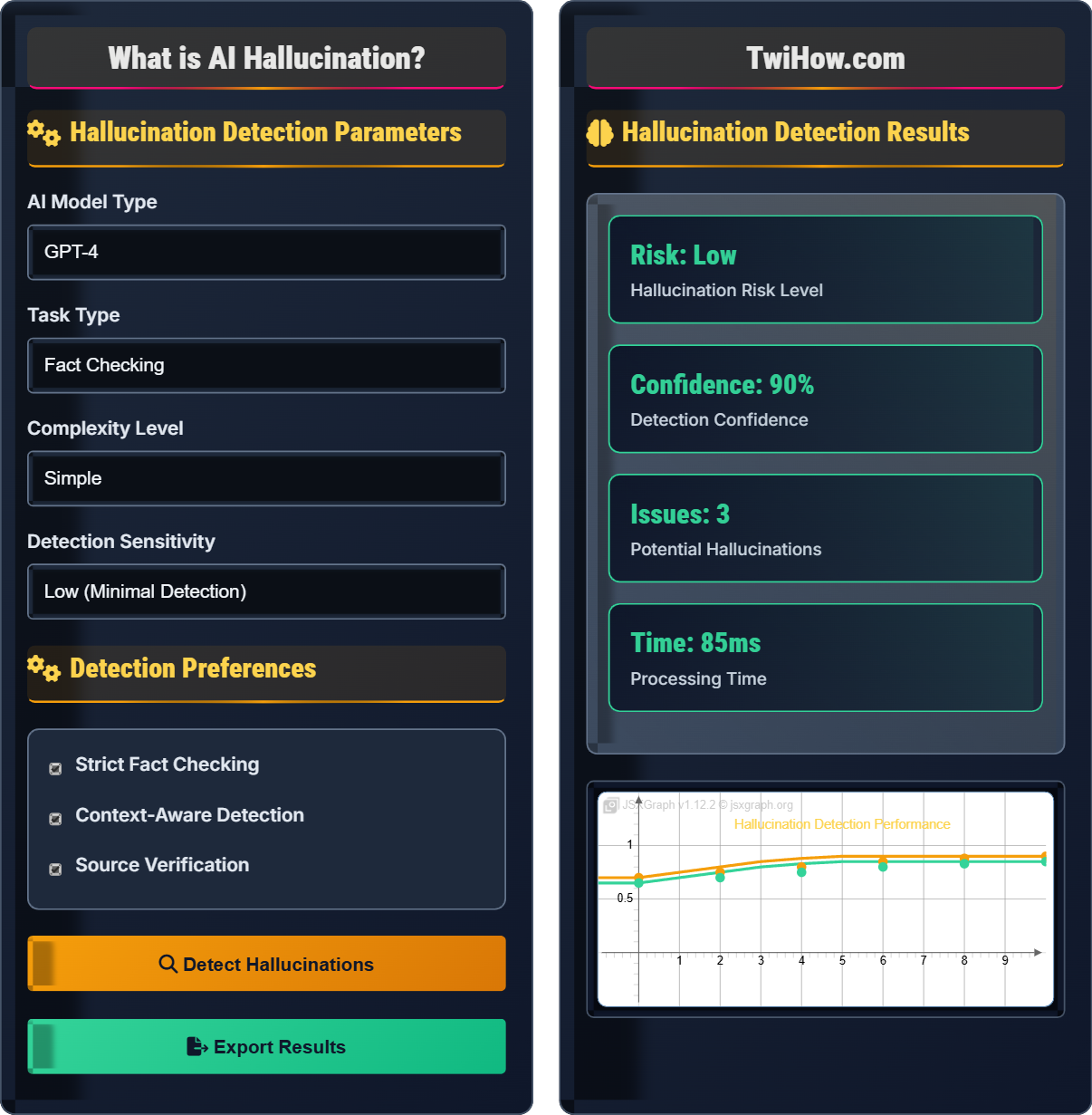
Hallucination Detection Parameters
Detection Preferences
Hallucination Detection Results
AI Output
Analysis
Detection
Flagging
Pattern Analysis Method:
Detecting unusual patterns in AI output that deviate from training data
Complete Guide to AI Hallucination
AI hallucination refers to the phenomenon where artificial intelligence systems generate false, inaccurate, or misleading information that appears plausible but is factually incorrect. This occurs when AI models create content based on patterns they've learned rather than verifiable facts. Unlike intentional deception, hallucinations are generated without awareness of their inaccuracy.
Recall memories
Fill in gaps with imagination
Blend similar experiences
Confabulate details
Believe in false memories
Repeat inaccuracies
Process training patterns
Extrapolate beyond data
Combine unrelated facts
Generate confident responses
Cannot verify truth
Reproduce inconsistencies
AI systems generate hallucinations when they fill gaps in knowledge with plausible but incorrect information.
Fact Checking
Verify against known facts
Contradiction Detection
Find inconsistencies
Pattern Analysis
Identify unusual patterns
Confidence Scoring
Measure certainty levels
Source Verification
Check information sources
Consistency Check
Compare with training data
Where P is the probability of hallucination given input x, φ(x) represents feature extraction, θ are model parameters, and σ is the sigmoid function. This represents how detection models assign probabilities to outputs.
- Probability Theory: Modeling uncertainty in AI outputs
- Statistical Analysis: Measuring deviation from training data
- Information Theory: Quantifying information content
- Bayesian Inference: Updating beliefs based on evidence
Detection Methods
Fact checking, contradiction detection, pattern analysis, confidence scoring, source verification.
- Verify against trusted sources
- Check for internal consistency
- Monitor confidence levels
- Apply multiple detection methods
Mitigation Strategies
Fact verification, training data curation, confidence calibration, human oversight, multi-model consensus.
Data Quality
Curated training data
Fact Checking
Verification systems
Human Review
Expert oversight
Guardrails
Constraint systems
- Balance accuracy and creativity
- Consider computational overhead
- Account for domain-specific needs
- Plan for continuous monitoring
AI Hallucination Assessment
Which type of AI hallucination involves generating confident responses with information that is factually incorrect?
Confident falsehoods refer to the type of AI hallucination where the system generates incorrect information with high confidence levels. This is particularly problematic because users may trust the response due to the confident presentation, even though the information is factually wrong.
The answer is B) Confident Falsehoods.
Confident falsehoods are among the most dangerous types of hallucinations because they combine inaccuracy with high confidence. This can lead users to believe false information is correct. The confidence level displayed by AI systems doesn't necessarily correlate with accuracy, which is why verification is crucial.
Hallucination: False information generated by AI
Confident Falsehood: Incorrect info with high confidence
Verification: Checking information accuracy
• Confidence ≠ Accuracy
• Check multiple sources
• Verify with trusted sources
• Look for citations
• Cross-check important facts
• Trusting confident responses without verification
• Assuming AI knows everything
• Not questioning seemingly plausible information
Explain the primary causes of AI hallucinations and how they relate to the training process.
Primary Causes of AI Hallucinations:
• Training Data Gaps: When training data lacks information on specific topics, models may fabricate responses
• Pattern Overfitting: Models learn spurious correlations that don't hold in real-world scenarios
• Extrapolation Beyond Data: Models attempt to generate content outside their training distribution
• Confidence Calibration Issues: Models express high confidence even when uncertain
• Context Misunderstanding: Models fail to properly interpret context or constraints
Relationship to Training:
• Training data quality directly impacts hallucination frequency
• Data diversity affects model's ability to handle novel situations
• Training objectives may not adequately penalize incorrect outputs
• Model size and complexity can influence hallucination patterns
Understanding these causes helps in designing better training and mitigation strategies.
AI hallucinations are fundamentally related to the limitations of the training process. Models learn patterns from data but lack true understanding. When faced with unfamiliar situations, they extrapolate patterns inappropriately. The quality and breadth of training data are crucial factors in determining how often hallucinations occur.
Training Data: Information used to train AI models
Overfitting: Learning patterns that don't generalize
Extrapolation: Extending patterns beyond valid range
• Training data quality matters
• Diverse data reduces hallucinations
• Context understanding is crucial
• Curate high-quality training data
• Include diverse examples
• Monitor model behavior
• Not considering training data limitations
• Assuming models understand context
• Ignoring confidence calibration
A healthcare organization is implementing an AI system to assist with medical information. The system will provide answers to patient questions and support clinical decision-making. Design a hallucination detection and mitigation strategy that addresses the critical nature of medical information.
Hallucination Detection Strategy:
1. Multi-Source Verification:
• Cross-reference with established medical databases
• Compare against peer-reviewed literature
• Validate against clinical guidelines
2. Confidence Thresholding:
• Set high confidence thresholds for medical claims
• Flag responses below threshold for review
• Provide uncertainty indicators
3. Expert Review:
• Implement human-in-the-loop for critical responses
• Medical expert validation of AI outputs
• Regular auditing of system responses
4. Context Awareness:
• Distinguish between general information and clinical advice
• Clearly indicate when information is for educational purposes only
• Prompt for human consultation when appropriate
Implementation:
• Use medical-specific fact-checking APIs
• Implement real-time verification systems
• Maintain audit trails for all responses
This strategy ensures patient safety while leveraging AI benefits.
Medical AI applications require the highest level of accuracy due to potential health consequences. The detection strategy must include multiple verification layers, human oversight, and clear disclaimers. The system should err on the side of caution, preferring to admit uncertainty rather than provide potentially harmful information.
Medical Database: Authoritative medical information repository
Human-in-the-Loop: Human oversight in AI systems
Confidence Thresholding: Minimum confidence for acceptance
• Patient safety first
• Medical expertise required
• Clear disclaimers essential
• Use authoritative medical sources
• Implement strict validation
• Regular expert review
• Using non-medical sources
• Not indicating uncertainty
A news organization wants to develop an AI system to detect hallucinations in AI-generated articles. The system must identify fabricated facts, inconsistent reporting, and misleading information. Analyze the requirements and propose a detection solution.
Requirements Analysis:
• Real-time processing of articles
• High accuracy for credibility
• Fast detection for workflow integration
• Detailed reporting for editors
Proposed Solution: Multi-Modal Detection System
• Fact Verification: Cross-reference claims against verified news sources
• Pattern Analysis: Identify unusual narrative structures
• Source Tracing: Verify citations and quotes
• Consistency Checking: Detect contradictions within articles
• Context Analysis: Verify temporal and spatial consistency
• Confidence Scoring: Assign reliability scores to content
• Human Review: Flag suspicious content for editor review
• Database Integration: Connect to fact-checking databases
This solution balances accuracy with speed for newsroom integration.
News verification systems require sophisticated detection capabilities because false information can spread rapidly and cause significant harm. The system must be able to verify claims in real-time while maintaining the fast pace required in newsrooms. Multiple verification methods increase accuracy while reducing false positives.
Fact Verification: Checking information accuracy
Pattern Analysis: Identifying unusual structures
Source Tracing: Verifying information origins
• Speed vs accuracy tradeoff
• Multiple verification sources
• Clear reporting for humans
• Use authoritative news sources
• Implement real-time processing
• Monitor system performance
• Relying on single verification source
• Not considering context
• Ignoring temporal relevance
Which emerging approach shows promise for reducing AI hallucinations by improving model training and verification?
Constitutional AI and Reinforcement Learning from Human Feedback (RLHF) show promise for reducing hallucinations by incorporating human values and factuality into the training process. These approaches help align AI behavior with human expectations and factual accuracy.
The answer is B) Constitutional AI and RLHF.
Constitutional AI trains models to follow a set of principles or "constitution" that emphasizes truthfulness and helpfulness. RLHF uses human feedback to reward accurate responses and penalize hallucinations. These approaches address hallucinations at the training level rather than just detecting them after generation.
Constitutional AI: AI trained with principles
RLHF: Reinforcement Learning from Human Feedback
Alignment: Matching AI behavior with human values
• Training alignment is crucial
• Human feedback improves quality
• Principles guide behavior
• Incorporate human feedback
• Use principled training
• Monitor alignment continuously
• Only focusing on model size
• Ignoring training alignment
• Not incorporating human feedback
FAQ
Q: How can I detect hallucinations in my AI model's outputs?
A: There are several approaches to detect hallucinations:
Fact-Checking:
• Cross-reference with known facts
• Use external knowledge bases
• Verify numerical claims
Pattern Analysis:
• Look for unusual confidence levels
• Check for internal consistency
• Identify fabricated citations
Confidence Analysis:
• Monitor confidence calibration
• Flag unusually high confidence
• Use ensemble methods for verification
Context Verification:
• Check temporal consistency
• Verify logical coherence
• Validate against training distribution
Combining multiple approaches improves detection accuracy.
Q: Can AI hallucinations be completely eliminated?
A: Completely eliminating AI hallucinations is currently not possible, but they can be significantly reduced:
Reasons for Persistence:
• Fundamental limitations in training data
• Inherent uncertainty in some domains
• Model complexity and emergence
• Novel situations beyond training scope
Reduction Strategies:
• Better training data curation
• Improved fact-checking systems
• Constitutional AI training
• Human oversight and verification
Acceptable Levels:
• Depends on application domain
• Critical applications require minimal hallucinations
• Creative applications may tolerate more
Continuous monitoring and improvement are essential.