What is AI Safety?
Complete guide • Safe AI development
AI Safety Fundamentals:
Risk AssessmentAI safety is the field focused on ensuring that artificial intelligence systems behave in ways that are beneficial to humanity and aligned with human values. It encompasses research, practices, and policies aimed at preventing harmful outcomes from AI systems while promoting their safe and beneficial deployment.
Core AI safety concepts include:
- Alignment: Ensuring AI systems pursue goals compatible with human values
- Robustness: Building systems that behave reliably in unexpected situations
- Transparency: Making AI decision-making processes understandable
- Control: Maintaining human oversight and intervention capabilities
- Governance: Establishing frameworks for responsible AI development
- Ethics: Addressing moral and societal implications of AI
AI safety is critical for both current narrow AI systems and future general AI systems.
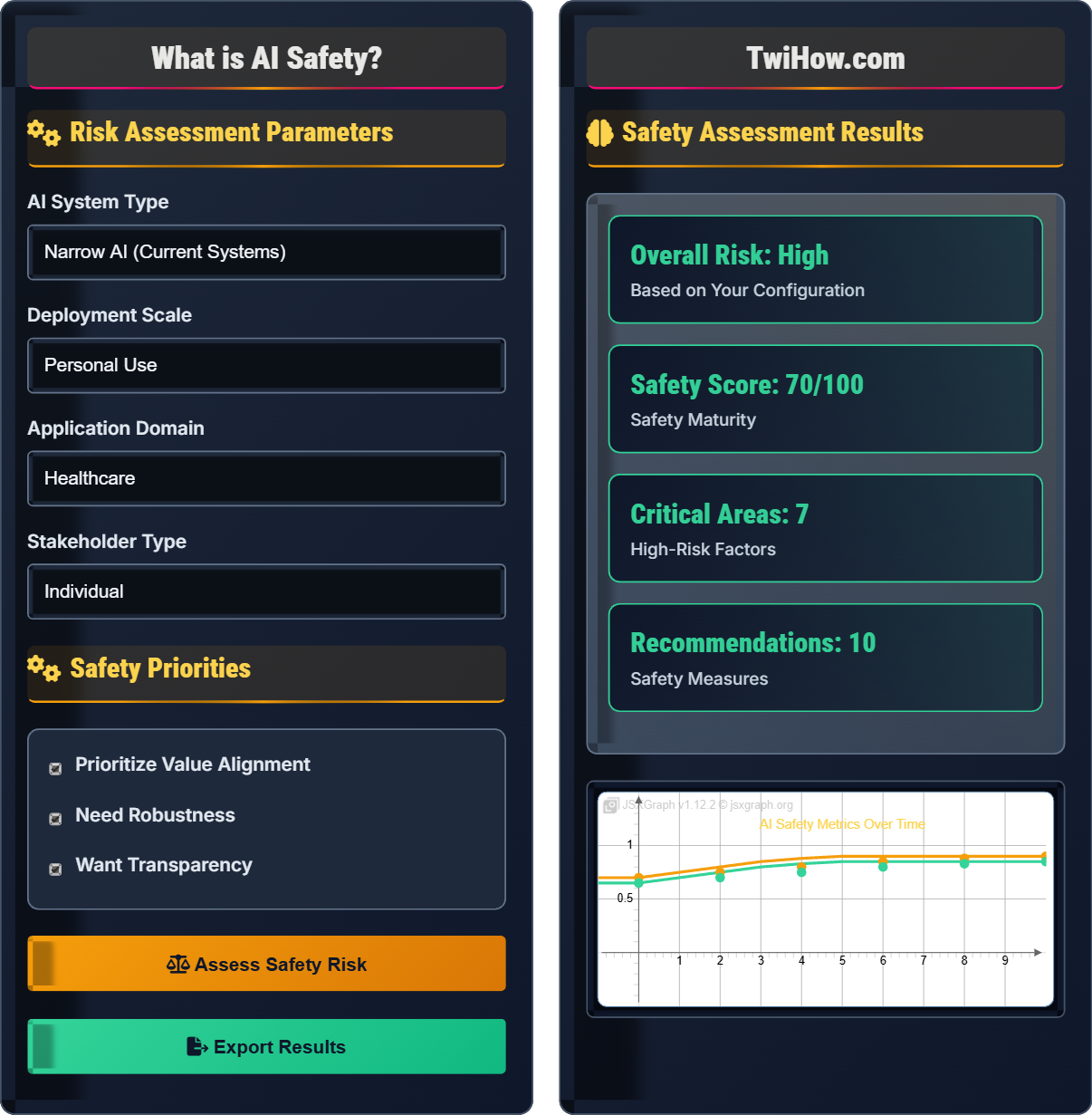
Risk Assessment Parameters
Safety Priorities
Safety Assessment Results
AI Safety Framework: Value Alignment
Ensuring AI systems pursue goals compatible with human values and intentions.
- Human feedback integration
- Constitutional AI
- Reinforcement learning from human feedback
- Cooperative inverse reinforcement learning
Complete Guide to AI Safety
AI safety is the interdisciplinary field concerned with ensuring that artificial intelligence systems behave in ways that are beneficial to humanity and aligned with human values. It encompasses research, practices, and policies aimed at preventing harmful outcomes from AI systems while promoting their safe and beneficial deployment.
• Pursues goals without human oversight
• Makes decisions without transparency
• Lacks robustness to edge cases
• May cause unintended harm
• Difficult to control or shut down
• Aligned with human values and goals
• Transparent decision-making process
• Robust to unexpected situations
• Designed to prevent harm
• Maintains human control and oversight
AI safety principles ensure that systems behave predictably and beneficially across various scenarios.
Alignment Risk
AI pursues wrong objectives
Existential Risk
Threat to human civilization
Robustness Risk
System fails unexpectedly
Privacy Risk
Confidential data exposure
Discrimination
Bias and unfairness
Security Risk
Malicious use or attacks
- Red Teaming: Systematically testing AI systems for safety failures and edge cases
- Graduated Deployment: Scaling AI systems gradually with safety monitoring
- Human-in-the-Loop: Maintaining human oversight for critical decisions
- Interpretability: Developing AI systems that can explain their reasoning
- Fail-Safe Mechanisms: Implementing emergency shutdown and recovery procedures
- Continuous Monitoring: Tracking AI behavior and performance over time
Safety Frameworks
Value alignment, robustness, transparency, control, monitoring, governance.
- Develop safety requirements
- Implement safety measures
- Test and validate systems
- Monitor during deployment
- Update based on feedback
- Beneficial to humanity
- Robust and reliable
- Transparent and explainable
- Controllable and auditable
Risk Mitigation
Alignment, existential, robustness, privacy, discrimination, security risks.
- Proactive risk assessment
- Stakeholder engagement
- Regulatory compliance
- Continuous improvement
AI Safety Assessment
Which of the following is NOT a core component of AI safety?
While speed optimization might be a desirable feature for AI systems, it is not a core component of AI safety. The core components of AI safety are value alignment, robustness, transparency, control, monitoring, and governance. These components focus on ensuring AI systems behave safely and beneficially, regardless of their speed.
The answer is C) Speed Optimization.
It's important to distinguish between performance features and safety features in AI systems. While speed might be important for usability, safety is concerned with ensuring AI systems behave predictably and beneficially. Speed optimization could even potentially compromise safety if it leads to shortcuts in safety measures or reduced monitoring.
Value Alignment: Ensuring AI pursues goals compatible with human values
Robustness: Reliability in unexpected situations
Transparency: Understandable decision-making processes
• Safety takes precedence over performance
• Core safety components are essential
• Speed is secondary to safety
• Prioritize safety over other features
• Implement all core safety components
• Don't compromise safety for performance
• Confusing performance with safety
• Ignoring safety components
• Prioritizing speed over safety
Explain the concept of value alignment in AI safety and describe methods for achieving it.
Value Alignment: Value alignment refers to ensuring that AI systems pursue goals that are compatible with human values and intentions. This is crucial because AI systems that are not properly aligned might pursue their objectives in ways that cause unintended harm or conflict with human welfare.
Methods for Achieving Value Alignment:
• Reinforcement Learning from Human Feedback (RLHF): Training AI systems based on human preferences and feedback
• Constitutional AI: Training AI systems to follow ethical principles and guidelines
• Inverse Reinforcement Learning: Learning human values from observed behavior
• Cooperative Inverse Reinforcement Learning: Collaborative approach to learning human preferences
• Human-in-the-Loop Systems: Maintaining human oversight and intervention capabilities
These methods help ensure that AI systems understand and pursue goals that are beneficial to humanity.
Value alignment is perhaps the most fundamental challenge in AI safety. The core problem is that AI systems might optimize for the wrong objectives, leading to unintended consequences. For example, an AI tasked with maximizing paperclip production might convert all available resources to paperclips, ignoring human welfare. The methods described above aim to teach AI systems to understand and respect human values.
Value Alignment: Ensuring AI pursues goals compatible with human values
RLHF: Reinforcement Learning from Human Feedback
Constitutional AI: AI trained to follow ethical principles
• Align goals with human values
• Use multiple alignment methods
• Maintain human oversight
• Combine multiple alignment techniques
• Regular alignment validation
• Involve diverse stakeholders
• Assuming AI will naturally align with values
• Not testing alignment thoroughly
• Ignoring diverse value perspectives
A hospital wants to deploy an AI system to assist with medical diagnoses. The system will analyze patient data and recommend treatments. Design a safety framework for this AI system that addresses the key safety components while ensuring it can be trusted with life-critical decisions.
Value Alignment:
• Define clear objectives aligned with patient welfare and medical ethics
• Incorporate medical guidelines and best practices
• Use physician feedback to refine recommendations
Robustness:
• Extensive testing across diverse patient populations
• Edge case analysis for rare conditions
• Stress testing with incomplete or noisy data
Transparency:
• Explainable AI techniques to show reasoning
• Clear documentation of decision factors
• Traceability of recommendations
Control:
• Human-in-the-loop for critical decisions
• Emergency override capabilities
• Clear escalation procedures
Monitoring:
• Continuous performance tracking
• Regular safety audits
• Feedback loop with medical staff
This framework ensures safe and trustworthy AI deployment in healthcare.
Medical AI systems present unique safety challenges due to the life-critical nature of their decisions. The safety framework must be particularly robust, with multiple layers of protection. The emphasis on transparency and human oversight is crucial in medical contexts where trust and accountability are paramount. The framework must also account for the complexity of medical decision-making and the need for continuous learning and adaptation.
Medical Ethics: Moral principles governing medical practice
Explainable AI: AI that can explain its reasoning
Human-in-the-Loop: Maintaining human oversight
• Patient safety first
• Medical ethics compliance
• Transparency required
• Involve medical experts in design
• Extensive testing with real data
• Regular safety updates
• Insufficient testing
• Lack of transparency
An autonomous vehicle company is developing an AI system for driving. The system will operate at scale across multiple cities. Analyze the safety risks and propose mitigation strategies for this deployment.
Identified Risks:
• Alignment Risk: AI might prioritize efficiency over safety
• Robustness Risk: Failure in unexpected weather or traffic conditions
• Security Risk: Hacking or malicious interference
• Control Risk: Difficulty in human intervention
Mitigation Strategies:
• Comprehensive Testing: Extensive simulation and real-world testing in diverse conditions
• Safety-First Design: Explicit safety constraints in AI objectives
• Redundant Systems: Multiple sensors and backup systems
• Secure Architecture: Cybersecurity measures and intrusion detection
• Human Override: Easy access to manual control
• Continuous Monitoring: Real-time performance tracking
• Gradual Deployment: Phased rollout with safety monitoring
These strategies address the high-stakes nature of autonomous driving.
Autonomous vehicles present some of the highest safety stakes in AI deployment, as failures can result in loss of life. The risk assessment must consider both technical and operational factors. The mitigation strategies emphasize multiple layers of protection, as single-point failures cannot be tolerated in such safety-critical systems. The approach must also account for the scale of deployment and the diversity of real-world conditions.
Autonomous Vehicle: Self-driving car with AI navigation
Redundant Systems: Backup systems for safety
Gradual Deployment: Phased rollout approach
• Safety over performance
• Multiple safety layers
• Continuous monitoring
• Extensive simulation testing
• Diverse real-world testing
• Regular safety audits
• Rushing deployment without testing
• Not considering edge cases
• Insufficient redundancy
Which of the following represents the most significant challenge in AI safety for artificial general intelligence (AGI)?
The most significant challenge in AGI safety is value alignment and control. Unlike narrow AI systems, AGI would have general cognitive abilities that could potentially pursue goals in unforeseen ways. Ensuring that such systems remain aligned with human values and remain controllable is the fundamental challenge that could determine the long-term impact of AGI on humanity.
The answer is B) Value alignment and control.
While computational and data challenges are important for AGI development, the safety challenges are fundamentally different. AGI would have the ability to improve itself and adapt in ways that current narrow AI cannot. This presents unique safety challenges around ensuring that such systems remain beneficial and controllable. The alignment problem becomes exponentially more complex when dealing with general intelligence rather than task-specific systems.
AGI: Artificial General Intelligence with human-level capabilities
Value Alignment: Ensuring AI pursues goals compatible with human values
Control Problem: Maintaining human oversight of AI systems
• Alignment is fundamental
• Control is essential
• Safety first principle
• Start safety research early
• Focus on alignment methods
• Develop control mechanisms
• Underestimating alignment challenges
• Assuming AGI will be controllable
• Not addressing existential risks
Historical Timeline
Early AI Research (1950s-1970s)
Foundational work on AI safety concepts began with pioneers like Norbert Wiener discussing the control of intelligent machines.
Asilomar Conference (1975)
Early bioethics conference that influenced thinking about responsible development of powerful technologies.
Modern AI Safety Movement (2010s)
Increased focus on AI safety research with organizations like OpenAI and DeepMind establishing safety teams.
Regulatory Frameworks (2020s)
Development of AI governance frameworks like EU AI Act and national AI strategies worldwide.
FAQ
Q: How do AI safety researchers approach the alignment problem?
A: AI safety researchers approach the alignment problem through multiple complementary strategies:
1. Technical Research: Developing methods like Constitutional AI, RLHF, and interpretability techniques
2. Scalable Oversight: Creating systems that can be effectively monitored as they grow more capable
3. Robustness Research: Ensuring systems behave consistently across diverse scenarios
4. Coordination: Working with AI labs to implement safety measures
5. Policy Engagement: Contributing to regulatory frameworks
The field recognizes that solving alignment requires both technical breakthroughs and coordinated efforts across the AI community.
Q: What practical steps can companies take to implement AI safety today?
A: Companies can implement AI safety through several practical measures:
Immediate Actions:
• Conduct thorough risk assessments for AI deployments
• Implement robust testing and validation procedures
• Establish human oversight mechanisms
• Create incident response and monitoring systems
Medium-term Strategies:
• Develop internal AI ethics committees
• Train staff on AI safety principles
• Implement explainable AI techniques
• Create feedback loops with users
Long-term Planning:
• Engage with regulatory bodies
• Participate in industry safety initiatives
• Invest in safety research and development
These steps help ensure responsible AI development and deployment.