What is Computer Vision?
Complete guide • Visual AI technology
Computer Vision Fundamentals:
Vision SimulatorComputer vision is a field of artificial intelligence that trains computers to interpret and understand the visual world. Using digital images from cameras and videos and deep learning models, machines can accurately identify and classify objects and then react to what they "see."
Core computer vision concepts include:
- Image Recognition: Identifying objects and scenes in images
- Object Detection: Locating objects within images
- Image Segmentation: Dividing images into meaningful parts
- Feature Extraction: Identifying key characteristics
- Pattern Recognition: Finding similarities and differences
- Visual Computing: Processing visual information
Computer vision enables machines to gain high-level understanding from digital images or videos.
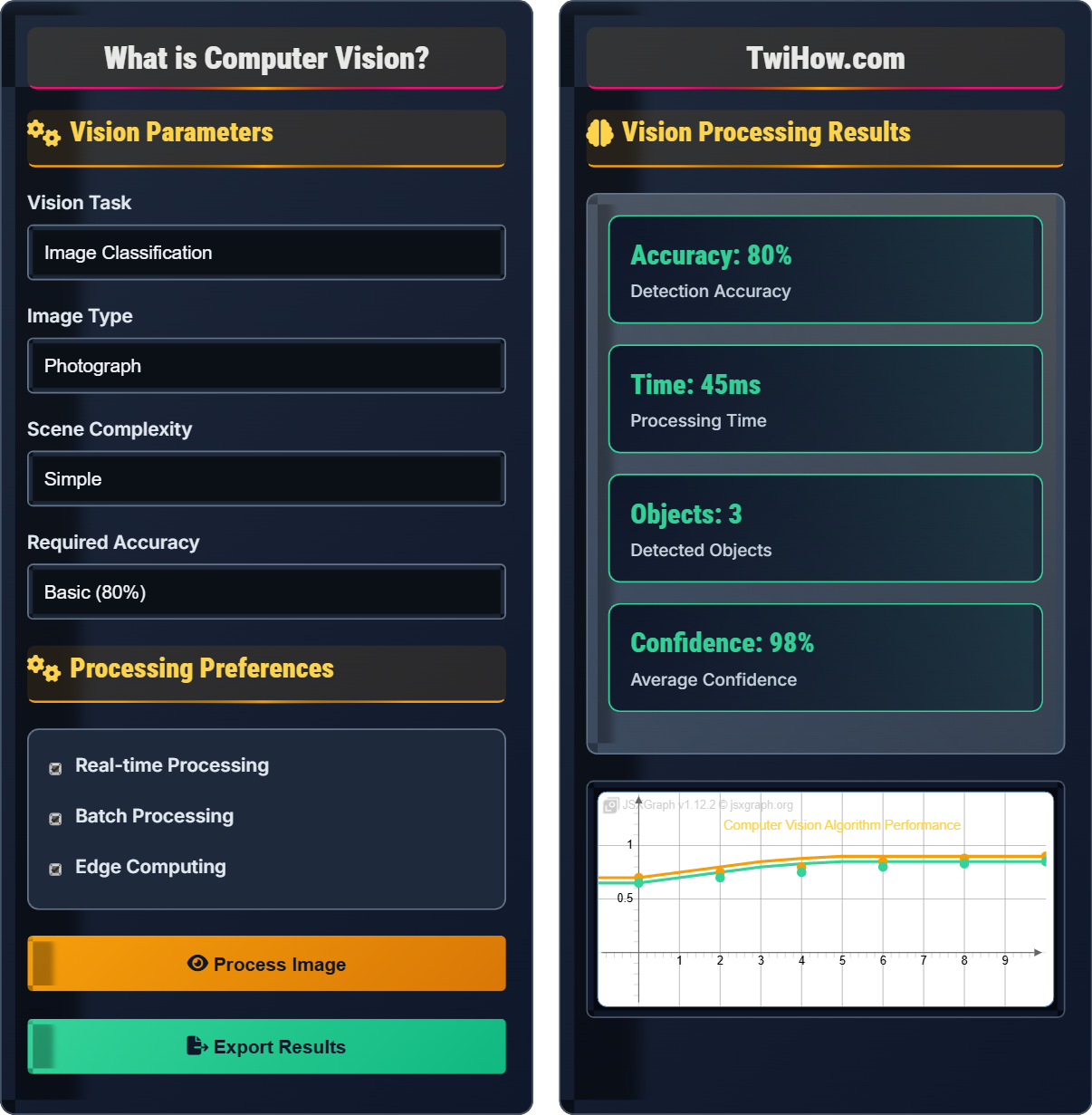
Vision Parameters
Processing Preferences
Vision Processing Results
Input Image
Preprocessing
Neural Network
Output
Convolutional Neural Network (CNN) Structure:
Input → Convolution → Pooling → Fully Connected
Complete Guide to Computer Vision
Computer vision is an interdisciplinary field that deals with how computers can be made to gain high-level understanding from digital images or videos. From a machine learning and artificial intelligence perspective, it deals with the automatic extraction, analysis, and understanding of useful information from a single image or a sequence of images.
Light enters eye
Retina captures image
Optic nerve transmits signals
Brain processes information
Recognition and understanding
Response to visual stimuli
Camera captures image
Pixel data conversion
Digital image processing
Feature extraction
Pattern recognition
Classification and decision
Computer vision systems process images using algorithms and neural networks to identify patterns and make decisions.
CNN
Convolutional Neural Networks
R-CNN
Region-based CNN
YOLO
You Only Look Once
SIFT
Scale-Invariant Feature Transform
HOG
Histogram of Oriented Gradients
Optical Flow
Motion estimation
Where f is the input image and g is the filter/kernel. This operation extracts features by sliding the kernel across the image.
- Linear Algebra: Matrix operations for image processing
- Calculus: Gradient computation for edge detection
- Probability: Statistical models for pattern recognition
- Fourier Analysis: Frequency domain image processing
Vision Algorithms
CNN, R-CNN, YOLO, SIFT, HOG, Optical Flow, ViT, EfficientNet.
- Match algorithm to task
- Consider computational requirements
- Account for accuracy needs
- Plan for scalability
Applications
Self-driving cars, medical imaging, surveillance, retail, manufacturing, agriculture.
Autonomous Vehicles
Object detection and tracking
Medical Imaging
Diagnosis and analysis
Retail
Inventory and checkout
Manufacturing
Quality control
- Real-time requirements
- Privacy and security
- Accuracy standards
- Computational resources
Computer Vision Assessment
Which computer vision task involves identifying and locating multiple objects within an image and drawing bounding boxes around them?
Object detection is the computer vision task that involves identifying and locating multiple objects within an image and drawing bounding boxes around them. This task combines classification (identifying what objects are present) with localization (finding where they are located).
The answer is B) Object Detection.
Object detection is a fundamental computer vision task that extends image classification by not only identifying what objects are in an image but also determining their precise locations. This is achieved by drawing bounding boxes around detected objects. Popular algorithms for object detection include R-CNN, YOLO, and SSD.
Object Detection: Identifying and locating objects in images
Bounding Box: Rectangle defining object location
Localization: Finding object positions
• Detection = Classification + Localization
• Bounding boxes define object regions
• Multiple objects can be detected
• Use YOLO for real-time detection
• Consider R-CNN for accuracy
• Evaluate precision and recall
• Confusing detection with classification
• Not considering overlapping objects
• Ignoring confidence thresholds
Explain the architecture of a Convolutional Neural Network (CNN) and how it processes visual information.
CNN Architecture Components:
• Convolutional Layers: Apply filters to extract features like edges, textures, and patterns
• Pooling Layers: Reduce spatial dimensions while retaining important features
• Activation Functions: Introduce non-linearity (typically ReLU)
• Fully Connected Layers: Classify based on extracted features
Processing Flow:
1. Input image is processed through multiple convolutional layers
2. Each layer extracts increasingly complex features (edges → shapes → objects)
3. Pooling reduces dimensionality and computational load
4. Final layers perform classification based on learned features
5. Output layer provides probability distribution over classes
CNNs automatically learn hierarchical feature representations from raw pixel data.
CNNs are designed to mimic how the human visual cortex processes information. The hierarchical structure allows the network to learn simple features in early layers (like edges) and combine them into more complex features in deeper layers (like object parts). This mimics how humans recognize objects by combining basic visual elements.
CNN: Convolutional Neural Network for visual data
Convolution: Mathematical operation for feature extraction
Pooling: Downsampling operation
• Hierarchical feature learning
• Spatial invariance
• Shared weights in filters
• Use dropout for regularization
• Batch normalization helps training
• Transfer learning speeds up training
• Not understanding feature hierarchy
• Incorrect padding choices
• Overfitting to training data
A hospital wants to develop a computer vision system to detect tumors in MRI scans. The system must achieve high accuracy, work in real-time, and provide precise tumor boundaries. Design a computer vision approach that addresses these requirements.
Recommended Approach: U-Net Architecture
Architecture:
• Encoder-Decoder Structure: Contracting path for feature extraction and expanding path for precise localization
• Skip Connections: Preserve spatial information for accurate segmentation
• Multi-Scale Processing: Capture both local and global context
Implementation Strategy:
• Use medical-specific preprocessing (normalization, augmentation)
• Implement dense annotations for precise boundaries
• Apply data augmentation to increase dataset size
• Use Dice coefficient for segmentation evaluation
• Optimize for real-time inference with model compression
Performance Optimization:
• Quantization for faster inference
• Pruning to reduce model size
• GPU acceleration for real-time processing
This approach provides the precision needed for medical applications.
Medical imaging applications require precise segmentation rather than just detection. U-Net is specifically designed for biomedical image segmentation with its encoder-decoder architecture and skip connections that preserve spatial information. The architecture is ideal for tasks requiring pixel-level accuracy like tumor boundary detection.
U-Net: CNN architecture for biomedical segmentation
Segmentation: Pixel-level image labeling
Encoder-Decoder: Compression and reconstruction architecture
• Precision is critical in medical
• Validation with medical experts
• Regulatory compliance
• Use medical-specific datasets
• Implement uncertainty quantification
• Regular validation with experts
• Not validating with medical experts
• Ignoring regulatory requirements
A security company needs to develop a real-time object detection system for monitoring surveillance cameras. The system must detect people, vehicles, and suspicious activities with minimal latency. Analyze the requirements and propose a solution.
Requirements Analysis:
• Real-time processing (30+ FPS)
• Low latency (< 100ms)
• High throughput (multiple cameras)
• Accurate detection of people and vehicles
Proposed Solution: YOLOv8 with Edge Computing
• Model Selection: YOLOv8 for optimal speed-accuracy tradeoff
• Edge Deployment: NVIDIA Jetson for on-site processing
• Multi-Camera Support: Parallel processing pipelines
• Activity Recognition: Combine detection with pose estimation
• Alert System: Real-time notifications for suspicious events
• Scalability: Distributed architecture for multiple locations
• Privacy: On-premises processing for data security
This solution balances performance, accuracy, and real-time requirements.
Real-time object detection for security applications requires careful balance between accuracy and speed. YOLO (You Only Look Once) architectures are specifically designed for real-time detection, processing images in a single pass. Edge computing ensures low latency by processing data locally rather than sending it to cloud servers.
YOLO: Real-time object detection algorithm
Edge Computing: Processing at data source
Latency: Time delay in processing
• Speed vs accuracy tradeoff
• Privacy and security
• Scalability requirements
• Use model quantization for speed
• Implement adaptive resolution
• Monitor system performance
• Choosing slow but accurate models
• Not considering hardware constraints
• Ignoring privacy regulations
Which emerging technology is revolutionizing computer vision by enabling models to process images with human-like understanding of context and relationships?
Vision Transformers (ViT) are revolutionizing computer vision by applying transformer architecture to visual data. Unlike traditional CNNs, ViTs can capture long-range dependencies and contextual relationships across the entire image, leading to more human-like understanding of visual scenes.
The answer is B) Vision Transformers (ViT).
Vision Transformers extend the success of transformers in natural language processing to computer vision. They divide images into patches and process them similarly to tokens in text, enabling the model to understand relationships between distant parts of an image. This approach has achieved state-of-the-art results in many vision tasks.
ViT: Vision Transformer architecture
Transformers: Attention-based neural networks
Attention: Mechanism for focusing on relevant parts
• Attention mechanisms enable context
• Transformers process sequentially
• ViT divides images into patches
• Combine ViT with CNNs for best results
• Use transfer learning for efficiency
• Consider computational requirements
• Not considering computational cost
• Ignoring model interpretability
• Not adapting to specific tasks
FAQ
Q: What's the difference between CNN and Vision Transformers for image processing?
A: CNNs and Vision Transformers differ in their approach to image processing:
CNNs:
• Use convolutional filters to extract local features
• Process images hierarchically (local to global)
• Inductive bias towards spatial locality
• More efficient for smaller datasets
Vision Transformers:
• Divide images into patches and process them with attention
• Capture global relationships between patches
• Better for large datasets and complex relationships
• Require more computational resources
Both have their place depending on the specific use case and requirements.
Q: How do computer vision systems handle different lighting conditions and image quality?
A: Computer vision systems handle varying conditions through several techniques:
Data Augmentation:
• Brightness and contrast adjustments
• Color jittering and noise addition
• Rotation and scaling variations
Preprocessing:
• Histogram equalization
• Normalization techniques
• Contrast enhancement
Robust Architectures:
• Batch normalization
• Dropout for regularization
• Multi-scale feature extraction
Training Strategies:
• Diverse training datasets
• Synthetic data generation
• Domain adaptation techniques
These approaches help models generalize to various real-world conditions.