What is Deep Learning?
Complete Deep Learning guide • Step-by-step explanations
Deep Learning Fundamentals:
Show Deep Learning SimulatorDeep Learning is a subset of machine learning that uses artificial neural networks with multiple layers (hence "deep") to model complex patterns in data. These networks learn hierarchical representations of data, starting with simple features and building up to more abstract concepts.
Deep learning systems automatically discover relevant features from raw data through multiple layers of processing, eliminating the need for manual feature engineering. This enables breakthrough performance in tasks like image recognition, natural language processing, and game playing.
Key Deep Learning concepts:
- Neural Networks: Computing systems inspired by the human brain
- Backpropagation: Algorithm for training neural networks
- Activation Functions: Functions that introduce non-linearity
- Convolutional Networks: Specialized for image processing
- Recurrent Networks: Designed for sequential data
Modern deep learning architectures include ResNets, Transformers, and Generative Adversarial Networks (GANs), achieving superhuman performance in various domains.
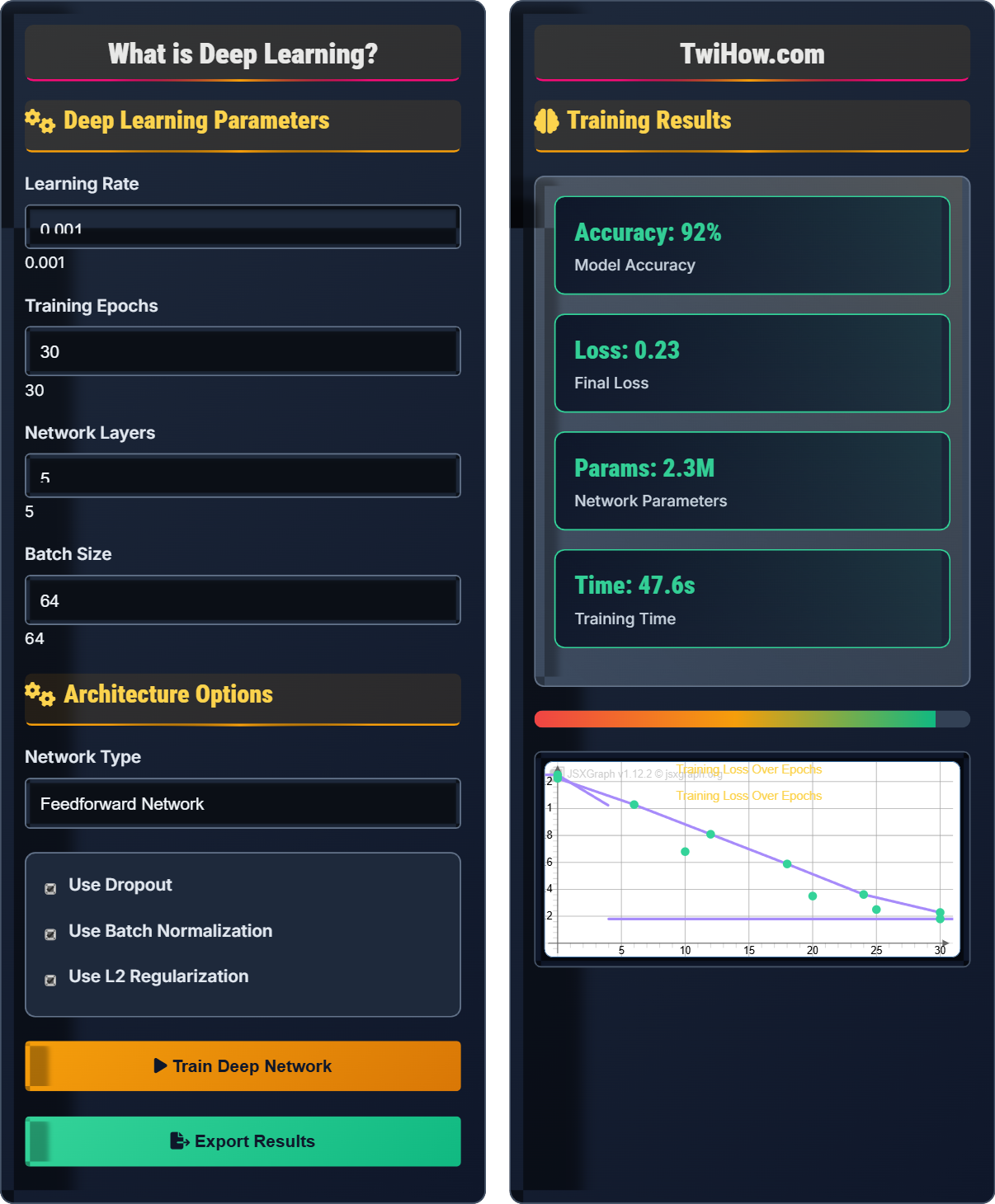
Deep Learning Parameters
Architecture Options
Training Results
| Epoch | Loss | Accuracy | Time (s) |
|---|---|---|---|
| 1 | 1.25 | 42% | 1.2 |
| 10 | 0.68 | 71% | 12.3 |
| 20 | 0.35 | 84% | 23.1 |
| 25 | 0.25 | 89% | 34.2 |
| 30 | 0.18 | 92% | 45.2 |
How Deep Learning Works Explained
Deep Learning is a subset of machine learning that uses artificial neural networks with multiple layers to model and understand complex patterns in data. Unlike traditional machine learning, deep learning algorithms automatically discover relevant features from raw data through hierarchical processing, mimicking the way the human brain processes information.
Basic neuron formula where x = inputs, w = weights, b = bias, f = activation function.
Cross-entropy loss function commonly used in classification tasks.
Chain rule used in backpropagation to compute gradients.
- Computer Vision: Image classification, object detection, facial recognition
- Natural Language Processing: Translation, summarization, chatbots
- Speech Recognition: Voice assistants, transcription services
- Healthcare: Medical imaging, drug discovery, diagnostics
- Autonomous Systems: Self-driving cars, robotics, drones
- Entertainment: Content recommendation, game AI, content generation
Deep Learning Fundamentals
Neural networks, backpropagation, gradient descent, activation functions, convolutional layers, recurrent layers.
Computes gradients by propagating errors backward through the network layers using the chain rule.
- More layers enable more complex feature representations
- Deeper networks require more data to train effectively
- Vanishing gradients can occur in very deep networks
- Regularization is crucial to prevent overfitting
Deep Learning Process
- Data Preparation: Clean and preprocess input data for training
- Architecture Design: Define network structure with appropriate layers
- Initialization: Set initial weights and biases randomly
- Forward Pass: Process input through network to generate predictions
- Loss Calculation: Compare predictions with true values
- Backward Pass: Compute gradients using backpropagation
- Parameter Update: Adjust weights using optimizer algorithm
- Iteration: Repeat until convergence or maximum epochs
- Use batch normalization to stabilize training
- Implement dropout to prevent overfitting
- Choose appropriate activation functions (ReLU, etc.)
- Monitor training and validation curves
- Use learning rate scheduling
Activation Functions
Backpropagation Animation
Animation showing forward pass (green) and backward pass (red) during backpropagation training
Deep Learning Learning Quiz
Which neural network architecture is most appropriate for processing images to identify objects within them?
Convolutional Neural Networks (CNNs) are specifically designed for image processing tasks. They use convolutional layers to automatically detect spatial features like edges, textures, and objects, making them ideal for object identification in images.
The answer is B) Convolutional Neural Network (CNN).
Understanding when to use different network architectures is crucial in deep learning. CNNs excel at image tasks because they preserve spatial relationships in data and share weights across locations. RNNs are better for sequential data, while feedforward networks are general-purpose but less efficient for images.
CNN: Convolutional Neural Network for spatial data
Convolution: Mathematical operation that detects features
Pooling: Downsampling operation to reduce dimensions
• Use CNNs for image and video data
• CNNs preserve spatial relationships
• Weight sharing reduces parameters
• Look for spatial patterns in data
• CNNs use filters to detect features
• Pooling layers reduce computation
• Using regular networks for image data
• Not understanding convolution operation
• Ignoring pooling operations
Explain the vanishing gradient problem in deep neural networks and describe at least three solutions to address it. Why is this problem particularly significant in deep learning?
Vanishing Gradients: As gradients flow backward through many layers during backpropagation, they become exponentially smaller, preventing early layers from learning effectively. This occurs because gradients are multiplied by small values at each layer.
Solutions:
1. ReLU Activation: Replaces sigmoid/tanh functions that cause saturation, allowing gradients to flow more easily
2. Residual Connections: Skip connections that allow gradients to bypass layers directly
3. Batch Normalization: Normalizes inputs to each layer, stabilizing gradients throughout training
This problem is critical because deep networks with many layers are fundamental to deep learning's success in learning complex hierarchical representations.
The vanishing gradient problem was one of the major obstacles that prevented deep learning from advancing for years. Early deep networks couldn't train effectively due to this issue. Modern solutions like ResNets and skip connections have largely solved this, enabling networks with hundreds of layers to be trained successfully.
Vanishing Gradients: Gradients become too small to update early layers
Residual Connections: Skip connections in ResNets
Gradient Flow: How gradients propagate through network
• Deeper networks need gradient solutions
• Activation functions affect gradient flow
• Architecture matters for training stability
• Use ReLU or its variants
• Implement skip connections
• Normalize inputs regularly
• Using sigmoid in deep networks
• Not addressing gradient issues
• Ignoring initialization schemes
A tech company wants to develop an AI system that can automatically generate captions for images posted on social media. The system should understand the content of images and describe them in natural language. Describe the deep learning architecture they would need to implement, including the technical components and challenges they would face.
Architecture: An encoder-decoder model combining CNN and RNN. The CNN (encoder) extracts visual features from images, while the RNN (decoder) generates text descriptions based on those features.
Components: CNN backbone (like ResNet), LSTM/GRU decoder, attention mechanism, vocabulary embedding.
Challenges: Aligning visual and textual modalities, handling diverse image content, generating grammatically correct descriptions, computational requirements.
Training: Requires large datasets of image-caption pairs (like COCO), careful preprocessing, and sophisticated loss functions.
Image captioning is a classic multimodal problem that combines computer vision and natural language processing. The system must learn to bridge the gap between visual and textual representations, requiring specialized architectures that can handle both modalities effectively.
Encoder-Decoder: Architecture for sequence-to-sequence tasks
Attention Mechanism: Focuses on relevant parts of input
Multimodal: Combines different types of data
• Match architecture to task requirements
• Handle different data modalities properly
• Attention improves quality significantly
• Use pre-trained CNN features
• Implement beam search for decoding
• Evaluate with BLEU/CIDEr metrics
• Not using attention mechanisms
• Poor vocabulary handling
• Insufficient training data
A deep learning model achieves 99% accuracy on training data but only 65% on validation data. Explain what is happening and propose five techniques to reduce overfitting in deep neural networks.
What's Happening: The model is overfitting - it has memorized the training data instead of learning generalizable patterns. The large gap between training and validation accuracy indicates poor generalization.
Techniques to Reduce Overfitting:
1. Dropout: Randomly set neurons to zero during training to prevent co-adaptation
2. Data Augmentation: Increase effective dataset size with transformations
3. Early Stopping: Stop training when validation performance degrades
4. L2 Regularization: Penalize large weights to encourage simpler models
5. Batch Normalization: Stabilize training and act as regularization
These techniques help the model focus on essential patterns rather than memorizing training examples.
Overfitting is a major challenge in deep learning because deep networks have millions of parameters that can memorize training data. The goal is to learn underlying patterns that generalize to new data, not just reproduce training examples. Regularization techniques help achieve this balance.
Overfitting: Model performs well on training but poorly on new data
Regularization: Techniques to prevent overfitting
Generalization: Performance on unseen data
• Monitor training vs validation performance
• Use multiple regularization techniques
• Larger datasets reduce overfitting
• Plot training and validation curves together
• Start with higher dropout rates
• Use cross-validation for robust estimates
• Ignoring validation metrics
• Using overly complex models
• Not implementing regularization
Which activation function is most commonly used in hidden layers of deep neural networks and why?
ReLU (Rectified Linear Unit) is the most commonly used activation function in deep networks because it's computationally efficient, helps mitigate the vanishing gradient problem, and often leads to faster training compared to sigmoid and tanh functions. Its simplicity (f(x) = max(0, x)) makes it ideal for deep architectures.
The answer is C) ReLU, because it's computationally efficient and mitigates vanishing gradients.
Activation functions are crucial for introducing non-linearity into neural networks, enabling them to learn complex patterns. ReLU became popular in deep learning because it addresses the vanishing gradient problem that plagued deep networks with sigmoid and tanh activations, while being computationally efficient.
ReLU: Rectified Linear Unit activation function
Non-linearity: Essential for learning complex patterns
Vanishing Gradients: Problem with gradient-based training
• Activation functions must be non-linear
• ReLU helps with gradient flow
• Different functions for different layers
• Use ReLU for hidden layers
• Sigmoid for binary outputs
• Softmax for multi-class classification
• Using linear activation in hidden layers
• Not considering gradient flow
• Using same activation everywhere
FAQ
Q: How is deep learning different from regular machine learning?
A: Traditional machine learning often requires manual feature engineering - humans decide which characteristics of the data are important. Deep learning automatically learns relevant features from raw data through multiple layers of processing. Deep networks can discover complex patterns that would be difficult to engineer manually, but they typically require more data and computational resources.
Q: What does "deep" mean in deep learning?
A: "Deep" refers to the number of layers in the neural network. Traditional neural networks had only a few layers, while deep learning networks have many layers (typically more than 3, often dozens or hundreds). These multiple layers allow the network to learn hierarchical representations of data - starting with simple features in early layers and building up to more complex abstractions in deeper layers.