Generative AI vs Machine Learning
Complete comparison • Definitions • Applications
Core Difference:
Compare NowMachine Learning (ML) is a broad field of AI that focuses on enabling systems to learn and improve from experience without explicit programming. Generative AI is a subset of ML that specializes in creating new, original content based on learned patterns.
Key distinctions:
- Machine Learning: Analyzes data, identifies patterns, makes predictions/classifications
- Generative AI: Creates new content, generates novel outputs based on training
- Relationship: Generative AI is a specialized application of ML techniques
- Output: ML predicts outcomes; GenAI creates new instances
Both rely on training data and statistical models, but serve fundamentally different purposes in the AI ecosystem.
Interactive Comparison
View Options
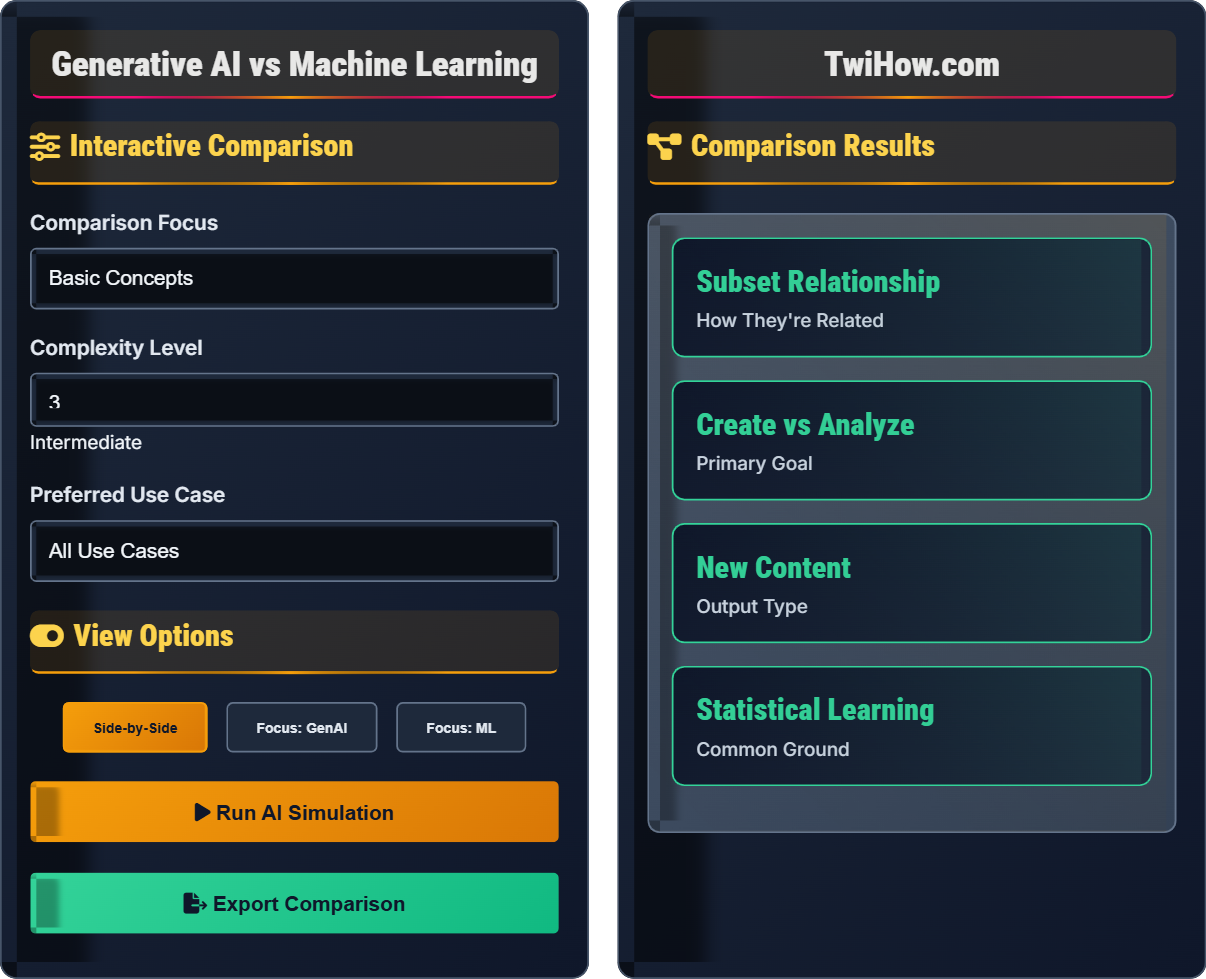
Comparison Results
Definition: AI systems that generate new, original content based on learned patterns from training data.
Goal: Create novel outputs that didn't exist before.
Examples: Text generation, image synthesis, music composition, code generation.
Definition: Systems that learn patterns from data to make predictions or decisions without explicit programming.
Goal: Identify patterns, classify data, predict outcomes.
Examples: Fraud detection, recommendation systems, predictive analytics, image recognition.
Core Concepts Comparison
Machine Learning: Analyze data and make predictions
Machine Learning: Classifications, predictions, insights
Machine Learning: Minimize prediction error on known data
Machine Learning: Accuracy, precision, recall, F1-score
Generative AI is a specialized application of machine learning techniques. While all generative AI systems are machine learning models, not all ML models are generative. The key distinction lies in the output: generative models create new data, while traditional ML models analyze existing data.
Technical Differences
Machine Learning: Regression, Decision Trees, Neural Networks
Machine Learning: Supervised/unsupervised learning with objective functions
Real-World Applications
- Text generation (ChatGPT, Claude)
- Image synthesis (DALL-E, Midjourney)
- Music composition
- Code generation (GitHub Copilot)
- Video generation
- Drug discovery
- Fraud detection
- Recommendation systems
- Predictive maintenance
- Image recognition
- Speech recognition
- Medical diagnosis
- AI-powered content moderation
- Personalized content creation
- Automated reporting with generated insights
- Intelligent data augmentation
- Enhanced recommendation systems
- Smart document processing
Generative AI vs ML Quiz
What is the primary difference between Generative AI and traditional Machine Learning?
The fundamental difference lies in the output: Generative AI creates new, original content based on learned patterns, while traditional ML analyzes existing data to make predictions or classifications. Generative models aim to replicate the underlying data distribution to generate novel instances, whereas traditional ML models focus on pattern recognition and prediction accuracy.
The answer is B) Output type (create vs analyze).
Understanding the output distinction is crucial for selecting the right approach for specific problems. If you need to generate new content (images, text, music), you need generative AI. If you need to analyze data and make predictions (fraud detection, recommendations), traditional ML is more appropriate. Both use similar underlying techniques but with different objectives.
Generative Model: AI that creates new data instances
Discriminative Model: AI that classifies or predicts existing data
Data Distribution: Statistical pattern of data occurrence
• Generative = Create new content
• ML = Analyze existing data
• Same techniques, different goals
• Match problem to approach type
• Consider evaluation metrics
• Think about desired output
• Confusing the two approaches
• Using wrong evaluation metrics
• Not understanding output differences
Explain the relationship between Generative AI and Machine Learning. How does Generative AI fit within the broader ML landscape?
Relationship: Generative AI is a specialized subset of Machine Learning. All generative AI systems are machine learning models, but not all ML models are generative.
Position in ML Landscape: ML encompasses various techniques for learning from data. Generative AI represents the branch focused on creating new content. Traditional ML focuses on analysis, prediction, and classification.
Shared Foundation: Both use statistical learning, neural networks, and optimization techniques. The difference lies in the objective function and training methodology.
Evolution: Generative AI builds upon traditional ML advances, particularly in deep learning and neural network architectures.
Think of ML as a large toolbox of techniques for learning from data. Generative AI is a specialized set of tools within that toolbox designed for creation. Just as hammers and screwdrivers are both tools but serve different purposes, traditional ML and generative AI are both AI techniques but with different objectives. Understanding this hierarchical relationship helps clarify when to use each approach.
Subset Relationship: One category contained within another
Objective Function: Mathematical function to be optimizedStatistical Learning: Learning patterns from data
• GenAI ⊂ ML ⊂ AI
• Shared technical foundation
• Different objectives
• Visualize as nested circles
• Focus on objective differences
• Consider shared techniques
• Treating as completely separate fields
• Ignoring shared foundations
• Misunderstanding hierarchy
A company wants to develop an AI system for two purposes: (1) predicting customer churn based on usage patterns, and (2) automatically generating personalized email campaigns for retained customers. Which AI approach should be used for each purpose, and why?
Customer Churn Prediction: Use traditional Machine Learning approach. This is a classification problem where the system analyzes historical data to identify patterns that indicate likely churn. The output is a prediction (yes/no) with confidence scores.
Personalized Email Generation: Use Generative AI approach. This requires creating new, original email content tailored to each customer. The system needs to generate natural language text that feels personalized and engaging.
Rationale: Churn prediction analyzes existing data to make predictions (traditional ML), while email generation creates new content (generative AI). Each problem requires the approach that matches its output requirements.
Hybrid Solution: ML model predicts churn risk, then GenAI generates appropriate retention messages based on risk level and customer profile.
This example demonstrates how to match AI approaches to specific problems. The key is analyzing the desired output: if you need to predict or classify existing data, use traditional ML. If you need to create new content, use generative AI. In complex scenarios, both approaches can be combined for more sophisticated solutions.
Classification: Assigning data to predefined categories
Content Generation: Creating new data instances
Hybrid Approach: Combining multiple AI techniques
• Match approach to output needs
• Consider problem type first
• Hybrid solutions often optimal
• Define desired output first
• Consider combining approaches
• Think about evaluation metrics
• Using wrong approach for problem
• Not considering hybrid solutions
• Ignoring evaluation requirements
You're building an AI system to help architects visualize building designs. The system should take design parameters (size, style, materials) and generate architectural drawings. Additionally, it should predict construction costs based on these parameters. What type of models would you use for each component, and how would you evaluate their performance?
Architectural Drawing Generation: Use a generative model like a diffusion model or GAN trained on architectural drawings. The model would take design parameters and generate visual representations.
Construction Cost Prediction: Use a traditional ML regression model trained on historical cost data. The model would predict numerical cost estimates based on design parameters.
Evaluation Metrics:
• Drawing Generation: Human evaluation of realism, adherence to specifications, creativity scores
• Cost Prediction: Mean Absolute Error (MAE), Root Mean Square Error (RMSE), R-squared
Integration: The system could first predict costs, then generate drawings that reflect budget constraints.
This scenario illustrates how different AI components can work together in a complex system. The key insight is that different tasks within the same application may require different AI approaches. Visual generation requires generative capabilities, while numerical prediction requires traditional ML. Each component has its own evaluation criteria based on its specific function.
Diffusion Model: Generative model that creates images by denoising
Regression: Predicting continuous numerical values
Evaluation Metrics: Quantitative measures of performance
• Different tasks need different approaches
• Each has specific evaluation metrics
• Components can work together
• Break complex problems into components
• Match approach to task requirements
• Consider evaluation early in design
• Using one approach for all tasks
• Not considering evaluation metrics
• Ignoring integration challenges
Which of the following best describes a key technical difference between generative and discriminative models?
Generative models learn the joint probability distribution P(x,y) or P(x), allowing them to generate new samples. Discriminative models learn the conditional probability P(y|x), focusing on the boundary between classes. This fundamental difference in what they learn explains their different capabilities: generative models can create new data, while discriminative models excel at classification.
The answer is B) Generative models learn P(x,y), discriminative models learn P(y|x).
This mathematical distinction underlies the behavioral differences between the two approaches. By modeling the joint distribution P(x,y), generative models capture the relationship between inputs and outputs, enabling them to generate new paired instances. Discriminative models focus only on the mapping from inputs to outputs, making them efficient classifiers but unable to generate new data.
Joint Probability P(x,y): Probability of both x and y occurring
Conditional Probability P(y|x): Probability of y given x
Probability Distribution: Function describing likelihood of outcomes
• Generative: P(x,y) - joint distribution
• Discriminative: P(y|x) - conditional
• Different learning objectives
• Remember: Generative = Joint
• Discriminative = Conditional
• Think about what gets learned
• Confusing P(x,y) with P(y|x)
• Not understanding probability concepts
• Missing mathematical foundation
FAQ
Q: Can I use the same model for both generative and discriminative tasks?
A: Yes, many models can be adapted for both tasks, though they're typically optimized for one. For example, transformer models like GPT (originally generative) can be fine-tuned for classification tasks. However, models optimized for one task usually perform better than those adapted from another. The fundamental difference in training objectives means specialized models generally outperform adapted ones.
Q: Which approach is more difficult to implement?
A: Generative AI is generally more challenging to implement and evaluate. It requires larger datasets, more complex architectures, and harder-to-define success metrics. Evaluating creativity, coherence, and quality is subjective. Traditional ML problems often have clear metrics like accuracy or F1-score. However, generative models are becoming more accessible with pre-trained models and APIs.