What is Machine Learning?
Complete ML guide • Step-by-step explanations
Machine Learning Fundamentals:
Show ML SimulatorMachine Learning (ML) is a subset of artificial intelligence that enables computers to learn and improve from experience without being explicitly programmed. It involves developing algorithms that can analyze data, identify patterns, and make predictions or decisions.
At its core, ML works by feeding large amounts of data to algorithms that learn to recognize patterns and make decisions based on that data. The more data the system receives, the better it becomes at its assigned task.
Key ML concepts:
- Supervised Learning: Learning from labeled examples
- Unsupervised Learning: Finding patterns in unlabeled data
- Reinforcement Learning: Learning through trial and error
- Feature Engineering: Selecting relevant input variables
- Model Evaluation: Measuring performance and accuracy
Modern ML systems use various algorithms like neural networks, decision trees, and support vector machines to solve complex problems across domains like image recognition, natural language processing, and predictive analytics.
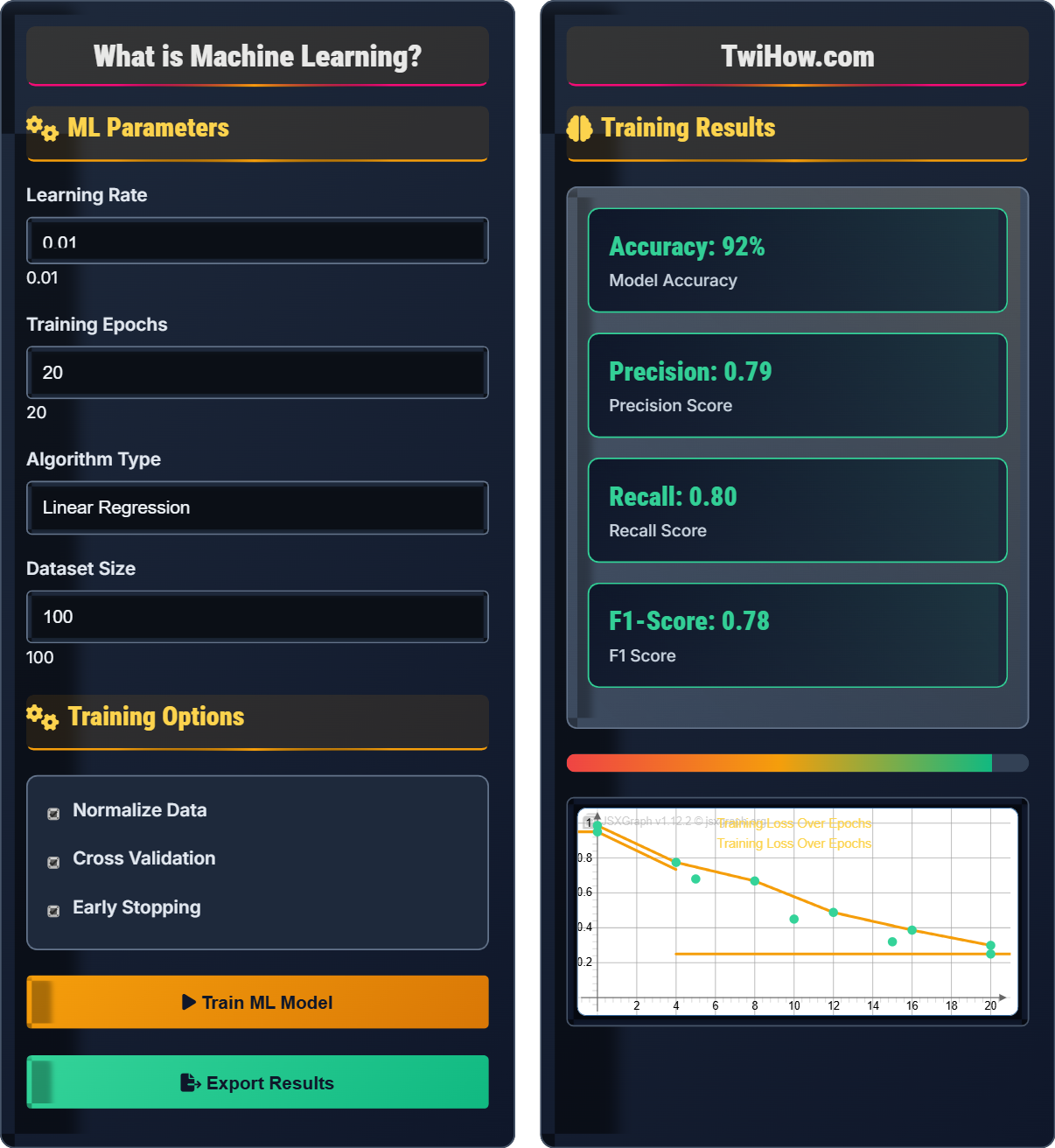
ML Parameters
Training Options
Training Results
| Epoch | Loss | Accuracy | Time (s) |
|---|---|---|---|
| 1 | 0.95 | 32% | 0.2 |
| 5 | 0.68 | 54% | 1.0 |
| 10 | 0.45 | 71% | 2.1 |
| 15 | 0.32 | 81% | 3.2 |
| 20 | 0.25 | 87% | 4.3 |
How Machine Learning Works Explained
Machine Learning (ML) is a branch of artificial intelligence that enables computers to learn and improve from experience without being explicitly programmed. Instead of following rigid instructions, ML algorithms find patterns in data and make decisions based on those patterns. The more data the system processes, the better it becomes at its assigned task.
- Healthcare: Disease diagnosis, drug discovery, medical imaging
- Finance: Fraud detection, algorithmic trading, credit scoring
- Technology: Recommendation systems, virtual assistants, search engines
- Marketing: Customer targeting, sentiment analysis, ad optimization
- Manufacturing: Predictive maintenance, quality control, supply chain optimization
- Transportation: Route optimization, autonomous vehicles, traffic prediction
ML Fundamentals
Supervised learning, unsupervised learning, reinforcement learning, neural networks, decision trees, clustering.
Where y = dependent variable, x = independent variable, m = slope, b = intercept.
- More data generally leads to better models
- Feature selection is crucial for performance
- Models must be validated on unseen data
- Overfitting occurs when models memorize training data
ML Process Steps
- Data Collection: Gather relevant datasets for training and testing
- Data Preprocessing: Clean, normalize, and transform data for consistency
- Feature Engineering: Select and create relevant input variables
- Model Selection: Choose appropriate algorithm based on problem type
- Training: Fit the model to training data by adjusting parameters
- Evaluation: Test model performance on unseen validation data
- Hyperparameter Tuning: Optimize model configuration for best performance
- Deployment: Integrate model into production environment
- Monitoring: Continuously evaluate and update model performance
- Always split data into training, validation, and test sets
- Handle missing data appropriately
- Normalize features when necessary
- Use cross-validation for robust evaluation
- Consider computational complexity and interpretability
ML Learning Quiz
Which type of machine learning algorithm would be most appropriate for identifying customer segments based on purchasing behavior without predefined categories?
Unsupervised learning is used when there are no predefined labels or categories. Clustering algorithms, which group similar data points together, are perfect for customer segmentation based on purchasing behavior without prior knowledge of segment definitions.
The answer is B) Unsupervised Learning.
Understanding the differences between ML types is crucial for selecting the right approach. Supervised learning uses labeled data to predict outcomes. Unsupervised learning finds hidden patterns in unlabeled data. Reinforcement learning learns through interaction with an environment. The choice depends on whether you have target labels and what you want to achieve.
Supervised Learning: Learning with labeled training data
Unsupervised Learning: Finding patterns in unlabeled data
Clustering: Grouping similar data points together
• Use supervised learning when you have labeled data
• Use unsupervised learning when finding hidden patterns
• Customer segmentation is a classic clustering problem
• Ask: Do I have target labels? Yes → Supervised, No → Unsupervised
• Clustering is unsupervised classification
• Association rules also fall under unsupervised learning
• Confusing supervised with unsupervised learning
• Using supervised methods without labels
• Overlooking the power of unsupervised methods
Explain what overfitting is in machine learning and describe at least three techniques to prevent it. Why is preventing overfitting important?
Overfitting: A model learns the training data too well, capturing noise and details that don't generalize to new data. The model performs excellently on training data but poorly on unseen data.
Prevention Techniques:
1. Cross-Validation: Split data into multiple folds and train/test on different combinations to validate generalization
2. Regularization: Add penalty terms to the loss function to discourage overly complex models
3. Early Stopping: Monitor validation performance and stop training when it starts to degrade
Preventing overfitting is crucial because the ultimate goal is good performance on new, unseen data, not just memorizing training examples.
Overfitting is one of the most critical challenges in ML. Think of it like a student who memorizes answers for a test but can't apply concepts to new problems. The model becomes too specialized to the training data and loses its ability to generalize. Effective ML practitioners always monitor for overfitting and employ prevention strategies.
Overfitting: Model performs well on training but poorly on new data
Cross-Validation: Technique to assess model generalization
Regularization: Method to prevent overly complex models
• Always validate on unseen data
• Monitor training vs validation performance
• Complexity isn't always better
• Plot training and validation curves together
• Use dropout in neural networks
• Prune decision trees to prevent over-complexity
• Evaluating only on training data
• Ignoring validation metrics
• Using overly complex models for simple problems
A hospital wants to develop an ML system to predict patient readmission risk within 30 days of discharge. The system will use patient data like age, medical history, medications, and length of stay. Describe the ML pipeline they would need to implement, including data considerations, model selection, and ethical implications.
Data Considerations: Large dataset of patient records with outcomes, ensuring diversity and addressing potential biases in historical data. Need to handle missing values and normalize features.
Model Selection: Logistic regression for interpretability, or random forest for handling complex interactions. Consider ensemble methods for improved accuracy.
Ethical Implications: Privacy protection, avoiding discrimination, ensuring fairness across demographics, transparency in decision-making, and maintaining human oversight.
Pipeline: Data collection → Privacy compliance → Feature engineering → Model training → Validation → Ethical review → Deployment with continuous monitoring.
Healthcare ML applications require special attention to ethics and interpretability. Unlike other domains, wrong predictions can have serious consequences. The system must be fair, explainable, and maintain human oversight. Data privacy regulations like HIPAA must be strictly followed.
Readmission Risk: Probability of patient returning to hospital within 30 days
Feature Engineering: Creating relevant input variables from raw data
Interpretability: Ability to understand model decision process
• Healthcare ML must prioritize safety
• Patient privacy is paramount
• Models must be explainable to clinicians
• Use SHAP values for model interpretability
• Implement bias detection mechanisms
• Plan for continuous model validation
• Ignoring ethical implications in healthcare
• Not considering regulatory compliance
• Using black-box models without interpretability
A data scientist is building a house price prediction model using features like square footage, number of bedrooms, location, age of house, and neighborhood crime rate. Explain how they should approach feature selection and what techniques they could use to identify the most predictive features.
Feature Selection Approach: Start with domain knowledge (square footage likely matters), then use statistical methods to validate relevance. Consider correlation analysis, mutual information, and feature importance scores.
Techniques:
1. Correlation Analysis: Identify features highly correlated with house prices
2. Recursive Feature Elimination: Iteratively remove least important features
3. Tree-based Importance: Use random forests to rank feature importance
4. LASSO Regression: Automatically select features through regularization
Proper feature selection reduces model complexity and improves generalization.
Feature selection is critical for model performance. Irrelevant features can introduce noise and lead to overfitting. Good features have strong relationships with the target variable while being relatively independent of each other. The goal is to retain predictive power while minimizing complexity.
Feature Selection: Choosing the most relevant input variables
Feature Importance: Measure of how much each feature contributes to predictions
Curse of Dimensionality: Problems arising from high-dimensional spaces
• More features aren't always better
• Correlation doesn't imply causation
• Remove redundant features
• Start with domain expertise
• Use multiple selection methods
• Validate selection with cross-validation
• Including irrelevant features
• Not considering feature interactions
• Using all available features without selection
Which of the following is the most significant challenge when deploying machine learning models in production environments?
Model drift occurs when the statistical properties of the target variable change over time, causing the model's performance to degrade. Continuous monitoring, retraining, and maintenance are required to keep models effective in production. While initial training is important, ongoing maintenance is the long-term challenge.
The answer is B) Model drift and maintenance.
Many people focus on the initial model creation but overlook the ongoing maintenance needs. Production ML systems face changing data distributions, concept drift, and evolving business requirements. Successful ML deployment requires infrastructure for monitoring, alerting, and continuous retraining—not just initial model development.
Model Drift: Degradation in model performance over time
Concept Drift: Change in relationship between input and output
Production ML: Deployed models serving real users
• Models require ongoing maintenance
• Monitor performance metrics continuously
• Plan for retraining cycles
• Set up automated monitoring pipelines
• Track data distribution changes
• Plan for A/B testing new models
• Assuming deployed models work forever
• Not monitoring for data drift
• Lacking retraining infrastructure
FAQ
Q: How is machine learning different from traditional programming?
A: In traditional programming, you write explicit instructions telling the computer exactly what to do. In machine learning, you provide data and let the algorithm figure out the instructions. Instead of coding rules, you feed examples and let the system learn patterns. For example, instead of writing rules to detect cats in photos, you show thousands of cat photos and let the ML system learn what cats look like.
Q: What's the difference between AI, ML, and Deep Learning?
A: These represent hierarchical concepts: Artificial Intelligence is the broadest concept of machines exhibiting human-like intelligence. Machine Learning is a subset of AI focused on systems that learn from data without explicit programming. Deep Learning is a specialized subset of ML using neural networks with many layers. Think of it as: Deep Learning ⊂ Machine Learning ⊂ Artificial Intelligence.