What is NLP?
Complete guide • Natural language processing
NLP Fundamentals:
Text AnalyzerNatural Language Processing (NLP) is a branch of artificial intelligence that focuses on the interaction between computers and humans through natural language. The ultimate objective of NLP is to read, decipher, understand, and make sense of human languages in a manner that is valuable.
Core NLP concepts include:
- Text Preprocessing: Cleaning and preparing text data
- Tokenization: Breaking text into individual tokens
- Part-of-Speech Tagging: Identifying grammatical roles
- Named Entity Recognition: Identifying entities in text
- Sentiment Analysis: Determining emotional tone
- Language Modeling: Predicting next words
NLP enables machines to understand and process human language effectively.
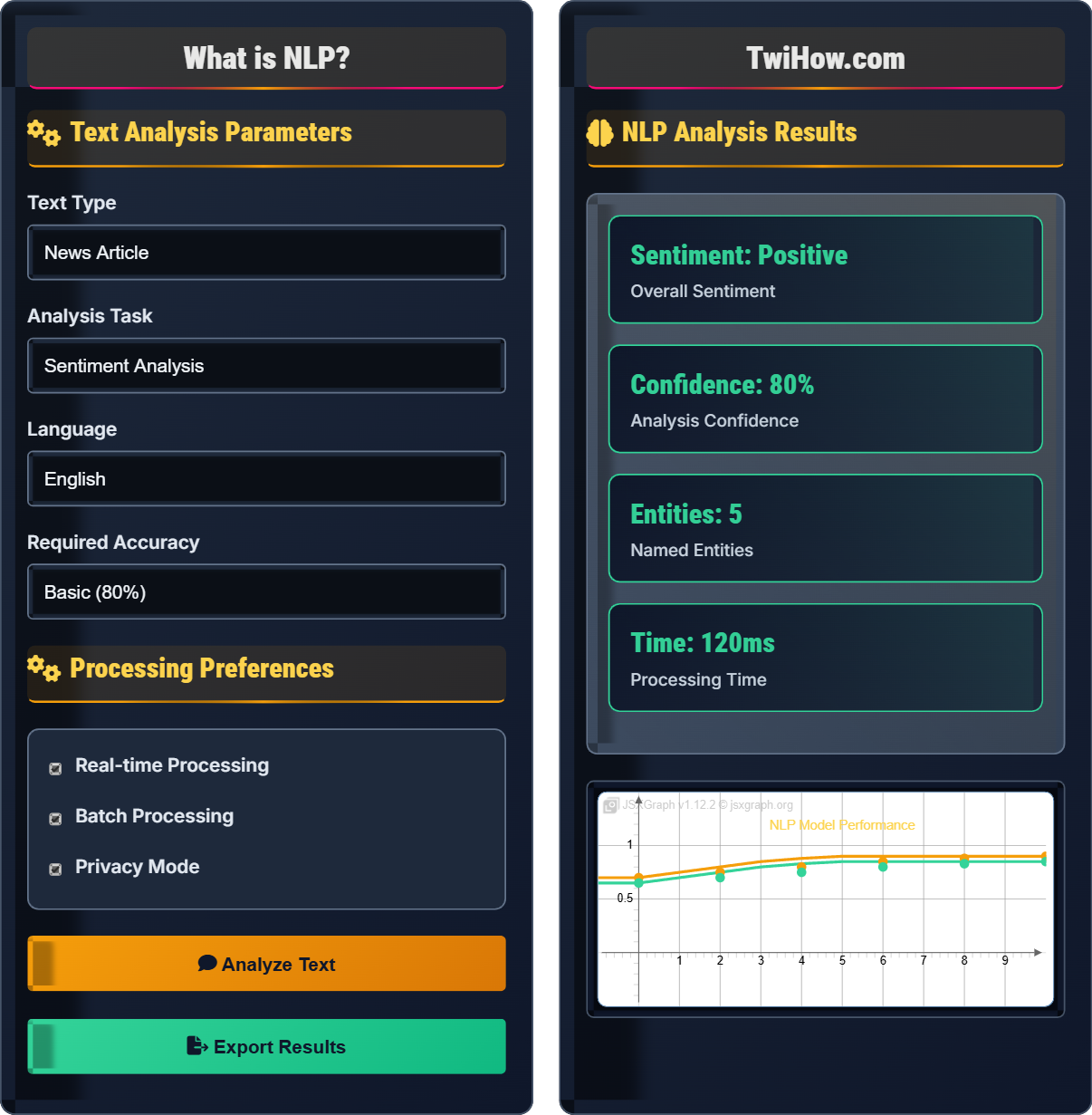
Text Analysis Parameters
Processing Preferences
NLP Analysis Results
Raw Text
Preprocessing
NLP Model
Output
Transformer Architecture:
Self-attention mechanism processes all tokens simultaneously
Complete Guide to Natural Language Processing
Natural Language Processing (NLP) is a branch of artificial intelligence that focuses on the interaction between computers and humans through natural language. The ultimate objective of NLP is to read, decipher, understand, and make sense of human languages in a manner that is valuable. NLP combines computational linguistics with statistical, machine learning, and deep learning models.
Thought formation
Language selection
Sentence construction
Word choice
Grammar application
Communication delivery
Text input
Tokenization
Feature extraction
Model processing
Pattern recognition
Output generation
NLP systems process human language using statistical models and neural networks to extract meaning and generate responses.
Transformers
BERT, GPT, T5
LSTM
Long Short-Term Memory
Word2Vec
Word embeddings
TF-IDF
Term frequency
RoBERTa
Robust BERT
Seq2Seq
Sequence models
Where Q (Query), K (Key), and V (Value) are matrices representing different aspects of the input. This mechanism allows models to focus on relevant parts of the input.
- Linear Algebra: Matrix operations for word embeddings
- Probability: Statistical models for language
- Calculus: Gradient computation for training
- Information Theory: Entropy and information gain
NLP Models
Transformers, LSTM, CNN, BERT, GPT, RoBERTa, T5, DistilBERT.
- Match model to task
- Consider computational requirements
- Account for accuracy needs
- Plan for scalability
Applications
Chatbots, translation, sentiment analysis, text summarization, search engines, content generation.
Customer Service
Chatbots and support
Translation
Language conversion
Analytics
Sentiment and trends
Content
Generation and analysis
- Real-time requirements
- Privacy and security
- Accuracy standards
- Computational resources
NLP Assessment
Which NLP task involves identifying and classifying entities like person names, organizations, and locations in text?
Named Entity Recognition (NER) is the NLP task that involves identifying and classifying entities like person names, organizations, locations, dates, and other named entities in text. This task is crucial for information extraction and understanding the context of documents.
The answer is B) Named Entity Recognition.
NER is a fundamental NLP task that helps machines understand the meaning of text by identifying important entities. It's used in applications like search engines, chatbots, and information extraction systems. NER models typically use sequence labeling approaches to classify each token in a text.
NER: Named Entity Recognition
Entities: Named objects in text
Sequence Labeling: Assigning tags to tokens
• Entities include persons, locations, organizations
• Context matters for disambiguation
• Preprocessing improves accuracy
• Use domain-specific models
• Consider context for accuracy
• Post-process for consistency
• Confusing NER with POS tagging
• Not handling ambiguous entities
• Ignoring context for disambiguation
Explain the transformer architecture and how it revolutionized NLP compared to previous approaches.
Transformer Architecture Components:
• Self-Attention Mechanism: Allows each token to attend to all other tokens in the sequence
• Multi-Head Attention: Multiple attention heads for capturing different relationships
• Feed-Forward Networks: Position-wise processing of attended representations
• Positional Encoding: Adding positional information since attention is permutation-invariant
Revolutionary Impact:
• Parallel Processing: Unlike RNNs, transformers can process all tokens simultaneously
• Long-Range Dependencies: Attention mechanism captures relationships regardless of distance
• Scalability: Can be scaled to larger models and datasets more effectively
• Transfer Learning: Pre-trained models can be fine-tuned for specific tasks
• Context Understanding: Better comprehension of context and meaning
Transformers have become the foundation for state-of-the-art NLP models like BERT and GPT.
The transformer architecture addressed key limitations of previous approaches like RNNs and LSTMs. Before transformers, sequential processing was required, making training slow and limiting the ability to capture long-range dependencies. The attention mechanism allows models to focus on relevant parts of the input regardless of their position, leading to better performance and faster training.
Transformer: Attention-based neural network architecture
Self-Attention: Attention mechanism within sequence
Multi-Head: Multiple attention perspectives
• Attention enables parallel processing
• Positional encoding is crucial
• Scalable architecture
• Use pre-trained models for efficiency
• Fine-tune for specific tasks
• Consider computational requirements
• Not understanding attention mechanism
• Ignoring computational costs
• Not using appropriate pre-trained models
A company wants to build a customer service chatbot that can understand user queries, extract relevant information, and provide accurate responses. Design an NLP pipeline that addresses these requirements.
Recommended NLP Pipeline:
1. Text Preprocessing:
• Tokenization and normalization
• Stop word removal
• Spell correction
2. Intent Classification:
• Use BERT or similar model to classify user intent
• Train on customer service query categories
3. Named Entity Recognition:
• Extract key information (order numbers, product names, dates)
• Use domain-specific NER models
4. Response Generation:
• Template-based responses for common queries
• Neural generation for complex responses
5. Context Management:
• Maintain conversation history
• Track session state
Implementation Strategy:
• Use transformer-based models for understanding
• Implement fallback mechanisms
• Continuously improve with user feedback
This pipeline provides a robust foundation for customer service chatbots.
Customer service chatbots require multiple NLP components working together. The pipeline starts with understanding the user's intent, then extracting relevant information, and finally generating appropriate responses. Context management is crucial for maintaining coherent conversations. Modern approaches often use pre-trained transformers fine-tuned on domain-specific data.
Intent Classification: Identifying user's goal
NER: Named Entity Recognition
Context Management: Tracking conversation state
• Understand user intent first
• Extract relevant information
• Maintain conversational context
• Use domain-specific models
• Implement fallback responses
• Continuously collect feedback
• Ignoring context in conversations
• Not implementing fallback mechanisms
A global company needs to analyze customer feedback in multiple languages. The system must handle different languages, cultural nuances, and varying text lengths. Analyze the challenges and propose an NLP solution.
Challenges Identified:
• Language-specific preprocessing requirements
• Cultural differences in expression and sentiment
• Varying sentence structures and grammar
• Different character sets and scripts
Proposed Solution: Multilingual Transformer Model
• Universal Encoder: Use multilingual BERT (mBERT) or XLM-R for cross-lingual understanding
• Language Detection: Automatically identify input language
• Normalization: Handle different scripts and encodings
• Translation: Convert to common language for processing
• Cultural Adaptation: Adjust for cultural sentiment expressions
• Quality Control: Validate results across languages
• Scalability: Design for multiple concurrent languages
This approach leverages shared representations across languages while accounting for cultural differences.
Multilingual NLP is challenging because different languages have varying structures, cultural expressions, and writing systems. Modern approaches like mBERT and XLM-R learn shared representations across languages, enabling cross-lingual transfer learning. However, cultural nuances still require careful consideration and adaptation.
mBERT: Multilingual BERT model
XLM-R: Cross-lingual model
Cross-lingual: Across multiple languages
• Account for cultural differences
• Use universal encoders
• Validate across languages
• Use language-specific preprocessing
• Collect multilingual training data
• Test across all target languages
• Treating all languages the same
• Not accounting for cultural differences
• Using monolingual models for multilingual tasks
Which advancement in NLP has enabled models to understand context and relationships between words more effectively than ever before?
Attention mechanisms have revolutionized NLP by allowing models to focus on relevant parts of the input when processing each token. This enables models to understand long-range dependencies and contextual relationships between words, which was a major limitation of previous approaches.
The answer is B) Attention Mechanisms.
Attention mechanisms allow NLP models to dynamically weight the importance of different words when processing text. This is particularly important for understanding context, as the meaning of a word often depends on other words in the sentence or document. The self-attention mechanism in transformers has been especially effective for this purpose.
Attention: Mechanism for focusing on relevant parts
Context: Surrounding information that influences meaning
Self-Attention: Attention within same sequence
• Attention enables context understanding
• Dynamic weighting improves performance
• Long-range dependencies are captured
• Use attention for complex tasks
• Consider computational requirements
• Fine-tune attention weights
• Not understanding attention weights
• Ignoring computational costs
• Not leveraging attention for context
FAQ
Q: What's the difference between BERT and GPT models in NLP?
A: BERT and GPT differ in their architectural approaches:
BERT (Bidirectional Encoder Representations from Transformers):
• Bidirectional: Looks at context from both directions
• Masked Language Model: Predicts masked words
• Better for understanding tasks (classification, QA)
GPT (Generative Pre-trained Transformer):
• Unidirectional: Processes text left-to-right
• Causal Language Model: Predicts next word
• Better for generation tasks (text, translation)
Both use transformer architecture but serve different purposes.
Q: How do NLP models handle ambiguity and context in human language?
A: NLP models handle ambiguity through several techniques:
Contextual Embeddings:
• Words get different representations based on context
• "Bank" in "river bank" vs "money bank" have different meanings
Attention Mechanisms:
• Models focus on relevant parts of text
• Long-range dependencies are captured
Pre-training on Large Corpora:
• Models learn general language patterns
• Statistical regularities help resolve ambiguity
Disambiguation Algorithms:
• Specific techniques for word sense disambiguation
• Named entity disambiguation
Modern models like BERT are particularly good at context-dependent understanding.