What is Prompt Engineering?
Complete Prompt Engineering guide • Step-by-step explanations
Prompt Engineering Fundamentals:
Show Prompt SimulatorPrompt Engineering is the practice of crafting precise, effective inputs (prompts) to guide AI models toward desired outputs. It involves understanding how language models process information and using specific techniques to elicit better, more accurate, and relevant responses.
Prompt engineering combines creativity, technical understanding, and iterative refinement to communicate effectively with AI systems. It's crucial for maximizing the utility and reliability of AI tools in various applications.
Key Prompt Engineering Concepts:
- Prompt Structure: Context, instruction, input, output format
- Techniques: Chain of thought, few-shot learning, role prompting
- Optimization: Iterative refinement and testing
- Context Management: Providing relevant background information
- Output Control: Specifying format and constraints
Modern prompt engineering leverages advanced techniques like few-shot learning, system messages, and specialized templates to achieve remarkable results with large language models.
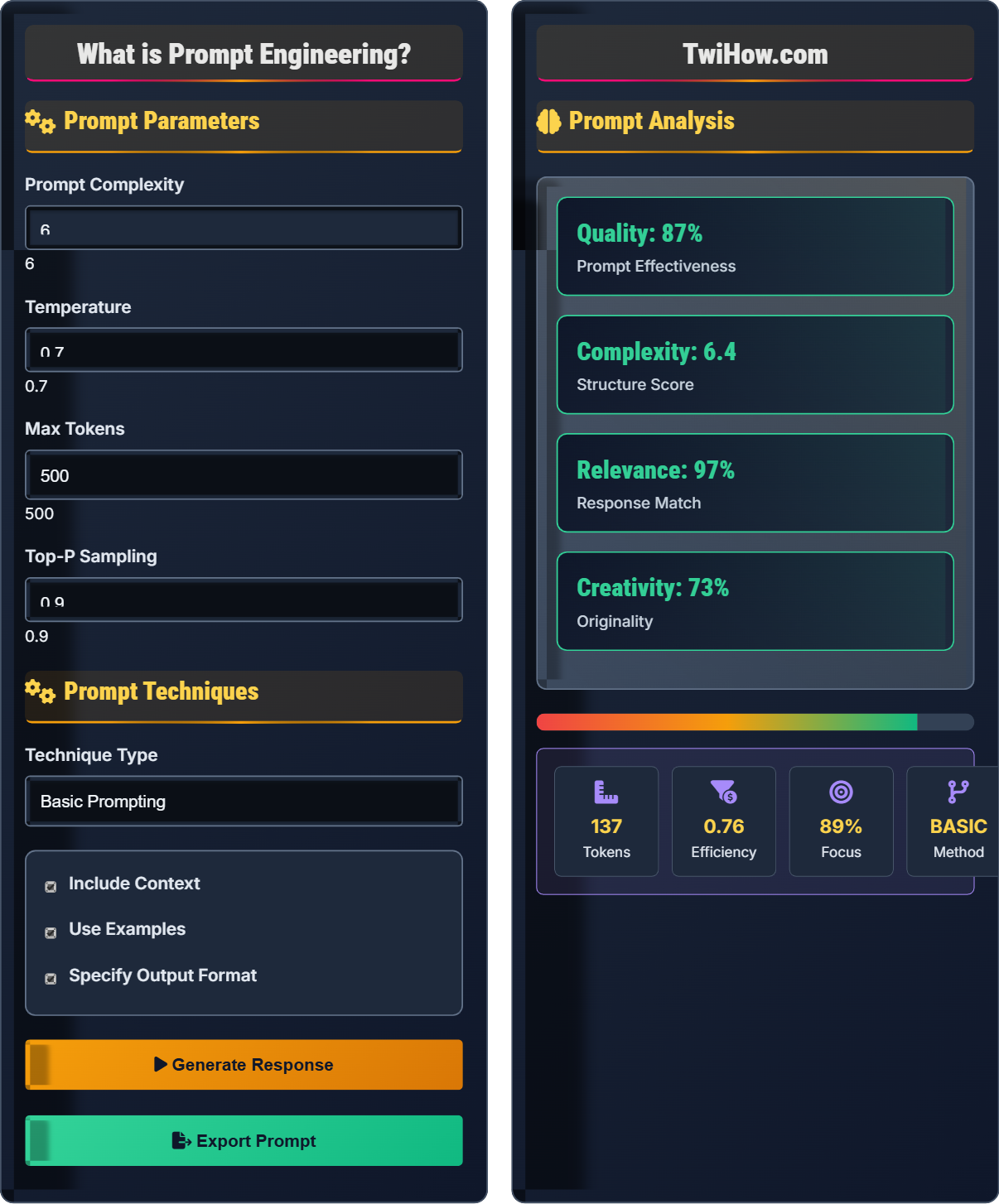
Prompt Parameters
Prompt Techniques
Prompt Analysis
What is Prompt Engineering: Complete Guide
Prompt engineering is the practice of designing and refining inputs (prompts) to guide AI language models toward producing desired outputs. It involves understanding how models process information and using specific techniques to communicate effectively with AI systems. Effective prompt engineering can dramatically improve the quality, relevance, and usefulness of AI-generated responses.
- Be Specific: Clearly define what you want and how you want it formatted
- Provide Context: Give relevant background information to guide responses
- Use Examples: Demonstrate the desired output format when possible
- Iterate and Refine: Test prompts and refine based on results
- Control Length: Balance detail with conciseness to avoid token limits
- Test Variations: Experiment with different phrasings to find optimal results
Prompt Patterns
- Instruction Pattern: "Perform task X on input Y using method Z"
- Question-Answer Pattern: "Question: [query] Answer: [expected response]"
- Classification Pattern: "Given [input], categorize into [options] based on [criteria]"
- Generation Pattern: "Create [output type] about [topic] in [style] format"
- Analysis Pattern: "Analyze [input] by examining [aspects] and conclude with [format]"
- Transformation Pattern: "Convert [input format] to [output format] while preserving [attributes]"
Choose patterns based on the task type: use instruction patterns for direct tasks, QA patterns for factual queries, and generation patterns for creative content.
- Match pattern to task type
- Keep consistent formatting
- Provide sufficient examples
- Specify output constraints
- Test with variations
Interactive Prompt Practice
Create Your Own Prompt:
Prompt Quality Metrics
Effective prompts should be evaluated based on clarity, specificity, completeness, and the quality of responses they generate. Key metrics include relevance, accuracy, and alignment with intended purpose.
Test prompts with different inputs, measure response consistency, and verify that outputs meet expectations. Iterate based on performance metrics.
- Clear instructions
- Well-defined scope
- Appropriate complexity
- Measurable outcomes
- Consistent results
Prompt Engineering Learning Quiz
Which of the following is NOT a standard component of an effective prompt?
Model architecture details are internal to the AI system and not part of the prompt. The standard components of an effective prompt are: Context (background information), Instruction (what to do), Input (specific data), and Output Format (how to present results).
The answer is D) Model Architecture Details.
Effective prompts should focus on communicating with the model, not on technical internals. The four key components work together: Context provides background, Instruction specifies the task, Input gives specific data to work with, and Output Format defines how results should be presented.
Context: Background information for the task
Instruction: What the model should do
Output Format: How results should be presented
• Focus on communication, not internals
• Include all four components when possible
• Be specific about desired format
• Use templates for consistency
• Provide examples when needed
• Specify constraints clearly
• Omitting context information
• Being too vague in instructions
• Not specifying output format
Explain what Chain of Thought (CoT) prompting is and why it's effective. Provide an example of a prompt that uses CoT technique.
Chain of Thought Prompting: A technique that encourages the model to break down complex problems into intermediate reasoning steps before providing the final answer. Instead of jumping directly to conclusions, the model explains its reasoning process.
Effectiveness: CoT improves performance on tasks requiring multi-step reasoning by allowing the model to decompose complex problems and track its logical progression.
Example: "Solve this math problem step by step: John has 12 apples. He gives 3 to his friend and buys 5 more. How many does he have now? First, subtract the apples given away, then add the apples bought."
Chain of thought prompting mimics human problem-solving by encouraging systematic thinking. It's particularly effective for mathematical reasoning, logical puzzles, and complex analytical tasks. By seeing the intermediate steps, users can understand the model's reasoning and identify errors.
Chain of Thought: Step-by-step reasoning process
Intermediate Steps: Reasoning between input and output
Multi-step Reasoning: Complex problems requiring multiple operations
• Use for complex reasoning tasks
• Encourage systematic thinking
• Verify intermediate steps
• Start with "think step by step"
• Break problems into smaller parts
• Ask for reasoning before conclusion
• Using CoT for simple tasks
• Not guiding the reasoning process
• Accepting incorrect intermediate steps
A marketing team wants to generate personalized email campaigns for their customers. They need to create a prompt that will generate compelling, personalized emails based on customer purchase history and preferences. Design an effective prompt structure and explain why each component is important.
Prompt Structure:
Context: You are a marketing expert creating personalized email campaigns for an e-commerce store.
Instruction: Generate a personalized email based on customer purchase history and preferences.
Input: Customer: [name], Purchase History: [items], Preferences: [interests], Recent Activity: [behavior]
Output Format: Subject line, greeting, body (3 paragraphs), call-to-action, signature.
Example: Input: Customer: Sarah, Purchases: Yoga mat, resistance bands, Subject: Special offer on yoga accessories
Importance: Context sets the role, Instruction defines the task, Input provides specific data, Format ensures consistency, Examples guide the style.
This prompt structure ensures the AI understands its role, knows exactly what to do, has the necessary customer data, and delivers results in a consistent format. The combination of context, instruction, input, and format creates a complete communication framework for the AI.
Personalization: Tailoring content to individual users
Customer Data: Purchase history and preferences
Email Structure: Consistent format for deliverables
• Include customer-specific data
• Maintain brand voice
• Ensure privacy compliance
• Use customer segmentation
• Include seasonal elements
• Test personalization levels
• Not including customer data
• Generic tone instead of personal
• Ignoring privacy concerns
A data analyst receives inconsistent and unfocused responses when asking an AI to analyze sales reports. The current prompt is: "Analyze this sales report." Propose improvements to this prompt and explain how each improvement would enhance the response quality.
Improved Prompt: "As a senior sales analyst, analyze the provided quarterly sales report for Q3 2023. Focus on revenue trends, regional performance, and product category performance. Identify top 3 growth opportunities and recommend specific actions. Present findings in a structured format with executive summary, key metrics, trend analysis, and action items."
Improvements:
1. Role Assignment: "Senior sales analyst" guides expertise level
2. Specific Data: "Q3 2023" provides temporal context
3. Focus Areas: Specifies key analysis areas to avoid generic responses
4. Actionable Output: Requests specific recommendations
5. Structured Format: Ensures organized presentation
These improvements would result in more focused, relevant, and actionable analysis.
Vague prompts often result in generic responses. By adding specificity, context, and structure, we guide the AI toward producing more valuable and targeted outputs. The key is to communicate as clearly as possible what you need and how you need it delivered.
Prompt Specificity: Level of detail in instructions
Role Assignment: Defining AI's perspective
Output Structure: Organized response format
• Be specific about requirements
• Provide necessary context
• Define output expectations
• Start with broad requirements
• Add specific constraints
• Test with sample inputs
• Using overly broad prompts
• Not specifying output format
• Omitting important context
Which prompting technique is most effective for tasks requiring logical reasoning and step-by-step problem solving?
Chain of Thought (CoT) prompting is specifically designed for logical reasoning and step-by-step problem solving. It encourages the model to break down complex problems into intermediate reasoning steps, making it ideal for mathematical problems, logical puzzles, and analytical tasks that require systematic thinking.
The answer is B) Chain of Thought.
Different prompting techniques are optimized for different types of tasks. Chain of Thought is particularly effective for problems that require sequential reasoning, where the path to the solution is as important as the final answer. Other techniques serve different purposes: Role Prompting for perspective, Few-Shot for pattern matching, and Templates for structure.
Chain of Thought: Step-by-step reasoning approach
Logical Reasoning: Systematic thinking process
Sequential Problem Solving: Multi-step analytical tasks
• Match technique to task type
• CoT for multi-step reasoning
• Consider complexity requirements
• Use "think step by step" phrase
• Break complex problems
• Verify intermediate steps
• Using simple prompts for complex tasks
• Not guiding the reasoning process
• Accepting illogical intermediate steps
FAQ
Q: Is prompt engineering the same as programming?
A: No, prompt engineering is different from traditional programming. Instead of writing code with explicit instructions, prompt engineering involves crafting natural language inputs that guide AI models. While programming tells the computer exactly what to do, prompt engineering asks the AI to generate responses based on its learned knowledge and patterns.
Q: How do I know if my prompt is effective?
A: Test your prompt with different inputs and evaluate the responses for relevance, accuracy, and consistency. Effective prompts produce high-quality responses consistently across various inputs. Look for responses that match your requirements in content, style, and format. Iterate and refine based on results.