What is Reinforcement Learning?
Complete RL guide • Step-by-step explanations
Reinforcement Learning Fundamentals:
Show RL SimulatorReinforcement Learning (RL) is a type of machine learning where an agent learns to make decisions by interacting with an environment. The agent takes actions, receives feedback in the form of rewards or penalties, and learns to maximize cumulative rewards over time.
Key RL concepts:
- Agent: The learner that makes decisions
- Environment: The world the agent interacts with
- Action: Decisions made by the agent
- State: Current situation in the environment
- Reward: Feedback signal for actions taken
- Policy: Strategy for selecting actions
RL systems learn through trial and error, optimizing their behavior based on past experiences and future rewards.
RL Parameters
Environment Settings
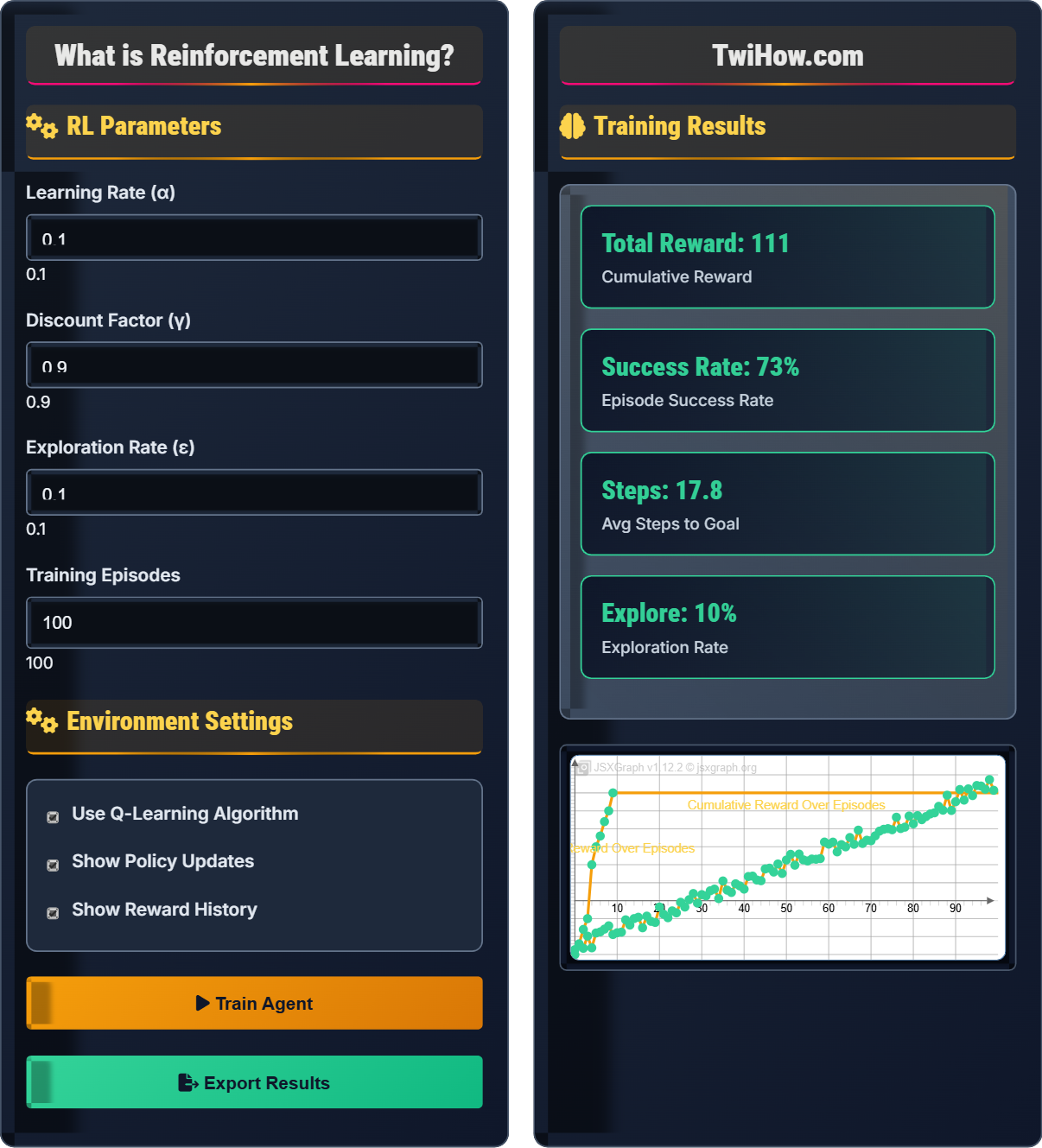
Training Results
| Episode | Reward | Steps | Success |
|---|---|---|---|
| 1 | -15 | 25 | No |
| 2 | -12 | 22 | No |
| 3 | -8 | 18 | No |
| 4 | -5 | 15 | No |
| 5 | 10 | 10 | Yes |
How Reinforcement Learning Works
Reinforcement Learning (RL) is a type of machine learning where an agent learns to make sequential decisions by interacting with an environment. The agent takes actions, observes the state of the environment, receives rewards or penalties, and learns to maximize cumulative rewards over time.
Where:
- Agent: The decision-maker that learns optimal behavior
- Environment: The external world the agent interacts with
- Action: Decision taken by the agent at each time step
- State: Current situation observed by the agent
- Reward: Immediate feedback signal for actions taken
- Policy: Strategy mapping states to actions
Where:
- Q(s,a): Expected future reward for taking action a in state s
- R(s,a): Immediate reward for action a in state s
- γ: Discount factor (0 ≤ γ ≤ 1)
- s': Next state after taking action a
This equation forms the foundation of Q-learning, a popular RL algorithm that helps agents learn optimal policies.
Key areas where RL is transforming industries:
- Gaming: AlphaGo, video game AI, strategy games
- Robotics: Autonomous navigation, manipulation tasks
- Finance: Trading strategies, portfolio management
- Healthcare: Treatment optimization, drug discovery
- Autonomous Vehicles: Path planning, decision making
- Recommendation Systems: Personalized content delivery
- Value-Based: Learn optimal value functions (Q-Learning, SARSA)
- Policy-Based: Directly optimize policy parameters (REINFORCE)
- Actor-Critic: Combine value and policy learning
- Model-Based: Learn environment dynamics for planning
- Deep RL: Use neural networks for complex state spaces
RL Fundamentals
Agent, environment, state, action, reward, policy, value function, exploration vs exploitation.
Q(s,a) ← Q(s,a) + α[r + γ max Q(s',a') - Q(s,a)]
Where Q(s,a) = expected future reward, α = learning rate, γ = discount factor.
- Balance exploration and exploitation
- Discount future rewards appropriately
- Learn from both positive and negative feedback
Applications
Game playing, robotics, autonomous systems, recommendation engines, resource management.
- Game AI development
- Robot control systems
- Trading algorithms
- Autonomous navigation
- Safety in critical systems
- Ethics in decision making
- Computational complexity
- Sample efficiency
RL Learning Quiz
Which of the following is NOT a fundamental component of the reinforcement learning framework?
Reinforcement Learning operates without supervised labels. Instead of being told the correct action for each state, the agent learns through trial and error by receiving rewards or penalties based on its actions. The key components are the agent, environment, state, action, and reward signal.
The answer is C) Supervised Labels.
It's crucial to distinguish RL from supervised learning. In supervised learning, we have input-output pairs (labels) to train on. In RL, there are no correct answers provided upfront - the agent must discover good behavior through interaction with the environment and feedback via rewards. This makes RL particularly suited for problems where optimal behavior is unknown or difficult to specify explicitly.
Agent: The decision-making entity that learns optimal behavior
Environment: The world the agent interacts with
Reward Signal: Feedback mechanism guiding the agent's learning
• RL learns from delayed feedback
• No explicit supervision provided
• Agent explores to discover optimal policy
• Remember: RL = Trial and error learning
• Think of it like teaching through consequences
• Exploration vs exploitation is key
• Confusing RL with supervised learning
• Thinking agent knows correct answers
• Underestimating exploration importance
Explain the exploration vs exploitation trade-off in reinforcement learning. Why is this balance critical for successful learning?
Exploration: The agent tries new actions to discover potentially better strategies and learn about the environment. This involves taking actions with uncertain outcomes to gather more information.
Exploitation: The agent uses known information to maximize immediate rewards by selecting actions that historically provided good outcomes.
Trade-off: Too much exploration leads to suboptimal short-term performance as the agent continuously tries new things without leveraging known good strategies. Too much exploitation leads to suboptimal long-term performance as the agent gets stuck in local optima and fails to discover better strategies.
Critical for success because it balances immediate gains with long-term learning potential, ensuring the agent discovers the globally optimal policy rather than settling for locally optimal ones.
Think of this like trying restaurants in a new city. Exploration means trying new restaurants to discover great food, while exploitation means going back to restaurants you know taste good. The optimal strategy involves balancing both - occasionally trying new places while still enjoying known favorites. In RL, algorithms like ε-greedy, UCB, or Thompson sampling help manage this balance automatically.
Exploration: Trying new actions to learn more about the environment
Exploitation: Using known good actions to maximize immediate rewards
ε-greedy: Algorithm that explores with probability ε and exploits with probability 1-ε
• Balance is essential for optimal learning
• Decreasing exploration over time often works well
• Different problems require different balances
• Start with more exploration, decrease over time
• Use domain knowledge to guide exploration
• Monitor performance to adjust balance
• Always exploring, never exploiting
• Getting stuck in local optima
• Not adapting exploration rate over time
A robot needs to navigate a 5x5 grid to reach a goal location while avoiding obstacles. Design the RL framework for this problem: define the state space, action space, and reward function. How would you handle the exploration-exploitation trade-off?
State Space: Each cell in the 5x5 grid represents a state (25 possible states). State could be represented as (row, col) coordinates.
Action Space: Four possible actions: move up, down, left, right (or stay if boundary reached).
Reward Function: -1 for each step (to encourage efficiency), +100 for reaching goal, -10 for hitting obstacle, 0 for empty cells.
Exploration-Exploitation: Use ε-greedy strategy starting with ε=0.3 (30% exploration) and decay to ε=0.05 over time. Alternatively, use UCB or Boltzmann exploration for more sophisticated balance.
This framework allows the robot to learn an optimal path through trial and error, balancing exploration of new routes with exploitation of known good paths.
Grid navigation is a classic RL problem that demonstrates all core concepts. The state-action-reward structure is fundamental to RL. The reward design is crucial - negative rewards per step encourage efficiency, positive rewards motivate goal achievement, and penalties discourage bad behavior. This example shows how RL can solve complex sequential decision-making problems.
State Space: Set of all possible states the agent can encounter
Action Space: Set of all possible actions available to the agent
Reward Function: Maps state-action pairs to numerical rewards
• Reward design significantly impacts learning
• State representation affects algorithm performance
• Action space should be comprehensive yet manageable
• Use sparse rewards sparingly
• Normalize reward magnitudes
• Consider shaping rewards for faster learning
• Designing rewards that don't align with goals
• Making state space too large
• Not considering boundary conditions
Implement the Q-learning update rule for a simple scenario where an agent is in state S with action A, receives reward R, and transitions to state S'. Given α=0.1, γ=0.9, current Q(S,A)=0.5, max Q(S',a')=0.8, calculate the updated Q-value. Explain the intuition behind this update.
Q-learning update rule: Q(S,A) ← Q(S,A) + α[R + γ max Q(S',a') - Q(S,A)]
Substituting values: Q(S,A) ← 0.5 + 0.1[0.5 + 0.9×0.8 - 0.5]
Q(S,A) ← 0.5 + 0.1[0.5 + 0.72 - 0.5]
Q(S,A) ← 0.5 + 0.1[0.72]
Q(S,A) ← 0.5 + 0.072 = 0.572
Intuition: The update adjusts the current estimate toward the target value (R + γ max Q(S',a')). The learning rate α controls how much the new information influences the old estimate. The target combines immediate reward with discounted future value, providing a learning signal that incorporates both short-term and long-term consequences.
The Q-learning update is fundamentally about learning from experience. The term [R + γ max Q(S',a') - Q(S,A)] is called the temporal difference (TD) error - it measures how much our prediction differed from reality. The algorithm uses this error to adjust its expectations, gradually converging to accurate value estimates. This is a form of bootstrapping where we use our current estimates to update our current estimates.
Temporal Difference (TD) Error: Difference between predicted and actual outcome
Learning Rate (α): Controls how quickly new information replaces old information
Discount Factor (γ): Controls preference for immediate vs future rewards
• TD error drives learning direction
• Learning rate affects convergence speed
• Discount factor balances time horizons
• Lower α for stable convergence
• Higher γ for long-term planning
• Monitor TD error to track learning
• Forgetting to discount future rewards
• Using inappropriate learning rates
• Not accounting for terminal states
Which of the following represents a significant challenge in reinforcement learning compared to other machine learning approaches?
Reinforcement Learning deals with sequential decision-making where the consequences of actions may not be immediately apparent. Unlike supervised learning where feedback is immediate and direct, RL agents must learn to connect actions with rewards that may occur many steps later. This temporal credit assignment problem, combined with the need to explore to find optimal strategies, makes RL particularly challenging.
The answer is B) Sequential decision making with delayed rewards.
This challenge is unique to RL. In supervised learning, we get immediate feedback on every prediction. In RL, we might take 100 actions before receiving a meaningful reward, making it difficult to determine which actions contributed to the outcome. This is called the credit assignment problem. Additionally, the agent must balance exploration (trying new things) with exploitation (using known good strategies), which doesn't exist in other ML paradigms.
Temporal Credit Assignment: Determining which past actions led to current rewards
Delayed Rewards: Feedback that comes after many intermediate actions
Exploration-Exploitation Trade-off: Balancing new discoveries vs known rewards
• RL handles delayed consequences
• Sequential decisions affect future states
• Agent must learn through interaction
• Use eligibility traces for credit assignment
• Design reward functions carefully
• Consider using function approximation
• Expecting immediate learning like supervised learning
• Not accounting for sequence dependencies
• Poor reward function design
FAQ
Q: How does reinforcement learning differ from traditional programming?
A: Traditional programming follows an imperative approach: you explicitly define the rules and steps for the computer to execute. In contrast, RL uses a behavioral approach where you define the goal (through rewards) and let the agent figure out how to achieve it through trial and error.
For example, in traditional programming, you'd write specific rules for a game-playing program. In RL, you provide the game rules and reward structure, then the agent learns strategies by playing millions of games against itself or opponents.
This makes RL particularly powerful for problems where the optimal solution isn't obvious or changes based on circumstances.
Q: What are the main differences between Q-learning and Deep Q-Networks (DQN)?
A: Q-learning and Deep Q-Networks (DQN) represent different scales of the same concept:
Q-learning: Classical tabular method that maintains a lookup table of Q-values for each state-action pair. Works well for small, discrete state spaces but becomes impractical as state space grows exponentially.
DQN: Uses a neural network to approximate the Q-function, allowing it to handle continuous or very large state spaces (like raw pixel inputs from games). The network learns to map states to Q-values for all possible actions.
DQN also introduces innovations like experience replay (storing and sampling past experiences) and target networks (stabilizing training) to handle the challenges of training neural networks on sequential data.