What is Data Breach? Cybersecurity Essentials
Complete data breach guide • Step-by-step explanations
Data Breach Fundamentals:
Show Breach SimulatorA data breach is an unauthorized access, disclosure, or theft of sensitive, protected, or confidential data. This can include personal information, financial records, intellectual property, or other valuable digital assets. Data breaches can occur through cyberattacks, physical theft, or accidental exposure.
Data breaches pose significant risks to individuals, organizations, and society at large. They can result in financial losses, identity theft, reputation damage, regulatory penalties, and compromised privacy. Modern cybersecurity practices focus on prevention, detection, and rapid response to minimize breach impact.
Key data breach concepts:
- Unauthorized Access: Gaining entry without permission
- Data Exfiltration: Stealing sensitive information
- Impact Assessment: Measuring consequences
- Incident Response: Containment and recovery procedures
Organizations must implement comprehensive security measures including access controls, encryption, employee training, and incident response plans to protect against data breaches and comply with privacy regulations.
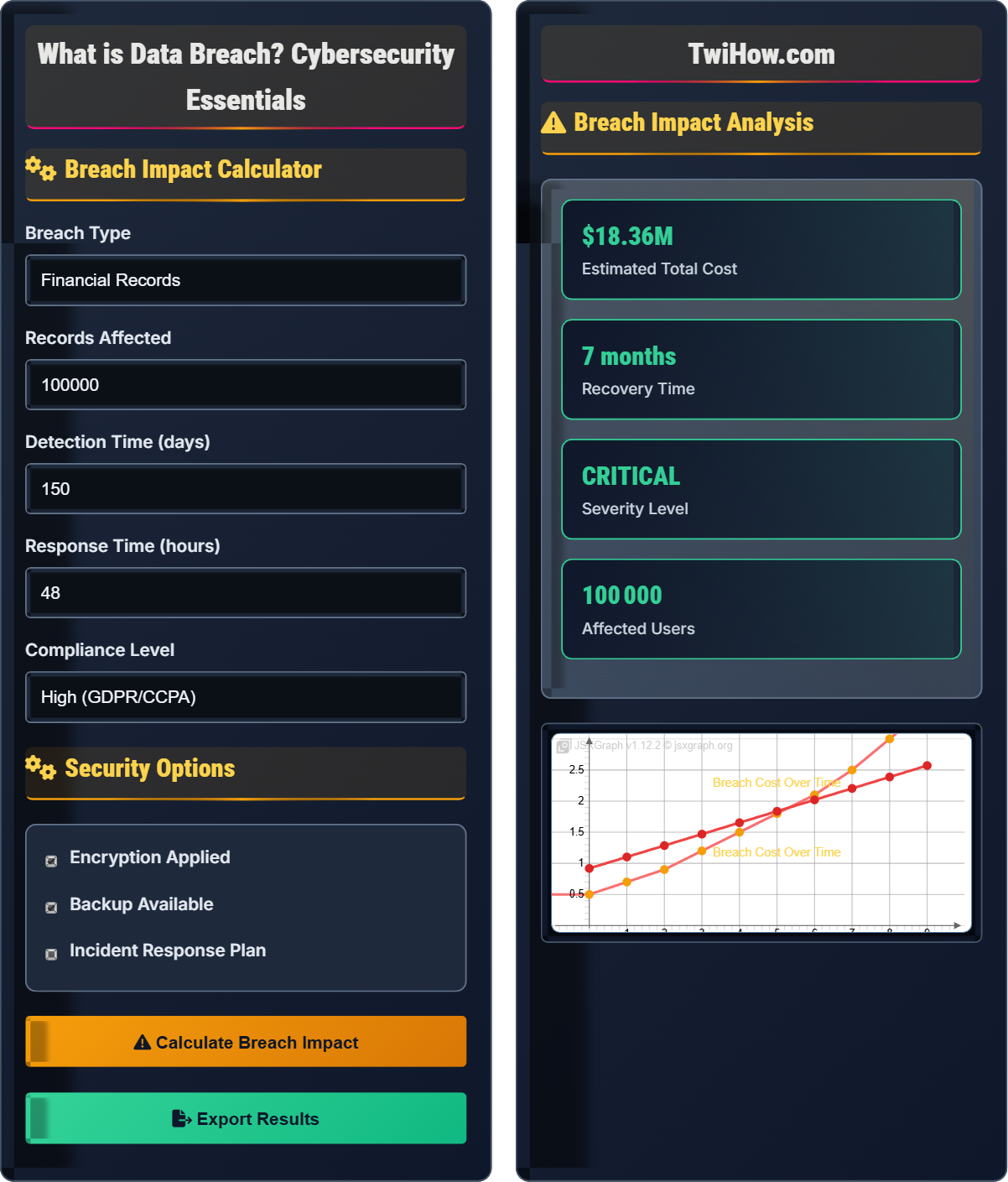
Breach Impact Calculator
Security Options
Breach Impact Analysis
| Category | Percentage | Amount | Notes |
|---|---|---|---|
| Legal/Regulatory | 38% | $1.62M | Fines and compliance |
| Customer Churn | 25% | $1.07M | Lost business |
| Notification Costs | 15% | $0.64M | Communication |
| Reputation Damage | 12% | $0.51M | Brand impact |
| Technical Remediation | 10% | $0.43M | System fixes |
How Data Breaches Happen Explained
A data breach is an incident where sensitive, protected, or confidential data is accessed, copied, transmitted, viewed, stolen, or used by an individual unauthorized to do so. Data breaches can involve personal health information (PHI), personally identifiable information (PII), trade secrets, intellectual property, or other confidential data. Breaches can occur through various means including cyberattacks, physical theft, or accidental exposure.
Different types of data breaches affect various types of information:
Where:
- Data Value: Sensitivity and worth of exposed data
- Vulnerability: Security weakness exploited
- Exposure Duration: Time data remained accessible
Key areas affected by data breaches:
- Financial: Direct costs, fines, legal fees, remediation expenses
- Reputational: Customer trust, brand damage, market position
- Operational: Business disruption, productivity loss, system downtime
- Regulatory: Compliance violations, investigations, sanctions
- Personal: Identity theft, privacy violation, emotional distress
- Competitive: Intellectual property theft, strategic advantage loss
- Access Controls: Limit data access to authorized personnel
- Encryption: Protect data both at rest and in transit
- Employee Training: Security awareness and phishing prevention
- Multi-Factor Authentication: Additional security layer
- Regular Audits: Identify and address vulnerabilities
- Incident Response: Prepared plans for quick containment
Breach Fundamentals
Personal Identifiable Information (PII), Protected Health Information (PHI), data exfiltration, unauthorized access, confidentiality breach.
Total Cost = Detection + Escalation + Notification + Post-Breach Activities
Where Total Cost = comprehensive financial impact of the breach.
- Speed of detection reduces cost significantly
- Encryption can reduce notification requirements
- Compliance frameworks mandate reporting timelines
Prevention & Response
Zero trust architecture, data classification, security monitoring, incident response planning, backup strategies.
- Contain the breach immediately
- Assess scope and impact
- Notify authorities and affected parties
- Remediate vulnerabilities
- Review and improve security
- Legal notification requirements vary by jurisdiction
- Transparency builds customer trust
- Continuous security improvement is essential
- Insurance can offset financial impacts
Data Breach Learning Quiz
Which of the following is considered the most sensitive type of data that, if breached, typically results in the highest regulatory penalties?
Protected Health Information (PHI) under HIPAA regulations carries some of the highest penalties for breaches. PHI includes individually identifiable health information held or transmitted by a covered entity or its business associate. Violations can result in fines up to $1.5 million per year for identical violations and criminal penalties including imprisonment.
The answer is B) Protected Health Information (PHI).
Understanding data sensitivity classifications is crucial for prioritizing security efforts. Different types of data are subject to different regulatory frameworks with varying penalty structures. PHI is particularly sensitive because it contains personal health information that can be used for identity theft, insurance fraud, and other serious crimes.
PHI: Protected Health Information under HIPAA
PII: Personally Identifiable Information
HIPAA: Health Insurance Portability and Accountability Act
• PHI has stricter protections than PII
• Healthcare breaches have severe penalties
• Remember HIPAA acronym: Health Information Protection
• Health data is more sensitive than financial
• Breach severity depends on data type
• Underestimating PHI protection requirements
• Confusing PII with PHI regulations
• Assuming all data has equal sensitivity
Explain the key steps in an effective data breach incident response plan and why immediate action is critical. Include specific timeframes that organizations should aim for in their response procedures.
Immediate Response Steps:
1. Containment (Within 1 hour): Isolate affected systems to prevent further data loss
2. Assessment (Within 24 hours): Determine scope, nature, and impact of the breach
3. Notification (Within 72 hours): Inform regulators and affected individuals as required by law
4. Eradication (Within 1 week): Remove threat actors and eliminate vulnerabilities
5. Recovery (Within 1 month): Restore systems and verify integrity
Criticality of Speed: Every hour of delay increases potential damage and costs. Studies show that breaches detected within 200 days cost significantly less than those taking longer to detect.
Time is of the essence in breach response. The longer a breach remains undetected, the more data can be stolen and the greater the damage. Regulatory frameworks like GDPR require notification within 72 hours of becoming aware of a breach. Having a pre-planned response procedure enables organizations to act quickly and effectively.
Incident Response: Coordinated approach to addressing security incidents
Containment: Preventing further spread of the breach
GDPR: General Data Protection Regulation (EU)
• Timeframes vary by jurisdiction and data type
• Preparation is key to effective response
• Documentation is required for compliance
• Practice response procedures regularly
• Maintain contact lists for key personnel
• Keep forensic tools ready for investigation
• Delaying notification to "investigate more"
• Not having a documented response plan
• Failing to preserve evidence for forensics
A healthcare organization stores 50,000 patient records containing PHI. Their security team identified a vulnerability that could potentially allow unauthorized access to these records. The estimated cost per record in case of a breach is $417 according to industry studies. Calculate the potential total impact of a breach and recommend three specific security measures to mitigate this risk.
Potential Impact Calculation:
Total Potential Cost = 50,000 records × $417 per record = $20,850,000
Recommended Security Measures:
1. Implement Multi-Factor Authentication: Add additional security layer for database access
2. Deploy Database Activity Monitoring: Detect unusual access patterns and potential breaches in real-time
3. Apply Role-Based Access Controls: Limit data access to only those who need it for their job functions
These measures would significantly reduce both the likelihood of a successful breach and the potential impact if one occurs.
Quantifying potential breach impact helps prioritize security investments. Healthcare data breaches are particularly costly due to regulatory requirements and the sensitive nature of health information. The calculation shows why investing in preventive security measures is financially justified compared to the potential costs of a breach.
ROI: Return on Investment for security measures
RBAC: Role-Based Access Control
DAM: Database Activity Monitoring
• Prevention costs less than breach response
• Healthcare data has higher breach costs
• ROI calculations support security investments
• Use industry benchmarks for cost estimates
• Consider both direct and indirect costs
• Factor in regulatory penalties
• Underestimating indirect costs of breaches
• Not considering regulatory penalties
• Failing to calculate ROI for security investments
A multinational company operates in both the EU and US. They experience a data breach affecting 10,000 EU citizens and 5,000 US customers. Explain the different notification requirements under GDPR (EU) and state data breach laws (US), and calculate the potential regulatory fines assuming a significant violation.
GDPR Requirements:
• Notify supervisory authority within 72 hours
• Notify affected individuals without undue delay if high risk
• Potential fine: Up to €20 million or 4% of annual global turnover
US Requirements:
• Varies by state (most require notification within 72 hours)
• Federal agencies may also need notification depending on data type
• Potential fines vary by state and federal regulations
Estimated Fines: For a significant GDPR violation affecting 15,000 people, potential fines could reach €20 million or 4% of global revenue, whichever is higher.
Global operations face complex compliance requirements with varying timelines and penalties. GDPR is one of the strictest data protection laws globally, with significant financial penalties. Companies operating internationally must understand and comply with multiple regulatory frameworks simultaneously.
GDPR: General Data Protection Regulation (EU)
Supervisory Authority: National data protection authority
Global Turnover: Annual worldwide revenue
• GDPR applies to EU residents regardless of company location
• US laws vary significantly by state
• Multiple jurisdictions may have authority
• Stay updated on changing regulations
• Consult legal experts for complex cases
• Missing notification deadlines
• Underestimating global compliance complexity
Which of the following security measures provides the most comprehensive protection against data breaches involving sensitive information?
While all listed measures are important for security, data encryption provides comprehensive protection that renders stolen data useless without the decryption keys. Even if attackers gain access to encrypted data through various means, they cannot read or use the information without the keys. Encryption protects data regardless of how the breach occurs.
The answer is B) Data encryption at rest and in transit.
Encryption is often called the "last line of defense" because it protects data even when other security controls fail. While strong passwords, training, and MFA prevent many breaches, encryption ensures that stolen data remains unreadable. A defense-in-depth strategy combines all these measures for maximum protection.
Encryption at Rest: Protecting stored data
Encryption in Transit: Protecting data during transmission
Defense in Depth: Layered security approach
• Encryption is essential for sensitive data
• Keys must be properly managed
• Encryption doesn't prevent all attacks
• Encrypt data by default, not as option
• Use strong encryption algorithms
• Implement proper key management
• Not encrypting sensitive data
• Poor key management practices
• Assuming other controls are sufficient
FAQ
Q: How do companies know when they've been hacked or had a data breach?
A: Companies discover data breaches through several methods:
1. Security Monitoring Tools: Automated systems detect unusual network activity, unauthorized access attempts, or data exfiltration
2. Third-Party Notifications: Security researchers, law enforcement, or other organizations report that stolen data has been found
3. Internal Audits: Regular security assessments uncover unauthorized access or configuration changes
4. Employee Reports: Staff members notice suspicious activity or receive phishing emails
5. Customer Complaints: Customers report fraudulent activity on their accounts or receive notifications from credit bureaus
Studies show that many breaches go undetected for months, highlighting the importance of continuous monitoring and threat detection capabilities.
Q: What's the difference between a data breach and a data leak?
A: While often used interchangeably, there are subtle differences:
Data Breach: Typically implies intentional unauthorized access by an attacker who actively exploits a vulnerability or uses malicious techniques to gain access to systems and steal data.
Data Leak: Often refers to unintentional exposure of sensitive information due to misconfigurations, poor security practices, or accidents. For example, leaving a database publicly accessible without proper authentication.
However, both terms are commonly used to describe any incident where sensitive data becomes accessible to unauthorized parties, regardless of intent. From a regulatory perspective, both usually trigger similar notification requirements.
Q: What should I do if my personal information is included in a data breach?
A: If you're notified that your information was part of a data breach, take these immediate steps:
1. Change Passwords: Immediately update passwords for the affected account and any other accounts using the same password
2. Monitor Accounts: Closely watch bank statements, credit card charges, and credit reports for suspicious activity
3. Enable Multi-Factor Authentication: Add extra security layer to important accounts
4. Consider Credit Freeze: If sensitive information like SSN was compromised, consider freezing your credit
5. Watch for Scams: Be alert for phishing emails or calls referencing the breach
Many companies offer free credit monitoring services after a breach. Take advantage of these services to help detect potential misuse of your information.