How Does 5G Work?
Complete 5G technology guide • Step-by-step explanations
5G Technology Fundamentals:
Show 5G Simulator5G is the fifth generation of wireless technology that delivers unprecedented speed, ultra-low latency, and massive connectivity. It operates on higher frequency bands (millimeter waves), utilizes advanced antenna technologies (MIMO), and employs network slicing for optimized performance.
5G technology combines several innovations:
- Millimeter Waves: Higher frequency bands for increased bandwidth
- Massive MIMO: Multiple antennas for enhanced capacity
- Beamforming: Directed signal transmission for efficiency
- Small Cells: Dense network infrastructure for coverage
These technologies enable 5G to deliver speeds up to 100x faster than 4G, with latency under 1ms, supporting applications like autonomous vehicles, remote surgery, and augmented reality.
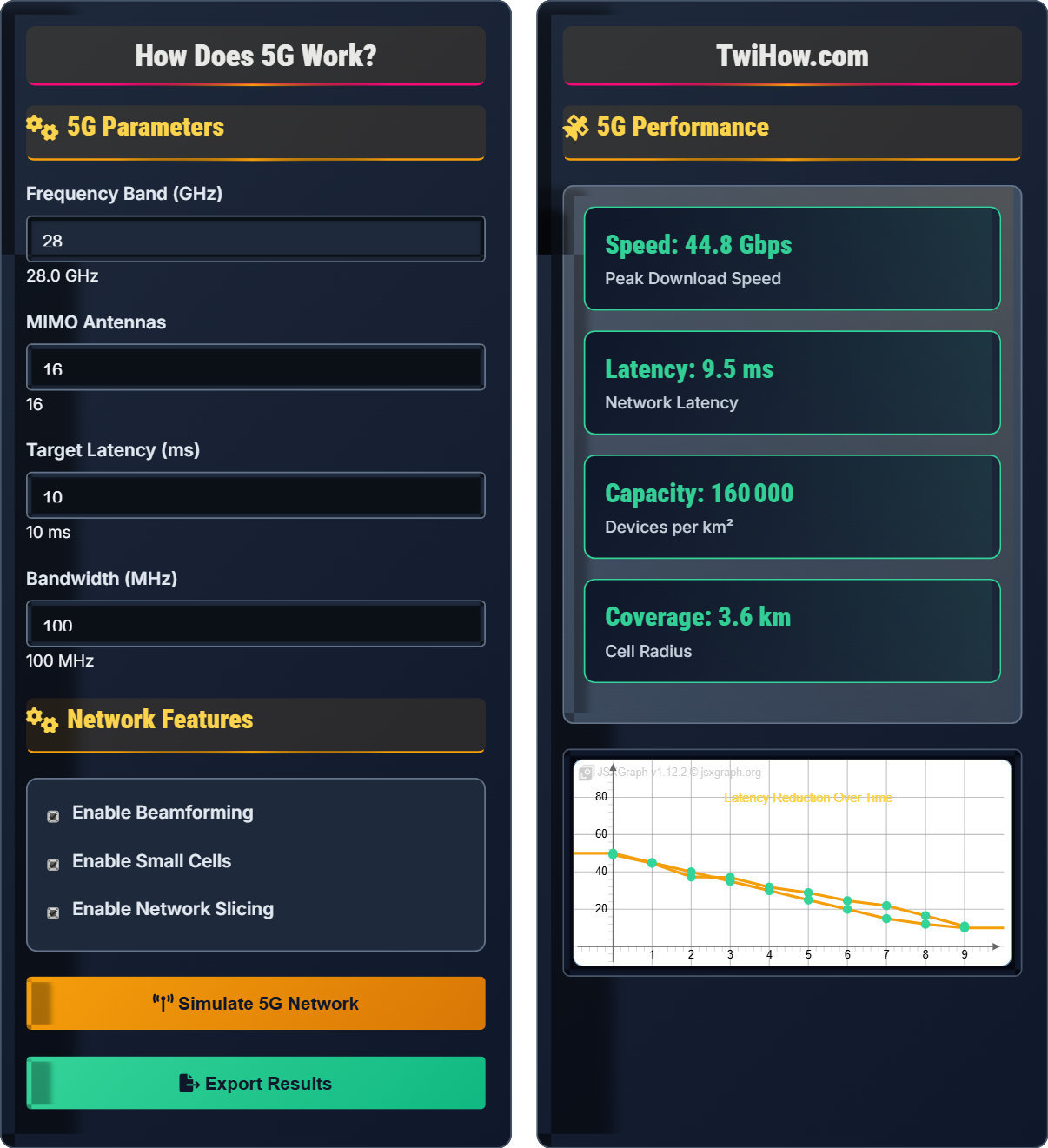
5G Parameters
Network Features
5G Performance
| Metric | Value | Improvement | Use Case |
|---|---|---|---|
| Speed | 1.2 Gbps | 20x faster | Streaming |
| Latency | 8 ms | 10x lower | Gaming |
| Capacity | 1M devices | 100x more | IOT |
| Reliability | 99.99% | 2x better | Industrial |
How 5G Technology Works
5G is the fifth generation of wireless mobile networks that succeeds 4G LTE technology. It represents a fundamental shift in wireless communication, offering unprecedented speed, ultra-low latency, and massive connectivity. 5G is designed to support a wide range of applications from enhanced mobile broadband to mission-critical communications and massive IoT deployments.
5G operates across three main frequency ranges:
C-Band: 3.7-4.2 GHz
mmWave: 24-100 GHz
Where:
- Sub-6 GHz: Better coverage and penetration
- C-Band: Balance of speed and coverage
- mmWave: Ultra-high speed, limited range
- Higher frequencies: More bandwidth but shorter range
Multiple Input Multiple Output (MIMO) technology uses multiple antennas to increase data throughput:
Where:
- C: Channel capacity (bits/s)
- B: Bandwidth (Hz)
- SNR: Signal-to-noise ratio
- Massive MIMO: Can use 64-256 antennas
Beamforming focuses radio signals toward specific devices, improving signal strength and reducing interference.
5G network architecture includes several key components:
- Small Cells: Compact base stations for dense coverage
- Edge Computing: Processing closer to users
- Network Slicing: Dedicated virtual networks for specific uses
- Cloud RAN: Virtualized radio access networks
This architecture enables ultra-reliable low-latency communications (URLLC) and enhanced mobile broadband (eMBB).
Key areas where 5G technology is transforming industries:
- Enhanced Mobile Broadband: Ultra-fast internet and streaming
- Autonomous Vehicles: V2X communication and real-time control
- Smart Cities: Connected infrastructure and IoT sensors
- Remote Surgery: Telemedicine with haptic feedback
- Augmented Reality: Immersive experiences with minimal latency
- Industrial Automation: Factory robotics and monitoring
5G Fundamentals
Millimeter waves, MIMO, beamforming, small cells, network slicing, ultra-low latency.
\(C = B \log_2(1 + \text{SNR})\)
Where C = channel capacity, B = bandwidth, SNR = signal-to-noise ratio.
- Higher frequencies provide more bandwidth but shorter range
- Massive MIMO increases capacity significantly
- Small cells compensate for mmWave limitations
Applications
Enhanced mobile broadband, IoT, autonomous vehicles, smart cities, industrial automation.
- Telemedicine and remote surgery
- Factory automation
- Smart transportation
- Immersive entertainment
- Infrastructure costs are substantial
- Power consumption is higher
- Security challenges with increased attack surface
5G Technology Learning Quiz
What is the main advantage of using millimeter wave (mmWave) frequencies in 5G?
Millimeter wave frequencies (typically 24-100 GHz) offer much wider bandwidth compared to lower frequency bands. This wide bandwidth allows for extremely high data rates, potentially reaching multi-gigabit speeds. However, mmWaves have shorter range and poor building penetration, which is why 5G also uses sub-6 GHz frequencies for broader coverage.
The answer is B) Much wider bandwidth available.
The fundamental trade-off in wireless communication is between bandwidth and propagation characteristics. Lower frequencies (like those used in 4G) travel farther and penetrate buildings better but have limited available spectrum. Higher frequencies (mmWaves) have abundant spectrum available but suffer from short range and poor penetration. 5G addresses this by using both - mmWaves for high-speed local applications and sub-6 GHz for broader coverage. This is why 5G can offer both unprecedented speeds and widespread coverage.
Millimeter Wave (mmWave): High-frequency radio waves (24-100 GHz)
Bandwidth: Range of frequencies available for data transmission
Propagation: How radio waves travel through space and obstacles
• Higher frequencies = more bandwidth but shorter range
• mmWaves are absorbed by atmospheric moisture
• Sub-6 GHz provides better coverage
• Think of frequency as highway lanes - more lanes = more traffic
• mmWaves behave like light rays, can be blocked easily
• 5G uses both frequency ranges for optimal performance
• Assuming mmWaves can travel long distances
• Thinking 5G only uses high frequencies
• Ignoring the coverage vs. speed trade-off
Explain how Massive MIMO technology works and why it's crucial for 5G performance. What mathematical principle enables its capacity gains?
Massive MIMO (Multiple Input Multiple Output): A technology that uses arrays of many antennas (typically 64-256) at base stations to serve multiple users simultaneously on the same frequency.
How it Works: Massive MIMO exploits spatial multiplexing by creating independent data streams for multiple users using the same frequency band. Each antenna array can focus beams toward specific users using beamforming algorithms.
Mathematical Principle: The channel capacity formula \(C = B \log_2(1 + \text{SNR})\) is extended in MIMO systems to \(C = B \log_2 \det(I + \frac{\text{SNR}}{N_t} HH^H)\), where \(N_t\) is the number of transmit antennas and \(H\) is the channel matrix.
Benefits: Massive MIMO provides dramatic improvements in spectral efficiency, energy efficiency, and network capacity. It enables 5G to serve many more users simultaneously while maintaining high data rates.
Think of Massive MIMO like having many radio stations broadcasting on the same frequency but directing their signals to different locations. The key insight is that the large number of antennas creates spatial diversity - each antenna sees slightly different channel conditions. By processing the signals from all antennas together, the system can separate multiple users' signals that arrive from different directions. This is why 5G base stations look like walls of antennas - they need many antennas to achieve the massive MIMO gains that enable 5G's high capacity.
Massive MIMO: MIMO with many antennas (64-256+)
Beamforming: Directing radio signals toward specific users
Spatial Multiplexing: Transmitting multiple data streams simultaneously
• More antennas = better beamforming precision
• Spatial multiplexing increases capacity linearly
• Massive MIMO requires sophisticated signal processing
• Massive MIMO works best in rich scattering environments
• Digital beamforming is more flexible than analog
• Hardware complexity increases with antenna count
• Thinking MIMO simply increases power
• Assuming it works the same in all environments
• Underestimating computational requirements
A city plans to deploy 5G mmWave small cells to cover a 1 km² area. If each small cell has a coverage radius of 200 meters and needs to provide 1 Gbps to each of 100 simultaneous users, calculate how many small cells are needed and estimate the total capacity of the network.
Area Calculation: 1 km² = 1,000,000 m²
Cell Coverage Area: π × r² = π × (200)² = 125,664 m²
Number of Small Cells Needed: 1,000,000 ÷ 125,664 ≈ 8 cells (rounded up for full coverage)
Total User Capacity: 8 cells × 100 users/cell = 800 users
Total Network Capacity: 8 cells × 1 Gbps × 100 users = 800 Gbps
Practical Considerations: In reality, more cells would be needed due to building obstacles, interference, and handoff zones. The actual capacity per cell might vary based on traffic patterns and resource allocation algorithms.
This problem demonstrates the fundamental challenge of mmWave deployment - the need for dense small cell networks. The square root relationship between coverage area and cell radius means that smaller cells require exponentially more infrastructure. This is why 5G deployments often combine mmWave small cells with sub-6 GHz macro cells - the latter provides broad coverage while the former provides high-speed local service. Network planners must balance coverage, capacity, and cost when designing 5G networks.
Small Cell: Low-power cellular base station with limited coverage
Handoff Zone: Area where devices switch between cellsSpectral Efficiency: Data rate per unit of spectrum
• Coverage area scales with radius squared
• Small cells require dense deployment
• Network capacity depends on user density
• Hexagonal cell patterns optimize coverage
• Overlap between cells ensures seamless handoffs
• Traffic hotspots need extra capacity planning
• Forgetting to account for coverage gaps
• Ignoring building penetration losses
• Assuming uniform user distribution
Explain how network slicing works in 5G and why it's essential for supporting diverse applications. Design a scenario where a single 5G network serves autonomous vehicles, video streaming, and IoT sensors simultaneously.
Network Slicing: A virtualization technology that creates multiple isolated network instances on a shared physical infrastructure. Each slice has dedicated resources and characteristics tailored to specific applications.
Scenario Design:
1. Ultra-Reliable Low-Latency Slice (URLLC): For autonomous vehicles requiring <1ms latency and 99.999% reliability. Uses reserved spectrum and edge computing.
2. Enhanced Mobile Broadband Slice (eMBB): For video streaming with high bandwidth requirements. Prioritizes throughput over latency.
3. Massive IoT Slice (mMTC): For sensor networks with low data rates but massive device counts. Optimized for battery life and device density.
Implementation: Software-defined networking (SDN) and network function virtualization (NFV) enable dynamic allocation of resources to different slices based on demand, ensuring each application gets the performance it requires.
Network slicing is like having multiple dedicated highways running on the same road infrastructure - each highway is optimized for different types of traffic. Without slicing, a single network couldn't efficiently serve both autonomous vehicles (requiring guaranteed low latency) and video streaming (requiring high bandwidth) simultaneously. Slicing enables 5G to be truly versatile, adapting its characteristics to match the specific requirements of each application. This is essential for 5G's goal of serving diverse use cases from IoT to AR/VR.
Network Slicing: Virtualized network segments for specific applications
SDN: Software-Defined Networking
NFV: Network Function Virtualization
• Slices are isolated from each other
• Resources can be dynamically allocated
• Each slice has specific SLA guarantees
• Slicing reduces infrastructure costs
• Enables new business models
• Supports 5G's diverse use cases
• Thinking slicing is just QoS prioritization
• Assuming all applications can share same slice
• Underestimating orchestration complexity
Which of the following represents a fundamental limitation of current 5G mmWave technology?
5G mmWave technology suffers from short range and poor building penetration due to the physics of high-frequency radio waves. Higher frequencies are more easily absorbed by atmospheric moisture, foliage, and building materials. This requires dense deployment of small cells to achieve adequate coverage, significantly increasing infrastructure costs. While mmWaves provide excellent speed, they are limited to line-of-sight applications and outdoor coverage in dense urban areas.
The answer is B) Short range and poor building penetration.
This limitation stems from fundamental physics - higher frequency waves have shorter wavelengths, which interact more strongly with matter. This is why 5G deployments typically combine mmWave small cells for high-speed local service with sub-6 GHz macro cells for broader coverage. The short range of mmWaves is actually beneficial in dense urban areas where it reduces interference between cells, but it requires careful network planning and substantial infrastructure investment. This is why 5G rollout often begins in dense urban areas where the infrastructure investment is justified by high user density.
mmWave: Millimeter wave frequencies (24-100 GHz)
Building Penetration: Ability of radio waves to pass through obstacles
Line-of-Sight: Direct path between transmitter and receiver
• Higher frequencies = shorter range
• mmWaves are absorbed by water vapor
• Dense deployment compensates for range limitations
• mmWaves work best in open areas
• Sub-6 GHz provides indoor coverage
• Hybrid approach optimizes performance
• Assuming 5G covers everywhere like 4G
• Thinking mmWaves work indoors effectively
• Underestimating infrastructure requirements
FAQ
Q: How does 5G achieve such fast speeds compared to 4G?
A: 5G achieves faster speeds through several technological advances:
1. Wider Spectrum: 5G uses higher frequency bands (including millimeter waves) with much more available bandwidth than 4G.
2. Massive MIMO: Uses many more antennas to create multiple data streams simultaneously.
3. Advanced Modulation: Uses higher-order modulation schemes (256-QAM vs 64-QAM in 4G).
4. Network Slicing: Optimizes network resources for specific applications.
5. Edge Computing: Places processing closer to users, reducing delays.
These technologies combined allow 5G to theoretically achieve speeds up to 100 times faster than 4G, though real-world speeds depend on network deployment and conditions.
Q: What are the main differences between 5G and previous generations?
A: The key differences between 5G and previous generations:
4G (LTE): Designed primarily for enhanced mobile broadband with peak speeds around 100 Mbps and latency of 30-50 ms.
5G: Designed for three main use cases:
1. eMBB (Enhanced Mobile Broadband): 10x+ faster speeds
2. URLLC (Ultra-Reliable Low Latency): <1ms latency for critical applications
3. mMTC (Massive Machine Type Communication): Support for millions of IoT devices
Additionally, 5G introduces network slicing, edge computing, and more flexible spectrum usage compared to the more rigid structures of 4G.