How Does Web3 Work?
Complete guide • Decentralization • dApps • Smart Contracts
Web3 Fundamentals:
Build Your dAppWeb3 represents the next generation of the internet, built on decentralized technologies like blockchain. It aims to give users control over their data, identity, and digital assets without relying on centralized authorities.
Key Web3 concepts:
- Decentralization: No single point of control
- Blockchain: Distributed ledger technology
- Smart Contracts: Self-executing agreements
- dApps: Decentralized applications
- Token Economics: Cryptocurrency and NFTs
Web3 enables peer-to-peer transactions, digital ownership, and programmable money without intermediaries.
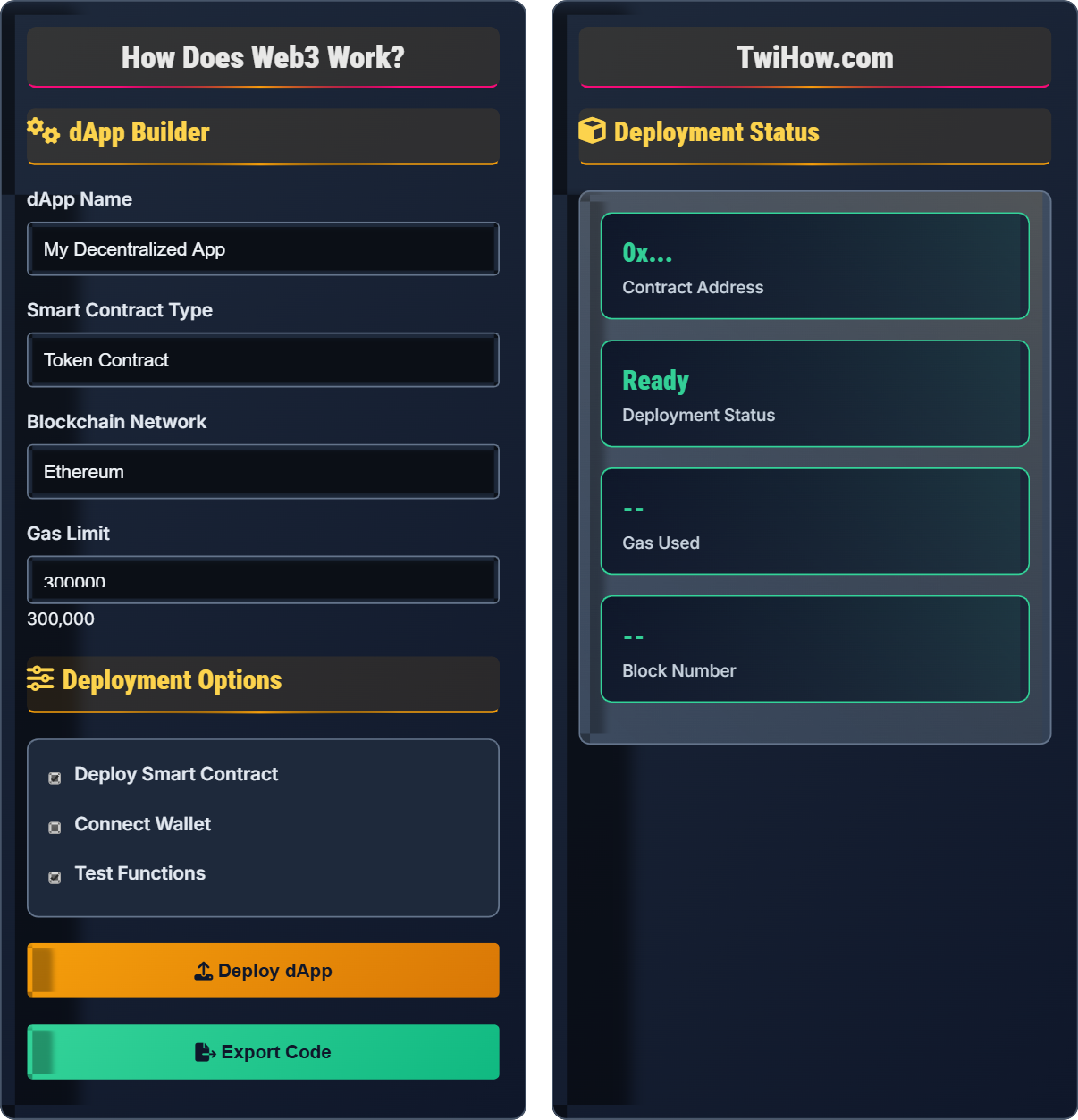
dApp Builder
Deployment Options
Deployment Status
Web3 Core Concepts
Web3 eliminates the need for centralized authorities by distributing data and control across a network of nodes. Instead of relying on servers owned by companies like Google or Facebook, Web3 applications run on peer-to-peer networks.
Benefits: Censorship resistance, data ownership, reduced single points of failure.
Smart contracts are self-executing contracts with terms directly written into code. They automatically execute when predetermined conditions are met, eliminating the need for intermediaries.
Features: Trustless execution, transparency, immutability, automation.
\( \text{Smart Contract} = \text{Code} + \text{Storage} + \text{Execution} \)
Cryptocurrencies and tokens enable programmable money and digital assets. They facilitate transactions, governance, and utility within Web3 ecosystems.
Types: Native cryptocurrencies (ETH, SOL), fungible tokens (ERC-20), non-fungible tokens (NFTs), governance tokens.
Provide access to services or features within a platform. Examples: LINK for Chainlink, UNI for Uniswap.
Uses: Transaction fees, staking, voting rights
Non-fungible tokens represent unique digital assets. Each token has distinct properties and cannot be exchanged one-to-one.
Uses: Digital art, collectibles, gaming items, identity
Provide voting rights in decentralized autonomous organizations (DAOs) and protocol governance.
Uses: Voting on proposals, protocol upgrades, treasury management
Web3 Architecture
In Web3, users interact with decentralized applications (dApps) that connect to blockchain networks. Unlike traditional web apps that store data on centralized servers, dApps store data on the blockchain, giving users control over their information and digital assets.
dApp Interaction Flow
Users connect their cryptocurrency wallet (MetaMask, Phantom) to authenticate and authorize transactions.
Process: Connect wallet → Sign transaction → Execute
Smart contracts execute automatically when conditions are met, updating the blockchain state.
Process: Send transaction → Verify conditions → Execute → Update state
The dApp front-end displays blockchain data and allows users to interact with smart contracts.
Process: Display data → User input → Send transaction
Web3 Applications
Financial services without traditional intermediaries. Includes lending, borrowing, trading, and yield farming.
Examples: Uniswap, Compound, Aave, MakerDAO
Play-to-earn games, virtual worlds, and digital asset ownership. Players truly own their in-game items.
Examples: Axie Infinity, Decentraland, Sandbox
Organizations governed by smart contracts and member voting, without traditional management structures.
Examples: ConstitutionDAO, MakerDAO, Aave Grants
Verifiable credentials, digital collectibles, and proof of ownership for digital and physical assets.
Examples: CryptoPunks, Bored Ape Yacht Club, ENS
Web3 Knowledge Quiz
What is the primary difference between Web2 and Web3?
Web3's primary innovation is decentralization and user ownership of data and digital assets. Unlike Web2, where companies like Facebook and Google control user data, Web3 gives users direct ownership and control over their digital identity and assets.
The answer is B) Web3 emphasizes decentralization and user ownership.
The shift from Web2 to Web3 represents a fundamental change in how the internet operates. Web2 centralized power in large corporations, while Web3 distributes it among users and network participants. This change affects everything from data ownership to how value is created and captured in digital ecosystems.
Web2: Centralized internet with corporate control
Web3: Decentralized internet with user ownership
Decentralization: Distributing control across network
• User ownership is key
• No central authority
• Peer-to-peer interactions
• Think of it as democratizing the internet
• Users control their data
• No single point of failure
• Thinking it's just about speed
• Not understanding ownership concept
• Confusing with specific applications
Explain what smart contracts are, how they work, and provide examples of their applications in Web3.
Definition: Smart contracts are self-executing contracts with terms directly written into code. They automatically execute when predetermined conditions are met.
How They Work: 1) Conditions are programmed into the contract, 2) When conditions are met, the contract executes automatically, 3) The blockchain records the transaction permanently.
Applications:
• DeFi: Lending/borrowing protocols, automated market makers
• NFTs: Minting, trading, royalty distribution
• Gaming: Item ownership, in-game economy
• DAOs: Governance voting, treasury management
Benefits: Trustless execution, transparency, automation, reduced costs.
Smart contracts eliminate the need for intermediaries by embedding trust into code. They represent programmable money and agreements that execute automatically, opening possibilities for financial services, digital ownership, and decentralized governance that were impossible before blockchain technology.
Smart Contract: Self-executing contract on blockchain
Trustless: No need to trust third parties
Programmable Money: Currency with embedded logic
• Code is law in smart contracts
• Cannot be changed once deployed
• Must be thoroughly tested
• Start simple and test thoroughly
• Use formal verification
• Consider edge cases
• Not testing edge cases
• Ignoring gas costs
• Not considering security
You're building a decentralized marketplace where users can buy and sell digital art NFTs. Design the architecture of this dApp, including the frontend, smart contracts, and user interactions. Explain how users would list items, make purchases, and how royalties would be handled.
Architecture Components:
• Frontend: React/Vue.js app connecting to wallet
• Smart Contracts: Marketplace contract, NFT contract
• Storage: IPFS for artwork, blockchain for metadata
User Interactions:
1. List Item: User approves NFT transfer, lists on marketplace with price
2. Purchase: Buyer sends payment, contract transfers NFT and funds
3. Royalties: Smart contract automatically pays artist percentage
Smart Contract Functions:
• listItem(tokenId, price)
• purchaseItem(tokenId, price)
• payRoyalty(artistAddress, amount)
Benefits: No platform fees, direct artist-to-buyer, automated royalties.
This example demonstrates how Web3 enables new business models. Traditional marketplaces take fees and control the ecosystem. A decentralized marketplace removes intermediaries, reduces costs, and ensures artists receive royalties automatically through smart contracts.
dApp: Decentralized application
NFT: Non-fungible token
Royalties: Ongoing payments to creators
• Decentralize where possible
• Automate through contracts
• Consider user experience
• Use existing standards (ERC-721)
• Optimize gas costs
• Provide good UX
• Complex smart contracts
• Ignoring gas costs
• Poor user experience
Design a decentralized lending protocol where users can deposit crypto as collateral and borrow other assets. Explain the risk management, liquidation mechanisms, and governance features that would be essential for such a system.
Protocol Design:
• Collateral deposits in smart contracts
• Borrow against collateral up to loan-to-value ratio
• Interest rates adjust based on utilization
Risk Management:
• Loan-to-value ratios (e.g., 75% max)
• Liquidation thresholds (e.g., liquidate at 80% LTV)
• Oracle feeds for real-time prices
Liquidation Mechanism:
• When collateral value drops below threshold
• Liquidators repay loan, receive collateral
• Penalty fee incentivizes liquidation
Governance:
• Token holders vote on parameters
• Emergency pause functionality
• Parameter adjustments over time
Benefits: Permissionless lending, transparent rates, automated operations.
This demonstrates how DeFi protocols recreate traditional banking services without intermediaries. Smart contracts handle risk management and liquidation automatically, while governance tokens allow the community to manage the protocol. This shows the power of programmable finance in Web3.
Loan-to-Value: Ratio of loan to collateral value
Oracle: Data feed for real-world prices
Liquidation: Forcible sale of collateral
• Overcollateralization required
• Price oracle security
• Governance for emergencies
• Use multiple oracles
• Conservative parameters
• Emergency functions
• Inadequate liquidation mechanisms
• Oracle manipulation
• No emergency controls
Which of the following is NOT a current limitation of Web3 technology?
User-friendly interfaces are actually a challenge for Web3 adoption. Current Web3 interfaces are often complex and difficult for non-technical users. High gas costs, slow speeds, and scalability issues are all legitimate current limitations that the industry is working to solve.
The answer is C) User-friendly interfaces.
Understanding both strengths and limitations is crucial for realistic Web3 adoption. While the technology offers significant benefits like decentralization and user ownership, challenges remain in usability, scalability, and cost that must be addressed for mainstream adoption.
Gas Costs: Fees for blockchain transactions
Scalability: Ability to handle growing usageUsability: Ease of use for average users
• Acknowledge current limitations
• Consider use case appropriateness
• Balance benefits with challenges
• Layer 2 solutions for scaling
• Improve user experience
• Consider gas costs
• Overestimating current capabilities
• Ignoring user experience
• Not considering limitations
FAQ
Q: Do I need cryptocurrency to use Web3 applications?
A: Yes, most Web3 applications require cryptocurrency for transactions. You need native tokens (like ETH for Ethereum) to pay for gas fees (transaction costs) and interact with smart contracts. Some dApps are experimenting with gasless transactions, but cryptocurrency remains essential for most Web3 interactions.
Q: Is Web3 secure compared to traditional web applications?
A: Web3 offers different security models than traditional web apps. Blockchain provides immutability and transparency, but introduces new attack vectors like smart contract bugs and private key management. Web3 is more secure against centralized attacks but requires users to manage their own security (private keys). The security model shifts from trusting institutions to trusting mathematics and code.