What is the Metaverse?
Complete guide • Virtual worlds • VR/AR • Digital identity
Metaverse Fundamentals:
Enter Virtual WorldThe metaverse is a collective virtual shared space that combines physical reality with digital virtual worlds. It's an immersive, persistent, synchronous environment where users can interact, work, play, and socialize through avatars.
Key metaverse components:
- Virtual Reality: Immersive 3D environments
- Augmented Reality: Overlaying digital content on real world
- Digital Identity: Persistent virtual personas
- Virtual Economy: Digital assets and currencies
- Social Interaction: Real-time communication
The metaverse represents the next evolution of the internet, blending physical and digital realities into unified experiences.
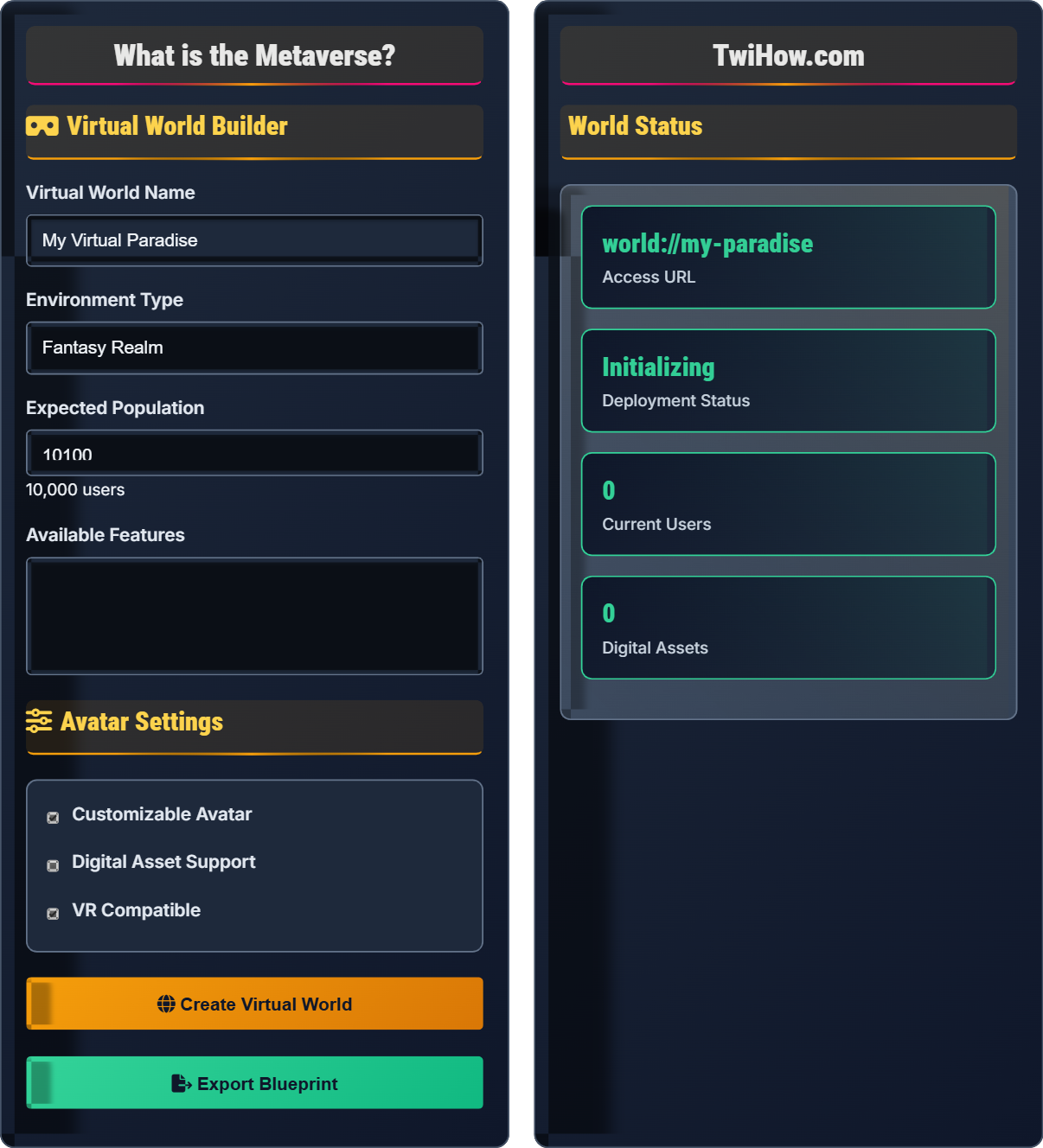
Virtual World Builder
Avatar Settings
World Status
Metaverse Core Concepts
Major Metaverse Platforms
Blockchain-based virtual world where users own digital land and create experiences. Built on Ethereum blockchain.
Features: User-generated content, virtual real estate, DAO governance
Game creation platform where users can build, own, and monetize their gaming experiences in a virtual world.
Features: Game creation tools, NFT integration, play-to-earn
Facebook's vision of the metaverse with VR headsets and social virtual experiences.
Features: Social VR, Horizon Worlds, VR meetings
User-generated virtual worlds platform with a thriving economy and social features.
Features: User creation, Robux currency, cross-platform play
Metaverse Architecture
The metaverse connects users, virtual worlds, digital assets, and social interactions through a network of interoperable platforms. Users access virtual worlds through various devices (VR headsets, smartphones, computers) and interact with persistent avatars and digital assets.
Real-World Applications
Immersive learning experiences, virtual classrooms, and hands-on training in safe digital environments.
Examples: Medical training, historical recreations, language learning
Virtual offices, collaborative workspaces, and immersive meeting experiences that transcend physical boundaries.
Benefits: Reduced travel, enhanced collaboration, immersive presentations
Immersive shopping experiences, virtual showrooms, and try-on experiences for digital and physical products.
Features: Virtual fitting rooms, product demonstrations, social shopping
Concerts, gaming, social gatherings, and entertainment experiences in virtual environments.
Examples: Virtual concerts, gaming tournaments, social hangouts
Metaverse Knowledge Quiz
What is the primary characteristic that distinguishes the metaverse from traditional online games or social platforms?
The metaverse is distinguished by its persistent virtual identity and economy. Unlike traditional games where progress resets, the metaverse maintains persistent avatars, digital assets, and economic value that can transfer between experiences and platforms.
The answer is B) Persistent virtual identity and economy.
The metaverse represents a shift from discrete digital experiences to a persistent, interconnected virtual world. While games and social platforms exist, the metaverse aims to create a unified digital realm where identity, assets, and relationships persist across different virtual environments.
Metaverse: Persistent virtual shared space
Persistence: Continues to exist when users leave
Interoperability: Assets/identity move between platforms
• Identity persists across sessions
• Assets have real value
• Cross-platform compatibility
• Think of it as a digital parallel universe
• Assets and identity follow you
• Real economic value
• Confusing with single games
• Thinking it's just VR
• Not understanding persistence
Explain the role of NFTs and digital assets in the metaverse, and how they differ from traditional in-game items.
NFTs in Metaverse: NFTs (Non-Fungible Tokens) represent unique digital assets that users truly own and can transfer between different metaverse platforms. They provide proof of ownership, scarcity, and authenticity.
Differences from Traditional Items:
• Ownership: NFTs provide true ownership; traditional items are licensed
• Transferability: NFTs can move between platforms; traditional items are locked in one game
• Value: NFTs have real market value; traditional items are game-specific
• Interoperability: NFTs work across metaverse platforms; traditional items are siloed
Applications: Virtual real estate, avatar wearables, gaming items, digital art, collectibles.
Digital assets in the metaverse represent a fundamental shift from platform-owned items to user-owned assets. This creates a true digital economy where users can invest in and profit from their virtual possessions, unlike traditional games where items disappear when the game ends.
NFT: Non-fungible token proving ownership
Digital Asset: Any item with value in virtual world
Interoperability: Moving assets between platforms
• True ownership vs licensing
• Cross-platform transfer
• Real market value
• Research before purchasing
• Consider utility and rarity
• Check platform compatibility
• Confusing with traditional game items
• Not researching platform support
• Overvaluing without utility
You're designing a metaverse platform where users can buy virtual real estate and develop it into commercial spaces. Users can rent out their spaces to other users for virtual events. Design the economic model, including how users earn income, how value is determined, and what mechanisms ensure the economy remains stable.
Economic Model:
• Land Purchase: Users buy virtual land with platform currency/NFT
• Development: Invest in building structures and amenities
• Renting: Set rental rates based on location, amenities, demand
• Event Revenue: Share of ticket sales from events held on property
Value Determination:
• Location (proximity to popular areas)
• Development quality and amenities
• Rental history and occupancy rates
• Scarcity and total land supply
Stability Mechanisms:
• Maximum land supply to prevent inflation
• Transaction fees to maintain platform health
• Anti-speculation measures (vacancy taxes)
• Governance tokens for economic decisions
Benefits: Creates real economic opportunities and investment potential.
This example demonstrates how the metaverse can create real economic opportunities. The key is creating a balanced economy where earning potential attracts users while maintaining stability through supply controls and governance mechanisms.
Virtual Real Estate: Digital land with ownership rights
Play-to-Earn: Earning real value through gameplay
Economic Stability: Maintaining value and preventing inflation
• Limited supply prevents inflation
• Multiple revenue streams
• Governance for stability
• Consider location and utility
• Plan for long-term value
• Diversify revenue streams
• Unlimited supply causing inflation
• No real utility for assets
• Poor governance mechanisms
Design a metaverse platform that focuses on social interaction and community building. How would you ensure users can maintain friendships across different virtual experiences, create lasting communities, and prevent toxic behavior while maintaining freedom of expression?
Social Infrastructure:
• Unified Identity: Persistent avatar and friend list across all experiences
• Community Spaces: Dedicated areas for groups and clubs
• Activity Feed: See friends' activities across different worlds
• Private Rooms: Invite-only spaces for close friends
Community Building:
• Group creation tools and management
• Shared goals and collaborative projects
• Reputation systems for positive contributors
• Community events and challenges
Behavior Management:
• User reporting and moderation tools
• Reputation penalties for toxic behavior
• Private blocking and filtering options
• Community self-governance features
Balance: Freedom of expression while maintaining safe spaces.
Social interaction is the heart of the metaverse. The challenge is creating persistent relationships across different virtual experiences while maintaining safety and positive community culture. This requires thoughtful design of social tools and governance mechanisms.
Persistent Identity: Avatar/experience continues across sessions
Community Governance: Users participate in platform decisions
Social Capital: Value of relationships and reputation
• Identity persists across experiences
• Communities self-govern
• Balance freedom with safety
• Enable cross-world friendships
• Reward positive behavior
• Give users control over experience
• Siloed social experiences
• No community governance
• Poor moderation systems
Which of the following is NOT a current technical challenge facing metaverse development?
While storage capacity is a consideration, "infinite storage capacity" is not a practical requirement or current challenge for metaverse development. The actual challenges include rendering high-quality graphics, creating seamless cross-platform experiences, and simulating realistic physics. Storage can be scaled through distributed systems and cloud computing.
The answer is D) Achieving infinite storage capacity.
Understanding real technical challenges versus misconceptions is important. While the metaverse requires significant computing resources, the challenges are more about efficiency, interoperability, and user experience than achieving impossible technical goals.
Real-time Rendering: Generating graphics instantly
Cross-platform: Working across different devices/systems
Physics Simulation: Realistic movement and interactions
• Focus on real technical challenges
• Consider user experience
• Balance performance with quality
• Optimize for target devices
• Plan for scalability
• Test cross-platform compatibility
• Over-engineering solutions
• Ignoring user experience
• Not planning for scale
FAQ
Q: Do I need expensive VR equipment to access the metaverse?
A: Not necessarily! While VR headsets provide the most immersive experience, many metaverse platforms are accessible through smartphones, tablets, and computers. The metaverse is designed to be accessible across different devices, with VR being just one way to experience it. You can enter virtual worlds through apps or web browsers without expensive equipment.
Q: Is the metaverse just a gaming concept or does it have practical applications?
A: The metaverse has numerous practical applications beyond gaming, including remote work, education, virtual commerce, social interaction, and creative expression. Companies are using virtual spaces for meetings, training, product demonstrations, and customer experiences. The metaverse represents the next evolution of the internet, not just a gaming platform.