How to Monetize an App?
Complete guide • App revenue strategies
App Monetization Fundamentals:
Revenue CalculatorApp monetization involves implementing strategies to generate revenue from mobile and web applications. This includes various models like freemium, subscriptions, in-app purchases, advertising, and premium features. Successful monetization requires balancing user experience with revenue generation to create sustainable income streams.
Popular monetization models include:
- Freemium: Free basic app with premium features
- Subscription: Recurring payments for ongoing access
- In-App Purchases: One-time purchases for content/features
- Advertising: Revenue from ad impressions and clicks
- Premium: One-time purchase for full access
- Pay-Per-Download: Initial payment for app access
Choosing the right monetization strategy depends on app type, user behavior, and market conditions.
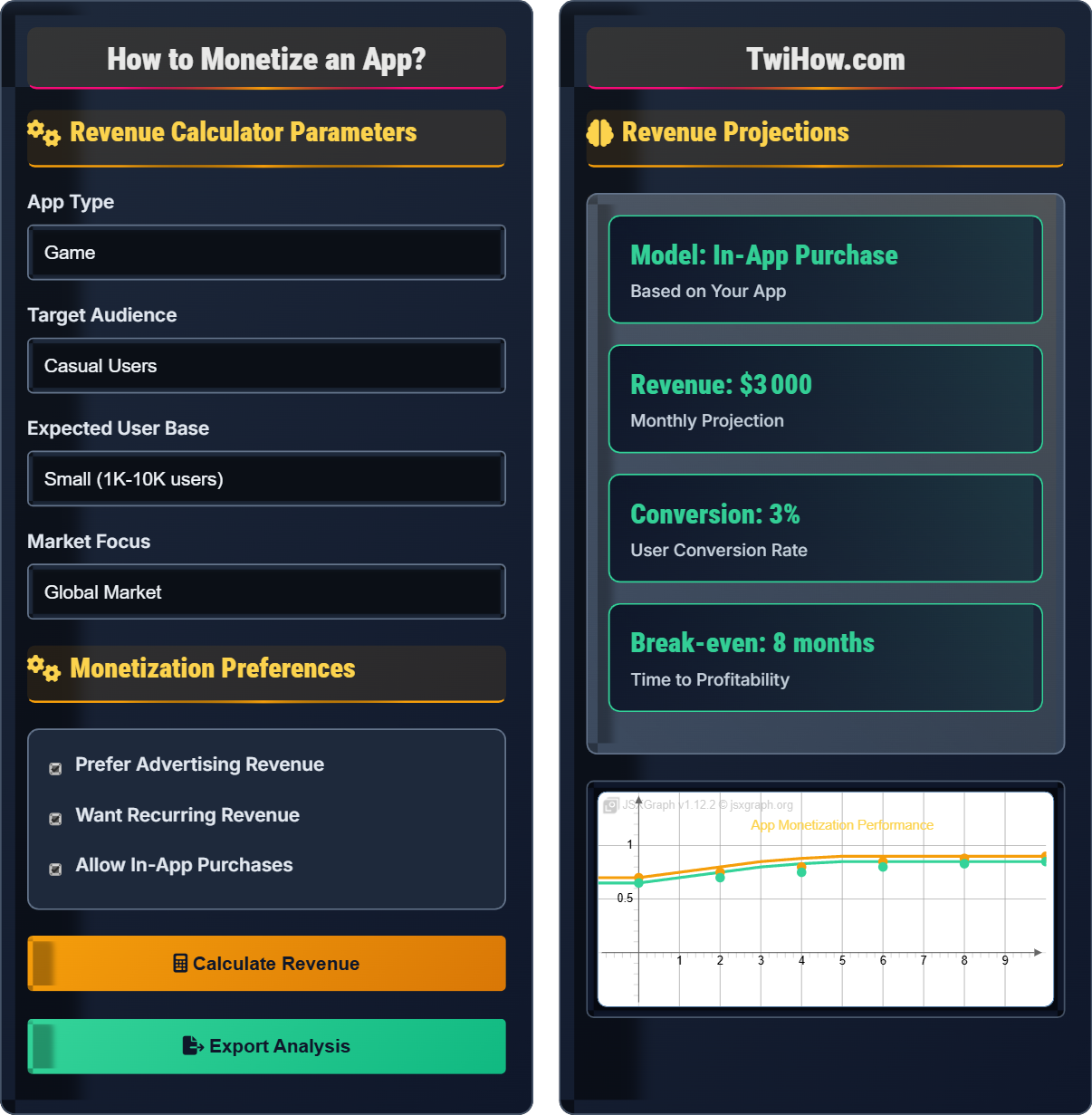
Revenue Calculator Parameters
Monetization Preferences
Revenue Projections
Downloads
Active Users
Engagement
Revenue
Freemium Model Example:
Basic Features: Free (100% of users)
Premium Features: $4.99/month (2.3% conversion)
Ad Revenue: $0.02 per view (50% of users)
Revenue Calculation: (100,000 users × 2.3% × $4.99) + (50,000 views × $0.02) = $12,497
Freemium model balances free access with premium features
Complete Guide to App Monetization
App monetization is the process of generating revenue from mobile and web applications. This involves implementing various strategies to convert app users into paying customers or revenue sources. Successful monetization requires understanding user behavior, market dynamics, and balancing user experience with revenue generation.
• Upfront payment required
• Immediate revenue
• Limited market reach
• Higher perceived value
• No ongoing revenue
• Lower user base
• Free basic access
• Premium features locked
• Larger user base
• Recurring revenue potential
• Higher conversion rates
• Better user retention
Choose the model that best fits your app type and target audience.
Freemium
Spotify, LinkedIn, Dropbox
Subscription
Netflix, Adobe Creative Cloud
In-App Purchase
Games, Tinder Gold
Advertising
Facebook, YouTube
Licensing
Microsoft Office, Adobe
Hybrid
Uber, Airbnb
Where ARPU represents the average amount spent per user. This formula helps predict revenue potential and optimize monetization strategies.
- Active Users: Monthly active users (MAU)
- Conversion Rate: Percentage of users who pay
- ARPU: Average revenue per user
- Ad Revenue: Revenue from advertising
Monetization Models
Freemium, subscription, in-app purchase, advertising, premium, hybrid models.
- Basic features free
- Premium features paid
- High user acquisition
- Conversion 2-5%
- Recurring payments
- Predictable revenue
- Higher lifetime value
- Retention critical
- One-time payments
- Virtual goods
- High margins
- Gaming focus
- Ad revenue
- High user base
- Lower ARPU
- User experience
- Match model to app type
- Consider user behavior
- Test different approaches
- Monitor conversion rates
Revenue Optimization
Conversion rate optimization, pricing strategy, user experience, retention tactics.
Revenue mix: 40% premium, 35% ads, 25% in-app purchases
- Continuously test pricing
- Improve user experience
- Optimize ad placement
- Focus on retention
App Monetization Assessment
Which monetization model is most suitable for a productivity app that provides ongoing value through premium features?
A freemium model with subscription is most suitable for productivity apps. This approach allows users to experience the core functionality for free while charging for premium features that provide ongoing value. The subscription model creates predictable revenue streams and encourages long-term user engagement.
The answer is B) Freemium with subscription.
Productivity apps benefit from freemium models because users need to experience the value proposition before paying. The subscription component provides ongoing value through premium features like advanced analytics, automation, or enhanced functionality. This model aligns with the ongoing nature of productivity needs.
Freemium: Free basic service with paid premium features
Subscription: Recurring payment model
ARPU: Average Revenue Per User
• Match model to app type
• Consider user behavior
• Test conversion rates
• Start with freemium to build user base
• Offer clear value in premium features
• Test pricing tiers regularly
• Charging for basic features
• Not providing enough free value
• Poor premium feature differentiation
Explain the best practices for implementing advertising in mobile apps without negatively impacting user experience.
Best Practices for App Advertising:
• Non-Intrusive Placement: Use rewarded videos, native ads, or banner placements that don't interrupt user flow
• Frequency Capping: Limit ad exposure to prevent user fatigue and app abandonment
• Relevant Content: Target ads to user interests and behavior patterns
• Timing Consideration: Show ads at natural breaks in user activity
• Quality Control: Block low-quality or inappropriate ad content
• User Control: Allow users to skip ads or choose ad-free options
• Performance Optimization: Ensure ads don't slow down app performance
• Transparency: Clearly indicate sponsored content
Ad Placement Strategies:
• Between levels in games
• At natural pause points
• In scroll feeds
• As optional rewards
These practices maximize revenue while maintaining user satisfaction.
Successful advertising in apps requires balancing revenue generation with user experience. Intrusive ads lead to user churn, while well-placed ads can enhance the experience (like rewarded videos that provide in-game currency). The key is understanding user behavior patterns and placing ads at moments when users are most receptive.
Frequency Capping: Limiting ad exposure
Rewarded Video: Optional ads with user benefits
Native Ads: Ads that blend with content
• User experience first
• Quality over quantity
• Respect user choice
• Use rewarded video ads
• Test different ad formats
• Monitor user retention
• Interrupting user flow
• Showing too many ads
• Not respecting user preferences
A mobile game developer wants to implement a monetization strategy for a puzzle game. The game has high retention but low session length. Design a monetization approach that maximizes revenue while maintaining user engagement.
Recommended Strategy: Hybrid Model
1. Freemium Core:
• Free gameplay with limited daily puzzles
• Premium subscription for unlimited puzzles
• Special puzzle packs for purchase
2. In-App Purchases:
• Hint packs ($0.99-$2.99)
• Extra lives ($0.99)
• Cosmetic items ($0.99-$4.99)
3. Advertising:
• Rewarded videos for extra hints
• Banner ads in menus
• Interstitial ads between levels
4. Subscription Model:
• Monthly subscription ($4.99) for premium features
• Ad-free experience
• Exclusive puzzle packs
Implementation Strategy:
• Focus on rewarded ads for hints
• Offer affordable IAPs for immediate gratification
• Use subscription for committed players
• A/B test different pricing tiers
This approach leverages high retention while providing multiple revenue streams.
For puzzle games with high retention, the key is to monetize through the user's desire to continue playing. Rewarded videos provide value (hints) while generating ad revenue. In-app purchases satisfy immediate needs, while subscriptions appeal to committed players. The hybrid approach ensures revenue from different user segments.
Hybrid Model: Multiple monetization strategies
ARPPU: Average Revenue Per Paying User
Retention: Users returning to app
• Match monetization to gameplay
• Diversify revenue streams
• Use psychology of urgency
• Offer value in IAPs
• Test pricing regularly
• Being too aggressive with ads
• Not testing different approaches
An app has 100,000 monthly active users with a 2% conversion rate to paid subscriptions at $9.99/month. The app experiences 20% monthly churn. Calculate the current annual revenue and propose strategies to improve retention and revenue.
Current Revenue Calculation:
• Monthly Active Users: 100,000
• Conversion Rate: 2% (2,000 subscribers)
• Monthly Revenue: 2,000 × $9.99 = $19,980
• Annual Revenue: $19,980 × 12 = $239,760
With 20% monthly churn:
• Average subscriber lifetime: 1/0.20 = 5 months
• Lifetime value: $9.99 × 5 = $49.95
Optimization Strategies:
• Reduce Churn (to 10%): Improved onboarding, value communication, user engagement
• Extend Lifetime: Add new features, content updates, loyalty programs
• Price Optimization: Test different pricing tiers and bundles
• Conversion Improvement: Better free trial experience, clearer value proposition
• Upselling: Premium features, family plans, annual discounts
Improved Scenario:
• Churn: 10% → Lifetime: 10 months
• LTV: $99.90 → Annual Revenue: ~$400,000
These strategies could double revenue with better retention.
Subscription revenue depends heavily on retention. A 20% monthly churn means losing 20% of subscribers each month, severely limiting lifetime value. Reducing churn has exponential effects on revenue. The key metrics are conversion rate, churn rate, and average revenue per user. Improving any of these can significantly impact overall revenue.
LTV: Lifetime Value of customer
Churn Rate: Percentage of users who cancel
ARPU: Average Revenue Per User
• Retention is crucial for subscriptions
• Small improvements in churn have big impacts
• Focus on value delivery
• Monitor churn reasons
• Implement win-back campaigns
• Focus on onboarding experience
• Not focusing on retention
• Ignoring churn reasons
• Not testing pricing tiers
Which monetization model is showing the strongest growth in mobile apps according to recent market trends?
The subscription model is showing the strongest growth in mobile apps. This model provides predictable revenue streams, higher lifetime value, and better user engagement. Subscription-based apps are seeing rapid growth across all categories, from productivity to entertainment, as they create ongoing relationships with users.
The answer is B) Subscription model.
The subscription model is preferred by investors and developers because it provides recurring revenue and better financial predictability. Users are increasingly comfortable with subscription models, especially for apps that provide ongoing value. The model also encourages continuous app improvement to retain subscribers, leading to better products.
Subscription: Recurring payment model
LTV: Lifetime Value of customer
Recurring Revenue: Predictable income stream
• Focus on retention
• Deliver ongoing value
• Test pricing regularly
• Start with freemium to build base
• Offer value in every update
• Implement free trials
• Not focusing on retention
• Poor onboarding experience
• Not delivering promised value
Revenue Timeline
Launch Phase (Month 1-2)
Initial downloads, low revenue, focus on user acquisition and retention.
Growth Phase (Month 3-6)
Increasing user base, early monetization experiments, revenue scaling.
Optimization Phase (Month 7-12)
Refining monetization strategies, improving conversion rates, maximizing revenue.
Mature Phase (Month 12+)
Established revenue streams, focus on retention and expansion.
FAQ
Q: What's the best monetization strategy for a new app with no user base?
A: For new apps, start with freemium model:
Initial Strategy:
• Free app with basic functionality
• Premium features locked behind subscription
• Focus on user acquisition and retention first
• Gradually introduce monetization elements
Why Freemium:
• Lower barrier to entry
• Allows users to experience value
• Builds larger user base for conversion
• Provides data on user behavior
Timing:
• Monetization after achieving 10% DAU/MAU ratio
• Focus on retention before revenue
• Test monetization with engaged users first
Build value first, then monetize the value created.
Q: How do I calculate the optimal pricing for app monetization?
A: Optimal pricing calculation:
Market Research:
• Analyze competitor pricing
• Survey target audience
• Consider regional purchasing power
Pricing Formulas:
• Value-Based Pricing: (Value delivered × 0.1-0.3)
• Competitive Pricing: 80-120% of competitor rates
• Cost-Plus Pricing: (Cost × 1.5-3) + value
Testing Strategy:
• A/B test different price points
• Monitor conversion rates
• Track user feedback
• Test willingness to pay
Optimization:
• Start with competitive pricing
• Adjust based on conversion data
• Consider psychological pricing
• Test different pricing tiers
Regular testing and adjustment is key to finding optimal pricing.