How do I develop leadership skills at any career stage?
Complete leadership development guide • Career progression
Leadership Development:
Show Leadership AnalyzerDeveloping leadership skills is essential for career advancement at any stage. Leadership is not just about managing people; it's about inspiring, influencing, and enabling others to achieve common goals. Effective leadership skills include communication, emotional intelligence, decision-making, and the ability to motivate and guide teams toward success.
Leadership development is a continuous journey that requires self-awareness, practice, and learning from experience. Whether you're an entry-level professional or a senior executive, leadership skills can be cultivated through deliberate practice, mentorship, and strategic learning.
Key leadership elements:
- Communication: Clear, empathetic, and persuasive communication
- Emotional Intelligence: Understanding and managing emotions
- Decision-Making: Critical thinking and problem-solving
- Inspiration: Motivating and empowering others
Modern leadership emphasizes collaboration, adaptability, and the ability to navigate complex, changing environments while maintaining team engagement and performance.
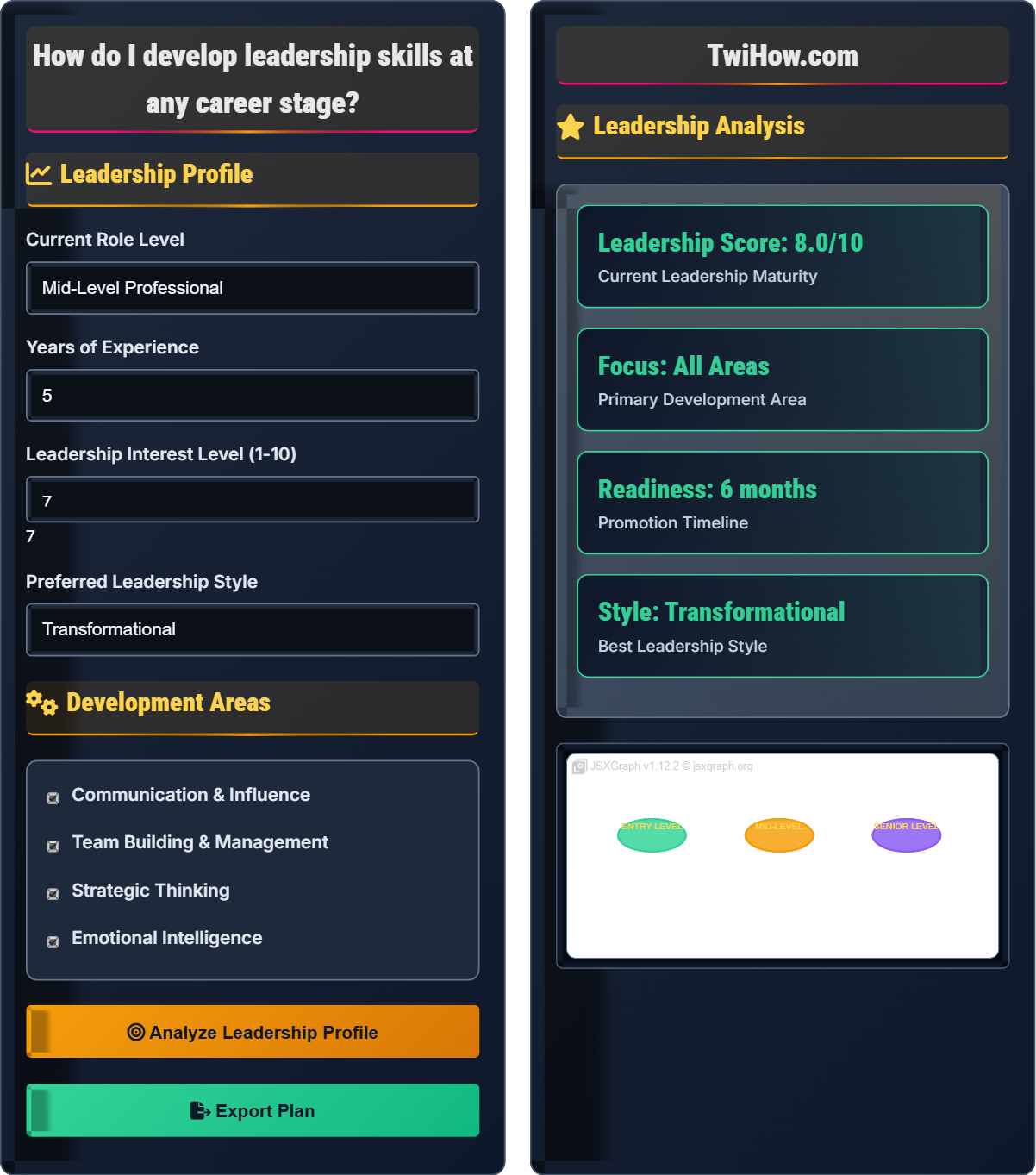
Leadership Profile
Development Areas
Leadership Analysis
| Skill | Current Level | Target Level | Development Plan |
|---|---|---|---|
| Communication | 6/10 | 8/10 | Public speaking course, feedback sessions |
| Decision Making | 7/10 | 8/10 | Case study analysis, mentorship |
| Emotional Intelligence | 5/10 | 7/10 | EQ training, self-reflection exercises |
| Strategic Thinking | 6/10 | 8/10 | Business strategy course, industry reading |
Leadership Development at Every Career Stage
Leadership development is the systematic process of enhancing leadership capabilities, skills, and competencies through learning, practice, and experience. It involves building emotional intelligence, communication skills, decision-making abilities, and the capacity to inspire and guide others toward achieving organizational goals.
Leadership development formula:
Where:
- Self-Awareness: Understanding personal strengths and weaknesses
- Communication: Ability to convey ideas and influence others
- Emotional Intelligence: Managing emotions and relationships
- Strategic Thinking: Vision and long-term planning capabilities
- Experience Factor: Learning from real-world situations
Leadership approaches that work best at different career levels:
- Entry Level: Coaching, servant leadership (focus on learning and development)
- Mid-Level: Transformational, situational leadership (balance between managing and leading)
- Senior Level: Strategic, visionary leadership (long-term planning and direction)
- Executive Level: Authentic, adaptive leadership (organizational transformation)
- Seek Feedback: Regularly ask for input on your performance
- Find Mentors: Connect with experienced leaders
- Take Initiative: Volunteer for leadership opportunities
- Develop Soft Skills: Focus on emotional intelligence and communication
- Continuous Learning: Pursue formal and informal education
- Build Networks: Cultivate professional relationships
Leadership Fundamentals
Leadership, management, emotional intelligence, communication, decision-making, strategic thinking, influence, delegation.
Leadership Impact = (Communication + Influence + Decision-Making) × Experience × Situational Awareness
Where Leadership Impact = effectiveness of leadership, Communication = ability to convey vision, Influence = ability to motivate others.
- Lead by example
- Listen more than you speak
- Adapt to your audience
Applications
Team management, project leadership, department heads, cross-functional initiatives, organizational change, mentorship.
- Assess current leadership skills
- Identify development areas
- Set specific goals
- Practice new skills
- Seek feedback regularly
- Personality fit
- Organizational culture
- Industry requirements
- Team dynamics
Leadership Development Learning Quiz
Which leadership style is most effective for developing junior team members?
The correct answer is B) Coaching leadership. Coaching leadership is most effective for developing junior team members because it focuses on nurturing growth, providing guidance, and building skills. This style involves active listening, asking powerful questions, providing feedback, and creating development opportunities. Coaching leaders invest in their team members' growth, which builds loyalty and enhances performance over time.
While other styles have their place, coaching is particularly valuable for junior employees who need support, guidance, and skill development.
Leadership styles should be matched to the development level of team members. Junior employees typically require more guidance, support, and skill-building than senior employees. The coaching style provides structure while encouraging growth. It balances directive guidance with supportive encouragement, which is ideal for developing competence and confidence. This approach helps junior employees build foundational skills while feeling supported in their professional growth journey.
Coaching Leadership: Style focused on developing others
Directive Guidance: Clear instructions and expectations
Supportive Encouragement: Emotional support and motivation
• Match style to development level
• Focus on growth
• Provide feedback regularly
• Ask open-ended questions
• Listen actively
• Set stretch goals
• Using same style for everyone
• Not providing development opportunities
• Micromanaging
Explain the importance of emotional intelligence in leadership and describe how to develop it.
Importance of Emotional Intelligence: Emotional intelligence (EI) is crucial for leadership because it enables leaders to understand and manage their own emotions while recognizing and influencing others' emotions. Leaders with high EI build stronger relationships, communicate more effectively, and create positive work environments.
Components of EI:
Self-Awareness: Understanding your emotions, strengths, and weaknesses.
Self-Regulation: Managing your emotions and impulses appropriately.
Motivation: Being driven by internal goals rather than external rewards.
Empathy: Understanding others' emotions and perspectives.
Social Skills: Managing relationships and building networks effectively.
Development Strategies: Practice mindfulness meditation, seek feedback, keep a journal, engage in active listening exercises, and participate in EI training programs.
Emotional intelligence is often more important than technical skills in leadership roles. It's the ability to perceive, understand, and manage emotions effectively. Leaders with high EI create psychological safety, foster collaboration, and build trust with their teams. Developing EI requires self-reflection and practice. It's a skill that can be cultivated over time through deliberate effort and feedback.
Emotional Intelligence: Ability to understand and manage emotions
Psychological Safety: Feeling comfortable taking risks
Self-Regulation: Managing emotional responses
• Practice self-awareness
• Manage your reactions
• Show empathy
• Pause before reacting
• Ask how others feel
• Practice active listening
• Suppressing emotions
• Not considering others' feelings
• Reacting impulsively
You're a mid-level manager and your company is implementing a new technology system that many team members are resistant to. Some employees are vocal about their concerns, while others are quietly disengaged. How would you approach this situation to lead your team through the change?
Assessment: Recognize that resistance is normal during change and often stems from fear of the unknown or concerns about job security.
Communication Strategy: Hold team meetings to explain the rationale for the change, address concerns directly, and provide clear information about the timeline and benefits.
Engagement Approach: Identify early adopters and champions to help influence others. Provide training and support to help team members develop necessary skills.
Support System: Create feedback channels, offer one-on-one meetings for concerns, and celebrate small wins during the transition.
Monitoring: Track adoption rates, gather feedback, and adjust support as needed. Address any ongoing resistance through coaching conversations.
This approach combines transparency, empathy, and structured support to guide the team through the change.
Change leadership requires understanding the psychology of change. People go through predictable stages when facing change (denial, resistance, exploration, commitment). Effective leaders meet people where they are in their change journey. The key is to acknowledge concerns while maintaining focus on the benefits. Providing multiple communication channels and support systems helps accommodate different learning styles and comfort levels with change.
Change Management: Process of guiding organizational change
Resistance to Change: Natural human reaction to new processes
Change Champions: Early adopters who support change
• Communicate early and often
• Address concerns directly
• Provide support systems
• Identify change champions
• Offer training and resources
• Celebrate milestones
• Not explaining the "why"
• Ignoring resistance
• Providing insufficient support
You're a senior professional with a team of five direct reports. You've been promoted to a role with increased responsibilities but the same team size. How do you balance your new duties with maintaining team performance? What delegation strategy would you use?
Assessment: Evaluate your new responsibilities and identify tasks that can be delegated based on team members' skills and development goals.
Delegation Strategy: Use situational leadership approach - match task assignment to each team member's competence and commitment level.
High Competence/Low Commitment: Involve them in decision-making to increase buy-in.
Low Competence/High Commitment: Provide specific instructions and close supervision.
High Competence/High Commitment: Delegate with minimal oversight.
Training Plan: Develop team members' skills to handle more complex tasks over time.
Monitoring: Set clear expectations, check progress regularly, and provide feedback.
This approach develops your team while managing your increased workload.
Effective delegation is about matching tasks to people's development level and providing appropriate support. It's not just about offloading work but about developing team members' capabilities. The key is to gradually increase responsibility while providing the necessary support and feedback. This creates a win-win situation where you can focus on higher-level responsibilities while team members grow professionally.
Delegation: Assigning tasks to others
Competence: Ability to perform tasks
Commitment: Willingness to perform tasks
• Match tasks to development level
• Provide clear expectations
• Support without micromanaging
• Start with small tasks
• Provide training
• Give credit for success
• Delegating without support
• Not providing clear instructions
• Taking back delegated tasks
What is the most effective way to develop leadership skills?
The correct answer is D) All of the above combined. Leadership development is most effective when it combines formal learning (training, reading), practical application (real situations), and reflection. Each component supports the others: formal learning provides frameworks, practice builds skills, and reflection creates insights. The combination creates a complete development approach that addresses different learning styles and reinforces concepts through multiple modalities.
Research shows that experiential learning with reflection is the most effective approach for leadership development.
Leadership skills require both knowledge and application. Formal learning provides theoretical frameworks and best practices. Practical experience builds muscle memory and contextual understanding. Reflection helps extract lessons and create insights. The combination creates a complete learning loop that accelerates development. Different people learn differently, so multiple approaches ensure comprehensive development.
Experiential Learning: Learning through experience
Reflection: Thinking critically about experiences
Leadership Development: Building leadership capabilities
• Combine learning methods
• Practice regularly
• Reflect on experiences
• Seek feedback
• Keep a learning journal
• Find a mentor
• Only relying on one method
• Not practicing regularly
• Not seeking feedback
FAQ
Q: How can I develop leadership skills if I don't have direct reports?
A: Leadership isn't defined by having direct reports—it's about influence and impact. You can develop leadership skills by: 1) Leading projects and initiatives, 2) Mentoring newer employees, 3) Volunteering for cross-functional committees, 4) Taking on stretch assignments, 5) Facilitating meetings and workshops, 6) Proposing and driving process improvements, and 7) Serving as a subject matter expert. Look for opportunities to coordinate with others, influence without authority, and drive results. These experiences build leadership capabilities that will prepare you for formal leadership roles when they become available.
Q: What's the difference between management and leadership?
A: Management focuses on maintaining order, systems, and processes, while leadership focuses on inspiring change, innovation, and growth. Managers plan, organize, and control resources to achieve predetermined goals. Leaders envision, influence, and motivate others toward a shared future. Good managers ensure things are done right; good leaders ensure the right things are done. Both are important, but leadership is more critical for innovation and long-term success. The best leaders combine management skills with leadership capabilities.