How do I handle workplace conflict professionally?
Complete conflict resolution guide • Professional skills
Conflict Resolution:
Show Conflict ResolverHandling workplace conflict professionally is a critical skill that separates high-performing professionals from their peers. Effective conflict resolution involves active listening, emotional regulation, and constructive communication. The key is focusing on issues rather than personalities, seeking mutual understanding, and finding solutions that benefit all parties.
Professional conflict resolution enhances workplace relationships, increases productivity, and creates a positive work environment. It demonstrates emotional intelligence and leadership capabilities that are highly valued by employers and colleagues.
Key resolution elements:
- Active Listening: Truly hearing and understanding perspectives
- Empathy: Understanding others' feelings and viewpoints
- Communication: Expressing thoughts clearly and respectfully
- Problem-Solving: Finding mutually beneficial solutions
Modern workplaces require professionals who can navigate disagreements constructively while maintaining relationships and achieving business objectives.
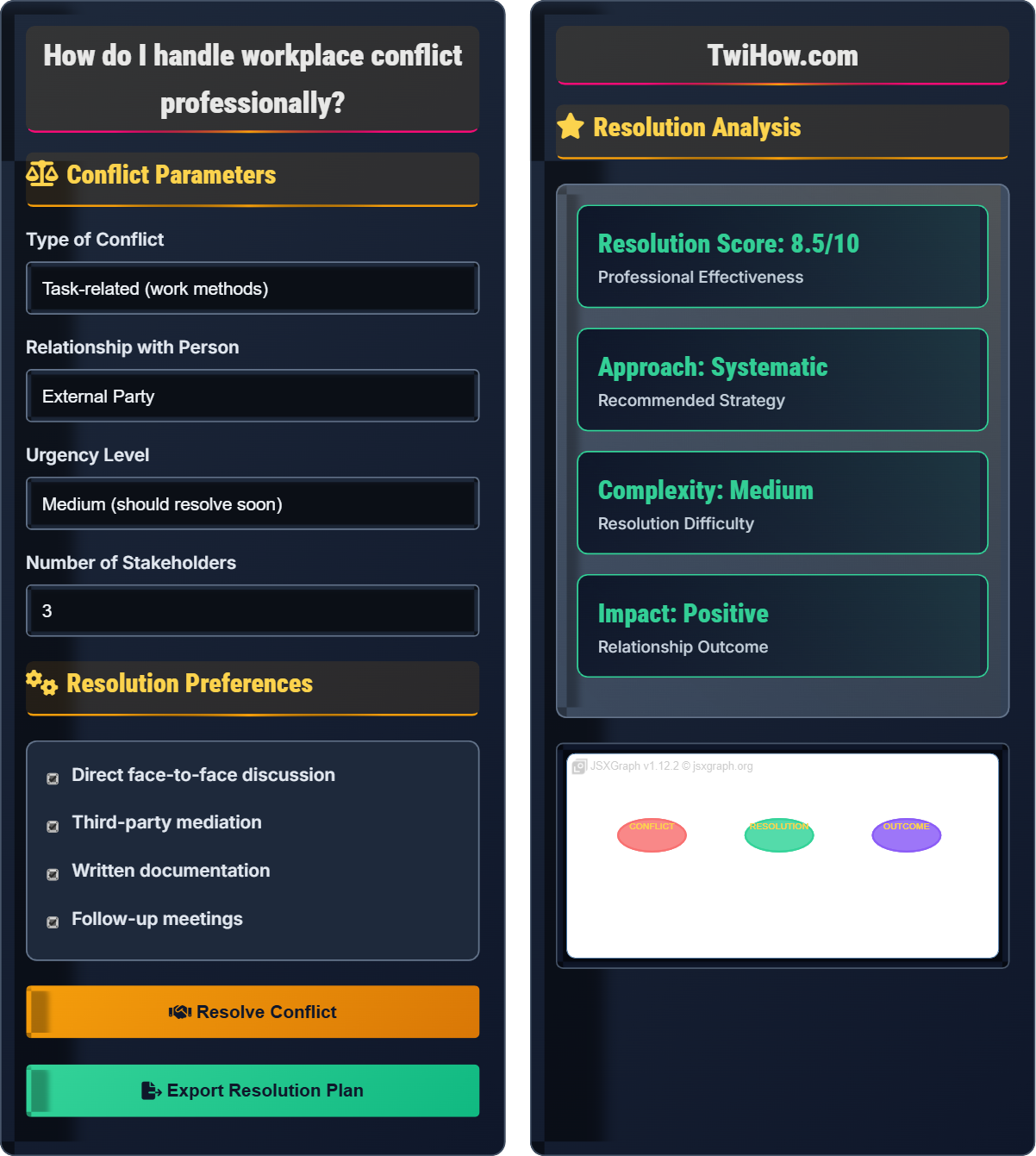
Conflict Parameters
Resolution Preferences
Resolution Analysis
| Step | Action | Priority | Timeline |
|---|---|---|---|
| 1 | Prepare for discussion | High | Today |
| 2 | Schedule private meeting | High | Within 2 days |
| 3 | Listen actively to concerns | Medium | During meeting |
| 4 | Propose solutions | Medium | During meeting |
| 5 | Document agreement | Low | Within 1 week |
Professional Workplace Conflict Resolution
Workplace conflict occurs when individuals or groups have incompatible goals, interests, values, or approaches. Professional conflict resolution involves addressing disagreements constructively while maintaining relationships and achieving business objectives. It requires emotional intelligence, communication skills, and problem-solving abilities.
Professional conflict resolution formula:
Where:
- Listening: Active listening and understanding
- Empathy: Understanding others' perspectives
- Communication: Clear, respectful expression
- Problem-Solving: Finding mutually beneficial solutions
- Timing Factor: Addressing conflict promptly
Professional conflict resolution in action:
- Interdepartmental Dispute: Marketing and Sales disagreeing on campaign strategy
- Resource Allocation: Two teams competing for the same budget
- Work Style Differences: Introvert vs. extrovert communication preferences
- Priority Conflicts: Individual goals vs. team objectives
- Focus on Issues: Address the problem, not the person
- Separate Facts from Feelings: Distinguish between objective facts and emotional reactions
- Seek Mutual Benefit: Look for win-win solutions
- Use "I" Statements: Express your perspective without blaming
- Document Agreements: Put resolutions in writing to prevent misunderstandings
Conflict Resolution Fundamentals
Conflict resolution, workplace communication, emotional intelligence, active listening, problem-solving, professional relationships.
Resolution Success = (Listening + Empathy + Communication + Problem-Solving) / 4 × Timing Factor
Where Resolution Success = effectiveness of conflict resolution, Listening = active listening skills, Empathy = understanding others' perspectives.
- Address conflicts early
- Maintain professionalism
- Focus on solutions
Applications
Team conflicts, manager-employee disputes, client disagreements, interdepartmental issues, project conflicts.
- Identify the root cause
- Prepare for the conversation
- Schedule private meeting
- Listen actively
- Propose solutions
- Power dynamics
- Company policies
- Legal implications
- Relationship preservation
Conflict Resolution Learning Quiz
Which of the following is the most important step when addressing workplace conflict?
The correct answer is B) Identifying the root cause of the conflict. Understanding the underlying issue is crucial for effective resolution. Without identifying the root cause, any solutions attempted will likely be superficial and the conflict may resurface. Root cause analysis helps determine whether the conflict is about work methods, personality differences, miscommunication, or competing priorities.
Once the root cause is understood, appropriate resolution strategies can be selected and implemented effectively.
Root cause identification is fundamental to professional conflict resolution because it addresses the underlying issue rather than just symptoms. This approach prevents recurring conflicts and builds long-term relationship improvements. The key is to separate the surface-level disagreement from the deeper issue that caused it. For example, what appears to be a personality clash might actually be a conflict over resource allocation or unclear role definitions.
Root Cause: The fundamental source of the conflict
Symptoms: Surface-level manifestations of deeper issues
Conflict Resolution: Systematic approach to addressing disagreements
• Address root causes, not symptoms
• Ask open-ended questions
• Look for underlying interests
• Consider context and history
• Assuming you know the cause
• Jumping to conclusions
• Focusing on symptoms only
Explain the importance of active listening in conflict resolution and describe specific techniques to demonstrate it.
Importance of Active Listening: Active listening is crucial in conflict resolution because it demonstrates respect, builds trust, and helps uncover the real issues. When people feel heard, they become more receptive to finding solutions. Active listening reduces defensiveness and creates an environment where productive dialogue can occur.
Active Listening Techniques:
Paraphrasing: Restate what you heard in your own words ("So what I'm hearing is...")
Reflecting Feelings: Acknowledge emotions ("It sounds like you're frustrated with...")
Asking Clarifying Questions: Seek to understand ("Can you tell me more about...?")
Maintaining Eye Contact: Shows engagement and respect
Avoiding Interruption: Let the speaker finish before responding
Using Verbal Affirmations: "I see," "That makes sense," "Go on"
These techniques help de-escalate tension and promote mutual understanding.
Active listening is more than just hearing; it's a deliberate process of fully concentrating on, understanding, and responding to the speaker. In conflict situations, people often feel misunderstood or dismissed, which intensifies their frustration. Active listening validates their perspective and creates psychological safety. This technique is particularly powerful because it shifts the dynamic from adversarial to collaborative. When people feel heard, they're more likely to listen to your perspective as well, creating a foundation for resolution.
Active Listening: Full concentration on understanding the speaker
Psychological Safety: Feeling comfortable expressing thoughts
Validation: Acknowledging others' feelings and perspectives
• Focus completely on speaker
• Avoid formulating responses while listening
• Demonstrate understanding
• Take notes if appropriate
• Summarize periodically
• Acknowledge emotions
• Interrupting to defend yourself
• Planning your response while listening
• Dismissing others' feelings
You're a project manager and two team members are in conflict over the approach to a deliverable. One prefers a detailed, methodical approach while the other wants to move quickly and iterate. The deadline is tight and their disagreement is affecting team morale. How would you address this conflict professionally?
Immediate Actions:
1) Separate Meeting: Meet individually with each team member to understand their perspectives and concerns.
2) Identify Interests: Discover the underlying reasons for each approach (quality vs. speed).
Resolution Strategy:
3) Joint Meeting: Facilitate a discussion focusing on shared goals (delivering quality work on time).
4) Hybrid Solution: Propose a phased approach: detailed planning for critical elements, iterative development for less critical parts.
5) Roles Definition: Assign the methodical team member to plan critical components, the quick developer to iterate on others.
Follow-up: Schedule regular check-ins to ensure the solution works and address any new issues promptly.
This approach respects both perspectives while achieving the common goal.
This scenario demonstrates the importance of separating positions from interests. The team members' positions (methodical vs. quick) appear incompatible, but their interests (delivering quality work on time) are aligned. The resolution involves finding a solution that incorporates both approaches. This approach acknowledges the validity of both perspectives while focusing on the shared objective. The key is to frame the conflict as a joint problem-solving exercise rather than a winner-takes-all competition.
Positions: What people want (their stated approach)
Interests: Why they want it (underlying needs)
Joint Problem-Solving: Working together to find solutions
• Separate positions from interests
• Focus on shared objectives
• Find win-win solutions
• Ask "why" and "what if" questions
• Look for common ground
• Propose multiple options
• Taking sides immediately
• Forcing one approach
• Not addressing team morale
You have a colleague who consistently dismisses others' ideas in meetings and interrupts frequently. This behavior creates tension and reduces team effectiveness. How would you address this professionally without escalating the conflict?
Private Approach: Schedule a one-on-one conversation focusing on collaboration and team effectiveness rather than personal criticism.
Specific Feedback: Use concrete examples: "In yesterday's meeting, when Sarah was presenting her idea, you interrupted her before she finished."
Impact Statement: Explain the effect: "This can make team members hesitant to share innovative ideas."
Positive Reframe: Acknowledge their enthusiasm: "I appreciate your eagerness to contribute."
Collaborative Solution: Suggest strategies: "Would you consider waiting for others to finish before sharing your thoughts?"
Meeting Facilitation: Implement structured meeting practices (round-robin sharing, designated speaking times) to ensure everyone has a chance to contribute.
This approach addresses the behavior while maintaining the relationship.
This scenario requires addressing problematic behavior while preserving the working relationship. The key is to focus on specific behaviors rather than personality traits, which can feel like personal attacks. Using "I" statements and focusing on impact helps the person understand consequences without becoming defensive. Providing positive alternatives gives them a clear path forward. The structured meeting approach helps prevent future occurrences while modeling the behavior you want to see.
Behavior vs. Personality: Focus on actions, not character
Specific Feedback: Concrete examples of observed behavior
Positive Reframing: Acknowledging good intentions
• Address behavior, not personality
• Use specific examples
• Provide positive alternatives
• Have private conversations
• Acknowledge positive intentions
• Model desired behavior
• Addressing in public settings
• Making personal attacks
• Not providing alternatives
When should you escalate a workplace conflict to a supervisor or HR?
The correct answer is D) When both B and C are true. HR or supervisory escalation is appropriate when: 1) Personal safety is threatened (harassment, threats, violence), and 2) Direct resolution attempts have failed. It's important to exhaust direct resolution options first when appropriate, but safety concerns should never be ignored. Other escalation triggers include discrimination, policy violations, or conflicts that significantly impact business operations.
Escalation should be a thoughtful decision based on the severity and persistence of the conflict.
Knowing when to escalate conflict is crucial for professional effectiveness. Generally, direct resolution should be attempted first as it preserves relationships and develops conflict resolution skills. However, safety concerns are non-negotiable and require immediate escalation. The key is recognizing when a conflict has reached an impasse or when there are serious policy violations. Premature escalation can damage relationships and reduce your credibility as a problem-solver, while delayed escalation in serious situations can allow harmful behavior to continue.
Escalation: Bringing conflict to higher authority
Impasse: Situation where no progress is possible
Policy Violation: Breach of company rules or ethics
• Exhaust direct resolution first
• Escalate for safety concerns
• Document resolution attempts
• Keep records of attempts
• Know company policies
• Seek guidance when unsure
• Escalating too quickly
• Ignoring safety concerns
• Not documenting attempts
FAQ
Q: How do I address conflict with a superior without risking my career?
A: Addressing conflict with superiors requires particular tact. Focus on business impact rather than personal grievances. Schedule a private meeting to discuss your concerns professionally. Frame the conversation around shared objectives and organizational success. Use data and specific examples rather than emotional appeals. Propose solutions rather than just highlighting problems. Choose your timing carefully - avoid addressing conflicts during high-stress periods. Document your concerns professionally and consider involving HR if necessary. Most importantly, approach the conversation with the assumption that your supervisor wants to solve the problem too. Present yourself as a problem-solver rather than a complainer.
Q: What should I do if the other person refuses to engage in conflict resolution?
A: When someone refuses to engage in conflict resolution, document your attempts to address the issue directly. Send a professional email summarizing the conflict and your desire to resolve it, requesting a meeting. If they continue to refuse, escalate to a supervisor or HR. Continue to maintain professional behavior regardless of their response. Focus on your own actions and responses rather than trying to force theirs. Keep detailed records of incidents and your attempts at resolution. Sometimes the act of documenting and escalating can prompt engagement. If the refusal continues and the conflict impacts work, involve HR or management to mediate the situation. Remember that you can only control your own behavior and responses.