How do I showcase achievements in performance reviews?
Complete performance review guide • Achievement presentation
Achievement Showcase:
Show Achievement AnalyzerEffectively showcasing achievements in performance reviews is crucial for career advancement and professional recognition. The key is to present accomplishments in a clear, quantifiable, and impactful way that demonstrates your value to the organization. This involves preparing compelling narratives that connect your contributions to business outcomes.
Successful achievement presentation combines quantitative metrics with qualitative impact stories. It requires strategic thinking to align personal accomplishments with organizational goals and values. Preparation is essential to ensure you can articulate your contributions confidently and persuasively.
Key presentation elements:
- Quantifiable Results: Measurable outcomes and metrics
- Business Impact: Connection to company objectives
- Problem Solving: Challenges addressed and solutions provided
- Leadership: Initiatives taken and influence demonstrated
Modern performance reviews emphasize continuous feedback and development planning, making achievement presentation an ongoing process rather than an annual event.
Achievement Parameters
Presentation Preferences
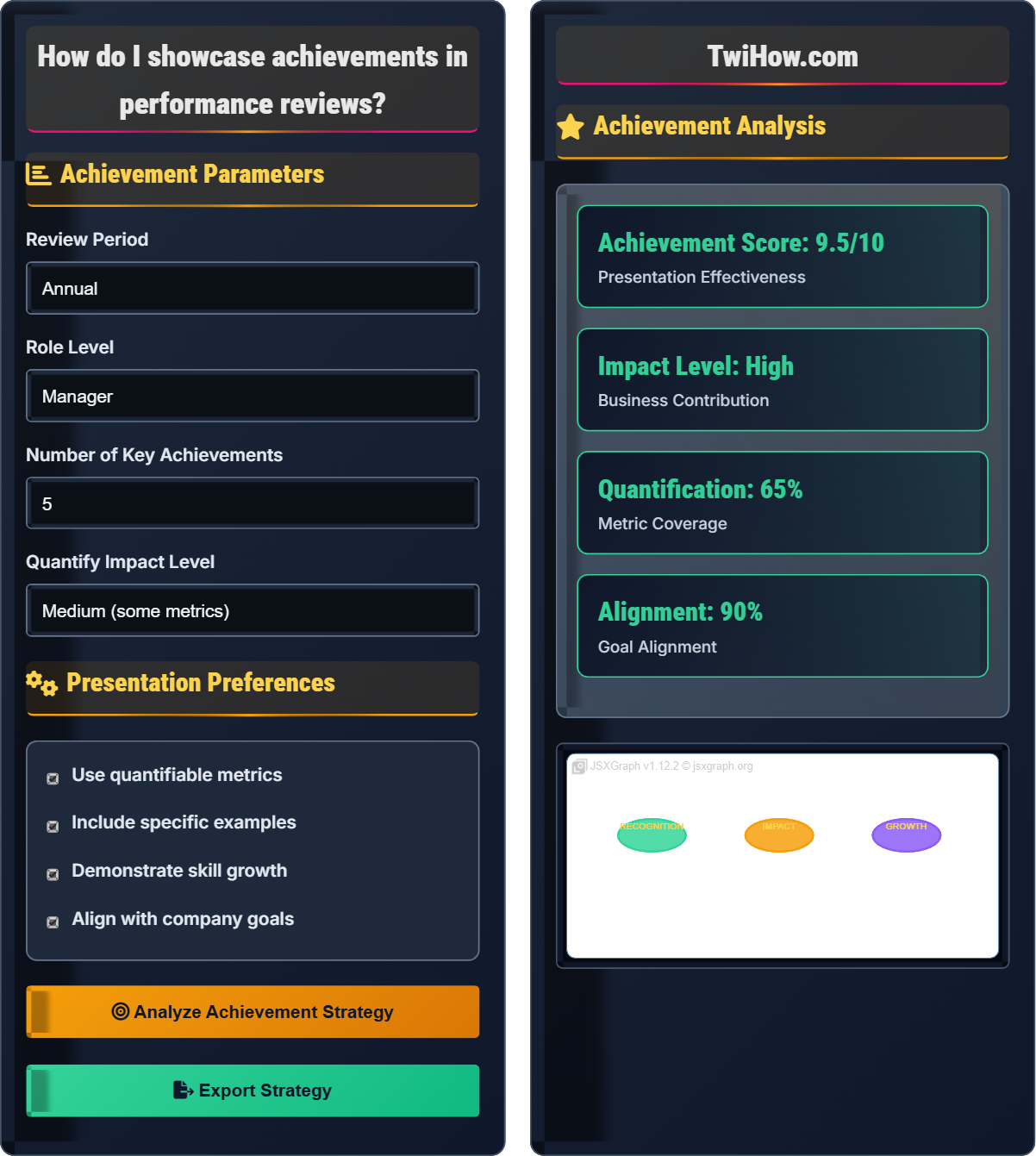
Achievement Analysis
| Achievement | Impact | Metrics | Alignment |
|---|---|---|---|
| Project Delivery | High | 95% on-time | Strategic |
| Cost Reduction | Medium | $150K saved | Operational |
| Team Development | High | 3 promotions | Cultural |
| Process Improvement | Medium | 25% faster | Efficiency |
Effective Achievement Presentation in Performance Reviews
Achievement presentation in performance reviews is the strategic communication of your professional accomplishments, contributions, and value to the organization. It involves organizing your work results into compelling narratives that demonstrate impact, growth, and alignment with company objectives.
Effective achievement presentation formula:
Where:
- Quantification: Use of specific metrics and numbers
- Impact: Business value created
- Alignment: Connection to company goals
- Narrative: Compelling story structure
- Context Factor: Relevance to role and company priorities
Effective achievement presentations by role level:
- Individual Contributor: "Increased sales by 23% through new prospecting approach"
- Team Lead: "Led team to deliver project 2 weeks early, saving $50K"
- Manager: "Reduced team turnover by 40% through new development program"
- Director: "Launched initiative that generated $2M in new revenue"
- Use the STAR Method: Situation, Task, Action, Result
- Quantify Everything: Convert achievements to numbers and percentages
- Show Growth: Demonstrate skill development and learning
- Align with Values: Connect achievements to company culture
- Prepare Examples: Have specific instances ready to illustrate points
Achievement Presentation Fundamentals
Achievement presentation, performance review, accomplishment documentation, professional value, business impact, quantifiable results.
Effectiveness = (Quantification + Impact + Alignment + Narrative) / 4 × Context Factor
Where Effectiveness = presentation quality, Quantification = use of metrics, Impact = business value.
- Always quantify achievements
- Connect to business objectives
- Use specific examples
Applications
Annual reviews, promotion requests, salary negotiations, professional development planning.
- Track achievements regularly
- Collect quantifiable metrics
- Align with company goals
- Practice presentation
- Prepare for questions
- Company culture and values
- Reviewer's priorities
- Industry standards
- Team dynamics
Achievement Presentation Learning Quiz
Which of the following is the most effective way to quantify an achievement?
The correct answer is B) "Increased customer satisfaction by 23% over 6 months". This quantifies the achievement with specific metrics (23% improvement) and timeframe (6 months). Quantification makes achievements more credible and comparable, allowing reviewers to understand the scope and significance of your contributions.
Effective quantification includes specific numbers, percentages, timeframes, and business metrics that demonstrate measurable impact.
Quantification is critical in achievement presentation because it provides objective evidence of your contributions. Vague statements like "improved satisfaction" are subjective and difficult to evaluate. Specific metrics like "23% increase" provide concrete evidence of impact. When possible, use percentages, dollar amounts, time savings, or other quantifiable measures to demonstrate your value to the organization.
Quantification: Converting achievements to measurable results
Metrics: Numerical measures of performance
Impact: Measurable business value created
• Always include specific numbers
• Use percentages when possible
• Provide context for metrics
• Track metrics regularly
• Compare to baseline
• Use before/after comparisons
• Using vague language
• Not providing context
• Forgetting timeframes
Explain the STAR method for presenting achievements and provide an example of how to apply it.
STAR Method Components:
Situation: Context of the achievement (when, where, what was happening)
Task: Your responsibility or challenge (what you needed to do)
Action: Steps you took (how you approached the challenge)
Result: Outcome with specific metrics (what was achieved)
Example: "When our customer service response time increased to 4 hours (Situation), I was tasked with reducing it to under 2 hours (Task). I analyzed the ticket flow, implemented a triage system, and created templates for common issues (Action). As a result, we reduced average response time to 1.5 hours, improving customer satisfaction by 23% (Result)."
This structure provides clear context, demonstrates problem-solving skills, and quantifies impact.
The STAR method is effective because it creates a complete narrative that demonstrates your thought process and impact. It helps reviewers understand not just what you accomplished, but how you approached challenges and contributed to business outcomes. The method ensures you provide enough context for meaningful evaluation while highlighting your problem-solving abilities and results.
STAR: Situation, Task, Action, Result framework
Narrative Structure: Organized storytelling approach
Context: Background information for achievements
• Include all four components
• Focus on your actions
• Quantify results
• Practice with multiple examples
• Prepare for follow-up questions
• Keep examples concise
• Skipping context (situation)
• Focusing too much on actions
• Not quantifying results
You're a marketing manager at a SaaS company. Your company's primary goal is customer acquisition, but you also worked on a project that improved customer retention. How should you frame your retention project in your performance review to align with company objectives?
Frame the retention project as supporting customer acquisition by highlighting how improved retention enables more aggressive acquisition spending. For example: "Improved customer retention by 15% through loyalty program, which reduced churn to 3% and allowed company to increase customer acquisition spend by $200K while maintaining ROI targets. This created a sustainable growth flywheel that supported our acquisition goals."
Alternatively: "Reduced customer churn by 15%, which lowered customer acquisition cost by 12% and improved LTV:CAC ratio to 4:1, enabling more efficient scaling of our acquisition efforts and supporting long-term growth objectives."
The key is connecting seemingly secondary projects to primary business objectives.
Alignment is crucial because reviewers evaluate how your work contributes to company goals. Even projects that don't directly match stated objectives can support broader business outcomes. The trick is identifying these connections and articulating them clearly. In this example, retention supports acquisition by making each acquisition more valuable, allowing for more aggressive spending on new customers.
Alignment: Connection to business objectives
Business Outcomes: Measurable results that benefit company
ROI: Return on investment
• Connect all work to business value
• Show indirect contributions
• Research company strategy
• Map projects to objectives
• Explain business impact
• Not connecting to business value
• Focusing on personal achievements
• Ignoring company priorities
You started as a junior developer and were promoted to senior developer. How should you present your growth and development in the performance review to demonstrate value?
Skills Development: "Advanced from basic coding to architectural design, now leading technical decisions for 3 projects worth $500K."
Responsibilities: "Expanded role from individual contributor to mentoring 2 junior developers and conducting code reviews."
Impact: "Reduced bug rate by 40% through improved code quality practices and mentored junior team to 25% faster development cycles."
Leadership: "Voluntarily led migration to new tech stack, training team and reducing technical debt by 60%."
Business Value: "My growth contributed to team's 30% faster delivery and $200K in cost savings through process improvements."
Present growth as value creation rather than just personal advancement.
Growth demonstration should focus on how your development benefited the organization, not just personal advancement. Frame your growth in terms of expanded capabilities that created business value. Show how your increased responsibilities contributed to team and company success. This approach demonstrates that your development was an investment that paid dividends for the organization.
Professional Growth: Skill and responsibility development
Business Value: Measurable contribution to company
Leadership: Influence and guidance of others
• Show business impact of growth
• Quantify skill improvements
• Demonstrate leadership
• Track skill improvements
• Document mentoring impact
• Show process enhancements
• Focusing only on titles
• Not quantifying growth impact
• Ignoring team contributions
When preparing for a performance review, which achievements should you prioritize?
The correct answer is B) The ones with the highest business impact. Performance reviews focus on value creation for the organization. While effort and enjoyment are important, reviewers evaluate how your work contributed to company objectives, financial results, and strategic goals. Prioritize achievements that demonstrate measurable business value, even if they weren't the most challenging or enjoyable.
Reviewers are looking for evidence that you understand what matters most to the business and can deliver meaningful results.
Business impact should always be the primary filter for achievement selection. This demonstrates that you understand your role in contributing to organizational success. High-impact achievements show you can prioritize effectively and deliver results that matter most to the company. While personal satisfaction and learning are valuable, performance reviews are fundamentally about the value you provide to the organization.
Business Impact: Measurable contribution to company
Value Creation: Benefit provided to organization
Strategic Alignment: Connection to business objectives
• Prioritize business value
• Quantify impact
• Align with objectives
• Rank achievements by impact
• Focus on measurable outcomes
• Connect to company goals
• Prioritizing personal favorites
• Not quantifying impact
• Ignoring business value
FAQ
Q: How should I handle achievements that didn't go as planned but taught valuable lessons?
A: Present learning achievements using this approach: 1) Acknowledge the initial goal and expected outcome, 2) Explain what happened and why, 3) Describe what you learned from the experience, 4) Detail how you applied those lessons to future projects, and 5) Quantify the positive impact of the lessons learned. For example: "While the initial project didn't achieve its 20% efficiency goal, I identified process bottlenecks that led to a new workflow saving 15% in 3 other areas. This taught me the importance of pilot testing, which I now apply to all process improvements."
Q: What if my role doesn't have easily quantifiable achievements?
A: For roles with less quantifiable metrics, focus on: 1) Process improvements and their impact, 2) Stakeholder feedback and testimonials, 3) Project completions and timelines, 4) Skill development and certifications earned, 5) Mentoring and team development contributions, and 6) Qualitative business outcomes like improved team morale or better customer relationships. You can often quantify these through surveys, completion rates, or before/after comparisons. The key is demonstrating value through multiple lenses when traditional metrics aren't available.