What is the gig economy and is it right for my career?
Complete gig economy guide • Career planning
Gig Economy:
Show Career Suitability AnalyzerThe gig economy represents a significant shift in how people work, characterized by temporary contracts or freelance work as opposed to permanent employment. It encompasses everything from ride-sharing and food delivery to freelance professional services and remote contract work. Understanding this economic model is crucial for career planning in the modern workforce.
The gig economy offers flexibility, variety, and potential for higher earnings, but also presents challenges around job security, benefits, and income stability. Success in the gig economy requires different skills and approaches compared to traditional employment.
Key gig economy elements:
- Flexibility: Work when and where you want
- Diversification: Multiple income streams and clients
- Independence: Self-directed work and business decisions
- Skills-Based: Focus on specific talents and expertise
Modern gig workers leverage technology platforms, digital tools, and online marketplaces to connect with clients and manage their businesses effectively.
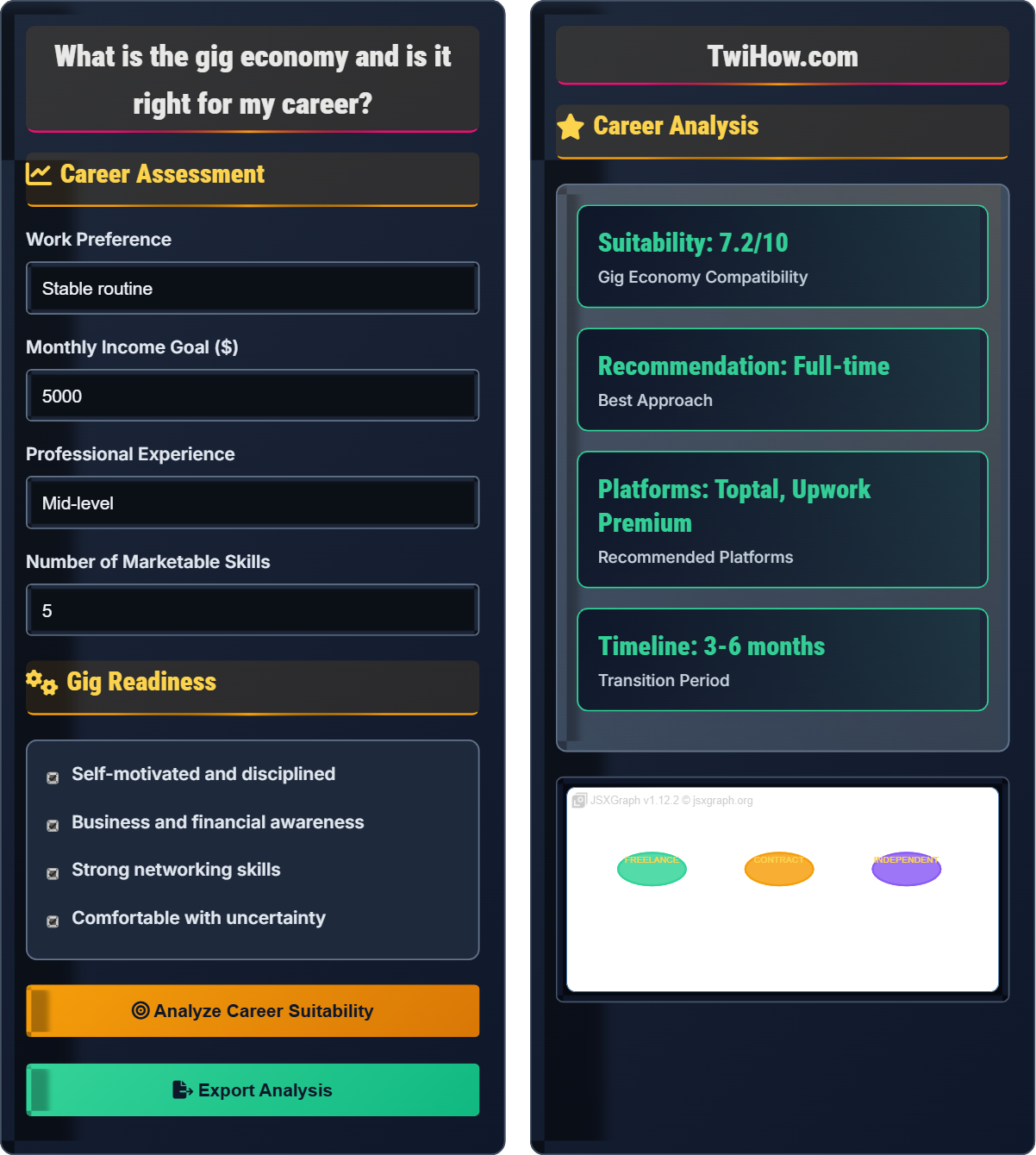
Career Assessment
Gig Readiness
Career Analysis
| Factor | Score | Impact | Recommendation |
|---|---|---|---|
| Flexibility | 8/10 | High | Well-suited |
| Income Stability | 6/10 | Medium | Plan carefully |
| Skills Match | 9/10 | High | Excellent fit |
| Risk Tolerance | 7/10 | Medium | Manageable |
Understanding the Gig Economy and Career Suitability
The gig economy refers to a labor market characterized by short-term contracts, freelance work, and independent contracting rather than permanent employment. Workers in the gig economy are typically self-employed or work as independent contractors, taking on individual projects or "gigs" rather than traditional full-time positions. This includes everything from ride-sharing and food delivery to professional services like graphic design, programming, and consulting.
Framework for evaluating gig economy suitability:
Where:
- Flexibility: Ability to adapt to variable schedules
- Skills: Marketable skills and expertise
- Risk Tolerance: Comfort with uncertainty
- Income Goals: Financial expectations and stability
- Market Demand: Availability of gig opportunities
Popular gig economy sectors:
- Transportation: Uber, Lyft, DoorDash, Instacart
- Professional Services: Upwork, Fiverr, Toptal, Freelancer
- Short-term Rentals: Airbnb, VRBO
- Delivery Services: Postmates, Grubhub, Amazon Flex
- Consulting: Independent consulting, corporate projects
- Content Creation: YouTube, TikTok, Patreon, Creative work
- Pros: Flexibility, variety of work, potential for higher earnings, independence
- Cons: Lack of benefits, income instability, no job security, self-management
- Skills Needed: Self-marketing, business acumen, time management, financial planning
- Financial Planning: Self-employment taxes, insurance, retirement planning
- Legal Considerations: Contract terms, intellectual property, liability
Gig Economy Fundamentals
Gig economy, freelance work, independent contractor, contract work, remote work, flexible employment, self-employment.
Suitability Score = (Flexibility + Skills + Risk Tolerance + Income Goals) / 4 × Market Demand
Where Suitability Score = overall compatibility, Flexibility = schedule adaptability, Skills = marketable abilities.
- Assess your risk tolerance
- Develop marketable skills
- Plan for financial stability
Applications
Freelancing, consulting, side hustles, remote work, project-based employment, digital nomadism.
- Identify marketable skills
- Research platform options
- Create professional profiles
- Set competitive pricing
- Build client relationships
- Financial stability requirements
- Market demand for skills
- Personal risk tolerance
- Long-term career goals
Gig Economy Learning Quiz
Which of the following is NOT a characteristic of the gig economy?
The correct answer is B) Traditional employment benefits. The gig economy is characterized by the absence of traditional employment benefits such as health insurance, paid time off, retirement plans, and unemployment insurance. Gig workers are typically classified as independent contractors and must arrange their own benefits. This is one of the key trade-offs of gig work - increased flexibility and potential earnings in exchange for job security and benefits.
Traditional benefits are typically provided by employers in permanent employment relationships.
Understanding the distinction between traditional employment and gig work is fundamental to making informed career decisions. The gig economy offers certain freedoms but requires individuals to take on responsibilities traditionally provided by employers. This includes managing taxes, securing health insurance, planning for retirement, and creating financial buffers for periods of reduced income. The lack of benefits is a significant consideration that affects both financial planning and quality of life.
Gig Economy: Labor market with short-term contracts
Independent Contractor: Self-employed worker
Traditional Benefits: Employer-provided perks and security
• Assess benefits trade-offs
• Plan for self-management
• Consider long-term implications
• Research benefit alternatives
• Budget for self-employment taxes
• Plan for income variability
• Underestimating benefit costs
• Not planning for taxes
• Ignoring retirement planning
Explain the financial planning considerations for someone transitioning to the gig economy.
Self-Employment Taxes: Gig workers must pay both employer and employee portions of Social Security and Medicare taxes (15.3%), which is significantly higher than traditional employment.
Income Variability: Plan for fluctuating income by creating a financial cushion of 6-12 months of expenses and budgeting conservatively.
Benefits Replacement: Secure health insurance, disability insurance, and life insurance independently, as these are not provided by gig platforms.
Retirement Planning: Contribute to SEP-IRA, Solo 401(k), or other self-employment retirement accounts to maintain long-term financial security.
Business Expenses: Track all business-related expenses for tax deductions, including equipment, software, office supplies, and home office costs.
Quarterly Tax Payments: Make estimated tax payments quarterly to avoid penalties and manage cash flow effectively.
Successful financial planning in the gig economy requires proactive management and discipline.
Financial planning in the gig economy is significantly different from traditional employment. The key difference is that gig workers must handle all financial responsibilities independently. This includes tax planning, benefit procurement, and income smoothing. The lack of automatic deductions and benefits means that gig workers must be much more proactive about their financial health. This requires a different mindset and skill set compared to traditional employment, where many of these responsibilities are handled automatically by employers.
Self-Employment Taxes: Combined Social Security and Medicare taxes
SEP-IRA: Simplified Employee Pension Individual Retirement Account
Income Smoothing: Managing variable income for stability
• Plan for higher tax obligations
• Build emergency funds
• Use accounting software
• Work with tax professionals
• Budget conservatively
• Not planning for taxes
• Underestimating benefit costs
• Poor cash flow management
You're a mid-level marketing professional earning $70,000 annually with full benefits. You're considering transitioning to freelance marketing work. Your research shows you could potentially earn $80,000-100,000 as a freelancer, but you'd lose $15,000 in benefits and face $10,000 in additional self-employment taxes. Calculate the net financial impact and describe the non-financial considerations.
Financial Analysis:
Current Salary: $70,000
Freelance Range: $80,000 - $100,000
Lost Benefits: $15,000
Additional Taxes: $10,000
Net Range: ($80,000 - $15,000 - $10,000) to ($100,000 - $15,000 - $10,000) = $55,000 - $75,000
Net Financial Impact: Potentially $15,000 less than current salary at minimum, but could match current income at high end.
Non-Financial Considerations: Flexibility, variety of work, client relationships, business development, skill diversification, work-life balance, professional growth, networking opportunities, and potential for higher earnings with experience.
The transition could be financially neutral but offers other valuable benefits.
This scenario demonstrates the complexity of evaluating gig economy transitions. While the potential earnings may seem attractive, it's crucial to account for all financial implications including lost benefits and additional taxes. The analysis shows that the actual net income might be lower than the gross freelance income. However, non-financial factors such as flexibility, variety, and autonomy may justify the financial trade-offs for many individuals. This highlights the importance of considering both quantitative and qualitative factors when making career decisions.
Net Income: Earnings after all expenses
Quantitative Factors: Measurable financial metrics
Qualitative Factors: Subjective non-financial benefits
• Account for all costs
• Consider non-financial benefits
• Plan for income variability
• Calculate total compensation
• Research benefit costs
• Consider long-term growth
• Only considering gross earnings
• Not accounting for benefits
• Ignoring tax implications
You're a graphic designer considering gig work. How would you assess your marketability and build a successful freelance career? What platforms would you use and what strategies would you employ?
Marketability Assessment:
1) Portfolio Analysis: Evaluate the quality, diversity, and relevance of your work to current market demands.
2) Skills Inventory: Identify both core design skills and complementary skills (marketing, client communication, project management).
3) Market Research: Analyze competitor pricing, demand, and trending design styles.
Platform Strategy:
4) Professional Platforms: Behance, Dribbble for portfolio; Upwork, Fiverr for clients; LinkedIn for networking.
5) Specialization: Focus on specific niches (web design, branding, social media graphics).
Success Strategies:
6) Consistent Delivery: Deliver high-quality work on time to build reputation.
7) Client Communication: Maintain clear, professional communication.
8) Continuous Learning: Stay updated with design trends and new tools.
9) Business Management: Track finances, set boundaries, price appropriately.
Success in freelance design requires both creative skills and business acumen.
This scenario illustrates that success in the gig economy requires more than just technical skills. Freelance success combines creative ability with business management skills. The key is to treat freelancing as running a small business rather than just doing work for clients. This includes marketing, financial management, customer service, and continuous professional development. The platform strategy is also crucial - different platforms serve different purposes and audiences. The combination of technical skills, business skills, and strategic platform use creates a sustainable freelance career.
Marketability: Ability to attract clients and earn
Portfolio: Collection of work samples
Specialization: Focusing on specific market niches
• Build strong portfolio
• Manage business aspects
• Focus on client satisfaction
• Diversify income streams
• Network consistently
• Price strategically
• Undervaluing work
• Poor time management
• Not tracking expenses
What is the most important risk management strategy for gig economy workers?
The correct answer is D) All of the above. Risk management in the gig economy requires a multi-faceted approach. Diversifying clients reduces dependency on single income sources. Building an emergency fund provides stability during low-income periods. Professional insurance protects against liability and business risks. These strategies work together to create a comprehensive risk management approach.
No single strategy is sufficient; gig workers need multiple protective measures.
Risk management in the gig economy is more complex than in traditional employment because gig workers don't have the safety nets provided by employers. The key principle is diversification - diversifying clients, income streams, and protective measures. This creates multiple layers of protection against various risks. The interconnected nature of these strategies means that addressing only one aspect leaves gaps in protection. Comprehensive risk management is essential for long-term success and financial security in the gig economy.
Risk Management: Strategies to protect against financial losses
Diversification: Spreading risk across multiple sources
Emergency Fund: Reserve for unexpected expenses
• Diversify income sources
• Build financial reserves
• Protect with insurance
• Plan for 3-6 months of expenses
• Maintain multiple client relationships
• Regularly review insurance needs
• Relying on single client
• Not saving for taxes
• Ignoring insurance needs
FAQ
Q: How do I determine if I'm suited for the gig economy?
A: Assess your suitability by considering: 1) Your comfort with uncertainty and income variability, 2) Self-motivation and discipline to work independently, 3) Ability to market yourself and build client relationships, 4) Financial stability to weather dry periods, 5) Skills that are in demand, and 6) Willingness to handle business aspects (taxes, contracts, marketing). Take a trial period doing freelance work alongside your current job to test your aptitude. Evaluate your ability to find clients, manage projects, and maintain work-life balance. Consider your risk tolerance and whether you enjoy variety in your work. The gig economy suits self-starters who thrive on autonomy and can handle the business aspects of work.
Q: What are the most important skills for gig economy success?
A: The most important skills are: 1) Technical skills in your field (obviously), 2) Client communication and relationship management, 3) Project management and time management, 4) Self-marketing and business development, 5) Financial management and tax planning, 6) Negotiation and contract management, and 7) Adaptability to changing market demands. Technical skills get you hired, but soft skills keep you employed. I've seen many talented freelancers struggle because they lacked business skills. Conversely, those who combine technical expertise with business acumen are most successful. The gig economy rewards those who can deliver technical results while managing client relationships effectively.