How do I balance vision with adaptability in a startup?
Complete startup guide • Strategic frameworks
Startup Balance:
Show Balance SimulatorBalancing vision with adaptability in a startup is one of the most critical challenges entrepreneurs face. Vision provides direction and purpose, while adaptability allows responding to market feedback and changing conditions. The key is maintaining a clear long-term mission while staying flexible on tactics and execution.
Successful startups establish core values and mission that remain constant while continuously iterating on products, strategies, and business models based on market feedback. This balance enables sustainable growth and competitive advantage.
Key balancing elements:
- Vision: Long-term mission and core values
- Strategy: Flexible approach to achieving goals
- Tactics: Adaptable execution methods
- Metrics: Balanced KPIs for growth and sustainability
Modern startups use frameworks like Lean Startup methodology, Agile development, and OKRs to maintain this balance while iterating quickly based on customer feedback.
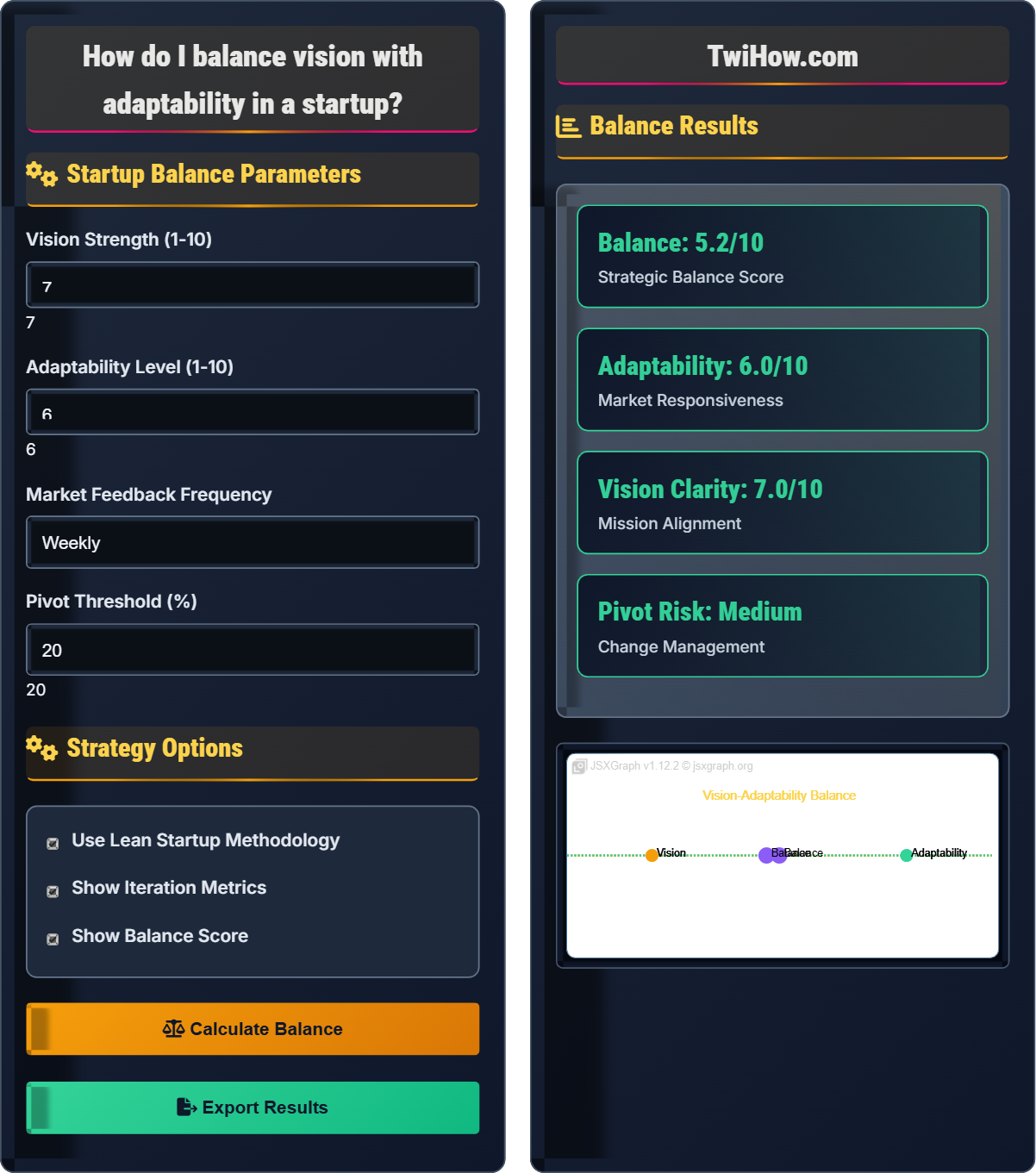
Startup Balance Parameters
Strategy Options
Balance Results
| Dimension | Score | Impact | Status |
|---|---|---|---|
| Vision Clarity | 7/10 | High | Strong |
| Adaptability | 6/10 | Medium | Average |
| Market Response | 8/10 | High | Good |
| Pivot Readiness | 5/10 | Medium | Needs Improvement |
Balancing Vision with Adaptability Explained
The vision-adaptability balance in startups refers to maintaining a clear long-term mission while remaining flexible enough to respond to market feedback, customer needs, and changing conditions. This balance is crucial for sustainable growth and competitive advantage.
Successful startups use frameworks that separate core elements (vision) from tactical elements (execution) while maintaining tight feedback loops:
Where:
- Vision Clarity: Consistency of long-term mission
- Adaptability: Flexibility in execution and tactics
- Feedback Responsiveness: Speed of iteration based on market input
Companies that successfully balanced vision with adaptability:
- Netflix: Started as DVD-by-mail, pivoted to streaming while maintaining entertainment vision
- Instagram: Originally Burbn (check-in app), pivoted to photo sharing while keeping social focus
- Slack: From gaming company to communication platform, maintaining team collaboration vision
- Twitter: From podcasting to microblogging, preserving real-time communication mission
- Core vs. Context: Distinguish between immutable values and adaptable methods
- Minimum Viable Product: Test assumptions quickly and cheaply
- Build-Measure-Learn: Continuous iteration cycle
- OKRs: Objectives and Key Results for tracking progress
- Customer Development: Regular validation of market assumptions
Startup Balance Fundamentals
Vision clarity, adaptability, feedback loops, pivot strategy, lean methodology, customer validation.
Balance Score = (Vision Clarity + Adaptability) / 2 × Feedback Responsiveness
Where Balance Score = strategic effectiveness, Vision Clarity = mission consistency, Adaptability = tactical flexibility.
- Keep core mission constant while adapting tactics
- Establish clear feedback mechanisms
- Define pivot thresholds in advance
Applications
Product development, market entry, scaling operations, funding rounds, team building.
- Define core mission and values
- Create measurable goals
- Establish feedback loops
- Iterate rapidly
- Monitor balance metrics
- Team alignment on vision
- Resource allocation
- Investor expectations
- Competitive positioning
Startup Balance Learning Quiz
Which of the following best describes the relationship between vision and adaptability in a successful startup?
The correct answer is C) Maintain core vision while adapting tactics and execution. Successful startups distinguish between their immutable core mission/values and the flexible methods used to achieve those goals. This allows them to pivot when necessary while maintaining strategic direction.
For example, Netflix's vision of entertainment remained constant while they adapted from DVDs to streaming to original content.
Understanding the vision-adaptability balance is fundamental to startup success. Vision provides the "why" - the long-term purpose and values that don't change. Adaptability governs the "how" - the methods, products, and strategies that can evolve based on market feedback. This distinction allows startups to remain resilient and responsive without losing sight of their ultimate goals.
Vision: Long-term mission and core values that remain constant
Adaptability: Flexibility in tactics and execution based on feedback
Pivot: Major change in strategy while maintaining core vision
• Keep core mission constant
• Adapt execution methods
• Establish feedback loops
• Define your "north star" mission clearly
• Separate core values from tactical approaches
• Create rapid feedback cycles
• Changing vision too frequently
• Being inflexible on tactics
• Lacking clear feedback mechanisms
Explain the difference between vision, strategy, and tactics in the context of startup balance. How should each element be treated differently regarding adaptability?
Vision: The unchanging core purpose and values of the startup. This should remain constant over time. Example: "To organize the world's information and make it universally accessible" (Google).
Strategy: The high-level plan for achieving the vision. This can be adjusted periodically based on market feedback and changing conditions. Example: Focusing on search initially, then expanding to other services.
Tactics: The specific actions and implementations used to execute the strategy. These should be highly adaptable and iterated frequently. Example: Specific product features, marketing campaigns, pricing models.
The key is to have the least adaptability in vision, moderate adaptability in strategy, and maximum adaptability in tactics.
This hierarchical approach to startup planning creates a framework for balancing consistency and flexibility. The vision acts as an anchor that provides stability and direction. The strategy serves as a bridge between the vision and tactical execution, allowing for some adjustment. Tactics are the most fluid element, enabling rapid experimentation and iteration. This structure prevents startups from losing their way while remaining responsive to market opportunities.
Vision: Immutable long-term mission and values
Strategy: High-level plan to achieve vision (moderately adaptable)
Tactics: Specific actions for execution (highly adaptable)
• Vision: Change minimally
• Strategy: Adjust periodically
• Tactics: Iterate frequently
• Document your vision clearly
• Review strategy quarterly
• Experiment with tactics weekly
• Changing vision too often
• Being rigid on tactics
• Confusing vision with strategy
A startup has developed a fitness app focused on workout tracking, but market research shows that users are more interested in nutrition guidance. The founding team is passionate about fitness, but revenue is declining. Using the vision-adaptability framework, describe how they should approach this situation while maintaining their core vision.
Core Vision Assessment: If the vision is "improving people's health and wellness," then pivoting to nutrition fits perfectly while maintaining the core mission.
Strategy Adjustment: Shift from workout-focused to comprehensive health management, incorporating nutrition tracking and guidance.
Tactical Changes: Redesign the app interface, add nutritional databases, partner with dietitians, and implement food tracking features.
Implementation: Conduct user interviews to validate the pivot, develop MVP for nutrition features, measure engagement metrics, and iterate based on feedback. The core vision of health improvement remains unchanged while adapting the product to meet actual user needs.
This scenario demonstrates the importance of distinguishing between vision and product. Many startups fail because they conflate their specific product idea with their core mission. By maintaining the broader vision of health improvement, the team can pivot their approach while staying true to their fundamental purpose. This approach reduces the risk of failure while maintaining team motivation and investor confidence.
Pivot: Strategic shift that maintains core vision
Product-Market Fit: Alignment between product and customer needsCustomer Validation: Testing assumptions with real users
• Preserve core mission during pivots
• Validate changes with customers
• Measure impact of adjustments
• Survey existing users before pivoting
• Build MVP to test new direction
• Communicate vision to stakeholders
• Abandoning core vision during pivots
• Making changes without validation
• Failing to communicate rationale
A SaaS startup has received conflicting feedback: some users want more features, others want simpler interfaces. The team is considering two approaches: 1) Adding customization options, or 2) Creating different product tiers. How should they evaluate which approach aligns with their vision of "making complex business processes simple" while maintaining adaptability?
Vision Alignment Analysis: The core vision emphasizes simplicity. Approach 1 (customization) might complicate the interface for all users, while Approach 2 (product tiers) maintains simplicity for each user group.
Testing Strategy: Create prototypes of both approaches and test with representative user segments. Measure ease of use, time to value, and user satisfaction.
Decision Criteria: Choose the approach that best preserves the "simple" aspect of the vision while addressing user needs. Tiered products likely align better with the simplicity vision.
Implementation: Develop minimum viable versions of both approaches, gather feedback, and select based on alignment with vision and user outcomes.
This scenario illustrates how to use vision as a decision-making filter when facing conflicting feedback. Rather than trying to satisfy all demands, the team should evaluate options based on how well they serve the core mission. This approach prevents feature bloat and maintains product coherence while still being responsive to customer needs. The key is finding solutions that address user pain points without compromising the fundamental value proposition.
Feature Creep: Uncontrolled addition of features
Product Coherence: Alignment of features with core value
User Segmentation: Dividing users into distinct groups
• Let vision guide feature decisions
• Test solutions with users
• Maintain product coherence
• Create user personas for testing
• Use A/B testing for validation
• Document decision rationale
• Adding features without vision alignment
• Not testing solutions with users
• Compromising core value proposition
According to the Lean Startup methodology, how should a startup balance its vision with the need for rapid iteration?
The correct answer is B) Maintain core vision while iterating on product and strategy. The Lean Startup methodology emphasizes rapid Build-Measure-Learn cycles to test hypotheses about the product-market fit while maintaining a consistent vision. This approach allows for quick pivots when necessary while preserving the long-term mission.
The methodology specifically advocates for validated learning through experiments, not frequent vision changes.
The Lean Startup methodology exemplifies the vision-adaptability balance. It encourages startups to form hypotheses about their product-market fit, build minimum viable products to test these hypotheses, measure the results, and learn from the data. This cycle allows for rapid iteration on product features and strategy while the core vision remains stable. This approach minimizes waste and maximizes learning, leading to more efficient pathfinding toward product-market fit.
Build-Measure-Learn: Core Lean Startup cycle
Minimum Viable Product (MVP): Product with minimal features for learning
Validated Learning: Knowledge gained through experiments
• Vision remains constant
• Products/strategies iterate
• Learn from experiments
• Formulate clear hypotheses
• Use actionable metrics
• Pivot when validated
• Changing vision during iterations
• Measuring vanity metrics
• Not pivoting when needed
FAQ
Q: How do I know when to pivot versus when to persevere with my original vision?
A: The key is establishing clear, measurable criteria before launching. Set specific milestones related to customer acquisition, retention, and engagement. If you're consistently missing these metrics despite iteration, it may be time to pivot. However, if you're seeing early signs of product-market fit but struggling with scale, perseverance might be the right choice. The critical factor is whether you're validating your core hypothesis about customer needs. Look for evidence of growing customer love (not just usage) and willingness to pay. If these aren't emerging after reasonable iteration, consider a strategic pivot while maintaining your core vision.
Q: What metrics should investors look for to assess a startup's vision-adaptability balance?
A: As an entrepreneur who has raised multiple rounds, I look for several key indicators: 1) Clear articulation of core mission that hasn't changed significantly, 2) Evidence of customer feedback integration showing responsiveness, 3) Cohort analysis demonstrating learning and improvement over time, 4) Pivots that made logical sense relative to the original vision, and 5) Metrics that show both growth and efficiency improvements. Investors want to see teams that can adapt while maintaining strategic direction. The best startups show they can course-correct based on data while keeping their long-term vision intact. This demonstrates both resilience and strategic thinking.