How to Build a Minimum Viable Product (MVP)
Complete guide to MVP development • Step-by-step explanations
MVP Development:
Show MVP BuilderA Minimum Viable Product (MVP) is the most basic version of a product that allows a team to collect the maximum amount of validated learning about customers with the least effort. It's a core principle of the Lean Startup methodology, enabling entrepreneurs to test their assumptions with real users before investing heavily in development.
Key MVP principles include:
- Core Feature Focus: Prioritize essential functionality only
- User Feedback Loop: Rapid iteration based on user input
- Validated Learning: Prove assumptions with real data
- Quick Iteration: Fast build-measure-learn cycles
The goal is to launch quickly with minimal features, gather user feedback, and then iterate based on actual market demand rather than hypothetical needs.
MVP Profile
Advanced Options
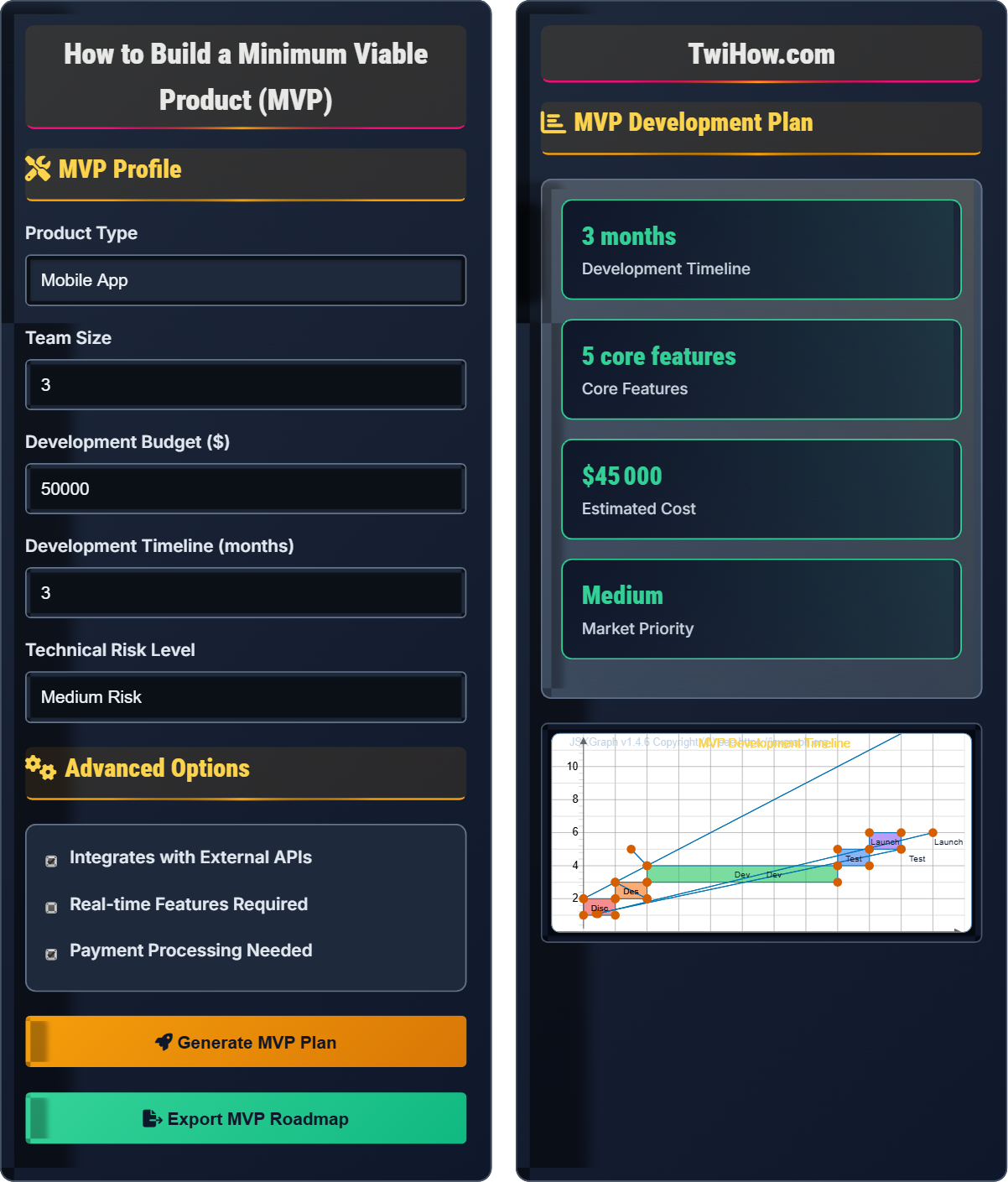
MVP Development Plan
| Phase | Duration | Focus | Deliverables |
|---|---|---|---|
| Discovery | Week 1 | User Research | Personas, Interviews |
| Design | Week 2 | UI/UX | Wireframes, Prototypes |
| Development | Weeks 3-8 | Core Features | Functional MVP |
| Testing | Week 9 | QA & Feedback | Test Results |
| Launch | Week 10 | Market Release | Live Product |
These features were selected based on your market requirements and timeline constraints.
MVP Development Explained
A Minimum Viable Product (MVP) is the simplest version of a product that can be released to users to test core assumptions and gather feedback. It contains only the essential features needed to solve the primary problem and validate the business model.
The core of MVP development follows the Build-Measure-Learn feedback loop:
Where:
- Build: Develop the smallest possible version with core features
- Measure: Collect quantitative and qualitative data from users
- Learn: Analyze data to validate or invalidate hypotheses
- Repeat: Iterate based on learning to improve the product
| Feature | Impact | Effort | Priority |
|---|---|---|---|
| User Authentication | High | Medium | High |
| Core Functionality | Very High | High | Very High |
| Payment Processing | High | High | Medium |
| Analytics | Medium | Low | Medium |
| Advanced UI | Low | High | Low |
MVP Fundamentals
Minimum viable product, lean startup methodology, validated learning, build-measure-learn cycle, feature prioritization.
MVP Success = (Core Problem Solved × User Value Delivered) ÷ (Development Effort + Time to Market)
Where the goal is to maximize user value while minimizing effort and time.
- Only build features that solve core problems
- Release early and often
- Measure everything that matters
- Learn from user feedback
- Iterate quickly based on data
Development Process
Discovery, Design, Development, Testing, Launch, Iteration.
- Start with a hypothesis
- Build the smallest solution
- Test with real users
- Measure results
- Learn and adapt
- Repeat the cycle
- Focus on user problems, not features
- Validate assumptions with data
- Minimize development waste
- Plan for rapid iteration
MVP Development Quiz
What is the primary purpose of a Minimum Viable Product (MVP)?
The primary purpose of an MVP is to test core business assumptions and gather validated learning about customers with the least effort and expense. It's designed to prove or disprove key hypotheses about the product-market fit before investing heavily in development.
The answer is B) To test core assumptions with minimal resources.
Understanding the true purpose of an MVP is crucial for entrepreneurs. Many mistakenly think an MVP is simply a "basic version" of their full vision. Instead, it's a strategic approach to minimize risk by validating critical assumptions early. The focus should be on learning, not building the most polished product possible.
MVP: Minimum Viable Product - the simplest version that enables learning
Validated Learning: Proving assumptions with real user data
Build-Measure-Learn: The core feedback loop of lean startup methodology
• MVPs prioritize learning over perfection
• Focus on solving core user problems
• Measure meaningful metrics
• Start with user problems, not solutions
• Focus on one primary metric
• Prepare for pivots based on feedback
• Building too many features initially
• Not defining success metrics upfront
• Treating MVP as a temporary product
Explain the difference between "must-have," "should-have," and "nice-to-have" features in MVP development. How should each category be treated?
Must-Have Features: Critical functionality without which the product fails to solve the core problem. These are included in the initial MVP release.
Should-Have Features: Important functionality that enhances the user experience but isn't critical for the core value proposition. These are planned for the next iteration.
Nice-to-Have Features: Enhancements that improve the product but don't significantly impact core value. These are deferred until after validation.
In MVP development, only must-have features should be implemented initially. The goal is to launch with the minimum set of features needed to solve the core problem and gather user feedback.
Feature prioritization is one of the most challenging aspects of MVP development. The MoSCoW method (Must, Should, Could, Won't) helps teams make disciplined decisions about what to include. The key insight is that more features don't necessarily mean a better MVP - they can actually slow down learning and increase risk.
MoSCoW Method: Prioritization technique (Must, Should, Could, Won't)
Feature Creep: Gradual addition of features beyond original scope
Core Value Proposition: Primary benefit the product delivers to users
• Only implement must-have features in MVP
• Define success criteria before building
• Resist adding non-essential features
• Use impact vs. effort matrix for prioritization
• Get user input on feature importance
• Document deferred features for future sprints
• Including should-have features in MVP
• Not properly defining core value
• Adding features based on team preferences
A food delivery startup wants to build an MVP with a tight timeline of 2 months and a small team of 2 developers. Their full vision includes restaurant discovery, menu browsing, order placement, payment processing, driver tracking, reviews, loyalty rewards, and social features. What should be included in their MVP, and what should be deferred? Explain your reasoning.
MVP Core Features:
1. Restaurant Discovery: Essential for users to find restaurants
2. Menu Browsing: Users need to see available options
3. Order Placement: Core functionality for the service
4. Payment Processing: Critical for business operation
Deferred Features:
• Driver Tracking (can start with estimated delivery time)
• Reviews (can add after initial validation)
• Loyalty Rewards (not essential for core functionality)
• Social Features (adds complexity without solving core problem)
Reasoning: The MVP focuses on the core transaction (find restaurant → browse menu → place order → pay → receive). Everything else can be added after validating market demand.
This scenario demonstrates the challenge of feature prioritization in constrained environments. The key is identifying the "critical path" - the minimum functionality needed for users to complete the core workflow. Everything else is secondary and can be added after validating the business model.
Critical Path: Sequence of steps required for core user workflow
Feature Prioritization: Process of ranking features by importance
Time-to-Market: Duration from concept to market availability
• Focus on core user journey completion
• Validate business model before adding features
• Consider technical dependencies
• Map out complete user journey
• Identify single most important metric
• Plan phased rollout strategy
• Trying to build everything at once
• Not considering technical complexity
• Failing to define success metrics
A fitness app MVP allows users to track workouts and view progress. The team needs to select key metrics to measure success. Which of the following metrics would be most appropriate for an MVP, and why? Calculate the expected retention rate needed for sustainable growth if they acquire 1000 users per month and want to grow by 20% monthly.
Potential metrics: Daily Active Users, Feature Adoption Rate, User Retention Rate, Total Downloads, Revenue per User, Support Tickets per User.
Most Appropriate MVP Metrics:
1. User Retention Rate: Measures if users find ongoing value
2. Daily Active Users: Indicates engagement level
3. Feature Adoption Rate: Shows if core features are valued
Retention Rate Calculation:
Monthly Growth Rate = (New Users + Retained Users) / Total Previous Users
1.2 = (1000 + Retained) / Previous Month Total
Assuming starting with 0 users: Month 1 = 1000 users
Month 2 target = 1200 users = 1000 new + 200 retained
Retention Rate = 200/1000 = 20%
For sustainable 20% growth, they need 20% monthly retention of previous users.
This problem illustrates the importance of selecting meaningful metrics for MVPs. Vanity metrics like total downloads don't indicate product-market fit. Instead, focus on metrics that reveal whether users find value and continue using the product. The retention calculation shows how growth depends on keeping existing users engaged.
Retention Rate: Percentage of users who continue using product over time
Vanity Metrics: Numbers that look good but don't indicate business health
North Star Metric: Primary metric indicating product success
• Focus on metrics that indicate user value
• Track retention alongside acquisition
• Avoid vanity metrics
• Define metrics before building MVP
• Track cohort analysis
• Focus on actionable metrics
• Tracking too many metrics
• Not defining success criteria
• Measuring inputs instead of outcomes
Which statement best describes a key difference between MVP development and traditional product development approaches?
The fundamental difference is that MVP development prioritizes learning and validation through user feedback over creating a perfect product. Traditional development often aims for completeness and polish upfront, while MVPs embrace iteration and improvement based on real user data.
The answer is B) MVPs focus on learning and validation rather than perfection.
This question highlights the philosophical shift required when adopting MVP methodology. Traditional project management often emphasizes completing a defined scope perfectly. MVP methodology emphasizes learning and adapting based on market feedback. This mindset change is crucial for successful MVP implementation.
Waterfall Development: Traditional sequential development approach
Agile Development: Iterative approach emphasizing adaptationLean Startup: Methodology emphasizing validated learning
• Embrace uncertainty and learning
• Validate assumptions with data
• Build iteratively based on feedback
• Accept that MVP will be imperfect
• Focus on user problems, not features
• Plan for multiple iterations
• Treating MVP as a temporary solution
• Not planning for iteration
• Building for perfection instead of learning
FAQ
Q: How do I know if my MVP is "good enough" to launch?
A: Your MVP is ready to launch when it:
1. Solves the core problem for your target users
2. Contains only essential features needed for the core workflow
3. Provides measurable value to early adopters
4. Allows you to collect meaningful feedback
5. Validates or refutes your key business assumptions
Remember: a "perfect" MVP is a contradiction. The goal is to learn quickly and cheaply. If you're not embarrassed by the first version, you've probably built too much.
Q: What's the difference between an MVP, prototype, and proof of concept?
A: Here's how they differ:
Proof of Concept (PoC): Technical demonstration that validates feasibility of a concept. Usually internal, not for users.
Prototype: A preliminary model for testing concepts. May be interactive but isn't necessarily usable by customers.
MVP: A functional product released to real users to test assumptions and gather feedback. It's a working product, though minimal.
In essence: PoC proves it can be done, prototype shows how it might work, MVP validates if it should be built.