How do I build a strong company culture from day one?
Complete culture guide • Leadership strategies
Company Culture:
Show Culture BuilderBuilding a strong company culture from day one is essential for startup success. Culture defines the shared values, beliefs, and behaviors that shape how people interact and work together. A strong culture attracts top talent, increases employee engagement, and drives business performance.
Effective culture building starts with clearly defined core values and mission that guide decision-making and behavior. It requires consistent communication, leadership modeling, and reinforcement through practices and policies. The earlier culture is established, the more deeply it becomes embedded in the organization.
Key culture elements:
- Core Values: Fundamental beliefs and principles
- Mission Statement: Purpose and direction of the company
- Leadership Behavior: How leaders model cultural values
- Practices: Rituals, traditions, and ways of working
Modern companies leverage technology, transparency, and employee feedback to continuously evolve and strengthen their culture as they grow.
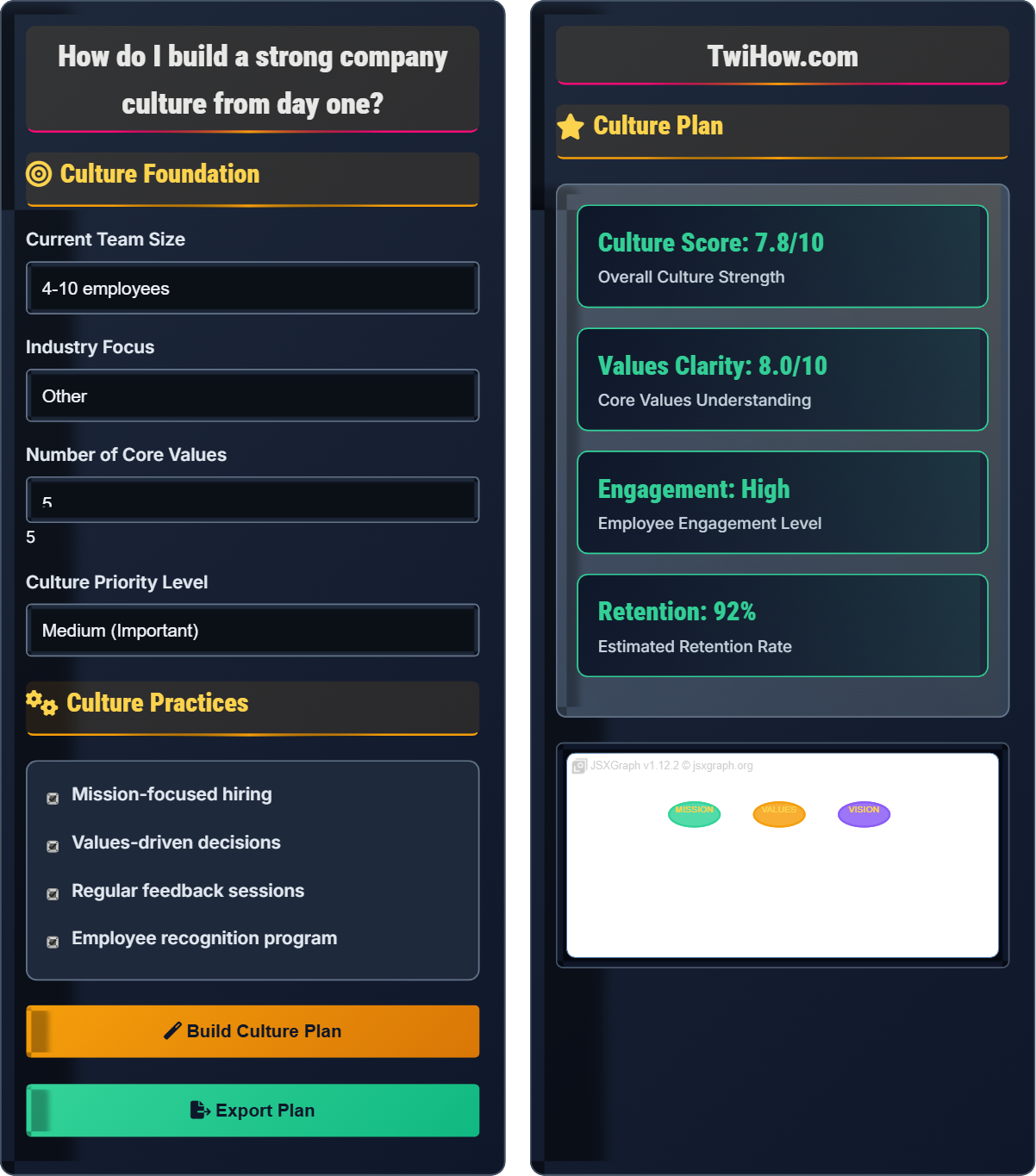
Culture Foundation
Culture Practices
Culture Plan
| Value | Description | Priority | Measurement |
|---|---|---|---|
| Integrity | Act with honesty and transparency | High | Behavior reviews |
| Innovation | Encourage creative solutions | High | Idea contributions |
| Collaboration | Work together effectively | Medium | Team feedback |
| Excellence | Deliver high-quality work | High | Performance metrics |
| Respect | Treat others with dignity | High | Peer reviews |
Building Strong Company Culture from Day One
Company culture encompasses the shared values, beliefs, attitudes, and behaviors that characterize an organization. It influences how employees interact, make decisions, and approach their work. A strong culture creates a sense of identity and belonging that drives engagement and performance.
Framework for building culture from day one:
Where:
- Values Clarity: How well-defined and communicated the core values are
- Leadership Alignment: How consistently leaders model cultural values
- Practice Consistency: How systematically values are reinforced through practices
Companies with strong cultures from day one:
- Zappos: Core values like "Deliver WOW Through Service" embedded in hiring
- Netflix: Culture of freedom and responsibility with radical transparency
- HubSpot: Culture code that defines expectations and behaviors
- Patagonia: Environmental values integrated into all business decisions
- Start Early: Define culture before it's too late to change
- Be Specific: Create clear behavioral examples for each value
- Consistent Reinforcement: Regularly acknowledge and reward cultural behaviors
- Involve Everyone: Engage all employees in culture building
- Evolve Thoughtfully: Allow culture to mature while maintaining core values
Culture Building Fundamentals
Company culture, core values, mission statement, employee engagement, leadership alignment, cultural fit, organizational behavior.
Culture Strength = (Values Clarity + Leadership Alignment + Practice Consistency) / 3
Where Culture Strength = overall cultural effectiveness, Values Clarity = definition of core values, Leadership Alignment = consistent modeling by leaders.
- Define culture before hiring begins
- Leaders must model cultural values
- Embed values in all processes
Applications
Startups, small businesses, growing companies, remote teams, hybrid workplaces.
- Define core values and mission
- Communicate to all team members
- Integrate into hiring process
- Model through leadership behavior
- Embed in practices and policies
- Team size and growth plans
- Industry and market demands
- Geographic distribution
- Company maturity level
Culture Building Learning Quiz
What is the most important reason to establish company culture from day one?
The correct answer is B) Because it becomes harder to change as the company grows. Once a company has more employees, habits are formed, and processes are established, changing culture becomes exponentially more difficult. Early-stage companies have the unique opportunity to define and embed culture before it's influenced by external factors and competing perspectives.
Establishing culture early ensures that all subsequent hires align with the company's values and expectations, creating a consistent and cohesive team environment.
Culture formation follows the principle of "first impressions" - the first cultural norms established tend to persist. As organizations grow, they become more resistant to change due to increased complexity, diverse perspectives, and established routines. This is why startups have a unique window of opportunity to intentionally design their culture. The earlier culture is established, the more naturally it becomes part of the organization's DNA, influencing hiring decisions, work practices, and strategic directions.
Company Culture: Shared values, beliefs, and behaviors
Cultural Norms: Expected behaviors within the organization
Organizational DNA: Fundamental characteristics that define the company
• Establish culture early
• It becomes harder to change over time
• Early influence is more effective
• Define values before the first hire
• Document cultural expectations
• Lead by example from day one
• Waiting until problems arise
• Not prioritizing culture initially
• Assuming culture will develop naturally
Explain the difference between company values and mission, and describe how they work together to build culture.
Company Mission: Defines the company's purpose, reason for existence, and what it aims to accomplish. It answers "Why do we exist?" and "What are we trying to achieve?" The mission is directional and often includes specific goals or objectives.
Company Values: Represent the fundamental beliefs and principles that guide behavior and decision-making. They answer "How do we behave?" and "What do we stand for?" Values are enduring and shouldn't change as the company evolves.
Working Together: The mission provides the destination, while values provide the roadmap for how to get there. Values guide daily decisions and behaviors that move the company toward its mission. For example, if a company's mission is "to make education accessible to everyone," its values might include "innovation" (to create new solutions) and "integrity" (to ensure quality and trustworthiness).
Understanding the relationship between mission and values is crucial for effective culture building. The mission serves as the north star, providing direction and purpose for all activities. Values serve as the guardrails, ensuring that the pursuit of the mission happens in a way that aligns with the company's core beliefs. Together, they create a framework for decision-making that is consistent across all levels of the organization. This alignment helps employees understand not just what they're working toward, but how they should behave while working toward it.
Mission: Company's purpose and goals
Values: Fundamental beliefs and principles
Cultural Framework: Structure guiding behavior and decisions
• Mission provides direction
• Values guide behavior
• Both must align for effective culture
• Link values to mission in communications
• Use both in decision-making processes
• Ensure values support mission achievement
• Having values that contradict the mission
• Not connecting values to daily operations
• Creating values that are too vague
You're starting a 5-person tech company with a core value of "transparency." How would you implement this value in your hiring, daily operations, and performance evaluations to ensure it becomes deeply embedded in your culture?
Hiring: Include transparency-related questions in interviews such as "Describe a time when you had to give difficult feedback" or "How do you handle disagreements in the workplace?" Look for candidates who openly discuss challenges and learn from mistakes. Share salary ranges and promotion criteria during interviews.
Daily Operations: Hold regular all-hands meetings where financials, challenges, and decisions are discussed openly. Use collaborative tools that make work visible to all team members. Encourage open feedback and create safe spaces for voicing concerns.
Performance Evaluations: Include transparency as a key performance indicator. Evaluate how well employees share information, provide honest feedback, and handle difficult conversations. Recognize and reward transparent behavior.
By embedding transparency in all these areas, the value becomes a lived reality rather than just words on a wall.
This scenario demonstrates the importance of operationalizing values through concrete actions. Simply stating a value is not enough - it must be woven into every aspect of the organization's operations. The key is to create multiple touchpoints where the value is reinforced and practiced. When employees see the value reflected in hiring decisions, daily interactions, and performance evaluations, they understand that it's not just rhetoric but a fundamental part of how the company operates. This consistent reinforcement helps the value become internalized by team members.
Operationalizing Values: Turning values into actionable behaviors
Touchpoints: Points of interaction where values are demonstrated
Internalized Values: Values that become part of employee mindset
• Embed values in all processes
• Create multiple reinforcement points
• Ensure consistency across functions
• Create behavioral examples for each value
• Include values in job descriptions
• Celebrate value-aligned behaviors
• Having values that aren't practiced
• Not connecting values to actions
• Inconsistency across departments
Your startup grew from 5 to 20 employees in 8 months. You notice that the collaborative culture you established is weakening as new hires seem to work more independently. How would you address this cultural drift while respecting the contributions of new team members?
Diagnosis: First, identify specific behaviors that indicate the cultural drift. Is it reduced cross-functional collaboration, fewer informal interactions, or siloed decision-making?
Communication: Acknowledge the change openly with the team. Explain the importance of collaboration to the company's success and values.
Reinforcement: Implement specific practices to encourage collaboration: regular cross-functional meetings, pair programming, shared projects, team lunches, or collaborative tools.
Integration: Create mentorship programs pairing new hires with longer-term employees to share cultural knowledge. Include collaboration in performance reviews and hiring criteria.
Evolution: Recognize that culture naturally evolves and may need refinement. Gather input from all team members on how to maintain collaboration while accommodating growth.
This scenario highlights a common challenge in growing companies: maintaining culture during rapid expansion. The key is to address cultural drift proactively while respecting new team members. Rather than viewing new hires as the problem, successful companies recognize that culture must be actively maintained and adapted during growth. This involves intentional communication, systematic reinforcement, and gradual evolution that honors the original culture while incorporating new perspectives. The goal is to preserve core values while allowing beneficial adaptations.
Cultural Drift: Gradual deviation from established culture
Growth Phase Challenges: Issues arising during company expansionCultural Evolution: Natural adaptation of culture over time
• Address drift proactively
• Respect new team members
• Maintain core values during evolution
• Regular culture check-ins
• Mentorship programs for new hires
• Collaborative onboarding process
• Ignoring cultural changes during growth
• Blaming new hires for cultural issues
• Not adapting culture appropriately
What is the most critical role of leadership in building and maintaining company culture?
The correct answer is B) Modeling cultural values through their behavior. Leaders set the tone for the entire organization through their actions, decisions, and daily behaviors. Employees watch leadership closely and often emulate what they see. If leaders don't live the values they espouse, the culture will be perceived as inauthentic, regardless of policies or hiring practices.
Leadership modeling is the foundation upon which all other cultural practices rest. Without authentic leadership behavior, other culture-building efforts will be ineffective.
Leadership modeling is the cornerstone of culture building because it demonstrates authenticity and creates trust. When leaders consistently embody the company's values, it signals to employees that these values are genuinely important rather than just marketing statements. This authenticity is crucial for employee buy-in and long-term cultural sustainability. Employees are more likely to adopt values they see being lived by respected leaders. The principle "actions speak louder than words" is especially true in culture building, where leadership behavior becomes the primary teaching tool for organizational values.
Leadership Modeling: Demonstrating values through behavior
Authenticity: Genuineness in value expression
Cultural Sustainability: Maintaining culture over time
• Leaders must live the values
• Actions must match words
• Authenticity builds trust
• Regular self-assessment against values
• Seek feedback on leadership behavior
• Be transparent about challenges
• Leaders not practicing what they preach
• Inconsistent leadership behavior
• Disconnect between values and actions
FAQ
Q: How do I balance maintaining culture while scaling the team quickly?
A: The key is to systematize your culture without losing its authenticity. Create clear cultural onboarding materials that explain your values and expected behaviors. Implement structured interview processes that assess cultural fit alongside skills. Assign culture mentors to new hires. Use storytelling to share examples of how values have been lived. Regular all-hands meetings help maintain connection as the team grows. Most importantly, continue to hire leaders who embody and reinforce your culture - they'll be responsible for maintaining it in their teams. Remember, scaling culture is about creating systems that reinforce values consistently, not diluting them.
Q: What cultural indicators do investors look for when evaluating startups?
A: As an investor, I look for several cultural indicators: 1) Clear, articulated values that team members can articulate, 2) Evidence that values influence hiring and firing decisions, 3) Low turnover rates indicating employee satisfaction, 4) Cohesive team dynamics during meetings, 5) How the team handles challenges and setbacks (do they work together or blame each other?), 6) Employee testimonials that reflect the stated culture, and 7) Consistency between stated values and actual practices. A strong culture signals good leadership, employee engagement, and operational discipline - all critical for scaling success. I also look for signs that the founders have thoughtfully built culture rather than letting it emerge organically.