How do I handle failure or pivot when things aren't working?
Complete failure & pivot guide • Recovery strategies
Failure & Pivot:
Show Recovery AnalyzerHandling failure and knowing when to pivot are critical skills for entrepreneurs. Failure is not the end but an opportunity to learn, adapt, and grow. A pivot involves changing your business model, product, or strategy based on market feedback while preserving core learnings. The key is recognizing early warning signs and having the courage to make necessary changes.
Successful entrepreneurs view failure as valuable feedback and pivot as a strategic maneuver rather than defeat. The ability to adapt quickly and effectively can mean the difference between business success and failure.
Key strategies:
- Early Warning Signs: Declining metrics, customer complaints, cash flow issues
- Decision Framework: Data-driven assessment of current strategy
- Pivot Types: Customer segment, product, business model, technology
- Recovery Plan: Learning from failure and moving forward
Modern startups embrace failure as part of the learning process, using methodologies like Lean Startup to iterate quickly and pivot when necessary.
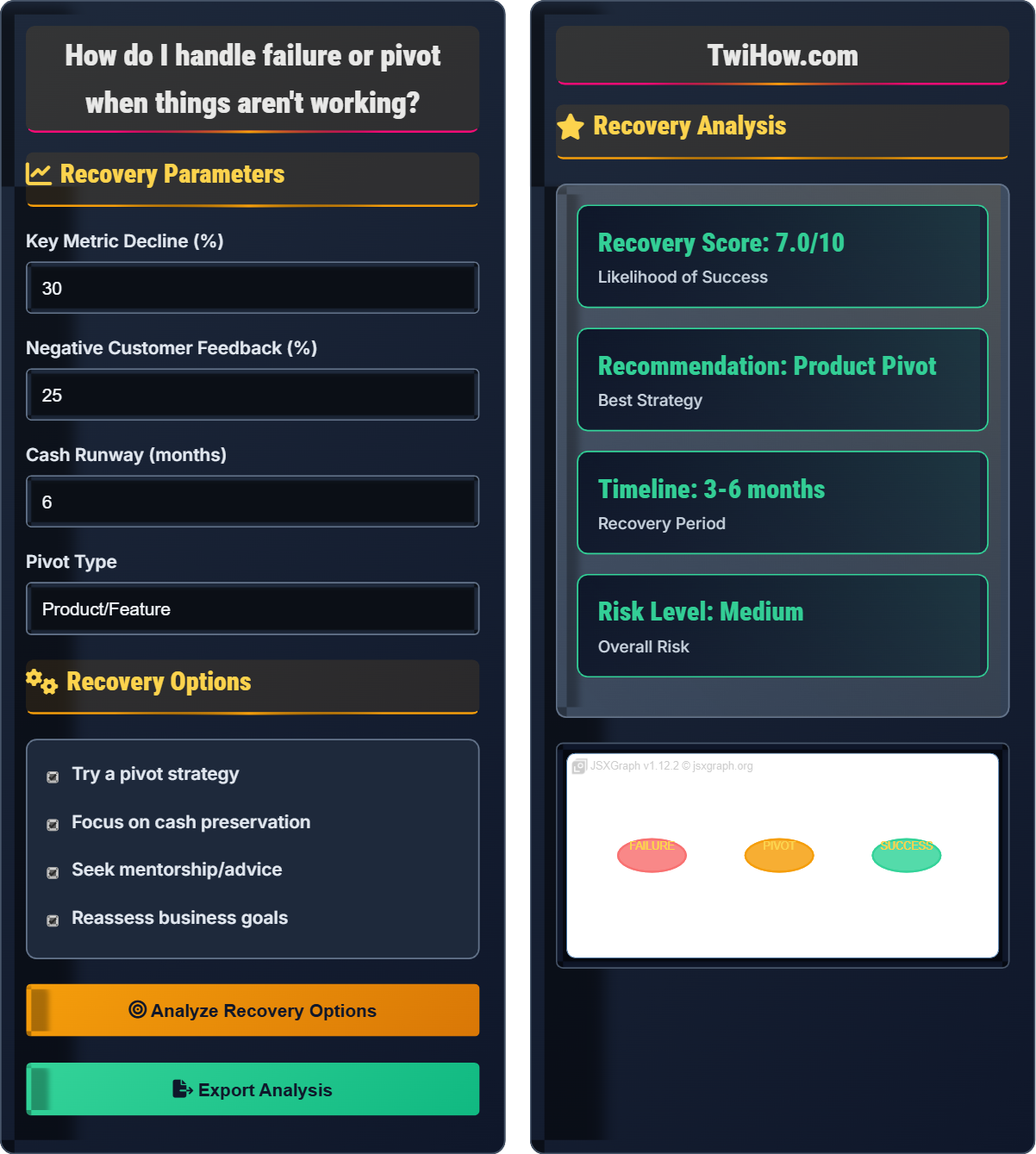
Recovery Parameters
Recovery Options
Recovery Analysis
| Metric | Current | Target | Recommendation |
|---|---|---|---|
| Customer Satisfaction | 70% | 85% | Improve product features |
| Monthly Growth | -5% | 5% | Focus on retention |
| Cash Burn Rate | $10K | $5K | Reduce operational costs |
| Churn Rate | 15% | 5% | Enhance customer support |
Handling Failure and Pivoting in Startups
Startup failure occurs when a company ceases operations due to inability to achieve product-market fit, run out of cash, or other business challenges. However, failure should be viewed as valuable learning experience rather than defeat. Many successful entrepreneurs have failed multiple times before achieving success.
A pivot is a structured course correction designed to test a new fundamental hypothesis about the product, business model, or engine of growth. It involves changing the business strategy based on market feedback while preserving core learnings and assets from the original approach.
Framework for handling failure and pivoting:
Where:
- Learning: Insights gained from failure
- Adaptability: Ability to change strategy
- Execution: Capability to implement new approach
- Market Opportunity: Potential of new market/path
Common pivot types based on successful examples:
- Customer Segment: Target different customers (Instagram from Burbn)
- Product/Feature: Change core offering (YouTube from dating site)
- Business Model: Change monetization approach (Netflix from DVD rental to streaming)
- Technology: Switch underlying technology (Twitter from Odeo)
- Platform: Move to different platform (from web to mobile)
- Preserve Assets: Protect intellectual property and key relationships
- Learn Quickly: Gather market feedback rapidly
- Stay Lean: Minimize costs during transition
- Seek Help: Leverage mentors, advisors, and support networks
- Focus on Customers: Understand real market needs
Failure & Pivot Fundamentals
Startup failure, pivot strategy, product-market fit, business model, market validation, resilience, adaptability.
Recovery Score = (Learning + Adaptability + Execution) / 3 × Market Opportunity
Where Recovery Score = chance of success, Learning = insights from failure, Adaptability = ability to change.
- View failure as learning opportunity
- Act quickly when pivot is needed
- Preserve core assets and relationships
Applications
Startups, small businesses, product development, market entry, business transformation.
- Recognize early warning signs
- Analyze root causes
- Evaluate pivot options
- Make data-driven decisions
- Execute systematically
- Market conditions
- Resource availability
- Team morale
- Investor relationships
Failure & Pivot Learning Quiz
Which of the following is the earliest warning sign that a startup might need to pivot?
The correct answer is B) Declining customer satisfaction scores. Customer satisfaction is a leading indicator of product-market fit and business health. When customers are dissatisfied, it suggests the product isn't meeting their needs, which is a fundamental reason for pivoting. Running out of cash is a consequence rather than a cause, competitors launching similar products might indicate market validation, and negative press is often a symptom of deeper issues.
Customer feedback provides the most direct insight into whether your value proposition resonates with the market.
Early warning signs are crucial for timely pivots. Customer satisfaction metrics are leading indicators because they reflect whether the core value proposition is resonating. Financial metrics like cash burn are lagging indicators that often come too late to pivot effectively. The key is to monitor customer-facing metrics closely and be willing to act on negative trends before they become critical.
Leading Indicator: Metric that predicts future outcomes
Lagging Indicator: Metric that reflects past performance
Product-Market Fit: Product satisfying market needs
• Monitor customer metrics first
• Act on early indicators
• Don't wait for crisis
• Implement customer feedback systems
• Track satisfaction regularly
• Survey customers proactively
• Ignoring customer complaints
• Focusing only on financial metrics
• Denying negative feedback
Explain the decision-making process for determining whether to pivot or shut down a failing startup. What factors should be considered?
Factors to Consider:
Market Opportunity: Is there still a viable market for a modified approach?
Customer Pain Points: Are customers experiencing real problems that could be solved differently?
Core Assets: What can be preserved and repurposed (technology, relationships, team)?
Financial Viability: Do you have resources to attempt a pivot?
Team Morale: Is the team committed to trying a new approach?
Learning Potential: What valuable insights have been gained?
Decision Process: 1) Analyze failure reasons objectively, 2) Identify potential pivot opportunities, 3) Validate new hypotheses with market research, 4) Assess resource requirements, 5) Create a pivot plan with success metrics, 6) Set a timeline for proving the new approach, 7) Make a definitive decision to pivot or shut down.
The pivot vs. shutdown decision requires objective analysis of multiple factors. The key is distinguishing between temporary setbacks and fundamental flaws in the business model. A pivot should be based on validated customer insights and a clear path to profitability. The decision framework helps separate emotional attachment from rational business judgment. Setting clear success metrics and timelines prevents endless pivoting attempts without progress.
Pivot: Structured course correction
Shutdown: Ceasing business operationsMarket Validation: Confirming customer needs exist
• Be objective about failure
• Validate new approaches
• Set clear timelines
• Seek external perspectives
• Test new hypotheses
• Preserve valuable assets
• Pivoting without validation
• Not admitting failure
• Endless pivoting cycles
You launched a fitness app targeting busy professionals, but user engagement is declining and churn rate is 40%. You have 8 months of runway left. Customer interviews reveal they want social features and accountability, not just workouts. Should you pivot or shut down? What would your pivot strategy be?
Decision: Pivot to a social fitness accountability platform.
Reasoning: Customer feedback reveals a real need (accountability) that your current product doesn't address. You have sufficient runway to implement changes. The core fitness domain is valid, but the approach needs adjustment.
Pivot Strategy: 1) Introduce social features and accountability tools, 2) Target fitness communities rather than individuals, 3) Implement group challenges and peer accountability, 4) Add coaching features, 5) Retain existing users by highlighting new social benefits.
Success Metrics: Increased session duration, lower churn rate, higher retention after 30/90 days, positive user feedback on social features.
This is a customer segment pivot that addresses the discovered need while leveraging existing assets.
This scenario demonstrates how customer feedback can reveal opportunities for pivoting. The key insight is that users wanted accountability, which led to a social features pivot. The decision was justified by: 1) Clear customer need, 2) Sufficient runway, 3) Existing user base to test changes. The pivot strategy addresses the root cause (lack of accountability) while preserving the fitness domain. Success metrics are specific and measurable, allowing for validation of the pivot.
Churn Rate: Percentage of customers who leave
Runway: Time before running out of cash
Customer Interview: Direct feedback gathering method
• Listen to customer feedback
• Address root causes
• Test pivot hypotheses
• Conduct user interviews
• Test with small group first
• Measure specific metrics
• Not listening to customers
• Pivoting without validation
• Ignoring negative feedback
Your e-commerce startup is failing with declining sales and high customer acquisition costs. You have 4 months of runway left. How would you create a recovery plan that maximizes the chances of success while minimizing risk?
Immediate Actions:
1) Cost Reduction: Cut non-essential expenses, negotiate better terms with suppliers, pause marketing spend.
2) Customer Analysis: Identify most profitable customer segments and focus on them.
3) Product Focus: Streamline product line to best-performing items.
Recovery Strategy:
4) Market Research: Conduct surveys with existing customers to understand their needs.
5) Channel Pivot: Consider B2B sales instead of B2C if customers prefer bulk purchases.
6) Partnerships: Explore white-label opportunities with larger retailers.
Success Metrics: Improved gross margins, lower customer acquisition cost, higher retention rate.
Timeline: 1 month for analysis, 2 months for implementation, 1 month for evaluation.
This recovery plan follows a systematic approach: stabilize first, analyze, then pivot. The cost reduction buys time for analysis. Focusing on profitable segments maximizes current resources. Market research ensures any pivot is based on validated insights. The timeline approach ensures accountability and prevents endless recovery attempts. The strategy leverages existing assets while exploring new opportunities.
Gross Margin: Revenue minus cost of goods sold
Customer Acquisition Cost: Cost to acquire new customers
White Label: Selling products under another brand
• Stabilize before pivoting
• Focus on profitable segments
• Validate new approaches
• Negotiate extended payment terms
• Focus on existing customers
• Explore partnership opportunities
• Continuing expensive marketing
• Not analyzing customer data
• Pivoting without focus
What is the most valuable lesson entrepreneurs can learn from failure?
The correct answer is B) How to build resilience and adaptability. While specific skills like cash flow management and marketing are important, the most valuable lesson from failure is developing the mental resilience to overcome setbacks and the adaptability to change course when necessary. These traits are essential for long-term entrepreneurial success.
Many successful entrepreneurs have failed multiple times, but their resilience and adaptability allowed them to learn and ultimately succeed.
Entrepreneurship inherently involves uncertainty and setbacks. The ability to bounce back from failure and adapt to changing circumstances is more important than avoiding mistakes entirely. Resilience helps entrepreneurs push through difficult periods, while adaptability allows them to recognize and seize new opportunities. These meta-skills compound over time and are applicable across different ventures and contexts.
Resilience: Ability to recover from setbacks
Adaptability: Ability to adjust to new conditions
Meta-Skills: Skills that apply across contexts
• Embrace failure as learning
• Build mental resilience
• Develop adaptability
• Reflect on experiences
• Build support networks
• Practice mindfulness
• Avoiding failure at all costs
• Not learning from mistakes
• Taking failures personally
FAQ
Q: How do I know if it's time to pivot versus when to quit?
A: The key is looking for validated customer pain points and market opportunities. If customers consistently tell you they need something different, and you can identify a clear path to profitability, that's a good pivot signal. However, if you can't find anyone who will pay for your product or service in any form, it might be time to quit. Another sign to quit is when you've tried multiple pivots without success and are running out of resources. The most important thing is to be honest about what you've learned. If you've discovered that the market doesn't exist or you're not the right team for the opportunity, quitting can be the smartest decision. Remember, failing fast and learning is better than burning through all your resources chasing an impossible dream.
Q: How do investors view entrepreneurs who have failed and pivoted?
A: As an investor, I actually prefer entrepreneurs who have experienced failure and learned from it. It shows they can handle adversity, learn from mistakes, and make tough decisions. However, there are important nuances: 1) The entrepreneur should clearly articulate what they learned from the failure, 2) They should demonstrate how they'll apply those lessons to avoid repeating mistakes, 3) The failure should have taught them something valuable about the market or business, and 4) They should show resilience and determination to try again. What I don't like to see is entrepreneurs who blame external factors for their failure or haven't really learned anything. The key is showing growth and wisdom gained from the experience. Many of our most successful portfolio companies were founded by entrepreneurs who had previously failed.