What is the difference between bootstrapping and venture capital?
Complete funding guide • Capital strategies
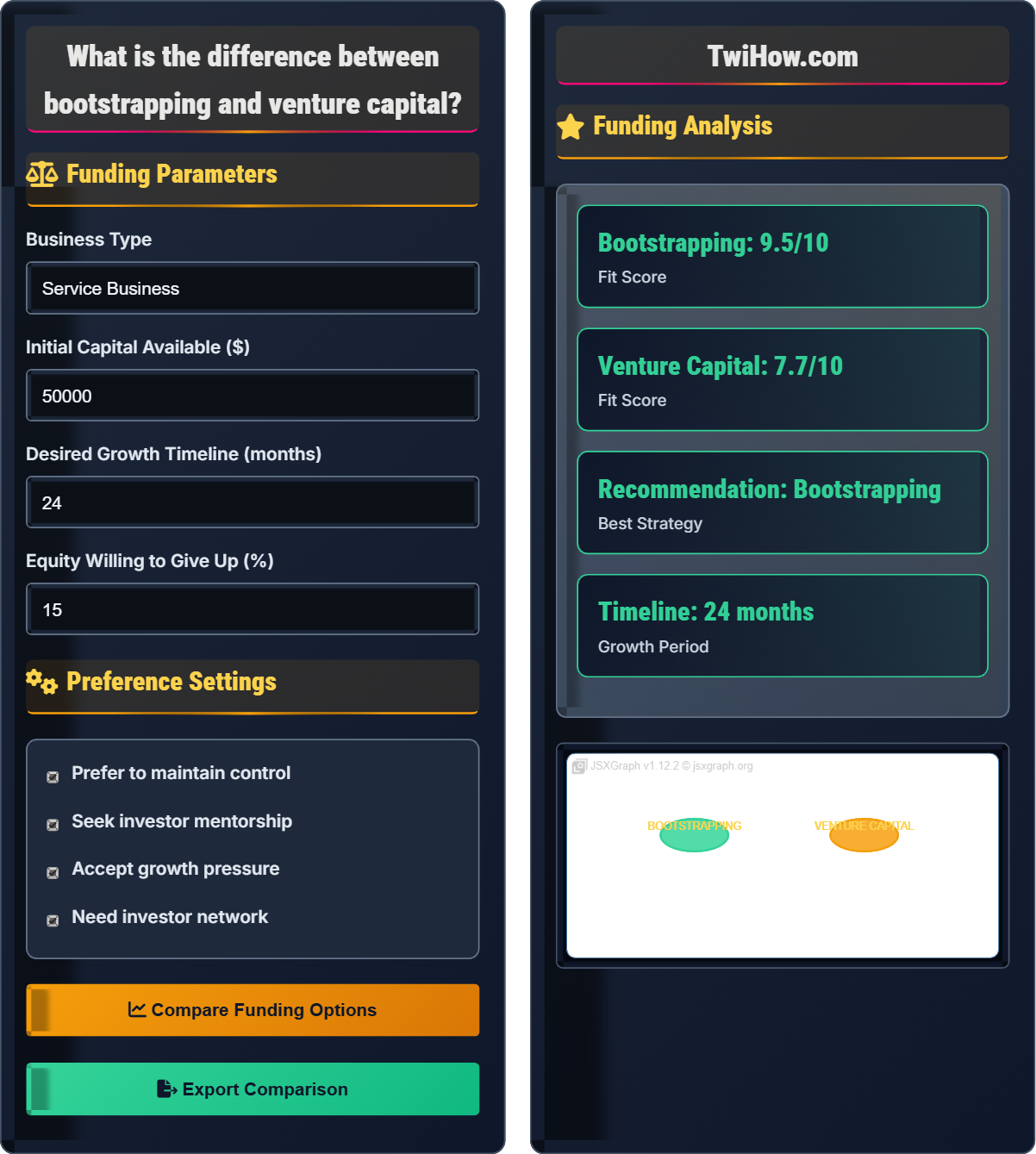
Funding Comparison:
Show Funding AnalyzerBootstrapping and venture capital represent two fundamentally different approaches to funding a startup. Bootstrapping involves using personal savings, revenue, and minimal external funding, giving entrepreneurs complete control but slower growth. Venture capital involves raising money from investors in exchange for equity, providing rapid growth potential but sacrificing ownership and control.
The choice between these approaches depends on factors like growth goals, risk tolerance, and business model. Both strategies have proven successful for different types of companies and circumstances.
Key differences:
- Ownership: Bootstrapping retains 100% ownership vs. VC dilution
- Control: Bootstrapping maintains autonomy vs. investor influence
- Speed: Bootstrapping grows organically vs. VC-accelerated growth
- Risk: Bootstrapping risks personal finances vs. VC pressure
Modern entrepreneurs often blend approaches, starting with bootstrapping and transitioning to VC funding when appropriate for their growth trajectory.
Funding Parameters
Preference Settings
Funding Analysis
| Aspect | Bootstrapping | VC Funding | Hybrid |
|---|---|---|---|
| Control | High | Low | Medium |
| Capital | Low | High | Medium |
| Speed | Slow | Fast | Medium |
| Risk | Personal | Exit Pressure | Combined |
Bootstrapping vs Venture Capital Comparison
Bootstrapping is a method of starting and growing a business using personal savings, revenue from the business, and minimal external funding. It emphasizes frugality, organic growth, and maintaining complete control over the company. Bootstrapped companies typically grow more slowly but maintain independence.
venture capital is a form of private equity financing where investors provide capital to startups in exchange for equity ownership. VCs typically invest in high-growth companies with scalable business models, expecting significant returns through acquisitions or IPOs. They often provide mentorship and strategic guidance.
Framework for comparing bootstrapping vs VC funding:
Where:
- Control: Degree of autonomy desired
- Capital Need: Amount of funding required
- Growth Timeline: Speed of growth desired
- Risk Tolerance: Comfort with financial risk
Companies using different funding strategies:
- Bootstrapping: Basecamp, Mailchimp, GitHub (initially)
- VC Funding: Uber, Airbnb, Facebook, Google
- Hybrid: Shopify (started with personal funds, later took VC)
- Bootstrapped Success: Buffer, Ghost, Stripe
- Business Model: Capital-intensive vs. service-based
- Market Size: Large markets favor VC, niche markets favor bootstrapping
- Growth Speed: Rapid growth requires significant capital
- Founder Preferences: Control vs. growth orientation
- Exit Strategy: IPO potential vs. lifestyle business
Funding Fundamentals
Bootstrapping, venture capital, equity financing, capital structure, ownership dilution, investor relations, cash flow management.
Funding Score = Control × Capital Need × Growth Timeline × Risk Tolerance
Where Funding Score = overall strategy fit, Control = degree of autonomy, Capital Need = funding requirement.
- Match funding strategy to business model
- Consider long-term implications
- Plan for growth requirements
Applications
Startups, small businesses, tech companies, service providers, product companies.
- Assess business model and needs
- Evaluate personal resources
- Define growth goals
- Consider market conditions
- Choose appropriate strategy
- Industry and market size
- Founder experience and network
- Capital requirements
- Control preferences
Funding Learning Quiz
Which business type is most suitable for bootstrapping?
The correct answer is B) Software service with low capital requirements. Software businesses typically have low upfront capital needs, can generate revenue quickly, and can scale with minimal additional investment. This makes them ideal for bootstrapping. Hardware startups, biotech companies, and restaurant chains typically require significant upfront investment that exceeds what most entrepreneurs can self-fund.
Bootstrapping works best for businesses that can start with minimal capital and generate cash flow early in their lifecycle.
The key to choosing the right funding strategy lies in understanding your business's capital requirements. Bootstrapping is only feasible when the initial capital needed is within the entrepreneur's financial capacity. Service-based businesses and software companies typically have lower capital barriers to entry compared to manufacturing, biotech, or real estate ventures. The business model's capital intensity is the primary determinant of which funding strategy is appropriate.
Capital Requirements: Amount of money needed to start and operate
Bootstrapping: Self-funding without external investment
Capital Intensity: How much money is needed to operate
• Match strategy to capital needs
• Consider growth requirements
• Evaluate personal resources
• Calculate minimum viable capital
• Consider revenue model
• Assess market size
• Underestimating capital needs
• Choosing strategy without analysis
• Not considering growth requirements
Explain the concept of equity dilution in venture capital and describe its impact on founders and employees.
Equity Dilution: The reduction in ownership percentage that occurs when a company issues new shares to investors. For example, if a founder owns 100% of a company and raises funding by selling 20% to investors, the founder's ownership drops to 80%.
Impact on Founders: Loss of control and voting power, reduced share of future profits, potential conflicts with investors over strategic decisions. However, if the investment leads to significant growth, the smaller percentage may be worth more than the original 100%.
Impact on Employees: Employee stock option pools are often diluted, reducing the value of equity compensation. However, if the company grows significantly, the diluted equity may still be worth more than pre-funding equity.
The key is ensuring that the value created by the investment outweighs the dilution effect.
Equity dilution is a fundamental concept in startup financing that represents the trade-off between growth capital and ownership. While dilution reduces the percentage of ownership, it can increase the absolute value of holdings if the investment leads to significant growth. The challenge for entrepreneurs is to balance the need for growth capital with the desire to maintain control and maximize ownership value. Understanding dilution helps founders make informed decisions about how much equity to give up at each funding round.
Equity Dilution: Reduction in ownership percentage
Stock Option Pool: Shares reserved for employees
Voting Power: Influence in company decisions
• Calculate dilution impact
• Consider value creation
• Plan equity allocation
• Negotiate terms carefully
• Plan for multiple rounds
• Consider employee impact
• Giving up too much equity early
• Not understanding dilution effects
• Poor employee equity planning
You're starting a SaaS company with $100,000 in savings. The business model requires $50,000 for initial development and you can generate $2,000 in monthly revenue after launch. You need $200,000 to scale to 100 customers. Should you bootstrap or seek VC funding? Explain your reasoning.
Analysis: With $100,000 savings and $50,000 needed for development, you have enough for initial development. At $2,000 monthly revenue, it would take 100 months ($200,000 ÷ $2,000) to accumulate the $200,000 needed for scaling. This is too long for competitive markets.
Recommendation: Consider a hybrid approach. Bootstrap the initial development and early revenue generation, then seek angel or seed funding once you have proof of concept and early customers. This validates the business model while minimizing dilution.
Alternative: Explore revenue-based financing or strategic partnerships that don't require equity dilution but provide growth capital.
This scenario demonstrates the importance of cash flow analysis in funding decisions. While bootstrapping is technically possible, the timeline to reach scale is prohibitively long. The hybrid approach balances the benefits of both strategies: initial bootstrapping to prove the concept, followed by external funding to accelerate growth. This approach minimizes dilution while providing the capital needed for competitive growth. The key insight is that funding decisions should be viewed as a series of stages rather than a single binary choice.
Cash Flow Analysis: Calculating money in and out over time
Proof of Concept: Demonstrating business viability
Hybrid Approach: Combining multiple funding strategies
• Analyze cash flow timelines
• Consider market timing
• Plan staged funding
• Calculate break-even time
• Consider market competition
• Plan for multiple funding rounds
• Not calculating growth timelines
• Ignoring market timing
• Failing to plan staged funding
You've raised $2M from VCs and now have investors on your board. They're pushing for aggressive growth that conflicts with your vision of sustainable profitability. How do you manage this relationship while maintaining your core business values?
Communication: Schedule regular meetings to discuss your vision and strategy. Present data that supports your approach to sustainable growth.
Negotiation: Propose alternative metrics that align with your values while meeting investor expectations (e.g., unit economics, customer lifetime value).
Compromise: Consider a balanced approach that incorporates both perspectives - perhaps accelerated growth in profitable segments.
Documentation: Ensure your rights and protections are documented in the shareholder agreement.
Exit Strategy: If irreconcilable differences exist, consider buyback options or bringing in additional investors who align with your vision.
This scenario highlights the tension between founder vision and investor expectations that often arises after securing VC funding. The key is establishing clear communication channels and finding alignment points that satisfy both parties. It's crucial to understand that bringing in investors means accepting their input in strategic decisions. The solution involves balancing fiduciary responsibilities to investors with personal values and long-term vision. Proactive communication and strategic planning can prevent many conflicts from arising.
Fiduciary Responsibility: Obligation to act in investors' interests
Unit Economics: Profitability per customer unit
Shareholder Agreement: Legal document governing rights
• Communicate proactively
• Present data-driven arguments
• Document agreements clearly
• Set expectations early
• Use data to support arguments
• Find win-win solutions
• Avoiding difficult conversations
• Not documenting agreements
• Ignoring investor concerns
Under what market conditions is venture capital funding most attractive?
The correct answer is B) Fast-growing markets with high competition. Venture capitalists seek companies with the potential for rapid growth and significant returns. In fast-growing markets, companies can capture market share quickly with adequate funding. High competition often indicates market opportunity and validates the business model. VCs provide capital to help companies win in competitive markets.
VCs typically avoid slow-growing, niche, or mature markets where the potential for outsized returns is limited.
Understanding VC motivations is crucial for determining if your business is suitable for venture funding. VCs are looking for "unicorns" - companies that can return 10x or more on their investment. This typically requires entering large, fast-growing markets where significant scale is possible. The competition factor is important because VCs want to invest in companies that can win in competitive environments, demonstrating strong product-market fit and execution capability. The market conditions must support the high-growth, high-return model that VC firms are structured to pursue.
Unicorn: Startup valued at $1B+
Market Opportunity: Size and growth potential
Product-Market Fit: Product solving real market need
• Match business to VC model
• Assess market potential
• Understand investor motivations
• Research market size
• Analyze competition
• Validate growth potential
• Seeking VC for slow markets
• Misjudging market size
• Not understanding VC goals
FAQ
Q: Can I switch from bootstrapping to VC funding later if my business grows?
A: Absolutely! Many successful companies start by bootstrapping to prove the concept and achieve early traction before seeking VC funding. This approach is often preferred by investors as it demonstrates that the business model works without external funding. Bootstrapping first allows you to retain more equity and enter negotiations from a position of strength. However, be aware that transitioning to VC funding requires significant changes in operations, reporting, and governance. You'll need to implement proper accounting, legal structures, and investor reporting systems. The key is timing - raise capital when you have proof of concept but need capital to scale.
Q: What are the hidden costs of venture capital beyond equity dilution?
A: Beyond equity dilution, there are several hidden costs of VC funding: 1) Loss of operational control and decision-making autonomy, 2) Pressure to grow at all costs, which can compromise long-term sustainability, 3) Extensive reporting requirements and administrative burden, 4) Potential conflicts with investors over strategic direction, 5) Pressure to exit through acquisition or IPO within 5-10 years, 6) Board obligations and governance requirements, 7) Potential for forced management changes, and 8) Costs associated with future funding rounds and dilution. Additionally, the time investment required for fundraising, investor relations, and board meetings can be substantial. It's important to weigh these costs against the benefits of capital, mentorship, and network access that VCs provide.