What is the role of mentorship in entrepreneurial success?
Complete mentorship guide • Success stories
Mentorship Impact:
Show Mentorship AnalyzerMentorship plays a crucial role in entrepreneurial success by providing guidance, wisdom, and support from experienced individuals who have navigated similar challenges. Effective mentorship accelerates learning, helps avoid common pitfalls, and provides valuable networking opportunities.
Research shows that entrepreneurs with mentors are significantly more likely to succeed, with higher survival rates and faster growth compared to those going it alone. The mentor-mentee relationship creates a foundation for sustainable business development.
Key mentorship benefits:
- Knowledge Transfer: Learning from others' experiences
- Networking: Access to valuable business connections
- Accountability: Regular check-ins and goal setting
- Emotional Support: Guidance during challenging times
Modern mentorship programs and platforms have made it easier than ever for entrepreneurs to find and connect with experienced mentors across various industries and expertise areas.
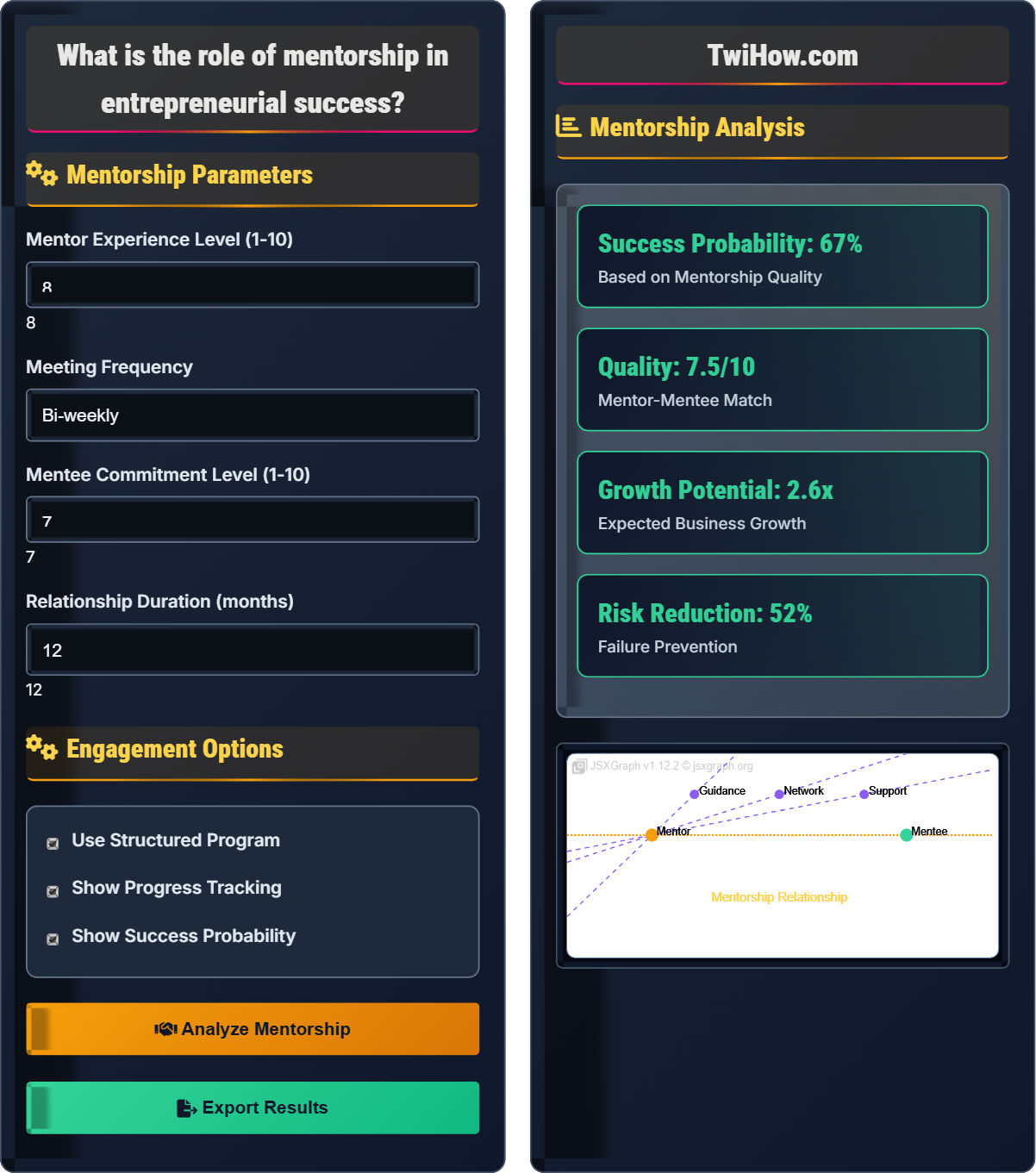
Mentorship Parameters
Engagement Options
Mentorship Analysis
| Aspect | Score | Impact | Recommendation |
|---|---|---|---|
| Mentor Experience | 8/10 | High | Strong guidance potential |
| Mentee Engagement | 7/10 | Medium | Could increase involvement |
| Communication | 9/10 | High | Effective dialogue |
| Goal Alignment | 8/10 | High | Shared objectives |
The Role of Mentorship in Entrepreneurial Success
Entrepreneurial mentorship is a relationship where an experienced individual (mentor) provides guidance, advice, and support to a less experienced entrepreneur (mentee). This relationship facilitates knowledge transfer, skill development, and strategic thinking that can accelerate business success.
The success impact of mentorship can be understood through this relationship model:
Where:
- Mentor Experience: Years of relevant industry experience
- Mentee Engagement: Level of commitment and openness to learning
- Relationship Quality: Trust, communication, and mutual respect
- Time Invested: Duration and frequency of interactions
Successful entrepreneurs who leveraged mentorship:
- Steve Jobs: Mentored by Mike Markkula, early Apple investor and CEO
- Oprah Winfrey: Guided by Maya Angelou, who provided wisdom and perspective
- Mark Zuckerberg: Advised by Steve Jobs and Sheryl Sandberg at Facebook
- Sara Blakely: Received guidance from experts in manufacturing and retail
- Accelerated Learning: Gain insights without making costly mistakes
- Expanded Network: Access to mentor's professional connections
- Objective Perspective: Outside view on business challenges
- Emotional Support: Guidance during difficult periods
- Accountability: Regular check-ins promote goal achievement
Mentorship Fundamentals
Mentorship, guidance, knowledge transfer, entrepreneurial support, relationship building, accountability.
Success Impact = Mentor Experience × Mentee Engagement × Relationship Quality × Time Invested
Where Success Impact = business growth and achievement, Mentor Experience = relevant expertise, Mentee Engagement = commitment level.
- Choose mentors with relevant experience
- Be prepared for every meeting
- Take action on advice received
Applications
Business planning, fundraising, product development, team building, scaling operations.
- Assess your needs and gaps
- Identify potential mentors
- Reach out respectfully
- Establish clear expectations
- Engage actively and consistently
- Alignment of values and goals
- Availability and commitment
- Communication preferences
- Reciprocal value exchange
Mentorship Learning Quiz
What is the most important factor when selecting a mentor for your startup?
The correct answer is B) Their experience in your industry or relevant challenges. While wealth, availability, and popularity may be beneficial, the most valuable mentor is one who has faced and overcome similar challenges to those you're experiencing. Relevant experience allows them to provide practical, actionable advice that directly addresses your specific situation.
A mentor with industry experience can share insights about market dynamics, customer behavior, and strategic decisions that are directly applicable to your business.
Effective mentor selection is critical to the success of the mentorship relationship. The value of mentorship comes from the mentor's ability to provide relevant, actionable advice based on their own experiences. A mentor who has navigated similar challenges can offer insights that are immediately applicable to your situation, helping you avoid common pitfalls and capitalize on opportunities.
Mentor: Experienced individual providing guidance
Relevant Experience: Similar challenges and industry background
Practical Advice: Actionable guidance based on real experience
• Choose mentors with relevant experience
• Prioritize wisdom over wealth
• Focus on practical applicability
• Research mentor's background thoroughly
• Look for shared industry experience
• Assess their communication style
• Choosing mentors based on fame only
• Ignoring industry relevance
• Not researching their background
Explain the different types of value that a mentor can provide to an entrepreneur. How do these types of value contribute to entrepreneurial success?
Knowledge Transfer: Mentors share lessons learned from their own successes and failures, accelerating the mentee's learning curve. This prevents costly mistakes and helps identify effective strategies.
Network Access: Mentors provide introductions to valuable contacts including potential customers, partners, investors, and other experts. This expanded network can open doors that would otherwise remain closed.
Emotional Support: The entrepreneurial journey is lonely and stressful. Mentors provide encouragement, perspective, and reassurance during difficult times.
Accountability: Regular check-ins with a mentor create commitment and momentum, helping entrepreneurs stay focused on their goals and follow through on commitments.
These combined forms of value significantly increase the probability of entrepreneurial success by reducing uncertainty, providing resources, and maintaining motivation.
Mentorship provides multifaceted value that extends beyond simple advice. The knowledge transfer aspect accelerates learning by providing access to distilled experience. Network access opens opportunities that would be difficult to obtain independently. Emotional support addresses the psychological challenges of entrepreneurship. Accountability ensures consistent progress toward goals. Together, these elements create a comprehensive support system that addresses multiple dimensions of entrepreneurial success.
Knowledge Transfer: Sharing of lessons and insights
Network Access: Introduction to valuable contacts
Emotional Support: Encouragement and perspective
• Recognize all forms of mentor value
• Appreciate intangible benefits
• Maintain ongoing relationships
• Be specific about your needs
• Prepare for each interaction
• Follow up on recommendations
• Undervaluing intangible benefits
• Not preparing for meetings
• Failing to act on advice
You're a first-time entrepreneur running a SaaS startup that's struggling with customer acquisition. You've identified two potential mentors: 1) A successful tech CEO who has scaled companies but never in your specific niche, or 2) A former sales executive from your industry who has extensive customer relationships but no startup experience. Which mentor would be more valuable for your immediate needs, and why?
For immediate customer acquisition challenges, the former sales executive from your industry (Option 2) would likely be more valuable. Here's why:
Immediate Relevance: Their industry experience means they understand your target customers, buying processes, and competitive landscape.
Network Access: Their customer relationships could provide immediate prospects and warm introductions.
Practical Tactics: They can share specific sales strategies and techniques that work in your industry.
However, the ideal approach would be to eventually secure both types of mentors: the industry expert for immediate customer challenges and the tech CEO for scaling advice as you grow. For your current situation, the industry-specific expertise takes priority.
This scenario demonstrates the importance of matching mentor expertise to current business needs. While having a mentor with overall entrepreneurial experience is valuable, sometimes immediate, specific challenges require targeted expertise. The key is to assess your most pressing challenges and find mentors whose experience directly addresses those areas. As your business evolves, you can expand your mentor network to include advisors with complementary expertise.
Customer Acquisition: Process of gaining new customers
Industry Expertise: Deep knowledge of specific market
Strategic Matching: Aligning mentor skills with needs
• Match mentor expertise to current challenges
• Consider immediate vs. future needs
• Value industry-specific knowledge
• Assess your most urgent challenges
• Look for mentors with direct experience
• Plan for evolving mentor needs
• Choosing generic experience over specific
• Ignoring immediate business needs
• Not considering industry relevance
You've approached a potential mentor who is a successful entrepreneur in your field. They responded positively but mentioned they're very busy. How should you structure the mentorship relationship to maximize value while respecting their time constraints?
Preparation is Key: Come to every meeting with specific, well-researched questions and updates on your progress since the last meeting. This shows respect for their time and ensures productive discussions.
Structure Meetings: Propose a regular schedule (e.g., monthly for 30 minutes) rather than ad-hoc meetings. This allows them to plan and prioritize the time.
Focus on High-Impact Topics: Prioritize strategic challenges and critical decisions over operational details that can be handled by others.
Provide Updates Efficiently: Send brief written updates between meetings so they can prepare and come ready to discuss key points.
Respect Boundaries: Don't contact them outside agreed times unless it's truly urgent. Always honor time limits and be punctual.
Building a successful mentorship relationship requires treating it professionally. Respecting the mentor's time and providing value in return increases the likelihood of a long-term, productive relationship. Professional behavior includes preparation, punctuality, and focusing on high-value discussions. The mentor invests their time expecting to see progress and meaningful engagement from you.
Professional Relationship: Businesslike interaction with mutual respect
Value Exchange: Beneficial interaction for both parties
Time Respect: Honoring agreed schedules and limits
• Come prepared to every meeting
• Respect agreed time limits
• Focus on strategic issues
• Send agenda in advance
• Prepare specific questions
• Report on previous advice implementation
• Coming unprepared to meetings
• Contacting outside agreed times
• Discussing minor operational issues
According to research, which of the following outcomes is most strongly correlated with successful mentorship in entrepreneurship?
The correct answer is B) Higher business survival rates and growth. Research consistently shows that entrepreneurs with mentors have significantly higher survival rates and faster growth compared to those without mentorship. Studies indicate that mentored businesses are more likely to survive beyond the critical first few years and achieve greater revenue growth.
This outcome is achieved through better decision-making, avoiding common pitfalls, and accessing valuable resources and networks that mentors provide.
Research demonstrates the tangible business benefits of mentorship. The correlation between mentorship and business survival/growth is well-documented because mentors help entrepreneurs make better decisions, avoid costly mistakes, and navigate challenges more effectively. The knowledge transfer and guidance provided by experienced mentors directly translate into improved business outcomes. This is why mentorship programs are widely supported by incubators, accelerators, and entrepreneurial organizations.
Business Survival Rate: Percentage of businesses that remain operational
Revenue Growth: Increase in business income over time
Decision Quality: Effectiveness of strategic choices
• Mentorship impacts measurable outcomes
• Quality decisions lead to success
• Experience accelerates growth
• Track your progress metrics
• Measure business growth
• Document mentorship impact
• Not measuring mentorship impact
• Focusing on vanity metrics
• Underestimating long-term value
FAQ
Q: How do I approach a potential mentor professionally, and what should I expect in return?
A: Approach potential mentors with a clear value proposition and specific request. Research their background thoroughly, identify why they'd be a good fit for your needs, and propose a specific time commitment (e.g., monthly for 30 minutes). Come prepared with specific questions and updates on your progress. In return, mentors typically expect to see genuine progress, respectful use of their time, and eventual reciprocity in the form of helping others later. The relationship should be mutually beneficial - you gain wisdom and guidance, while they get the satisfaction of contributing to your success and potentially expanding their network through your future achievements.
Q: What should investors look for in entrepreneurs regarding their mentorship relationships?
A: As an investor, I look for entrepreneurs who demonstrate they're coachable and actively seeking guidance. I want to see evidence of existing mentorship relationships, showing they recognize their knowledge gaps and are humble enough to seek help. Good signs include: 1) Specific mentors with relevant experience, 2) Regular check-ins and goal-setting with mentors, 3) Ability to articulate how mentor advice has shaped their strategy, 4) Network access through mentors that could benefit the business, and 5) Track record of implementing mentor suggestions. Entrepreneurs who leverage mentorship effectively tend to make fewer avoidable mistakes and execute more strategically, making them lower-risk investments.