How Do I Protect Myself From Financial Scams?
Complete guide • Step-by-step protection strategies
Financial Security Fundamentals:
Show Scam Risk CalculatorFinancial scams are fraudulent schemes designed to steal money or personal information from victims. They come in many forms including phishing emails, investment fraud, fake charity requests, and identity theft. Protection requires awareness, verification, and proactive security measures.
Common scam types:
- Phishing: Fake emails/links to steal login credentials
- Investment Scams: Promises of high returns with little risk
- Identity Theft: Unauthorized use of personal information
- Charity Fraud: Fake organizations soliciting donations
Effective protection combines education, verification protocols, and technological safeguards to create multiple layers of defense against financial fraud.
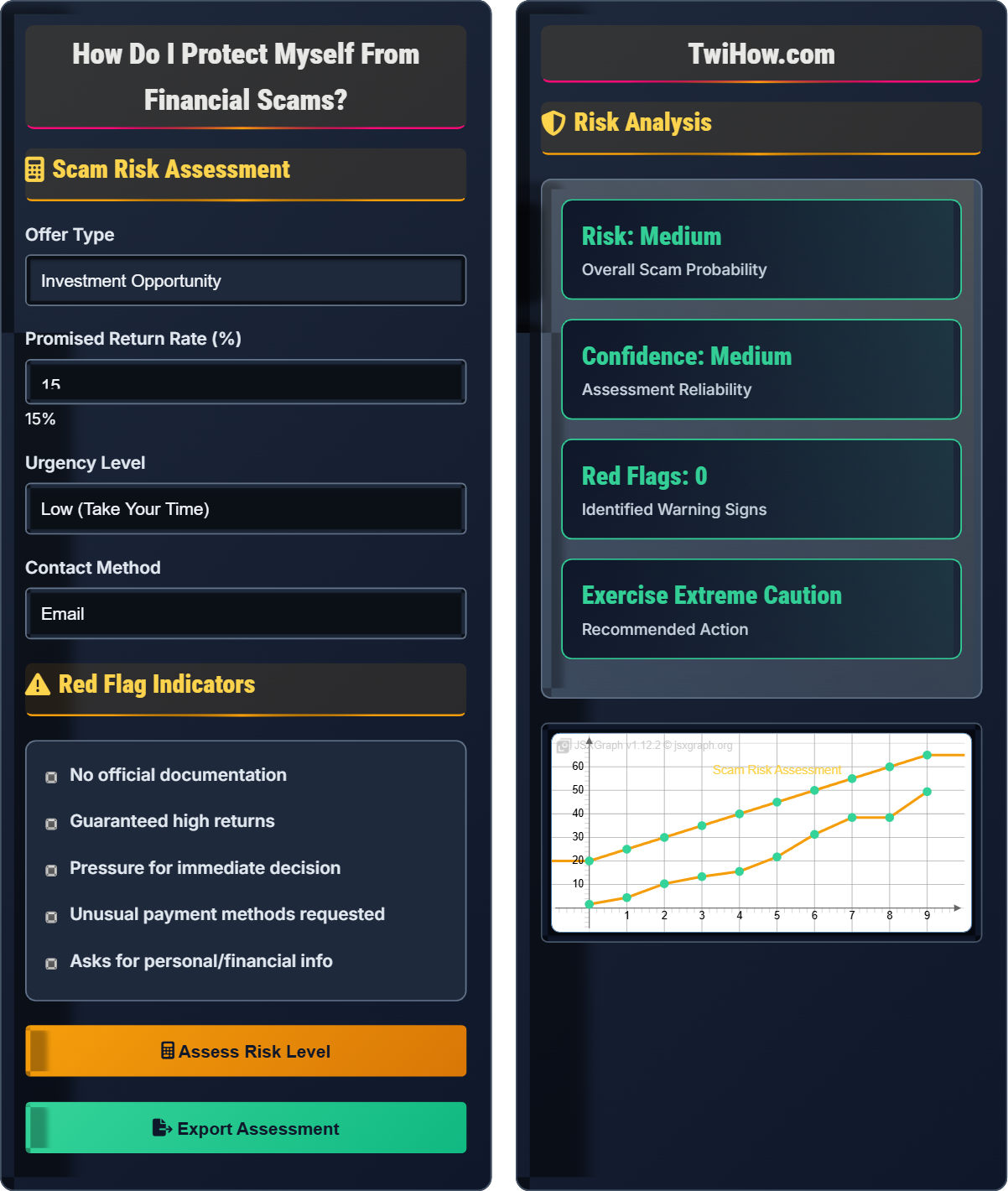
Scam Risk Assessment
Red Flag Indicators
Risk Analysis
| Factor | Score | Weight | Impact |
|---|---|---|---|
| Offer Type | Low | 20% | Safe |
| Return Promise | Medium | 25% | Moderate |
| Urgency | Low | 15% | Safe |
| Contact Method | Low | 10% | Safe |
| Red Flags | 0 | 30% | Safe |
Verification Checklist
- Check company registration with authorities
- Search for reviews and complaints online
- Verify contact information independently
- Consult with trusted advisors
- Request written documentation
Financial Scam Prevention Explained
Financial scams are fraudulent schemes designed to deceive individuals into giving up their money or personal information. These scams often promise unrealistic returns, exploit emotional triggers, or create false urgency to pressure victims into making hasty decisions without proper verification.
Scam probability is calculated using multiple factors:
Where:
- Factor_i: Individual risk factor score (0-100)
- Weight_i: Importance weight of each factor
- Total Weight: Sum of all weights (100%)
Major categories of financial scams:
- Investment Fraud: Ponzi schemes, pyramid schemes, fake investment opportunities
- Identity Theft: Credit card fraud, tax identity theft, medical identity theft
- Online Fraud: Phishing, romance scams, fake websites
- Insurance Fraud: Fake insurance policies, premium scams
- Charity Fraud: Fake charities, disaster relief scams
- Two-Factor Authentication: Add extra layer of security
- Regular Monitoring: Check accounts frequently
- Suspicious Activity Reports: Notify institutions immediately
- Education: Stay informed about new scam tactics
- Secure Communication: Verify requests through official channels
Protection Fundamentals
Scam identification, verification protocols, risk assessment, red flag recognition.
Scam probability = Σ(Factor score × Weight) / Total weight
Where Factor score = individual risk indicator, Weight = importance factor.
- If it seems too good to be true, it probably is
- Never give personal info to unsolicited contacts
- Always verify through independent sources
Real-World Examples
Phishing emails, investment fraud, lottery scams, identity theft, charity fraud.
- Check sender authenticity
- Verify promises through research
- Look for grammatical errors
- Confirm through official channels
- Use secure networks
- Monitor accounts regularly
- Update security software
- Shred sensitive documents
Financial Scam Prevention Quiz
You receive an email claiming to be from your bank, stating your account has been compromised and asking you to click a link to verify your account details. Which of the following is the BEST course of action?
This is a classic phishing attempt. Legitimate banks will never ask for sensitive information via email. The correct approach is to independently verify the communication by contacting the bank through official channels (the number on your card or official website).
The answer is B) Call your bank using the number on your debit card to verify.
Phishing is one of the most common financial scams where fraudsters impersonate trusted entities to steal personal information. The key principle is to never trust unsolicited communications requesting sensitive information. Always verify through independent means before providing any personal data. This creates a "verification loop" that protects against social engineering attacks.
Phishing: Fraudulent attempt to obtain sensitive information by disguising as trustworthy entity
Social Engineering: Psychological manipulation to trick people into revealing confidential information
Verification Loop: Independent confirmation process to validate communications
• Legitimate organizations don't request sensitive info via email
• Always verify through official, independent channels
• Never click links in unsolicited emails
• Look for generic greetings ("Dear Customer") instead of your name
• Hover over links to see actual destination URLs
• Check for spelling and grammar errors
• Trusting email appearance over verification
• Acting quickly without proper verification
• Sharing personal information via email
Explain how to identify and protect against investment scams that promise unusually high returns with "little or no risk." What are the warning signs and verification steps you should take?
Warning Signs: Guarantees of high returns, pressure for immediate decisions, lack of proper documentation, unregistered investments, promises of "risk-free" profits.
Verification Steps: Check with SEC/FINRA databases, verify advisor licenses, research company history, request written contracts, consult with licensed financial advisors.
Protection Strategy: Remember that legitimate investments carry inherent risks, and higher returns typically require accepting higher risks.
Investment scams often exploit greed and fear of missing out. The fundamental economic principle that "higher returns require higher risk" is consistently violated by scammers. Understanding this principle helps investors recognize unrealistic promises. The verification process involves multiple independent checks to confirm legitimacy before investing any money.
Ponzi Scheme: Fraudulent investment operation paying returns to earlier investors with funds from newer ones
SEC Registration: Securities and Exchange Commission verification of investment offerings
Risk-Return Tradeoff: Economic principle that higher returns require accepting higher risks
• If returns seem too good to be true, they probably are
• Always verify through official regulatory databases
• Take time to research before investing
• Research on FINRA BrokerCheck
• Verify with SEC EDGAR database
• Consult with licensed financial professionals
• Being influenced by pressure tactics
• Not researching investment credentials
• Investing without proper documentation
Your credit card company calls you claiming there's suspicious activity on your account and asks for your card number and PIN to verify your identity. They say they'll send someone to your house to pick up your card and replace it. How should you handle this situation, and what are the proper verification steps?
Immediate Response: Hang up immediately. Legitimate credit card companies will never ask for full card numbers or PINs over the phone. They also don't send representatives to collect cards.
Proper Verification: Call the customer service number on the back of your card using a different phone. Do not call back the number that called you.
Additional Steps: Report the incident to your credit card company, monitor your account for unauthorized charges, and consider placing a fraud alert on your credit reports.
This scenario demonstrates a sophisticated social engineering attack. Fraudsters often use "pretexting" - creating a believable story to gain trust. The key principle is that legitimate financial institutions have established protocols and will never ask for sensitive information through unsolicited calls. The verification method must use independently confirmed contact information, not information provided by the suspected fraudster.
Pretexting: Social engineering technique using fabricated scenarios to obtain information
Independent Verification: Confirming information through sources not controlled by suspectFraud Alert: Notification to creditors to verify identity before extending credit
• Financial institutions never ask for PINs over phone
• Always verify through independently confirmed numbers
• Never give full card numbers to unsolicited callers
• Keep official numbers in your records
• Use reverse phone lookup for unknown numbers
• Document suspicious calls with details
• Providing information to unsolicited callers
• Calling back the number that contacted you
• Not monitoring accounts after suspicious activity
A charity contacts you via social media claiming to support disaster relief efforts and asks for immediate donations. They provide a PayPal link and say they're registered with the government. How would you verify this charity's legitimacy, and what are the red flags you should look for?
Verification Steps: Check with GuideStar, Charity Navigator, or state charity registries. Verify the charity's tax-exempt status with the IRS. Research the organization's history and financial transparency.
Red Flags: Unsolicited social media requests, pressure for immediate donations, vague mission statements, refusal to provide financial information, using PayPal for donations instead of official channels.
Best Practices: Research before donating, give directly through official websites, verify tax-deductible status.
Charity scams exploit empathy and the desire to help others. The verification process requires checking multiple independent sources to confirm legitimacy. Scammers often create fake organizations during disasters when emotions run high. Understanding the proper verification channels helps protect both your money and your desire to help worthy causes.
Charity Navigator: Organization rating charity transparency and accountability
Tax-Exempt Status: IRS designation allowing tax deductions for donations
Disaster Relief Scams: Fraudulent fundraising during crisis events
• Verify through independent charity databases
• Check financial transparency
• Give through official channels only
• Use GuideStar or Charity Navigator first
• Check financial reports for overhead costs
• Research leadership and mission alignment
• Donating immediately without verification
• Giving to social media appeals
• Not checking financial transparency
Which of the following is the MOST effective combination of security practices to protect financial accounts from unauthorized access?
The most effective approach combines multiple security layers. Two-factor authentication adds a critical second verification step beyond passwords. Regular monitoring allows for immediate detection of unauthorized activity. Together, they provide both prevention and early detection capabilities.
The answer is B) Two-factor authentication and regular monitoring.
Account security follows the principle of defense in depth - multiple layers of protection that work together. Two-factor authentication addresses password vulnerabilities by requiring a second factor (something you have, not just something you know). Regular monitoring provides early detection of breaches that may have bypassed other security measures. This combination addresses both prevention and detection aspects of security.
Two-Factor Authentication (2FA): Security process requiring two different authentication factors
Defense in Depth: Security strategy using multiple layers of protection
Security Monitoring: Continuous observation for suspicious activities
• Use unique, complex passwords for each account
• Enable 2FA wherever possible
• Monitor accounts regularly for unusual activity
• Use password managers for unique passwords
• Set up account alerts for transactions
• Review account statements monthly
• Reusing passwords across accounts
• Disabling security features for convenience
• Not monitoring accounts regularly
FAQ
Q: How can I tell if an investment opportunity is legitimate?
A: To verify an investment opportunity:
1. Check Registration: Verify with the SEC's EDGAR database and FINRA's BrokerCheck system
2. Research the Advisor: Confirm licenses through your state securities regulator
3. Review Documentation: Legitimate investments provide detailed prospectuses and offering documents
4. Understand the Business: You should comprehend exactly how the investment generates returns
5. Verify Contact Information: Confirm office locations and phone numbers independently
Red flags include promises of guaranteed high returns, pressure to invest quickly, and inability to provide proper documentation.
Q: What should I do if I think I've fallen victim to a financial scam?
A: If you've been scammed:
1. Stop Further Contact: Cease all communication with the scammer immediately
2. Contact Your Bank: Report the fraud and request account freezes if necessary
3. File Reports: Report to the FTC at ReportFraud.ftc.gov and your local police
4. Document Everything: Save all communications, receipts, and transaction records
5. Freeze Your Credit: Contact credit bureaus to place fraud alerts
6. Seek Professional Help: Consult with a consumer protection attorney if significant amounts were lost
Time is crucial - act quickly to potentially recover funds and prevent further damage.
Q: Are seniors more likely to be targeted by financial scams?
A: Yes, seniors are disproportionately targeted by financial scammers for several reasons:
1. Accumulated Wealth: Often have substantial savings and home equity
2. Trust in Authority: More likely to believe official-sounding communications
3. Technology Gaps: May be less familiar with online scam tactics
4. Isolation: Loneliness can make them susceptible to "relationship" scams
Common scams targeting seniors include grandparent scams, Medicare fraud, and home improvement scams. Family members should discuss scam awareness and establish verification protocols for financial decisions.
Education and open communication are the best defenses against targeting of vulnerable populations.