What Is the Best Way to Track My Spending?

Complete guide • Step-by-step tracking strategies

Spending Tracking Fundamentals:

Show Expense Tracker

Tracking your spending is the foundation of good financial management. It helps you understand where your money goes, identify unnecessary expenses, and make informed decisions about your financial priorities. Effective tracking methods include manual recording, budgeting apps, bank integration, and spreadsheets.

Popular tracking methods:

  • Manual Tracking: Writing down expenses in a notebook or app
  • Budgeting Apps: Automatic categorization and analysis
  • Bank Integration: Automatic transaction importing
  • Spreadsheets: Customizable tracking with formulas

The best method depends on your spending habits, tech comfort level, and time availability. The key is consistency and choosing a method that you'll actually use regularly.

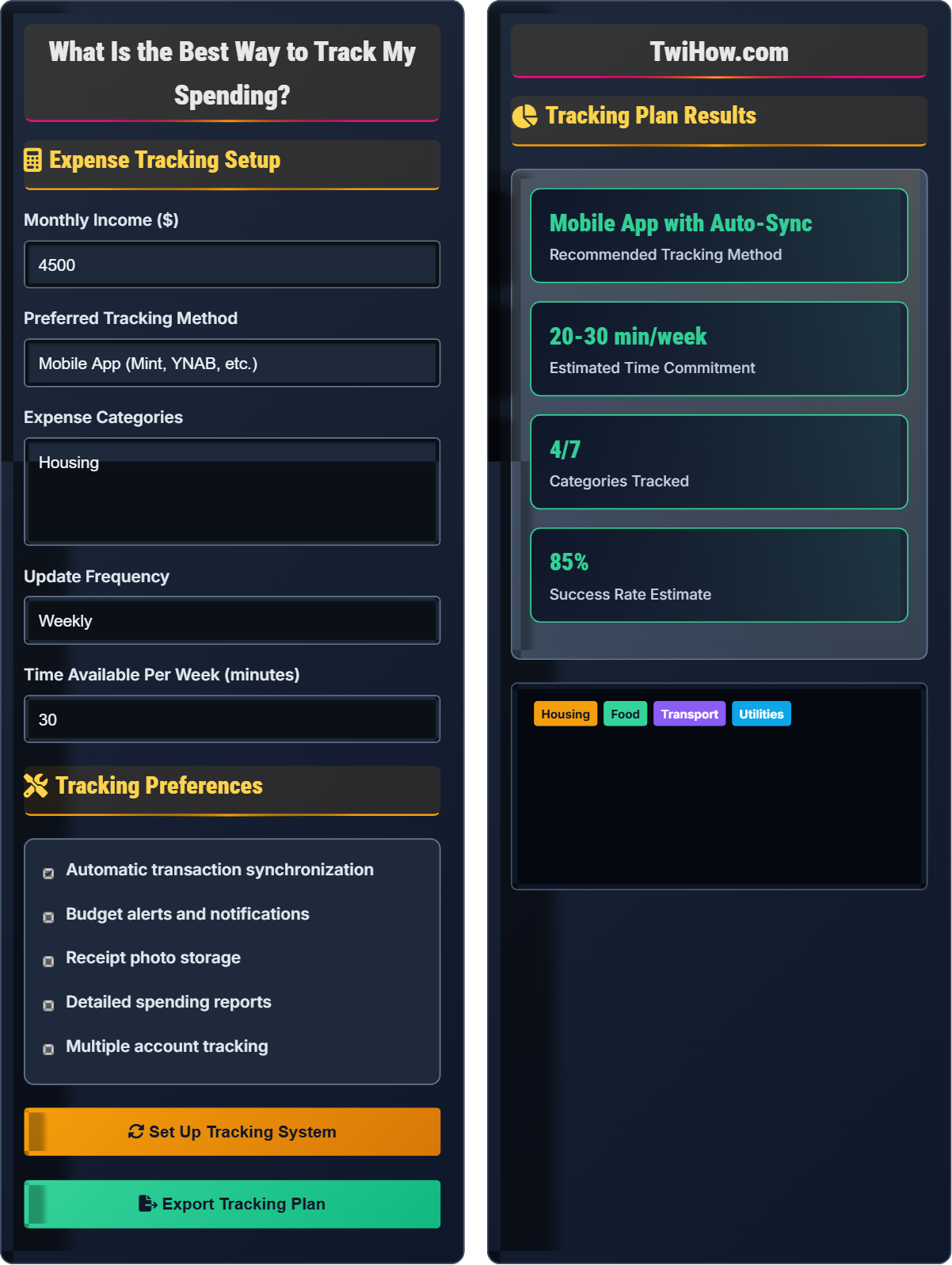
Expense Tracking Setup

Tracking Preferences

Tracking Plan Results

Mobile App
Recommended Tracking Method
25 min/week
Estimated Time Commitment
5/7
Categories Tracked
85%
Success Rate Estimate
Method Pros Cons Time/Week
ManualSimple, no costTime-consuming, error-prone60-90 min
AppAutomatic, detailedLearning curve, privacy concerns20-30 min
BankIntegrated, automaticLess control, limited features15-25 min
SpreadsheetCustomizable, privateRequires maintenance, manual entry30-45 min

Implementation Steps

  • Download recommended app or set up chosen method
  • Connect bank accounts if using app
  • Set up initial categories and budgets
  • Begin tracking all expenses immediately
  • Review and adjust settings weekly

Maintenance Schedule

  • Daily: Record major purchases immediately
  • Weekly: Review and categorize all transactions
  • Monthly: Analyze spending patterns and adjust budget
  • Quarterly: Review goals and update tracking system
  • Annually: Assess effectiveness and make improvements

Spending Tracking Explained

What Is Spending Tracking?

Spending tracking is the process of monitoring and recording all expenses to understand where money is going. This includes purchases, bills, subscriptions, and any money leaving your accounts. Effective tracking helps identify spending patterns, eliminate waste, and ensure expenses align with financial goals.

Tracking Effectiveness Formula

Tracking effectiveness can be measured by:

\text{Effectiveness} = \frac{\text{Tracked Expenses}}{\text{Total Expenses}} \times 100

Where:

  • Tracked Expenses: Amount of spending that is recorded and categorized
  • Total Expenses: All money spent during the tracking period

Tracking Process
1
Choose Method: Select a tracking system that matches your lifestyle and preferences.
2
Set Categories: Define expense categories that reflect your spending patterns.
3
Record Expenses: Consistently log all purchases and expenses.
4
Review Regularly: Analyze spending patterns and identify trends.
5
Adjust Behavior: Make changes based on insights gained from tracking.
Tracking Categories

Common expense categories for effective tracking:

  • Housing: Rent/mortgage, utilities, maintenance
  • Food: Groceries, dining out, beverages
  • Transportation: Gas, public transit, car payments, maintenance
  • Entertainment: Movies, hobbies, subscriptions, travel
  • Healthcare: Insurance, medications, medical visits
  • Personal: Clothing, grooming, gifts, subscriptions
  • Other: Miscellaneous expenses that don't fit other categories
Success Strategies
  • Start Simple: Begin with basic categories and expand gradually
  • Consistency: Track expenses daily or weekly to avoid forgetting
  • Use Technology: Leverage apps and automatic features when possible
  • Review Regularly: Weekly or monthly reviews to identify patterns
  • Set Goals: Use tracking data to set and achieve financial goals

Tracking Fundamentals

Core Concepts

Expense tracking, budgeting, financial monitoring, spending patterns, categorization.

Effectiveness Formula

Effectiveness = (Tracked Expenses / Total Expenses) × 100

Where tracked expenses are recorded and categorized spending.

Key Rules:
  • Track all expenses, not just large ones
  • Be consistent with categorization
  • Review data regularly for insights

Real-World Examples

Case Studies

Student budgeting, family expenses, business owners, retirees.

Tracking Methods
  1. Choose appropriate tracking method for your situation
  2. Set up categories that match your spending patterns
  3. Establish a regular routine for logging expenses
  4. Review and analyze data monthly
  5. Adjust budget based on insights
Best Practices:
  • Use the 50/30/20 rule as a starting point
  • Track for at least 3 months to establish patterns
  • Include seasonal expenses in planning
  • Automate where possible

Spending Tracking Quiz

Question 1: Multiple Choice - Tracking Methods

Which tracking method is most effective for someone with a busy schedule who makes many small purchases?

Solution:

Mobile apps with automatic bank sync are most effective for busy individuals with many small purchases. They automatically import transactions, categorize them (often), and provide real-time insights. This eliminates the need for manual entry while ensuring comprehensive tracking. The convenience factor makes it more likely the user will maintain the habit.

The answer is B) Mobile app with automatic bank sync.

Pedagogical Explanation:

The key principle is matching the tracking method to your lifestyle and habits. For busy individuals, convenience and automation are crucial for maintaining consistency. Manual methods require time and discipline that busy people often lack. Automatic methods leverage technology to maintain accuracy without requiring daily effort, making them more sustainable for long-term use.

Key Definitions:

Automatic Sync: Technology that imports transactions without manual entry

Sustainability: Ability to maintain tracking behavior long-term

Convenience Factor: How easy it is to use the tracking method

Important Rules:

• Match method to lifestyle

• Prioritize sustainability over features

• Consider time constraints

Tips & Tricks:

• Try multiple apps to find the best fit

• Set up alerts for unusual spending

• Use receipt scanning features

Common Mistakes:

• Choosing complex methods for simple needs

• Not reviewing categories regularly

• Forgetting to track small purchases

Question 2: Tracking Strategy

If you want to reduce your food spending by 20%, what is the most important tracking strategy to implement?

Solution:

The most important strategy is to separate grocery spending from dining-out expenses. This allows you to see exactly where your food budget is going and identify which area needs attention. Without this separation, you might cut grocery shopping while unknowingly increasing restaurant visits, resulting in no overall reduction.

Additionally, tracking daily food purchases helps identify impulse buying patterns and allows for real-time budget adjustments.

Pedagogical Explanation:

This example demonstrates the importance of granular categorization in spending tracking. Simply tracking "food" as one category doesn't provide actionable insights. Breaking it down into subcategories (groceries vs. restaurants) reveals specific behaviors that can be changed. The principle extends to all expense categories - the more detailed your tracking, the more specific and effective your budgeting can be.

Key Definitions:

Granular Categorization: Detailed breakdown of expense categories

Actionable Insights: Information that enables specific behavioral changes

Impulse Buying: Unplanned purchases driven by emotion rather than need

Important Rules:

• Separate similar expense types

• Track subcategories for better insights

• Monitor patterns regularly

Tips & Tricks:

• Use tags for additional detail

• Track location of purchases

• Note the reason for each purchase

Common Mistakes:

• Combining dissimilar expenses

• Not tracking small purchases

• Forgetting to update categories

Question 3: Real-World Application Problem

You notice that your spending tracking shows you spend $300 more on entertainment in December than in other months. How should you evaluate this pattern and what does it suggest about your tracking system?

Solution:

Evaluation:

Seasonal Pattern: December typically includes holiday gifts, parties, and travel, which are entertainment-related

Normal Variation: Seasonal spending is expected and budgetable

Tracking System: The system is working if it captured this predictable pattern

Recommendation: Plan for seasonal variations by setting aside money monthly for higher-need months. This is called "smoothing" your expenses. The tracking revealed a legitimate pattern rather than problematic spending.

Effective tracking systems should reveal these patterns so you can budget accordingly rather than being surprised by higher seasonal expenses.

Pedagogical Explanation:

This example shows how tracking can reveal legitimate spending patterns rather than just highlighting problems. Good tracking systems help distinguish between problematic spending and normal variations. The insight allows for proactive budgeting (setting aside money monthly for seasonal expenses) rather than reactive budgeting (dealing with surprise expenses).

Key Definitions:

Seasonal Spending: Predictable variations in expenses throughout the year

Expense Smoothing: Setting aside money regularly for periodic large expenses

Pattern Recognition: Identifying regular spending behaviors

Important Rules:

• Distinguish between patterns and problems

• Plan for predictable variations

• Use historical data for future planning

Tips & Tricks:

• Average seasonal expenses over 12 months

• Create sinking funds for seasonal expenses

• Track year-over-year comparisons

Common Mistakes:

• Treating all variations as problems

• Not planning for predictable expenses

• Ignoring seasonal patterns

Question 4: Application-Based Problem - Technology Integration

You're considering using a budgeting app that connects to your bank accounts automatically. What are the main advantages and disadvantages of this approach compared to manual tracking, and how should you evaluate the security risks?

Solution:

Advantages of Automatic Tracking:

Completeness: Captures all transactions without relying on memory

Real-time: Shows spending as it happens

Convenience: Requires minimal daily effort

Analysis: Provides detailed reports and trends

Disadvantages:

Security: Requires sharing bank login information

Privacy: Third-party access to financial data

Accuracy: May misclassify transactions

Dependency: Relies on app and internet connectivity

Security Evaluation: Check if the app uses bank-level encryption, has a good security track record, and is regulated by financial authorities.

Pedagogical Explanation:

This problem highlights the trade-offs between convenience and security in financial technology. The principle of "security vs. convenience" applies broadly to financial management tools. Users must evaluate their comfort level with data sharing against the benefits of automation. Reputable apps use secure APIs and encryption that may be safer than manual tracking in some cases.

Key Definitions:

API: Application Programming Interface for secure data access

Bank-Level Encryption: Security standards used by financial institutions

Financial Data Privacy: Protection of personal financial information

Important Rules:

• Verify app security credentials

• Read privacy policies carefully

• Use strong, unique passwords

Tips & Tricks:

• Start with non-critical accounts for testing

• Monitor for unauthorized access

• Use apps with two-factor authentication

Common Mistakes:

• Not researching app security

• Using weak passwords for financial apps

• Ignoring privacy settings

Question 5: Multiple Choice - Habit Formation

What is the most effective strategy for forming a consistent spending tracking habit?

Solution:

The most effective strategy is to begin with major expenses and gradually add smaller ones. This approach reduces the initial burden and complexity, making it easier to form the habit. Starting with large expenses (housing, utilities, groceries) covers most of your spending while keeping the tracking task manageable. As the habit strengthens, you can add more detailed tracking.

Behavioral science shows that gradual habit formation is more sustainable than trying to implement comprehensive changes immediately.

The answer is B) Begin with major expenses and gradually add smaller ones.

Pedagogical Explanation:

This question addresses the psychological aspect of habit formation. The "implementation intention" theory suggests that starting small and building gradually is more effective than attempting comprehensive changes immediately. This approach reduces resistance and cognitive load, making it more likely the behavior will become automatic. The principle applies to all financial habits, not just tracking.

Key Definitions:

Habit Formation: Process of making behavior automatic through repetition

Implementation Intention: Specific plan to execute a behavior

Gradual Adoption: Slowly incorporating new behaviors over time

Important Rules:

• Start with manageable changes

• Build consistency before adding complexity

• Focus on one habit at a time

Tips & Tricks:

• Link tracking to existing habits

• Set up automatic reminders

• Celebrate small wins

Common Mistakes:

• Trying to track everything at once

• Setting unrealistic expectations

• Not adjusting for difficulty level

What is the best way to track my spending?What is the best way to track my spending?What is the best way to track my spending?

FAQ

Q: I'm on a tight budget as a student. Do I really need to track my spending?

A: Yes, tracking is especially important on a tight budget:

1. Maximize Every Dollar: Helps ensure money goes to most important needs

2. Identify Waste: Reveals unnecessary expenses that can be eliminated

3. Build Good Habits: Establishes financial discipline early

4. Plan for Irregular Expenses: Prepares for books, supplies, emergencies

5. Track Financial Aid: Ensures grants/scholarships are used effectively

For students, even simple tracking (like a notebook or free app) can prevent overspending on non-essentials and ensure adequate funds for important expenses. The goal isn't to restrict fun, but to make conscious choices about where limited money goes.

Q: How long should I track my expenses before I can trust the data?

A: For reliable data:

First Month: Baseline establishment and initial patterns

Three Months: Normal patterns emerge, seasonal variations visible

Six Months: Comprehensive view including irregular expenses

Twelve Months: Full annual picture with all seasonal variations

However, you can start making budgeting decisions after 2-3 weeks of consistent tracking. The key is consistency rather than duration - tracking for 3 months consistently provides more value than 6 months of inconsistent tracking.

Pay special attention to months with holidays or unusual expenses to understand your full spending pattern.

Q: How do I track expenses when our family has multiple income sources and spending accounts?

A: For multiple income sources and accounts:

Centralized System: Use one app or spreadsheet to track all accounts

Link Accounts: Connect all bank and credit accounts for automatic import

Joint Review: Schedule weekly family budget meetings to review spending

Designated Tracker: Assign one person primary responsibility for data entry

Category Allocation: Assign different categories to different family members

Shared Access: Ensure all adults have access to the tracking system

Consider using apps like Mint, YNAB, or EveryDollar that can handle multiple accounts and users. The key is ensuring all family spending is visible in one place for comprehensive oversight.

Set up alerts for when family spending approaches budget limits.
About

Financial Tracking Team
This spending tracking guide was created with care and may make errors. Consider checking important information. Updated: Jan 2026.