How to Get Website Traffic?
Complete digital marketing guide • Step-by-step explanations
Traffic Generation:
Show Traffic SimulatorGetting website traffic involves implementing various digital marketing strategies to attract visitors to your website. This includes Search Engine Optimization (SEO), content marketing, social media marketing, email marketing, and paid advertising campaigns.
Effective traffic generation combines organic strategies (free traffic) with paid methods (paid traffic) to maximize reach and engagement. The goal is to attract qualified visitors who are likely to convert into customers or take desired actions.
Key traffic sources:
- Organic Search: Visitors finding your site through search engines
- Social Media: Traffic from social platforms and sharing
- Direct Traffic: Visitors typing your URL directly
- Email Marketing: Traffic from email campaigns
- Paid Advertising: Visitors from ads and sponsored content
Success depends on understanding your audience, creating valuable content, optimizing for search engines, and consistently measuring and improving your strategies.
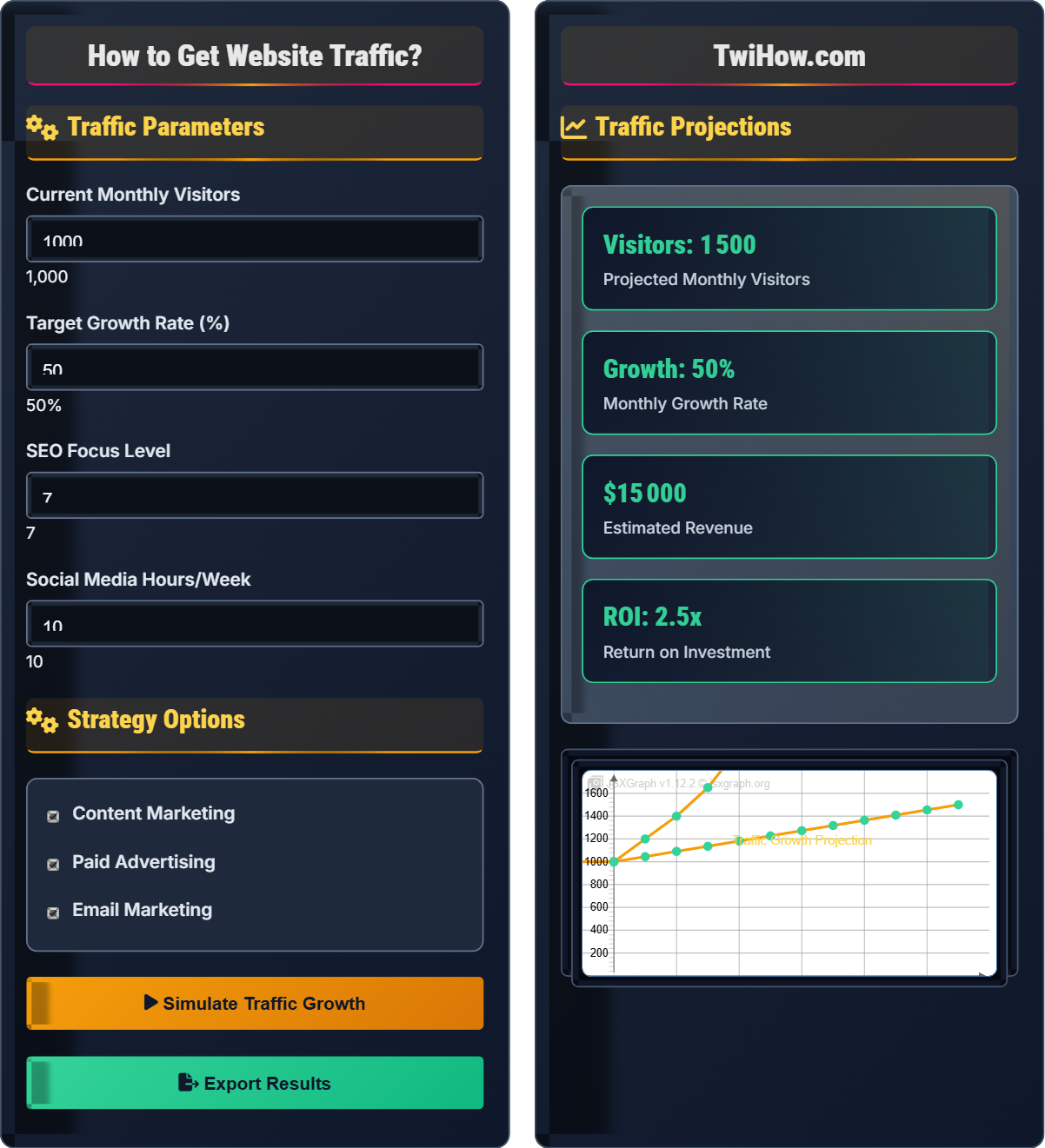
Traffic Parameters
Strategy Options
Traffic Projections
How to Get Website Traffic Explained
Website traffic refers to the number of visitors who come to your website. It's a crucial metric for any online business as it indicates how many people are visiting and potentially engaging with your content, products, or services.
Where:
- Current Visitors: Your current monthly visitor count
- Growth Rate: Desired growth percentage per period
- Time Period: Number of months or periods to project
Primary channels for driving website traffic:
- Organic Search: Visitors from search engines like Google
- Social Media: Traffic from Facebook, Twitter, LinkedIn, Instagram
- Direct Traffic: Visitors typing URL directly or bookmarking
- Referral Traffic: Visitors from other websites linking to yours
- Email Marketing: Traffic from email campaign links
- Paid Advertising: Visitors from PPC ads, social ads, display ads
- SEO Optimization: Improve search engine rankings organically
- Content Marketing: Create valuable content to attract visitors
- Social Media Marketing: Engage audiences on social platforms
- Email Marketing: Nurture leads and drive repeat visits
- PPC Advertising: Drive immediate traffic through paid ads
- Guest Blogging: Build backlinks and brand awareness
Traffic Generation Fundamentals
SEO, content marketing, social media, email marketing, paid advertising, conversion optimization.
Future Visitors = Current Visitors × (1 + Growth Rate)^Time Period
Where Future Visitors = projected traffic, Growth Rate = desired increase, Time Period = months ahead.
- Quality content attracts more engaged visitors
- Diversified traffic sources reduce risk
- Consistent effort yields sustainable results
Traffic Channels
- Keyword research and optimization
- Quality content creation
- Technical site improvements
- Link building and authority
- Platform-specific content
- Community building
- Paid social advertising
- Influencer partnerships
- Search engine advertising
- Social media ads
- Display advertising
- Retargeting campaigns
- SEO provides long-term sustainable traffic
- Social media builds community and brand
- Paid ads offer immediate results
- Email marketing nurtures existing leads
Case Studies
A small e-commerce store increased traffic by 250% in 6 months by implementing a comprehensive strategy:
- Optimized product pages for relevant keywords
- Created weekly blog content addressing customer pain points
- Launched targeted Facebook and Google Ads campaigns
- Developed email sequences for abandoned cart recovery
Result: From 2,000 to 7,000 monthly visitors, with 40% coming from organic search.
A SaaS company grew their blog traffic from 10,000 to 50,000 monthly visitors by focusing on long-tail keywords and creating comprehensive guides:
- Published 3 in-depth articles per week
- Optimized for featured snippets and voice search
- Created internal linking structure
- Repurposed content across social platforms
Result: 400% increase in organic traffic, leading to 150% growth in leads.
Traffic Metrics Dashboard
Total Visitors: The total number of unique individuals visiting your site in a given period.
Bounce Rate: Percentage of visitors who leave after viewing only one page.
Average Session Duration: Average time spent on your site per visit.
Conversion Rate: Percentage of visitors who complete a desired action.
Traffic Generation Learning Quiz
Which of the following best describes the main difference between organic SEO traffic and paid advertising traffic?
The fundamental difference is that paid traffic requires direct payment to platforms (Google Ads, Facebook Ads, etc.) to appear in front of potential customers, while organic traffic is earned through optimizing your website and content to rank well in search engines without paying for placement.
Organic traffic takes time to build but provides sustainable, cost-effective results. Paid traffic offers immediate visibility but stops when you stop paying.
The answer is C) Paid traffic requires payment while organic traffic is earned.
Understanding the distinction between organic and paid traffic is crucial for developing a balanced marketing strategy. Organic traffic builds over time through SEO efforts, quality content, and reputation building. Paid traffic provides immediate exposure but requires ongoing investment. Most successful businesses use both approaches strategically.
Organic Traffic: Visitors who find your site through unpaid search results
Paid Traffic: Visitors who come through paid advertisements
SEO: Search Engine Optimization to improve organic rankings
• Organic traffic takes longer to build but lasts longer
• Paid traffic provides immediate results but costs money
• Both strategies should complement each other
• Start with paid ads for immediate results
• Invest in SEO for long-term sustainability
• Track both organic and paid performance separately
• Relying only on one traffic source
• Expecting instant results from SEO
• Not tracking ROI on paid campaigns
Explain how content marketing contributes to website traffic generation and describe the steps to create an effective content marketing plan.
Content Marketing's Role in Traffic Generation: Content marketing attracts visitors by providing valuable, relevant, and consistent information that addresses audience needs and interests. Quality content ranks well in search engines, gets shared on social media, and builds trust with potential customers.
Steps for Effective Content Marketing Plan:
1. Audience Research: Identify target audience demographics, pain points, and search behaviors
2. Keyword Analysis: Find relevant keywords with good search volume and manageable competition
3. Content Calendar: Plan topics, formats, and publishing schedule
4. Content Creation: Develop high-quality, original content optimized for target keywords
5. Promotion Strategy: Distribute content through social media, email, and other channels
6. Performance Tracking: Monitor traffic, engagement, and conversion metrics
7. Continuous Optimization: Refine strategy based on performance data
Content marketing is a long-term strategy that builds authority and trust. By consistently providing value, you establish your brand as a thought leader in your industry. The key is to focus on solving audience problems rather than promoting products directly. This approach naturally attracts visitors who are interested in your expertise.
Content Marketing: Strategic marketing focused on creating valuable content
Thought Leadership: Positioning yourself as an expert in your field
Content Calendar: Schedule of planned content publication
• Focus on audience value over sales promotion
• Maintain consistency in publishing schedule
• Measure content performance regularly
• Repurpose content across different formats
• Use trending topics to increase visibility
• Create content series for better engagement
• Publishing infrequently or inconsistently
• Creating content that doesn't solve audience problems
• Not promoting content beyond your website
A company currently has 10,000 followers on Instagram and generates 500 website visits per month from social media. If they increase their followers by 25% and improve their engagement rate from 3% to 5%, what would be the expected increase in social media traffic? Assume the average follower clicks through to the website at the engagement rate.
Current Situation:
- Followers: 10,000
- Engagement Rate: 3%
- Current Traffic: 10,000 × 0.03 = 300 visits per month
(Note: The problem states 500 visits, suggesting other factors contribute)
Projected Situation:
- New Followers: 10,000 × 1.25 = 12,500 followers
- New Engagement Rate: 5%
- Projected Traffic: 12,500 × 0.05 = 625 visits per month
Expected Increase: 625 - 500 = 125 additional visits per month
Percentage Growth: (125 / 500) × 100 = 25% increase in social traffic
This problem demonstrates the relationship between social media metrics and website traffic. The formula combines audience size (followers) with engagement quality (engagement rate) to estimate traffic potential. Higher engagement rates indicate more active followers who are likely to click through to your website.
Engagement Rate: Percentage of followers who interact with your content
Social Traffic: Visitors coming from social media platforms
Click-Through Rate: Percentage who click on links in your posts
• Quality engagement matters more than follower count
• Consistent posting increases visibility
• Call-to-actions drive traffic conversion
• Post when your audience is most active
• Use compelling visuals and headlines
• Include clear calls-to-action in posts
• Buying fake followers instead of growing organically
• Posting inconsistent content quality
• Not tracking social media traffic to website
A startup wants to diversify their traffic sources to reduce dependency on a single channel. Currently, 90% of their traffic comes from Google Ads, making them vulnerable to changes in ad costs or policies. Design a balanced traffic strategy that would distribute traffic across 4 different channels within 6 months.
Recommended Balanced Strategy:
Month 1-2: Foundation Building
- Begin SEO optimization (keyword research, on-page optimization)
- Set up content calendar and publish 2-3 pieces per week
- Start building email list with lead magnets
Month 3-4: Channel Development
- Launch social media accounts and begin regular posting
- Create and promote first comprehensive guide or resource
- Start building backlinks through guest posting
Month 5-6: Scaling and Optimization
- Scale successful content and social media efforts
- Launch email newsletter with valuable content
- Refine Google Ads strategy to complement other channels
Target Distribution Goal:
- Organic Search: 35%
- Email Marketing: 25%
- Social Media: 20%
- Paid Advertising: 20%
Diversifying traffic sources reduces risk and creates multiple revenue streams. Each channel has different timelines for showing results - paid ads work immediately, social media builds over weeks, content marketing takes months to gain traction, and SEO builds over time. A balanced approach allocates resources across channels with different time horizons.
Traffic Diversification: Spreading traffic sources to reduce risk
Multi-Channel Strategy: Using multiple marketing channels together
Lead Magnets: Free content offered to capture email addresses
• Don't abandon successful channels completely
• Allocate resources based on channel potential
• Monitor performance across all channels
• Repurpose content across multiple channels
• Use successful channels to promote others
• Track attribution to optimize allocation
• Spreading resources too thin across channels
• Not tracking ROI for each channel
• Abandoning channels too quickly
Which of the following metrics is most important to track after successfully increasing website traffic?
While all metrics are important, conversion rate is the most critical after increasing traffic because it measures whether the additional visitors are taking the desired actions (purchasing, signing up, contacting, etc.). Getting traffic is only valuable if that traffic converts to customers or leads.
High traffic with low conversion rates indicates that the traffic isn't targeted properly or the website isn't optimized to convert visitors. The ultimate goal of traffic generation is to drive business results, which is measured by conversions.
The answer is C) Conversion rate.
Traffic generation is only half the battle - converting that traffic into valuable actions is equally important. A website with 10,000 visitors and 1% conversion rate generates fewer results than a site with 1,000 visitors and 10% conversion rate. This is why successful marketers focus on both traffic acquisition and conversion optimization simultaneously.
Conversion Rate: Percentage of visitors completing desired action
Bounce Rate: Percentage leaving after viewing one page
Page Load Time: Speed at which pages load for users
• More traffic doesn't automatically mean more revenue
• Quality visitors matter more than quantity
• Conversion rate should be tracked by traffic source
• A/B test landing pages for better conversions
• Match ad copy to landing page expectations
• Simplify conversion paths
• Focusing only on traffic numbers
• Not optimizing landing pages for conversions
• Ignoring mobile experience for conversions
FAQ
Q: I'm starting a new website. Should I focus on SEO or paid advertising first?
A: For a new website, I recommend starting with paid advertising for immediate traffic while simultaneously building your SEO foundation. Here's the strategic approach:
1. Immediate Results: Launch targeted Google Ads or social media ads to get initial visitors and validate your value proposition
2. Foundation Building: Begin SEO work (technical setup, keyword research, content planning) which takes 3-6 months to show results
3. Content Creation: Start publishing quality content that supports both SEO and paid ad targeting
4. Scale Sustainably: As your organic traffic grows, gradually shift budget from paid to content marketing and SEO maintenance
This approach gives you immediate feedback while building long-term sustainable traffic.
Q: How much of my marketing budget should go to traffic generation versus other marketing activities?
A: The ideal budget allocation depends on your business stage and goals, but here's a general framework:
New Businesses (0-2 years): 60-70% traffic generation, 20-30% retention/engagement, 10% analytics/tools
Growing Businesses (2-5 years): 50-60% traffic generation, 30-35% retention/engagement, 10-15% analytics/tools
Established Businesses (5+ years): 40-50% traffic generation, 40-45% retention/engagement, 10-15% analytics/tools
Track the customer acquisition cost (CAC) versus lifetime value (LTV) for each traffic channel. Reallocate budget toward channels with the best ROI. Remember to invest in conversion optimization alongside traffic generation - getting more visitors won't help if they don't convert.