What is Affiliate Marketing?
Complete affiliate marketing guide • Step-by-step explanations
Affiliate Marketing:
Show Commission CalculatorAffiliate marketing is a performance-based marketing strategy where businesses reward affiliates for bringing customers or visitors through their marketing efforts. It's a partnership model where publishers earn commissions by promoting other companies' products or services.
Success in affiliate marketing requires understanding the ecosystem: merchants (businesses selling products), affiliates (publishers promoting products), and networks (platforms connecting both parties). The model benefits all participants by creating a win-win scenario.
Key components:
- Commission Structures: Percentage-based, fixed amount, or recurring payments
- Tracking Systems: Cookies, pixels, and unique links to attribute sales
- Payment Models: Pay-per-sale, pay-per-lead, or pay-per-click
- Content Creation: Reviews, comparisons, and promotional materials
- Relationship Building: Long-term partnerships with merchants
Modern affiliate marketing leverages content marketing, SEO, and digital channels to drive targeted traffic and conversions.
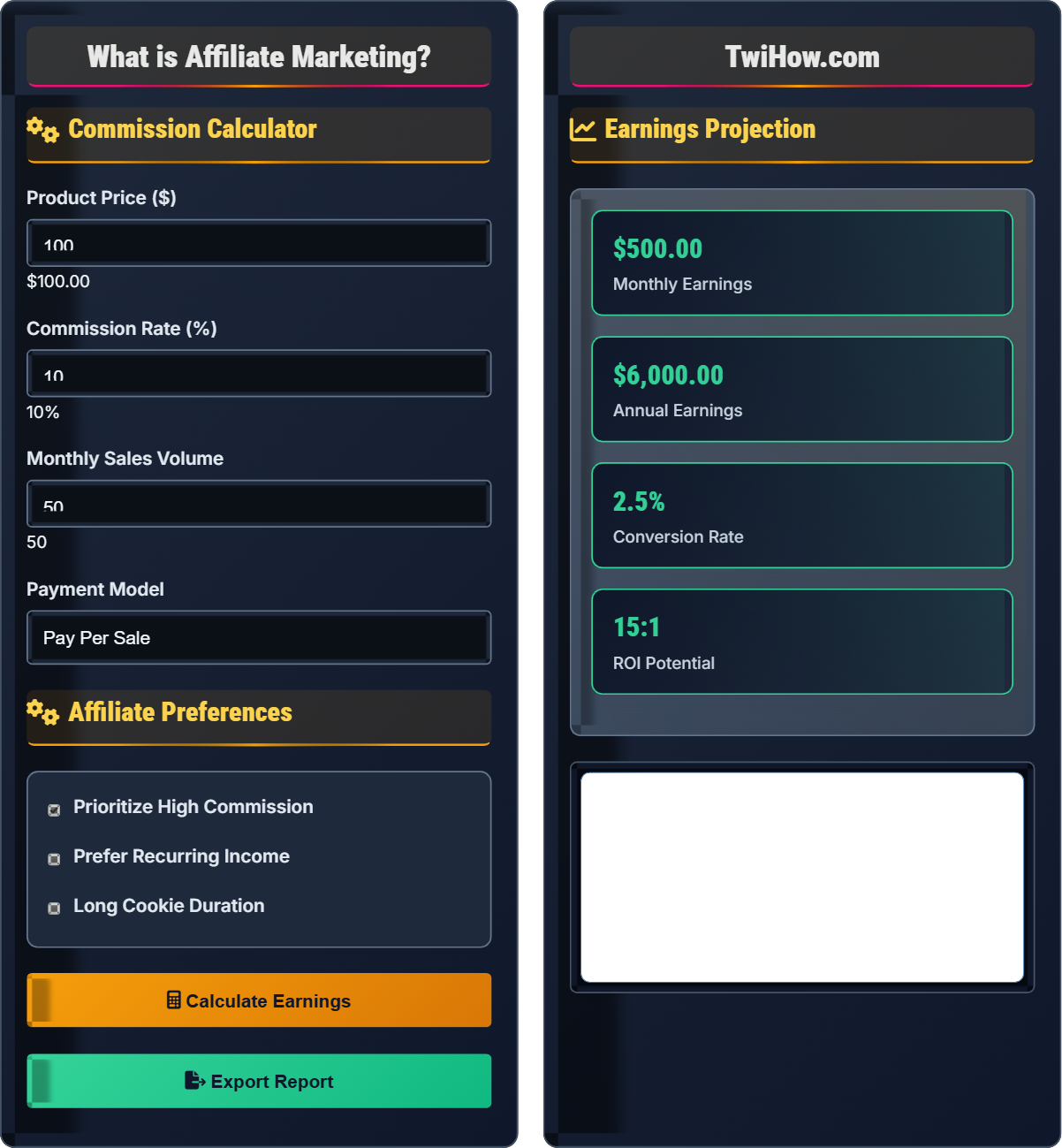
Commission Calculator
Affiliate Preferences
Earnings Projection
What is Affiliate Marketing Explained
Affiliate marketing is a performance-based marketing arrangement where a business rewards one or more affiliates for each visitor or customer brought by the affiliate's own marketing efforts. It's a revenue-sharing model where affiliates earn commissions for promoting other companies' products or services.
Where:
- Commission: Amount earned by the affiliate
- Sale Amount: Value of the sale made by customer
- Commission Rate: Percentage or fixed amount agreed upon
Different ways affiliates can earn commissions:
- Pay Per Sale (PPS): Earn commission for each sale made
- Pay Per Lead (PPL): Earn commission for qualified leads
- Pay Per Click (PPC): Earn for each click generated
- Recurring Commissions: Ongoing payments for subscription products
- Bonus Commissions: Additional rewards for hitting targets
- Hybrid Models: Combination of different payment types
- Choose Relevant Products: Promote items that match your audience
- Create Quality Content: Provide value through reviews and tutorials
- Build Trust: Be transparent and honest in promotions
- Track Performance: Monitor which strategies work best
- Optimize Continuously: Test different approaches and refine
- Maintain Relationships: Communicate regularly with merchants
Affiliate Marketing Fundamentals
Commission, tracking, attribution, cookie duration, conversion rate, ROI.
Commission = Sale Amount × Commission Rate
Where Commission = affiliate earnings, Sale Amount = transaction value, Rate = agreed percentage.
- Transparency is essential for trust
- Relevance drives higher conversions
- Tracking accuracy affects payments
Commission Structures
- Typically ranges from 1% to 50%
- Higher-value products often have lower rates
- Can be tiered based on performance
- Most common in e-commerce
- Fixed payment per conversion
- Predictable earnings model
- Common for subscriptions and services
- Less dependent on product value
- Ongoing payments for subscriptions
- Lifetime or set duration
- Higher long-term value
- Common in SaaS and membership sites
- Percentage models favor high-value products
- Fixed amounts provide predictable income
- Recurring commissions offer passive income
- Hybrid models combine multiple approaches
Affiliate Networks
High-Quality Programs
Enterprise Focus
Global Reach
Amazon's affiliate program has generated billions in sales through millions of publishers worldwide:
- Simple integration with Amazon's vast product catalog
- Trusted brand that customers recognize
- Competitive commission rates
- Robust tracking and reporting
Result: One of the world's largest and most successful affiliate programs.
Earnings Process
Revenue Metrics Dashboard
Monthly Revenue: Total commissions earned in a month.
Monthly Clicks: Number of clicks sent to merchant sites.
Conversions: Number of successful transactions.
Conversion Rate: Percentage of clicks that result in sales.
Affiliate Marketing Learning Quiz
Which of the following is the most common commission model in affiliate marketing?
Pay Per Sale (PPS) is the most common commission model in affiliate marketing. In this model, affiliates earn a commission only when a customer makes a purchase through their affiliate link. This aligns the interests of the merchant and affiliate, as both benefit when actual sales occur.
PPS is preferred because it provides clear value to merchants (actual revenue) and offers potentially higher earnings to affiliates (based on product value). Other models like PPC are less common because they don't guarantee value to merchants.
The answer is B) Pay Per Sale (PPS).
Understanding commission models is crucial because they determine how you'll earn money as an affiliate. PPS is the most popular because it creates a win-win situation: merchants only pay when they make money, and affiliates can earn more from higher-value products.
PPS: Pay Per Sale - commission for each purchase
PPL: Pay Per Lead - commission for qualified leads
PPC: Pay Per Click - commission for each click
• PPS aligns affiliate and merchant interests
• Higher-value products often have lower PPS rates
• Commission models vary by industry and product
• Look for programs with fair PPS rates
• Consider PPL for lead generation sites
• Understand cookie duration for each program
• Choosing programs with unrealistic commission rates
Explain how affiliate tracking systems work and why they are critical to the success of affiliate marketing.
Affiliate Tracking Systems: These are technologies that monitor and record the customer journey from clicking an affiliate link to completing a purchase. They use cookies, pixels, and unique identifiers to attribute sales to the correct affiliate.
How Tracking Works:
1. Unique Link Generation: Each affiliate receives a unique tracking URL with their ID
2. Cookie Placement: When a customer clicks the link, a cookie is placed on their browser
3. Visit Attribution: The system tracks the customer's journey and purchase
4. Commission Assignment: Sales are credited to the affiliate's account
Critical Importance: Tracking systems are essential because they ensure fair compensation, prevent fraud, and provide transparency for both merchants and affiliates. Without accurate tracking, there would be no way to verify which affiliate generated sales.
Think of tracking systems as the accounting department of affiliate marketing. Just as businesses need to track sales to pay employees, affiliate programs need tracking to pay affiliates. The technology ensures that everyone gets credit where credit is due.
Tracking Cookie: Small piece of data stored on user's browser
Pixel Tracking: Invisible image that records user actions
Attribution: Assigning credit for conversions
• Tracking must be accurate to maintain trust
• Cookie duration affects attribution windows
• Privacy regulations impact tracking methods
• Understand cookie duration for each program
• Use last-click attribution for most programs
• Monitor tracking accuracy regularly
• Not understanding attribution models
• Ignoring cookie duration limitations
• Not verifying tracking accuracy
An affiliate promotes a software product priced at $297 with a 20% commission rate. If the affiliate generates 25 sales in a month, calculate their total commission earnings. Then determine their average earnings per click if they received 5,000 clicks during the same period.
Calculate Commission Per Sale:
Commission per sale = Product Price × Commission Rate
Commission per sale = $297 × 0.20 = $59.40
Calculate Total Monthly Commission:
Total Commission = Commission per sale × Number of sales
Total Commission = $59.40 × 25 = $1,485
Calculate Earnings Per Click:
Earnings per click = Total Commission ÷ Total Clicks
Earnings per click = $1,485 ÷ 5,000 = $0.297 per click
The affiliate earns $1,485 for the month and averages $0.297 per click.
This calculation demonstrates how high-ticket items with reasonable commission rates can generate substantial earnings. The $297 product with 20% commission ($59.40 per sale) shows how affiliate marketing can be profitable when promoting valuable products to targeted audiences.
Commission Rate: Percentage of sale paid to affiliate
Click-Through Rate: Percentage of clicks vs impressions
Earnings Per Click: Average revenue per click received
• Higher ticket items can generate more per sale
• Conversion rate affects overall profitability
• Earnings per click indicates efficiency
• Promote products with good commission rates
• Focus on audiences likely to convert
• Track earnings per click to optimize
• Not calculating actual earnings potential
• Ignoring conversion rates in planning
• Focusing only on high commission rates
An affiliate promotes a high-value course ($1,200) through two different programs with identical 15% commission rates but different cookie durations: Program A offers 30-day cookies while Program B offers 90-day cookies. If a customer clicks on both links but waits 45 days to purchase, which program would credit the sale to the affiliate? Explain the impact of cookie duration on affiliate earnings.
Program A (30-day cookie): The cookie expires after 30 days, so the affiliate would NOT receive credit for the purchase made 45 days later.
Program B (90-day cookie): The cookie remains active for 90 days, so the affiliate WOULD receive credit for the purchase made 45 days later.
Impact of Cookie Duration:
• Longer cookies increase attribution chances for high-value, considered purchases
• Shorter cookies may miss sales from customers with longer decision cycles
• High-value products often require longer consideration periods
• Cookie duration directly affects affiliate revenue potential
In this case, Program B would result in a $180 commission ($1,200 × 15%) for the affiliate.
Cookie duration is crucial for high-value products where customers often research extensively before purchasing. A 90-day cookie captures more sales from thoughtful buyers, while a 30-day cookie might miss these conversions entirely.
Cookie Duration: Time period tracking remains active
Attribution Window: Period for assigning credit to affiliate
Consideration Period: Time customer takes to make purchase
• Longer cookies benefit high-value products
• Consider customer decision cycles
• Cookie duration affects conversion attribution
• Prioritize programs with longer cookies for high-value items
• Understand your audience's buying behavior
• Compare cookie durations when selecting programs
• Not checking cookie duration before joining programs
• Ignoring impact on high-value product promotions
• Not considering customer decision timeline
Which of the following is the most important factor for success in affiliate marketing?
Building trust with your audience is the most important factor for success in affiliate marketing. Trust leads to higher conversion rates, repeat purchases, and long-term success. When your audience trusts your recommendations, they're more likely to purchase through your links.
Without trust, even high-commission products will fail to convert. A large following without trust is less valuable than a smaller, trusting audience. Trust creates sustainable, long-term affiliate income.
The answer is B) Building trust with your audience.
Audience trust is the foundation of affiliate marketing success. When people trust you, they believe your recommendations and are willing to make purchases based on your suggestions. This trust translates directly into higher conversion rates and more commissions.
Conversion Rate: Percentage of clicks that result in sales
Audience Trust: Confidence in your recommendations
Long-term Success: Sustainable income over time
• Trust drives conversion rates
• Quality over quantity in audience building
• Transparency builds credibility
• Only promote products you genuinely recommend
• Provide honest reviews and comparisons
• Disclose affiliate relationships
• Promoting products solely for high commissions
• Not disclosing affiliate relationships
• Sacrificing trust for short-term gains
FAQ
Q: I'm just starting with affiliate marketing. What are the first steps I should take?
A: Starting with affiliate marketing requires these foundational steps:
Phase 1 - Setup:
• Choose your niche and build an audience (blog, social media, YouTube, etc.)
• Join relevant affiliate programs related to your niche
• Set up tracking tools and analytics
Phase 2 - Content:
• Create valuable content that addresses your audience's needs
• Naturally incorporate affiliate links into helpful content
• Build trust through honest reviews and recommendations
Phase 3 - Optimization:
• Track which links perform best
• Test different content formats and approaches
• Scale successful strategies
Remember: Focus on providing value to your audience first, commissions second.
Q: How do we structure our affiliate program to maximize performance while controlling costs?
A: Structuring an effective affiliate program requires balancing incentives with profitability:
Commission Structure:
• Start with competitive rates (typically 5-20% for physical goods)
• Consider tiered commissions for high performers
• Offer bonuses for reaching sales milestones
Tracking & Attribution:
• Implement robust tracking systems
• Set appropriate cookie duration (30-90 days)
• Use last-click attribution initially
Program Management:
• Vet affiliates to ensure brand alignment
• Provide marketing materials and support
• Monitor for fraudulent activity
Performance Optimization:
• Regularly review program performance
• Adjust rates based on ROI analysis
• Reward top-performing affiliates