How to Avoid Plagiarism and Cite Sources Correctly
Complete guide • Academic integrity • Step-by-step instructions
Academic integrity is fundamental to scholarly work and requires proper attribution of all sources used in your writing. Plagiarism involves using someone else's work without proper acknowledgment, which can result in serious academic consequences. Proper citation demonstrates respect for intellectual property and allows readers to locate your sources.
Key components include:
- Source Attribution: Giving credit to original authors
- Citation Styles: Following specific formatting guidelines (MLA, APA, Chicago)
- Paraphrasing: Rewording while maintaining original meaning
- Quotation: Using exact text with proper attribution
- Reference Lists: Comprehensive source documentation
This guide provides comprehensive strategies for maintaining academic integrity in all your work.
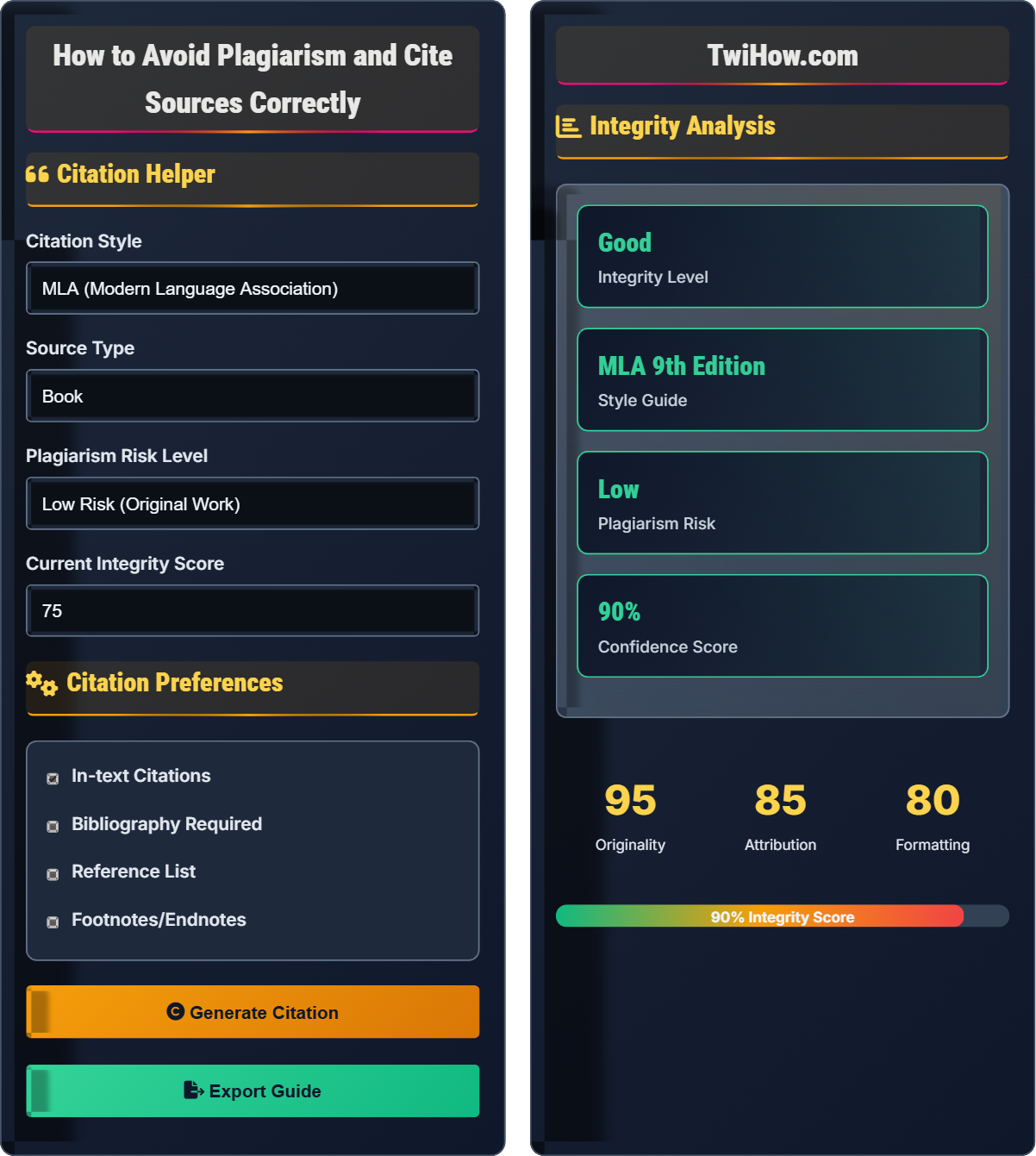
Citation Helper
Citation Preferences
Integrity Analysis
Always attribute sources with proper in-text citations and include full bibliographic information in your reference list.
Maintain honesty and transparency in all academic work by properly crediting all sources used.
| Style | Format | Example |
|---|---|---|
| MLA | Author (Page) | (Smith 45) |
| APA | Author (Year, Page) | (Johnson, 2023, p. 45) |
| Chicago | Footnote | ¹Smith, John. Book Title, 45. |
Understanding Academic Integrity
Plagiarism involves presenting someone else's work, ideas, or expressions as your own without proper attribution. This includes copying text, paraphrasing without citation, using images or data without permission, and purchasing or submitting work created by others.
Citations acknowledge the sources of information, ideas, and expressions used in your work. They allow readers to locate your sources and demonstrate your engagement with scholarly discourse. Proper citation includes both in-text citations and a complete reference list.
- Author information
- Publication date
- Title of work
- Page numbers (when applicable)
- Publisher information
- DOI or URL (for online sources)
Different academic disciplines use specific citation styles with distinct formatting requirements. Common styles include MLA for literature and humanities, APA for social sciences, and Chicago for history and some social sciences.
Paraphrasing involves expressing someone else's ideas in your own words while maintaining the original meaning. Effective paraphrasing requires understanding the source material and expressing it differently while still providing proper attribution.
- Completely restructure the sentence
- Use synonyms appropriately
- Maintain the original meaning
- Always cite the source
- Verify accuracy after paraphrasing
- Compare with original to ensure proper attribution
Citation Style Comparison
Citation Timeline
Academic Integrity Quiz
Which of the following constitutes plagiarism?
Using someone else's ideas without attribution constitutes plagiarism. Even if you express the ideas in your own words, you must give credit to the original source. This includes concepts, theories, and arguments developed by others. Proper attribution is essential regardless of how you present the information.
The answer is B) Using someone else's ideas without attribution.
Plagiarism extends beyond copying text to include any use of someone else's intellectual property without proper attribution. This includes ideas, concepts, and even the structure of arguments. Academic integrity requires acknowledging all sources of information and ideas, regardless of how you present them in your work.
Intellectual Property: Original ideas and expressions
Attribution: Giving credit to original source
Academic Integrity: Honesty in scholarly work
• Attribute all sources of ideas
• Cite even paraphrased content
• Give credit for concepts and arguments
• Keep detailed source notes
• Cite as you write
• Use plagiarism detection tools
• Forgetting to cite paraphrased ideas
• Assuming common knowledge doesn't need citation
• Not citing conceptual frameworks
Explain the differences between MLA, APA, and Chicago citation styles and when to use each one.
MLA (Modern Language Association):
• Usage: Literature, language arts, and humanities
• Format: (Author Page) for in-text citations
• Reference List: "Works Cited" at end of document
• Example: (Smith 45) with full citation in Works Cited
APA (American Psychological Association):
• Usage: Social sciences, psychology, education
• Format: (Author, Year, Page) for in-text citations
• Reference List: "References" at end of document
• Example: (Johnson, 2023, p. 45) with full citation in References
Chicago Manual of Style:
• Usage: History, some social sciences, and general use
• Formats: Two systems - notes-bibliography or author-date
• Notes System: Footnotes or endnotes with Bibliography
• Author-Date: Similar to APA with References
• Example:¹Smith, John. Book Title, 45.
Always consult your instructor or publication guidelines to determine which style to use.
Citation styles serve different disciplinary needs and audiences. MLA emphasizes authorship and literary analysis, APA focuses on recency and scientific methodology, and Chicago provides flexibility for various types of scholarship. Consistent use of the appropriate style demonstrates professionalism and facilitates reader access to sources.
Citation Style: Standardized format for citing sources
Disciplinary Convention: Standards within academic fields
In-text Citation: Brief reference within text
• Follow assigned style consistently
• Use correct punctuation and formatting
• Include all required information
• Use citation generators with caution
• Consult official style manuals
• Keep style guide handy while writing
• Mixing different citation styles
• Incorrect punctuation
• Omitting required information
You read an article that says: "Climate change represents the most significant environmental challenge of the 21st century, requiring coordinated global action to prevent catastrophic consequences." How should you properly paraphrase and cite this statement?
Proper Paraphrase:
Climate change poses the greatest environmental threat in the current century, necessitating international cooperation to avoid devastating outcomes (Author, Year).
Key Changes Made:
• Replaced "represents" with "poses"
• Changed "most significant" to "greatest"
• Substituted "21st century" with "current century"
• Transformed "coordinated global action" to "international cooperation"
• Replaced "prevent catastrophic consequences" with "avoid devastating outcomes"
Important Considerations:
• Meaning Preserved: The paraphrase maintains the original concept
• Proper Attribution: Includes in-text citation with author and year
• Significant Restructuring: Sentence structure is substantially different
• Accurate Representation: Faithfully represents the original idea
Remember to include the full citation in your reference list.
Effective paraphrasing requires more than substituting synonyms. It involves completely restructuring the sentence while preserving the original meaning. The paraphrase should sound like your own writing while still acknowledging the source. Proper attribution is essential even when ideas are expressed in your own words.
Paraphrasing: Expressing ideas in your own words
Proper Attribution: Giving credit to original source
Substantial Restructuring: Significant changes to sentence structure
• Preserve original meaning
• Restructure sentence completely
• Always cite the source
• Read the original, then write from memory
• Change sentence structure significantly
• Verify accuracy after paraphrasing
• Only changing a few words
• Forgetting to cite paraphrased content
• Altering the original meaning
You're writing a research paper and have collected numerous sources. How should you organize your research and citations to avoid plagiarism and ensure proper attribution?
Research Organization:
• Source Tracking: Create a detailed source log with full citation information, access dates, and page numbers
• Annotation System: Take notes with clear distinctions between your thoughts and source material
• Color Coding: Use different colors or symbols to distinguish between sources
• Digital Tools: Use reference managers like Zotero, Mendeley, or EndNote
Citation Management:
• Real-time Citation: Insert in-text citations as you write, not afterward
• Source Identification: Clearly mark direct quotes, paraphrases, and summaries
• Version Control: Keep track of different drafts and citation changes
• Verification Process: Double-check all citations against original sources
Plagiarism Prevention:
• Originality Checks: Use plagiarism detection software before submission
• Peer Review: Have others review your citations and attributions
• Consistency Checks: Ensure all sources are cited both in-text and in reference list
• Style Verification: Confirm all citations follow the required format
Effective organization prevents accidental plagiarism and ensures proper attribution.
Systematic source management is essential for maintaining academic integrity. Organization prevents confusion between your ideas and those of others, making proper attribution easier and more accurate. The key is establishing systems early in the research process and maintaining them consistently throughout writing.
Source Management: Organizing and tracking research materials
Reference Manager: Software for organizing citations
Systematic Organization: Structured approach to research
• Track sources from the beginning
• Cite as you write
• Verify all citations
• Use digital tools for source management
• Keep detailed notes with page numbers
• Verify citations before submission
• Not tracking sources during research
• Adding citations after writing
• Forgetting to cite paraphrased content
Which of the following requires citation?
Specific statistics from a research study require citation. While widely known facts, common sayings, and generally accepted principles may not require citation, specific data, statistics, and findings from particular studies must be attributed to their sources. The key is whether the information is specific to a particular work or widely known.
The answer is B) Specific statistics from a research study.
Determining what requires citation involves distinguishing between common knowledge and specific information. Common knowledge includes widely known facts that can be verified in multiple sources. However, specific data, statistics, and findings from particular studies require attribution. When in doubt, it's safer to cite the source.
Common Knowledge: Widely known information
Specific Data: Particular facts from sources
Widely Known: Information in multiple sources
• Cite specific data and statistics
• When in doubt, cite the source
• Verify what constitutes common knowledge
• If you found it in one source, cite it
• Consult multiple sources for common knowledge
• Err on the side of caution
• Assuming all facts are common knowledge
• Not citing specific statistics
• Misjudging what constitutes common knowledge
Citation Examples
Academic Integrity Checklist
FAQ
Q: Do I need to cite information from my textbook?
A: Yes, you must cite information from textbooks. Textbooks contain specific ideas, interpretations, and information that belong to their authors. Even widely accepted concepts in textbooks should be cited when you're directly referencing the textbook's presentation of the information. However, if you're referring to common knowledge that appears in multiple sources, citation may not be necessary.
Q: How can I help my child understand academic integrity?
A: Help your child understand that academic integrity means being honest about the sources of ideas and information. Teach them that using others' work without attribution is like taking credit for someone else's ideas. Encourage them to ask questions about when to cite sources and to view citation as a way of honoring others' contributions. Model integrity in your own work and discuss the importance of original thinking and proper attribution.