How to Build a Strong Resume with Limited Work Experience?
Resume excellence guide • Career optimization
Resume Building:
Show Resume BuilderBuilding a strong resume with limited work experience requires emphasizing transferable skills, academic achievements, volunteer work, and relevant projects. Focus on demonstrating competencies through various experiences rather than years of employment. This guide provides strategies to showcase your potential and value to employers, highlighting education, skills, and accomplishments that demonstrate your readiness for professional roles.
Key strategies:
- Skills Focus: Highlight transferable skills from any experience
- Education Emphasis: Showcase academic achievements and projects
- Volunteer Work: Include community service and leadership roles
- Relevant Projects: Detail academic or personal projects that demonstrate skills
Success comes from strategically positioning your experiences to show value and potential rather than just listing jobs. Every experience can demonstrate relevant competencies when presented effectively.
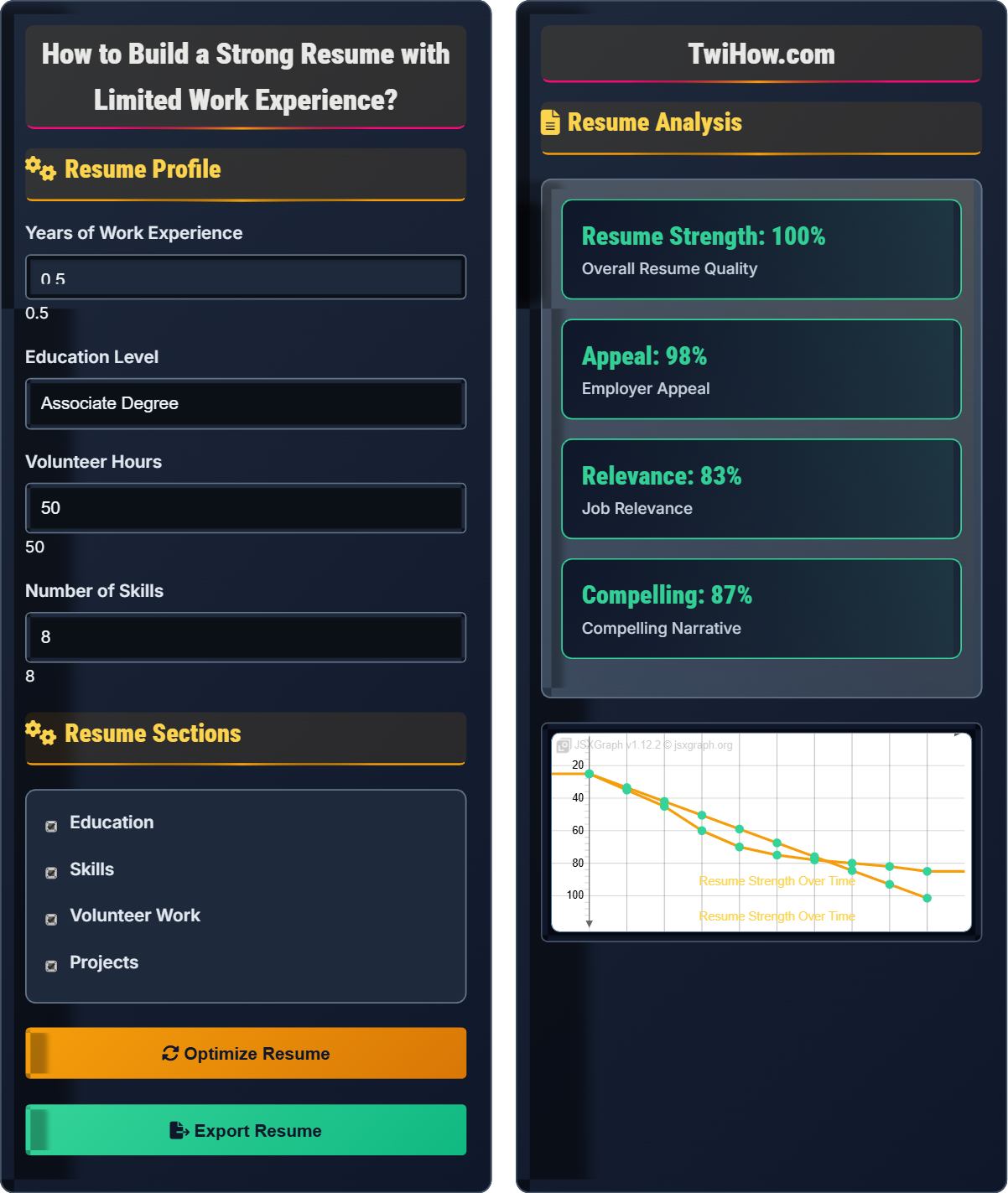
Resume Profile
Resume Sections
Resume Analysis
| Section | Status | Recommendation | Priority |
|---|---|---|---|
| Education | Strong | Highlight GPA and honors | High |
| Skills | Good | Add specific software/tools | Medium |
| Volunteer Work | Good | Quantify impact | Medium |
| Projects | Needs Work | Add more details | High |
| Summary | Missing | Add compelling summary | High |
Building a Strong Resume with Limited Experience
Many students and recent graduates face the classic "catch-22" of needing experience to get a job, but needing a job to get experience. However, limited formal work experience doesn't mean you lack valuable skills or accomplishments. The key is strategically presenting your experiences to demonstrate competency and potential to employers.
Resume strength can be maximized by focusing on transferable skills and alternative experiences:
Where:
- Skills: Technical and soft skills relevant to target positions
- Education: Academic achievements, projects, and learning
- Achievements: Awards, recognitions, and measurable accomplishments
- Potential Indicators: Leadership roles, volunteer work, and initiatives
Expand your resume beyond traditional work experience:
- Leadership Roles: Student government, club presidencies, team captain
- Volunteer Work: Community service, non-profit involvement
- Academic Projects: Research, capstone projects, presentations
- Internships: Part-time, summer, or project-based internships
- Freelance Work: Independent projects, consulting, or contract work
- Campus Involvement: Organizations, committees, event planning
- Focus on Outcomes: Emphasize results and achievements
- Use Action Verbs: Start bullet points with strong action words
- Quantify Where Possible: Add numbers, percentages, or timeframes
- Highlight Relevant Skills: Match skills to job requirements
- Show Initiative: Demonstrate proactivity and drive
- Include Soft Skills: Communication, teamwork, problem-solving
Core Resume Concepts
Transferable skills, alternative experiences, quantifiable achievements, targeted resumes, soft skills.
Resume Strength = (Education + Skills + Achievements) × Relevance Factor
Where Resume Strength = overall effectiveness of the resume for target positions.
- Every experience can demonstrate relevant skills
- Quantify achievements wherever possible
- Customize for each application
Practical Applications
Entry-level positions, internships, graduate school applications, career changers, freelancers.
- Identify all relevant experiences
- Extract transferable skills
- Quantify achievements
- Organize strategically
- Customize for each role
- Get feedback and iterate
- Industry-specific expectations
- Company culture fit
- Job requirements prioritization
- Professional presentation
Resume Building Quiz
Which of the following experiences best demonstrates transferable skills that employers value?
Organizing a campus charity event demonstrates multiple transferable skills: leadership, project management, communication, budget management, and teamwork. These are highly valued by employers regardless of the industry. While other experiences also have value, this example shows the most diverse skill set in action.
The answer is B) Organizing a campus charity event with 200 attendees.
Transferable skills are abilities that can be applied across different jobs, industries, or situations. Employers value skills like leadership, communication, problem-solving, and project management regardless of the specific role. When building a resume with limited work experience, focus on experiences that demonstrate these universal skills. Even short-term or informal experiences can showcase valuable competencies when described effectively.
Transferable Skills: Abilities applicable across different contexts
Project Management: Planning, executing, and completing projects
Leadership: Guiding and inspiring others toward goals
• Extract skills from any experience
• Focus on outcomes and results
• Match skills to job requirements
• Use action verbs to start bullet points
• Quantify achievements when possible
• Highlight leadership opportunities
• Undervaluing non-work experiences
• Not quantifying achievements
• Using generic descriptions
How should students effectively showcase academic projects on their resumes when they have limited work experience? Provide specific strategies and examples.
Strategies: Academic projects can be powerful resume elements when presented strategically. Focus on technical skills demonstrated, problems solved, and outcomes achieved.
Formatting: Include project title, course/semester, team size, technologies used, and key outcomes.
Examples: "Developed Python web application for campus event management, serving 500+ users, using Flask framework and PostgreSQL database."
Key Elements: Use action verbs, quantify results, mention technologies, and emphasize relevance to target positions.
Connection: Draw parallels between project skills and job requirements. For example, a research project demonstrates analytical skills.
Academic projects are valuable resume content because they demonstrate technical skills, problem-solving abilities, and initiative. They often involve more complex, long-term work than entry-level jobs. The key is translating academic language into professional terms that employers understand. Focus on the skills developed and outcomes achieved rather than just describing what the project was about.
Academic Projects: Coursework assignments requiring substantial work
Technical Skills: Proficiency in tools, languages, or methodologies
Problem-Solving: Identifying and resolving challenges
• Include relevant technologies used
• Quantify project outcomes
• Highlight teamwork when applicable
• Mention programming languages or tools
• Include project scope and scale
• Describe challenges overcome
• Using overly academic language
• Not explaining project significance
• Omitting technical details
You volunteered at a local animal shelter for 6 months, spending 4 hours per week walking dogs and cleaning facilities. How would you transform this experience into a compelling resume bullet point that highlights transferable skills for a customer service position?
Transformed Bullet Point: "Volunteered 24+ hours monthly at animal shelter, demonstrating reliability and compassion while managing multiple responsibilities including client interactions and facility maintenance."
Highlighted Skills: Reliability (consistent schedule), compassion (customer empathy), multitasking (priority management), responsibility (trustworthiness), communication (client interactions).
Enhanced Version: "Coordinated with staff to prioritize urgent care tasks for 30+ animals daily, demonstrating organizational skills and commitment to service excellence."
Key Strategy: Focus on the skills developed rather than just the tasks performed. Emphasize soft skills like reliability, empathy, and responsibility that translate directly to customer service roles.
This example shows how to reframe any experience to highlight relevant skills. The key is identifying the transferable competencies inherent in the activity. Walking dogs demonstrates patience and reliability. Cleaning facilities shows attention to detail and work ethic. Interacting with shelter staff develops communication skills. All of these are valuable for customer service roles.
Volunteer Experience: Unpaid work for charitable or community purposes
Customer Service: Assisting customers with their needs
Soft Skills: Interpersonal and communication abilities
• Focus on skills rather than tasks
• Use professional language
• Quantify time commitment
• Emphasize consistency and commitment
• Highlight interpersonal interactions
• Show responsibility and reliability
• Using informal language
• Focusing on what you did vs. skills gained
• Not connecting to job requirements
You're a junior in college majoring in Business Administration with a 3.6 GPA and several relevant course projects. How should you structure your education section to maximize its impact when you have limited work experience? What additional elements should you include beyond basic degree information?
Education Section Structure:
Degree Information: Bachelor of Science in Business Administration, Expected Graduation: May 2025
Academic Achievement: GPA: 3.6/4.0 (include if above 3.5)
Relevant Coursework: Marketing Strategy, Financial Analysis, Operations Management, Project Management
Academic Projects: "Marketing Plan for Local Startup: Developed comprehensive marketing strategy reaching 500+ potential customers"
Honors/Achievements: Dean's List (2 semesters), Business Club Treasurer
Additional Elements: Certifications, workshops, study abroad, academic competitions, research projects, presentations, and leadership roles in academic organizations.
Strategic Positioning: Place education near the top when work experience is limited. Lead with achievements that demonstrate competence and potential.
When work experience is limited, education becomes the primary indicator of your capabilities. The education section should be comprehensive and strategic. Include not just basic information but also evidence of your academic engagement and achievements. This demonstrates intellectual curiosity, dedication, and relevant knowledge that compensates for limited professional experience.
Education Section: Part of resume detailing academic background
Academic Projects: Course-related work demonstrating skills
Relevant Coursework: Classes related to target positions
• Include GPA if above 3.5
• Highlight relevant courses
• Show academic engagement
• List expected graduation date
• Include academic honors
• Mention leadership roles
• Only listing basic degree info
• Not highlighting academic achievements
• Omitting relevant coursework
Which approach to the skills section is most effective for someone with limited work experience?
Include technical and soft skills from all experiences. Skills can be developed through coursework, projects, volunteer work, extracurricular activities, and personal endeavors. This comprehensive approach demonstrates the full range of competencies you possess, making up for limited formal work experience.
The answer is B) Include technical and soft skills from all experiences.
Skills are developed through various experiences, not just paid employment. Programming skills from personal projects, leadership from student organizations, communication from presentations, and analytical skills from academic research are all valuable. The skills section allows you to showcase competencies that might not be evident elsewhere on your resume, particularly important when work experience is limited.
Technical Skills: Job-specific abilities and tools
Soft Skills: Interpersonal and behavioral competencies
Competency: Ability to perform a task successfully
• Include skills from all relevant experiences
• Categorize technical and soft skills
• Match skills to job requirements
• Use industry-relevant keywords
• Group related skills
• Include proficiency levels
• Only listing work-related skills
• Not including soft skills
• Using vague skill descriptions
FAQ
Q: I only worked at a fast-food restaurant for 3 months during high school. Should I include this on my college graduate resume?
A: Generally, if you have more recent and relevant experiences, you can omit this older experience. However, if you lack other work experience, include it briefly to show you have some professional experience. Focus on transferable skills: "Fast Food Associate: Demonstrated reliability, customer service, and ability to work in high-pressure environment." As you gain more experience, replace this with more relevant positions.
Q: How do I balance showcasing research experience with teaching assistant duties on my resume?
A: Create separate sections for Research Experience and Teaching Experience. For research, emphasize publications, conference presentations, and methodologies. For teaching, highlight communication skills, curriculum development, and mentoring. Both demonstrate valuable skills: research shows analytical and independent work, while teaching shows communication and leadership abilities. Tailor emphasis based on your career goals.