How to Choose a Major That Aligns with Your Interests and Career Goals
Complete guide • Career planning • Step-by-step instructions
Choosing a college major is one of the most important decisions in your academic and professional journey. The right major should align with your interests, strengths, and career aspirations while providing marketable skills and knowledge. This decision requires careful self-assessment, research, and planning to ensure long-term satisfaction and success.
Key considerations include:
- Interest Assessment: Understanding your passions and preferences
- Strengths Evaluation: Identifying your natural abilities and talents
- Career Research: Exploring job prospects and earning potential
- Market Demand: Evaluating industry trends and opportunities
- Personal Values: Aligning with your core beliefs and lifestyle goals
This guide provides comprehensive strategies for making an informed major selection decision.
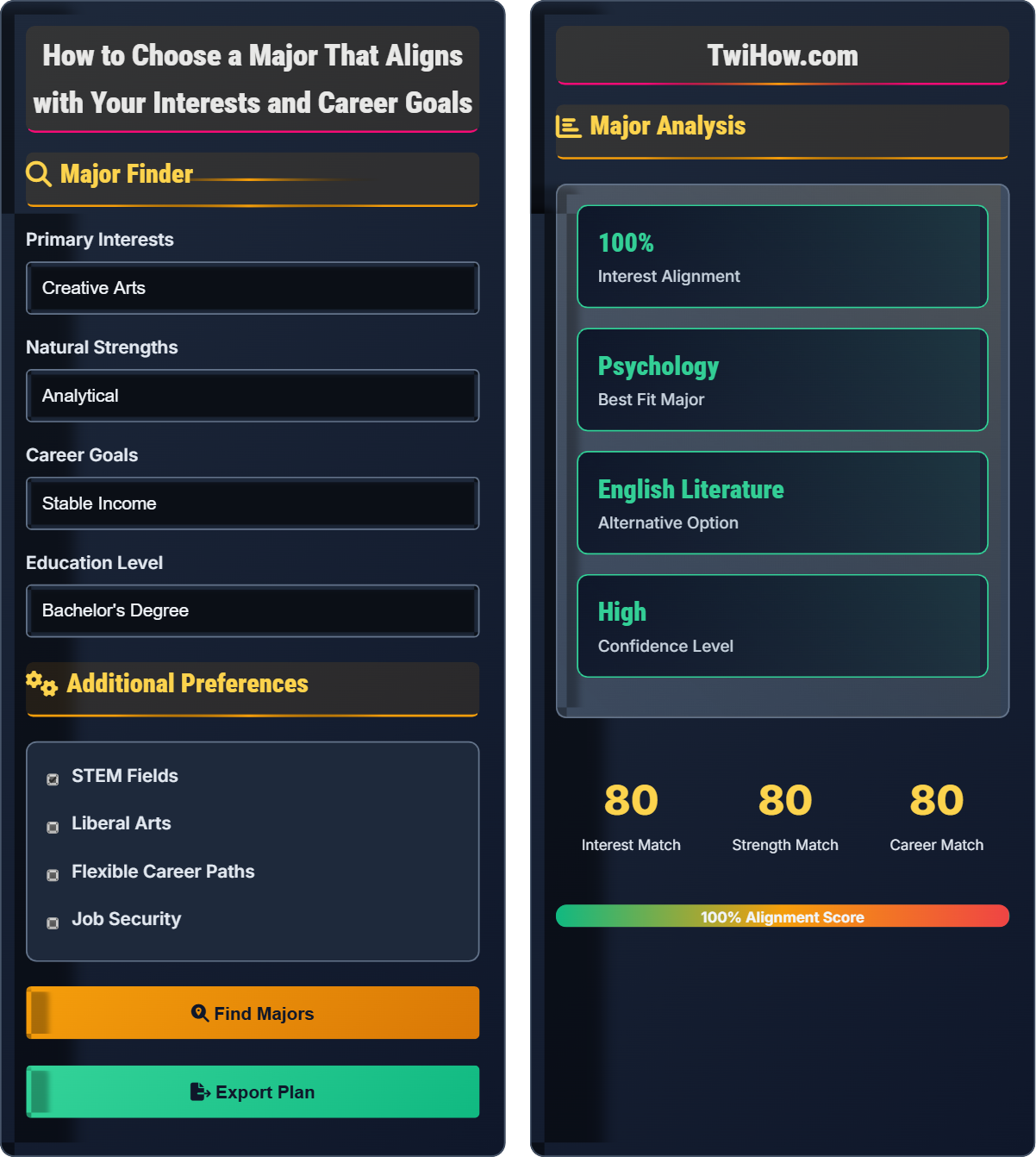
Major Finder
Additional Preferences
Major Analysis
Strong alignment with your technical interests and analytical strengths. Offers excellent career growth potential and job security.
Good match for your interpersonal strengths and interest in helping others. Provides diverse career opportunities in various fields.
| Step | Action | Timeline |
|---|---|---|
| 1 | Self-Assessment | Week 1-2 |
| 2 | Research Options | Week 3-4 |
| 3 | Explore Career Paths | Week 5-6 |
| 4 | Make Decision | Week 7-8 |
Self-Assessment Process
Understanding your interests is crucial for selecting a major that will keep you engaged and motivated. Consider subjects you enjoy, activities that energize you, and topics that spark your curiosity. Use tools like the Holland Code (RIASEC) to identify your interest patterns and compatible career fields.
Identify your natural talents and skills that will help you succeed in your chosen field. Consider your academic strengths, personal qualities, and abilities that come easily to you. This assessment helps ensure you choose a major that plays to your strengths rather than fighting your natural inclinations.
- Academic abilities (mathematical, verbal, spatial)
- Personal qualities (leadership, creativity, attention to detail)
- Interpersonal skills (communication, empathy, teamwork)
- Technical aptitudes (computer skills, analytical thinking)
- Organizational abilities (planning, time management)
Consider your long-term career aspirations and how different majors can help you achieve them. Think about your desired lifestyle, income expectations, work environment preferences, and career trajectory. Some majors open more doors than others, while some lead to very specific career paths.
Consider your core values and how they align with different majors and career paths. Some people prioritize work-life balance, others value social impact, and some focus on financial success. Your major should align with your fundamental beliefs and desired lifestyle.
- Work-life balance preferences
- Desired level of social impact
- Income expectations and financial goals
- Geographic mobility preferences
- Job security vs. risk tolerance
Career Pathways
Selection Timeline
Major Selection Quiz
What is the most important factor to consider when choosing a college major?
Your interests and strengths are the most important factors when choosing a major. When you study something that aligns with your interests and plays to your strengths, you're more likely to remain engaged, perform well academically, and find long-term satisfaction in your career. While other factors like earning potential are important, they shouldn't override your fundamental interests and abilities.
The answer is B) Your interests and strengths.
Successful major selection requires a deep understanding of yourself. When your major aligns with your natural interests and abilities, you're more likely to excel academically and find fulfillment in your studies. This foundation of engagement and success often translates into career satisfaction and professional achievement.
Self-Assessment: Evaluating your own interests and abilities
Interest Alignment: Matching your passions with your studies
Strength-Based Selection: Choosing based on your natural talents
• Choose based on your own interests
• Consider your natural strengths
• Think long-term satisfaction
• Take interest inventories
• Reflect on favorite subjects
• Consider what energizes you
• Choosing based on others' expectations
• Ignoring personal interests
• Focusing only on salary
Explain how to research career prospects for different majors and what factors to consider.
Research Methods:
• Salary Data: Use resources like Bureau of Labor Statistics, PayScale, or Glassdoor to research typical earnings for different careers.
• Job Outlook: Check employment projections to understand growth potential and job security.
• Required Skills: Identify what skills and qualifications are needed for different careers.
• Work Environment: Research typical work settings, hours, and culture.
Factors to Consider:
• Earning Potential: Starting salary, growth potential, and long-term earning capacity.
• Job Stability: Likelihood of job security and industry resilience.
• Work-Life Balance: Typical hours, stress levels, and flexibility.
• Career Advancement: Opportunities for promotion and professional growth.
• Geographic Mobility: Whether the career offers opportunities in various locations.
Informational Interviews: Connect with professionals in fields you're considering to gain insider perspectives on the realities of different careers.
Thorough career research helps you make informed decisions about your major. Understanding the practical implications of different career paths allows you to align your academic choices with your long-term goals. This research prevents unpleasant surprises after graduation and helps you make strategic decisions about your education.
Salary Data: Compensation information for different careers
Job Outlook: Future employment projections
Informational Interview: Conversation to learn about a career
• Research multiple sources
• Consider both short and long-term prospects
• Look beyond salary to overall satisfaction
• Use government labor statistics
• Connect with alumni in your field
• Attend career fairs and events
• Relying on stereotypes about careers
• Not researching job market conditions
• Ignoring work-life balance factors
Sarah loves creative writing and English literature but her parents want her to major in business for financial security. She's torn between following her passion and practical considerations. How should she approach this decision?
Self-Assessment:
• Interest Evaluation: Sarah should honestly assess how passionate she is about writing and literature. Does she enjoy it consistently, or is it more of a hobby?
• Strength Assessment: Does she have natural writing abilities and analytical skills? Can she see herself developing these further?
• Values Clarification: What matters most to her - creative fulfillment or financial security?
Research Options:
• English Career Paths: Research careers in writing, editing, publishing, journalism, or teaching. Look at salary ranges and job security.
• Business Alternatives: Consider if there are business specializations that might incorporate her writing interests (marketing, communications).
• Hybrid Approaches: Could she minor in English while majoring in business, or vice versa?
Communication Strategy:
• Discuss with Parents: Share her research and explain her career plans based on English studies.
• Present Evidence: Show concrete examples of successful careers in English-related fields.
• Compromise Solutions: Propose a plan that addresses both her interests and financial concerns.
Sarah should make the decision based on her own interests and goals, but with full research and consideration of practical factors.
Major selection often involves balancing personal interests with external pressures and practical considerations. The key is conducting thorough research to understand all options and making decisions based on your own values and goals while considering important practical factors. Communication with concerned parties should be based on facts and well-researched plans.
Self-Determination: Making decisions based on your own values
Research-Based Decision: Choice based on factual information
Practical Considerations: Real-world factors affecting choices
• Make your own decision
• Research all options thoroughly
• Consider practical factors
• Look for career paths that combine interests
• Research alternative routes to success
• Communicate with facts, not emotions
• Letting others make the decision for you
• Not researching career options
• Ignoring practical considerations
David declared a pre-med major as a freshman but realized he doesn't enjoy the science courses and has no interest in medicine. He's now a sophomore and worried about changing majors. What should he do?
Immediate Assessment:
• Identify True Interests: What subjects does David actually enjoy? What activities energize him?
• Recognize the Significance: It's better to change direction early than continue down an unsuitable path.
• Inventory Completed Credits: Determine which credits will transfer to a new major.
Exploration Phase:
• Take Introductory Courses: Sample courses in potential new majors.
• Meet with Advisors: Discuss timeline and credit transfer options.
• Explore Career Options: Research careers in different fields.
Planning Ahead:
• Timeline Adjustment: Understand that changing majors may extend graduation timeline.
• Summer Courses: Consider summer classes to catch up.
• Gap Year Option: Evaluate if taking a year to explore options would be beneficial.
Support Systems:
• Academic Counseling: Work with advisors to create a new plan.
• Peer Support: Connect with others who have changed majors.
• Family Communication: Explain the reasoning for the change.
Changing majors is common and often leads to better outcomes when done thoughtfully.
Changing majors is a normal part of the college experience for many students. The key is making the decision based on self-knowledge and careful planning rather than avoiding challenges. Early recognition of a poor fit and thoughtful exploration of alternatives often leads to better academic performance and career satisfaction.
Major Change: Switching academic focus during college
Academic Planning: Strategic course selection
Self-Knowledge: Understanding your own interests and abilities
• Don't persist in a poor fit
• Plan the transition carefully
• Seek appropriate guidance
• Many credits transfer between majors
• Changing early is easier than late
• Use general education requirements
• Staying in an unsuitable major
• Changing without planning
• Not seeking guidance
When considering a double major, what is the most important factor to evaluate?
Whether your interests truly align with both fields is the most important factor. A double major requires dedication and passion for both subjects. If you're only pursuing one of the majors for external reasons, you're likely to struggle academically and personally. The combination should make sense for your interests and career goals.
The answer is B) Whether your interests truly align with both fields.
Double majors require significant commitment and genuine interest in both fields. Success in a double major depends on your ability to maintain engagement with both subjects over several years. The combination should enhance your career prospects and align with your interests rather than being pursued for external validation.
Double Major: Completing requirements for two different fields
Interest Alignment: Passion for both subject areas
Academic Commitment: Dedication to rigorous coursework
• Pursue what you're passionate about
• Consider the workload realistically
• Ensure career alignment
• Research credit requirements
• Plan your schedule carefully
• Consider the impact on your GPA
• Pursuing double majors for prestige
• Not considering the workload
• Ignoring career implications
Evaluation Process
FAQ
Q: Is it okay to be undecided about my major?
A: Yes, being undecided is completely normal and acceptable. Many students take time to explore different fields before choosing a major. Use this time to take introductory courses in various subjects, engage in self-assessment, and explore different career paths. Most colleges have undeclared programs that allow you to explore while completing general education requirements.
Q: How can I support my child in choosing a major?
A: Support your child by encouraging self-reflection and research rather than pushing specific majors. Help them access resources like career counseling, informational interviews, and job shadowing opportunities. Listen to their interests and concerns, and provide guidance on practical considerations without making the decision for them.