How to Select the Ideal Educational Institution
Complete guide • Decision-making strategies
Choosing the right college or university is one of the most important decisions in a person's life. It affects not only their education but also their career prospects, financial situation, and personal development. The decision should be based on careful evaluation of multiple factors including academic programs, campus culture, location, cost, and career services. A systematic approach to college selection helps ensure the best fit for individual needs and goals.
Key decision factors:
- Academic Quality: Faculty expertise, program reputation, research opportunities
- Financial Considerations: Cost, scholarships, financial aid, potential debt
- Location: Geographic, climate, urban/rural, distance from home
- Campus Culture: Social environment, diversity, activities, values
- Post-Graduation Outcomes: Employment rates, salary data, alumni networks
Research shows that students who attend colleges that match their academic and personal preferences have higher graduation rates and better career outcomes.
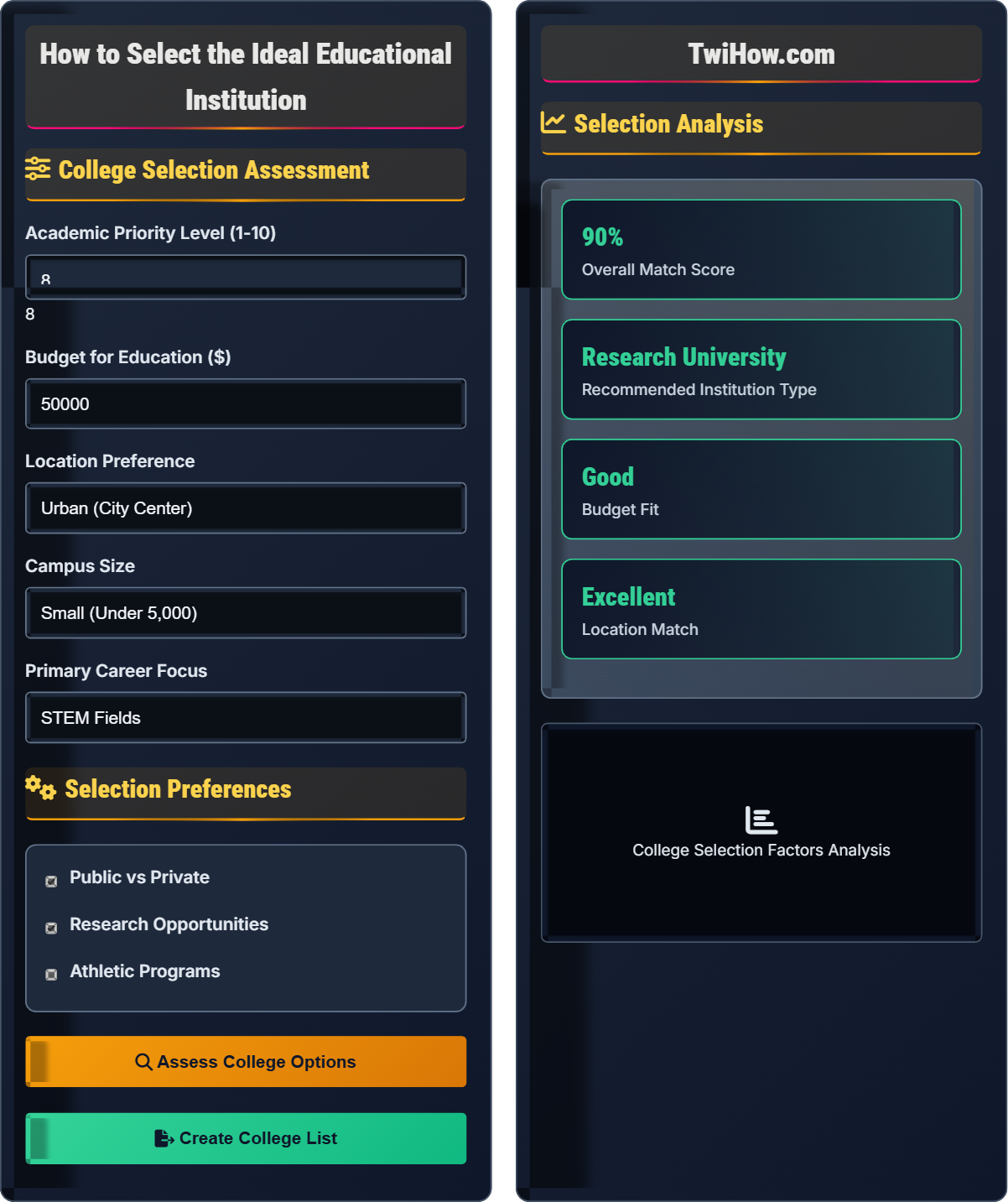
College Selection Assessment
Selection Preferences
Selection Analysis
College Selection Factors Analysis
| College | Match Score | Cost | Location |
|---|---|---|---|
| State University | 90% | $25,000 | Suburban |
| Regional College | 85% | $35,000 | Urban |
| Private University | 80% | $50,000 | Suburban |
| Liberal Arts College | 75% | $45,000 | Rural |
Evaluation Factors
Academic Quality: 30% weight in decision
Financial Affordability: 25% weight in decision
Location & Environment: 20% weight in decision
Career Services: 15% weight in decision
Personal Fit: 10% weight in decision
College Selection Guide
The college selection process involves a systematic evaluation of institutions based on multiple criteria. The most effective approach combines quantitative data with qualitative factors to ensure a good fit for academic, financial, and personal needs.
Key components:
- Academic Programs: Quality, reputation, faculty, resources
- Financial Considerations: Cost, aid, scholarships, debt potential
- Location Factors: Geographic, climate, urban/rural, proximity to home
- Campus Culture: Social environment, diversity, activities, values
- Post-Graduation Outcomes: Employment rates, salary data, graduate school placement
The weighted scoring model for college selection:
Where:
- Factor: Individual evaluation criteria (0-100 scale)
- Weight: Importance assigned to each factor (0-1)
- n: Number of evaluation criteria
Comprehensive list of factors to consider:
- Academic Excellence: Faculty credentials, student-to-faculty ratio, research opportunities
- Program Quality: Accreditation, curriculum, specializations, internship opportunities
- Financial Aid: Scholarships, grants, work-study programs, loan options
- Campus Life: Housing, dining, extracurricular activities, student organizations
- Career Services: Job placement rates, alumni networks, career counseling
- Location: Climate, cost of living, proximity to family, transportation
- Support Services: Counseling, tutoring, disability services, international student support
Signs of a good college fit:
- Academic Satisfaction: Enjoying coursework and professors
- Personal Growth: Developing independence and maturity
- Financial Stability: Managing expenses without excessive debt
- Social Integration: Building meaningful relationships
- Career Preparation: Gaining relevant skills and experience
- Overall Well-being: Maintaining physical and mental health
Selection Criteria
Academic quality, financial affordability, location, campus culture, career services, program fit.
Weighted scoring, comparison matrices, campus visits, information interviews, financial analysis.
- Match institution to career goals
- Consider total cost of attendance
- Visit campuses when possible
- Verify program accreditation
Financial Considerations
Tuition, fees, housing, meals, books, transportation, personal expenses, loan interest.
- Calculate total cost of attendance
- Research available financial aid
- Compare net costs after aid
- Estimate potential debt and repayment
- Consider return on investment
- Plan for unexpected expenses
- Thorough research and comparison
- Realistic financial planning
- Consider long-term implications
- Factor in career outcomes
College Selection Quiz
Which of the following is the most important factor to consider when selecting a college?
While all factors have some importance, the quality of academic programs and career outcomes are the most critical for long-term success. The primary purpose of attending college is to receive a quality education that prepares you for a career. Academic reputation, faculty expertise, program accreditation, and graduate employment statistics have the greatest impact on your future opportunities.
The answer is B) Academic program quality and career outcomes.
College selection should prioritize educational outcomes over peripheral factors. While social environment and location are important, they shouldn't overshadow the fundamental purpose of higher education: academic preparation for a career. Students who choose institutions based primarily on academic excellence tend to have better long-term career and financial outcomes.
Academic Program Quality: Standards of education, faculty expertise, and curriculum effectiveness
Career Outcomes: Post-graduation employment, salary, and professional advancement
Return on Investment: Financial benefit relative to educational cost
• Focus on educational value over social appeal
• Research post-graduation statistics
• Consider long-term career impact
• Check job placement rates
• Review alumni career paths
• Investigate faculty credentials
• Choosing based on popularity rather than fit
• Overlooking career services and outcomes
Explain how to evaluate the financial impact of attending different colleges and calculate the potential return on investment.
Financial Evaluation Process:
1. Calculate Total Cost: Tuition + fees + housing + meals + books + transportation + personal expenses
2. Research Financial Aid: Scholarships, grants, work-study, loans available
3. Determine Net Cost: Total cost minus financial aid
4. Estimate Debt: Calculate potential student loan burden
5. Research Outcomes: Average starting salaries, employment rates for graduates
6. Calculate ROI: Compare potential earnings to total investment
ROI Formula: [(Expected Lifetime Earnings Difference) - (Total College Cost)] / (Total College Cost) × 100
For example, if attending College A costs $200,000 over 4 years and leads to a career earning $2 million more over 30 years than not attending, the ROI would be ($2,000,000 - $200,000) / $200,000 = 900%.
Financial planning for college requires considering both immediate costs and long-term benefits. The investment should be evaluated in terms of potential career earnings, job security, and professional opportunities. It's important to factor in the time value of money and the opportunity cost of not working during college years.
Total Cost of Attendance: All expenses associated with attending college
Net Cost: Actual cost after financial aid is applied
Opportunity Cost: Income lost by not working during college years
• Consider total cost, not just tuition
• Research career outcomes and salaries
• Factor in time value of money
• Compare net costs between institutions
• Look at 10-year career trajectories
• Consider loan forgiveness programs
• Only considering tuition costs
• Not researching financial aid options
• Underestimating the impact of debt
You're planning campus visits to three colleges you're considering. How would you structure these visits to maximize information gathering and help with your decision-making process?
Pre-Visit Preparation: Research the institution thoroughly, prepare specific questions, identify key areas of interest.
During Visit: Attend an information session, take a guided tour, sit in on a class in your major, eat in the dining hall, talk to current students and faculty.
Key Observations: Class sizes, campus atmosphere, student engagement, facility quality, diversity of activities.
Post-Visit: Document impressions, compare with other institutions, follow up on unanswered questions.
Questions to Ask: What makes this institution unique? What support services are available? How do students typically spend their time? What opportunities exist for internships and research?
This approach ensures you gather both objective information and subjective impressions that will inform your final decision.
Campus visits provide crucial firsthand information that can't be obtained from brochures or websites. The goal is to experience the environment and culture to determine if it matches your personal and academic needs. These visits should be structured to maximize information gathering while allowing for spontaneous observations.
Campus Atmosphere: Overall environment and culture of the institution
Student Engagement: Level of participation in academic and extracurricular activities
Support Services: Resources available to help students succeed
• Visit during regular academic sessions
• Engage with current students
• Observe real campus life
• Stay overnight if possible
• Attend classes in your major
• Explore the surrounding area
• Only visiting during special events
• Not talking to students
• Focusing only on tour highlights
You're considering two universities for the same major, but one has a higher national ranking while the other has better local industry connections. How would you evaluate which is the better choice for your career goals?
Evaluate National Ranking: Consider what the ranking measures (research output, selectivity, etc.) and how it relates to your goals.
Assess Local Connections: Investigate internship opportunities, job placement rates, alumni networks in your target industry.
Research Career Goals: Determine if you want to work regionally or nationally after graduation.
Consider Program Specifics: Look at curriculum, faculty expertise, research opportunities in your specific area of interest.
Factor in Resources: Evaluate career services, professional development programs, and industry partnerships.
Make Decision: If you want to work in the region, choose the school with local connections. If you want national opportunities, the higher-ranked school may be better.
Remember that rankings don't always reflect program quality in specific majors or regional career prospects.
College rankings can be misleading if not understood in context. Different rankings measure different things, and what matters for your career depends on your specific goals. A school with strong local industry ties may provide better opportunities for regional careers than a nationally ranked institution.
National Rankings: Institutional rankings based on broad criteria
Local Industry Connections: Relationships with nearby employers and organizations
Program-Specific Quality: Excellence in a particular field of study
• Look beyond overall rankings to program quality
• Consider your specific career goals
• Research outcomes in your target field
• Contact program coordinators directly
• Speak with recent graduates
• Evaluate faculty research in your area
• Relying solely on national rankings
• Not researching program specifics
• Ignoring local career opportunities
What is the most important consideration when deciding between two colleges with similar academic quality?
When academic quality is similar, financial considerations become paramount. The college with the better financial aid package will reduce your debt burden and provide more flexibility after graduation. Financial stress can significantly impact your college experience and post-graduation choices.
The answer is B) Which offers the better financial aid package.
When institutions are academically comparable, differentiating factors become more important. Financial aid packages can have a significant impact on your college experience and long-term financial health. The money saved can be invested in other educational opportunities or reduce post-graduation financial pressure.
Financial Aid Package: Combination of grants, scholarships, work-study, and loans
Debt Burden: Total student loan obligations
Post-Graduation Flexibility: Career choices not constrained by debt
• Financial considerations significantly impact college experience
• Debt can limit post-graduation options
• Compare total net costs, not just sticker prices
• Negotiate financial aid packages
• Consider the full cost of attendance
• Factor in potential salary differences
• Not comparing net costs after aid
• Underestimating the impact of debt
• Choosing more expensive option without justification
FAQ
Q: How do I know if I'm making the right choice if I can't visit all the colleges I'm considering?
A: If you can't visit all colleges, maximize your research:
• Schedule virtual tours and information sessions
• Attend college fairs and virtual events
• Connect with current students and recent alumni
• Review student-produced content and social media
• Request detailed materials and publications
• Speak with admissions representatives
• Look at post-graduation outcomes and employment statistics
While in-person visits are ideal, thorough virtual research can provide valuable insights into campus culture and academic offerings.
Q: What if my child chooses a college that I think is wrong for them?
A: Support your child's decision-making process:
1. Provide Guidance: Share your concerns constructively
2. Research Together: Help them evaluate options thoroughly
3. Discuss Consequences: Help them understand potential outcomes
4. Respect Their Choice: Ultimately, they must live with the decision
5. Plan for Adjustments: Consider transfer options if needed
Remember that college choice isn't irreversible. Students can change paths, and the decision-making process itself is valuable for their development.