How to Improve Time Management as a Student
Complete guide • Productivity strategies • Step-by-step instructions
Effective time management as a student involves organizing and planning how to divide your time between different activities. Good time management enables you to work smarter rather than harder, so you get more accomplished in less time. It's about prioritizing tasks, setting realistic goals, and maintaining balance between academic and personal life.
Key components include:
- Goal Setting: Clear objectives for academic and personal tasks
- Prioritization: Identifying what matters most and when
- Scheduling: Allocating specific time blocks for activities
- Focus Management: Maintaining concentration during study
- Balance: Integrating work, rest, and personal time
This guide provides comprehensive strategies for mastering student time management.
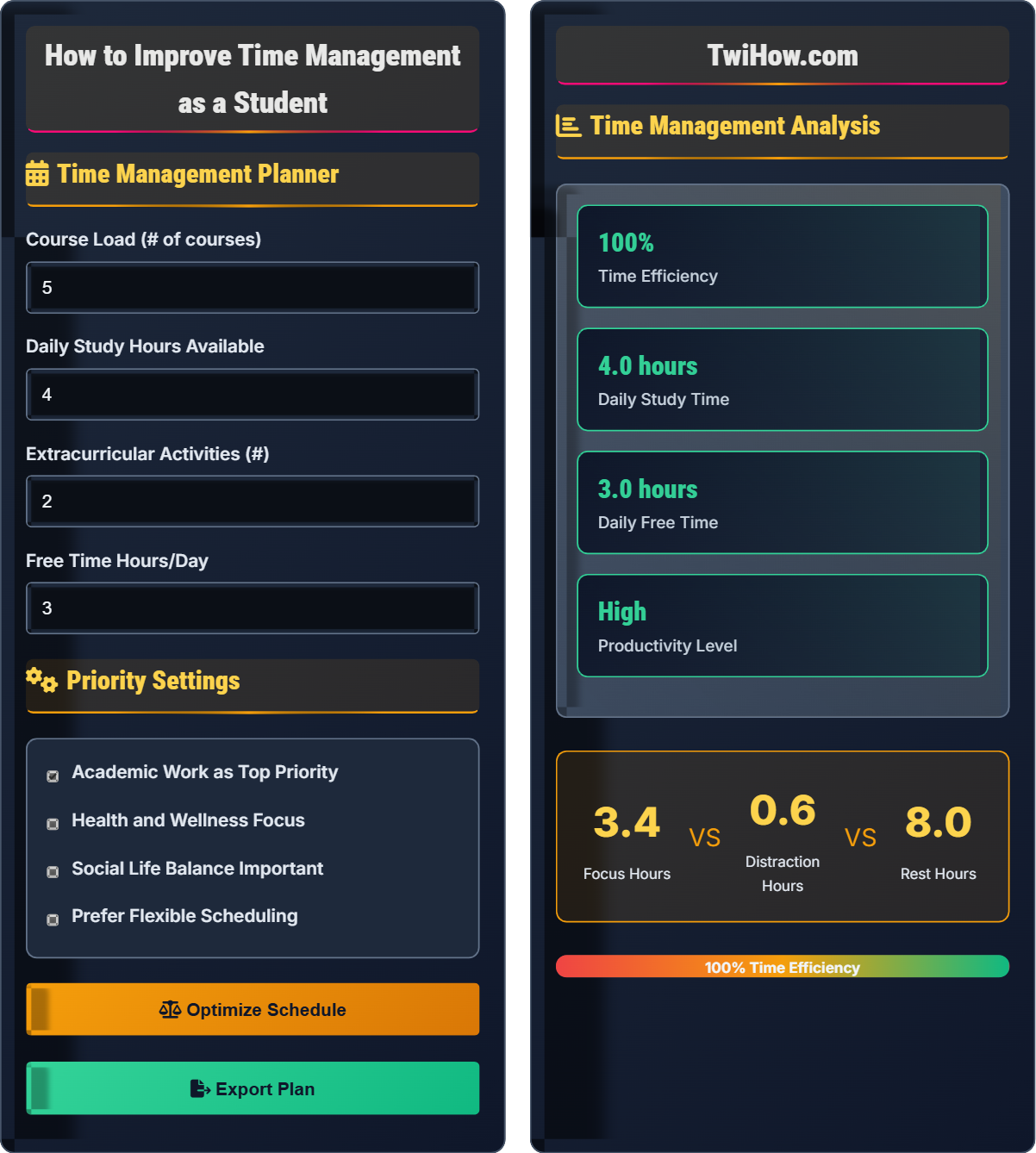
Time Management Planner
Priority Settings
Time Management Analysis
| Time | Activity | Priority |
|---|---|---|
| 8:00-9:00AM | Review Notes | Medium |
| 9:00-11:00AM | Class Time | High |
| 2:00-4:00PM | Study Block | High |
| 6:00-7:00PM | Exercise | Low |
Use the Eisenhower Matrix to categorize tasks by urgency and importance. Focus on important tasks first.
Assign specific time blocks to different activities to maintain focus and prevent overlap.
Time Management Strategies
Effective time management starts with proper prioritization. Use the Eisenhower Matrix to categorize tasks into four quadrants: urgent and important, important but not urgent, urgent but not important, and neither urgent nor important. Focus on important tasks, especially those that are important but not urgent, to prevent crises.
Time blocking involves scheduling specific time blocks for different activities throughout your day. This technique helps maintain focus, prevents task switching, and ensures adequate time for important activities. Allocate larger blocks for complex tasks and shorter blocks for routine activities.
- Reduces decision fatigue
- Improves focus and concentration
- Prevents overcommitment
- Ensures important tasks get attention
- Creates work-life boundaries
Break large projects into smaller, manageable tasks. Use techniques like the Pomodoro Technique (25-minute focused work sessions followed by 5-minute breaks) to maintain productivity. Create daily and weekly to-do lists, and celebrate small wins to maintain motivation.
- Chunking large projects
- Pomodoro Technique
- Two-minute rule (do immediately if under 2 minutes)
- Batch similar tasks together
- Review and adjust daily plans
Leverage technology to enhance time management. Use calendar apps for scheduling, task management apps for tracking, and focus apps to minimize distractions. Popular tools include Google Calendar, Todoist, Forest, and RescueTime. Choose tools that integrate well with your workflow.
- Google Calendar for scheduling
- Todoist or Trello for task management
- Forest for focus and productivity
- RescueTime for tracking usage
- Notion for comprehensive organization
Effective time management includes scheduling for rest, exercise, and social activities. Include buffer time between activities and plan for unexpected events. Regular breaks and adequate sleep improve overall productivity and prevent burnout.
- Schedule regular breaks
- Include physical activity
- Maintain social connections
- Plan for flexibility
- Prioritize adequate sleep
Weekly Schedule Template
8-10AM: Study
10-12PM: Class
2-4PM: Project
9-11AM: Class
1-3PM: Review
4-5PM: Exercise
8-10AM: Study
10-12PM: Class
3-5PM: Group Work
9-11AM: Class
1-3PM: Research
4-6PM: Free Time
8-10AM: Study
10-12PM: Class
5-7PM: Social
10-12PM: Review
2-5PM: Relax
7-8PM: Plan Week
9-11AM: Prep
2-4PM: Rest
6-7PM: Weekly Review
Focus Areas Tracker
Time Management Quiz
According to the Eisenhower Matrix, which tasks should you focus on first?
Tasks that are important but not urgent should be scheduled and planned for. These include long-term projects, relationship building, and preventive activities. Focusing on these tasks prevents them from becoming urgent crises later. While urgent and important tasks need immediate attention, proactively managing important but non-urgent tasks is key to effective time management.
The answer is B) Tasks that are important but not urgent.
The Eisenhower Matrix is a powerful tool for prioritization that helps distinguish between what is urgent and what is important. Most people focus on urgent tasks, but effective time management requires focusing on important tasks, even if they're not immediately urgent. This prevents important tasks from becoming urgent crises.
Urgent: Requires immediate attention
Important: Contributes to long-term goals
Eisenhower Matrix: Four-quadrant prioritization tool
• Focus on important, non-urgent tasks
• Schedule important activities
• Delegate urgent, non-important tasks
• Use the matrix for daily planning
• Review tasks regularly
• Move tasks between quadrants
• Only focusing on urgent tasks
• Not planning for important activities
• Confusing urgency with importance
Explain the time blocking technique and how it improves student productivity.
Time Blocking: Time blocking is a time management technique where you divide your day into specific time blocks dedicated to particular activities or types of work. Each block is assigned to a specific task or category, such as academic study, extracurricular activities, or personal time.
How It Improves Productivity:
1. Reduces Decision Fatigue: Knowing you have a predetermined schedule eliminates the mental energy spent deciding what to do next.
2. Increases Focus: Dedicated time blocks allow for deep, uninterrupted focus on specific tasks.
3. Prevents Overcommitment: Visualizing your schedule makes it clear when you're overbooked.
4. Reduces Procrastination: Having a specific time allocated for tasks makes it easier to start.
5. Improves Work-Life Balance: Ensures time is allocated for both academic and personal activities.
Implementation: Start by blocking out fixed commitments like classes, then allocate time for study, exercise, and personal activities. Include buffer time between blocks for transitions.
Time blocking works because it addresses the cognitive load of constantly deciding what to do next. When you have a predetermined schedule, your mind can focus entirely on the task at hand rather than managing competing priorities. This technique is particularly effective for students who struggle with procrastination or feel overwhelmed by choices.
Time Blocking: Assigning specific time periods to activities
Decision Fatigue: Reduced decision-making ability from excessive choices
Deep Work: Focused, uninterrupted work on cognitively demanding tasks
• Protect your time blocks from interruptions
• Include buffer time between activities
• Be flexible when adjustments are needed
• Use different colors for different types of activities
• Schedule study time during peak focus hours
• Include transition time between activities
• Not protecting time blocks from interruptions
• Scheduling during low-energy periods
• Not including buffer time
Sarah has 5 courses, works part-time 15 hours/week, participates in 2 clubs, and wants to maintain 7-8 hours of sleep nightly. She currently feels overwhelmed and struggles to complete assignments. How should she structure her weekly schedule to improve time management?
Time Analysis:
Sleep: 7 hours × 7 days = 49 hours/week
Part-time work: 15 hours/week
Classes: Assuming 15 hours/week (3 hours per course)
Available hours: 168 - 49 - 15 - 15 = 89 hours for study, clubs, meals, and personal time
Recommended Schedule:
• Study Time: 25-30 hours/week (5-6 hours daily on study days)
• Club Activities: 6-8 hours/week (3-4 hours each club)
• Personal Time: 15-20 hours/week (including meals, exercise, social)
• Buffer Time: 5-10 hours for unexpected tasks
Implementation: Use time blocking with study periods during peak energy times, batch similar tasks together, and include regular breaks. Schedule club meetings on specific days to prevent overlap with study time. Use the Pomodoro Technique during study sessions.
Effective schedule optimization requires a realistic assessment of time commitments and available hours. Sarah's situation requires acknowledging that 24 hours per day is finite and must be allocated intentionally. The key is finding the right balance between academic requirements, work obligations, personal activities, and rest.
Time Analysis: Calculating available time for different activities
Schedule Optimization: Maximizing efficiency within time constraints
Peak Energy Times: When you're most alert and focused
• Account for all time commitments
• Include adequate rest time
• Build in flexibility for adjustments
• Track actual vs. planned time usage
• Identify peak productivity hours
• Build in flexibility for adjustments
• Underestimating time requirements
• Not accounting for transition time
• Ignoring the need for rest and recovery
Michael finds himself constantly distracted by his phone and social media while studying, which significantly reduces his productivity. What strategies can he implement to minimize distractions and improve focus during study sessions?
Environmental Controls:
• Phone Management: Put phone in another room, use airplane mode, or place it face-down in a drawer
• Study Location: Choose quiet locations away from distractions
• Workspace Setup: Keep only necessary materials on desk
Technology Solutions:
• Focus Apps: Use apps like Forest, Cold Turkey, or Freedom to block distracting websites
• Browser Extensions: Install extensions that block social media during study time
• Notification Settings: Turn off non-essential notifications
Behavioral Strategies:
• Pomodoro Technique: 25 minutes focused work, 5 minutes break
• Pre-Study Ritual: Create a routine that signals focus time
• Accountability Partner: Study with someone who keeps you accountable
• Time Blocking: Dedicate specific times for checking messages
Combining multiple strategies often provides the best results for maintaining focus.
Managing distractions is crucial for effective time management. Digital distractions are particularly problematic because they fragment attention and make it difficult to achieve deep focus. The key is removing temptations from your environment and creating systems that support sustained attention. Different strategies work for different people, so experimentation is important.
Digital Distractions: Technology-based interruptions that disrupt focus
Deep Focus: Sustained attention on cognitively demanding tasks
Attention Fragmentation: Breaking focus into small segments
• Remove temptations from study environment
• Create clear boundaries around technology use
• Build in designated break times for technology
• Use physical barriers to phone access
• Schedule specific times for social media
• Track time spent on distractions
• Keeping phone nearby during study
• Not creating clear boundaries
• Failing to track distraction patterns
Which of the following is the most important element of maintaining work-life balance as a student?
Including adequate rest and personal time is essential for maintaining work-life balance and preventing burnout. Balance involves allocating time for academic work, personal activities, social connections, and rest. This approach improves overall productivity and well-being, which ultimately enhances academic performance.
The answer is B) Including adequate rest and personal time in your schedule.
True productivity comes from sustainable practices that include adequate rest and recovery. Students who maintain balance often perform better academically than those who sacrifice personal time for study. Rest is not wasted time—it's essential for cognitive function, memory consolidation, and overall well-being. Balance creates a sustainable system for long-term success.
Work-Life Balance: Equitable distribution of time across different life areas
Sustainable Productivity: Maintaining performance over time
Burnout Prevention: Avoiding exhaustion from overwork
• Schedule personal time like any other commitment
• Maintain social connections
• Prioritize adequate sleep and rest
• Treat personal time as non-negotiable
• Include physical activity in your schedule
• Maintain hobbies and interests
• Sacrificing rest for study time
• Not scheduling personal activities
• Believing more study hours equals better results
Implementation Timeline
Success Strategies
To improve time management as a student:
- Set clear, realistic goals for academic and personal tasks
- Use priority matrices to organize tasks effectively
- Implement time blocking for focused work sessions
- Minimize distractions during study time
- Include adequate rest and personal time in your schedule
- Track your progress and adjust as needed
- Use technology tools to support your system
Remember that time management is a skill that improves with practice and consistency.
FAQ
Q: How do I know if my time management system is working?
A: Signs of an effective time management system include: completing tasks on time, feeling less stressed, having adequate time for both academic and personal activities, improved academic performance, and feeling in control of your schedule. You should also notice fewer instances of procrastination and less time spent on decision-making about what to do next.
Q: Should my child follow a rigid schedule or have flexibility?
A: The best approach combines structure with flexibility. Have a general framework with fixed times for classes, sleep, and important commitments, but build in buffer time for unexpected events and allow for adjustments. This provides the benefits of planning while accommodating life's unpredictability. The key is maintaining consistent routines for sleep and study while allowing flexibility in daily scheduling.