How to Create and Stick to a Student Budget?
Budgeting excellence guide • Financial planning
Student Budgeting:
Show Budget CalculatorCreating and maintaining a student budget is crucial for financial success and academic focus. A well-planned budget helps you track expenses, avoid debt, and build healthy financial habits. This guide provides strategies for creating realistic budgets, tracking spending, and developing sustainable financial practices that will serve you throughout your academic journey and beyond.
Key budgeting principles:
- Income Tracking: Understanding all sources of financial support
- Expense Categorization: Organizing spending into meaningful categories
- Emergency Planning: Preparing for unexpected expenses
- Savings Allocation: Building financial security over time
Successful student budgeting requires discipline, planning, and regular review. The goal is to live within your means while supporting your academic success and personal well-being. A balanced approach considers both essential needs and reasonable wants while building toward financial independence.
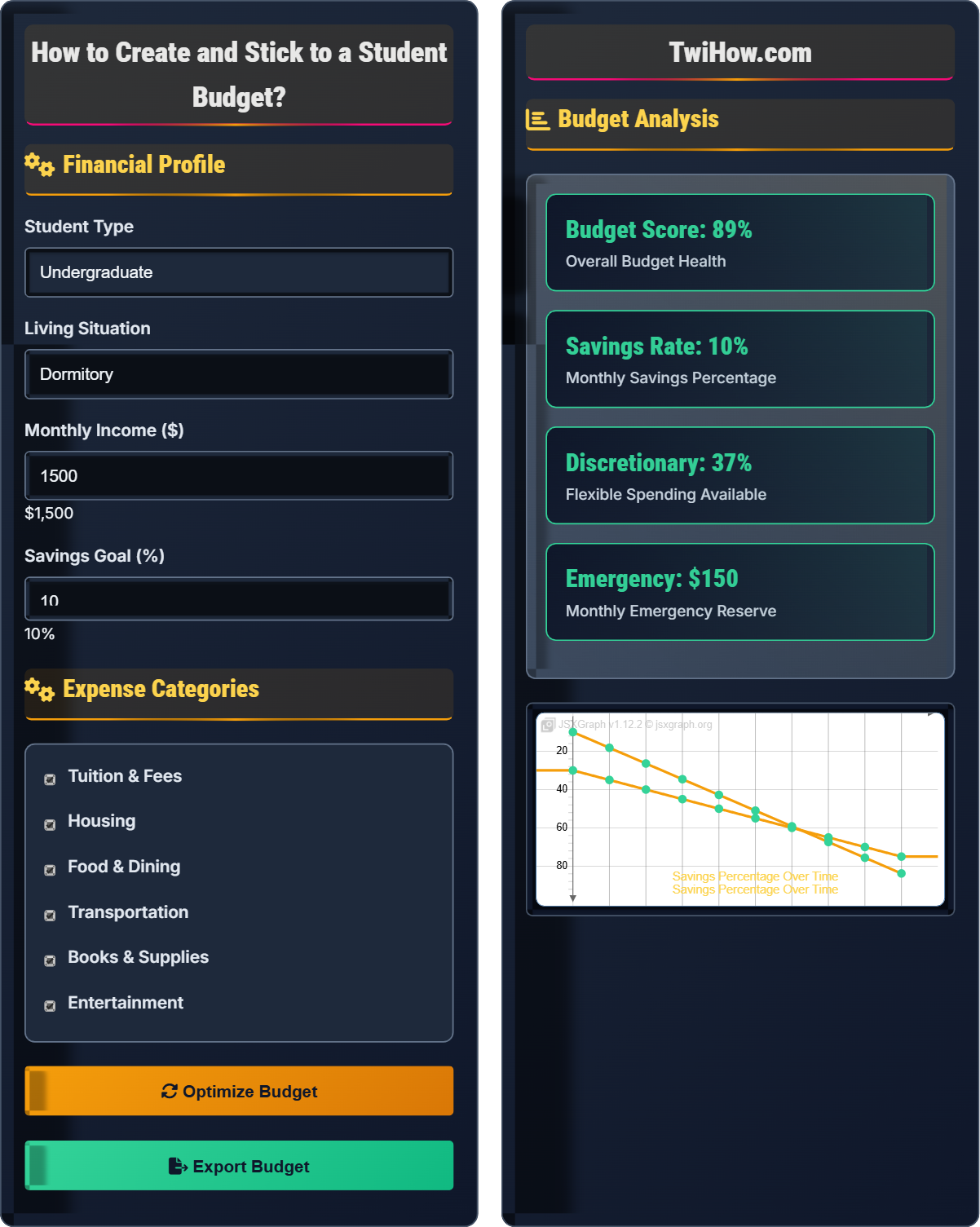
Financial Profile
Expense Categories
Budget Analysis
| Category | Amount | % of Income | Recommendation |
|---|---|---|---|
| Housing | $600 | 40% | Appropriate |
| Food | $300 | 20% | Appropriate |
| Tuition | $400 | 27% | Fixed Cost |
| Transportation | $100 | 7% | Good |
| Entertainment | $100 | 7% | Manageable |
Mastering Student Financial Management
Student financial management requires understanding the unique challenges of limited income, fluctuating expenses, and irregular cash flows. Unlike permanent careers, student financial situations change significantly over time. Success requires planning for these fluctuations while building healthy financial habits that will serve throughout your life. The goal is to support your academic success while developing financial independence.
Effective budgeting follows a simple yet powerful principle:
Where Financial Health = percentage of income remaining after expenses (should be positive). The goal is to maintain a positive balance while allocating funds appropriately to essential needs, savings, and reasonable wants.
Student expenses typically fall into several categories:
- Fixed Costs: Rent, tuition, insurance (unavoidable monthly expenses)
- Necessities: Food, transportation, basic supplies (essential for survival)
- Academic: Books, supplies, lab fees (directly related to education)
- Discretionary: Entertainment, dining out, hobbies (flexible spending)
- Savings: Emergency fund, future goals (financial security)
- Cook at Home: Significantly cheaper than eating out
- Buy Used: Textbooks, furniture, electronics
- Use Student Discounts: Many businesses offer student pricing
- Public Transportation: Often cheaper than car ownership
- Free Entertainment: Campus events, libraries, parks
- Meal Plans: Can be economical for frequent dining
Core Financial Concepts
Student budget, discretionary spending, fixed expenses, variable expenses, emergency fund, financial literacy.
Available Funds = (Income - Fixed Expenses) × (1 - Savings Rate)
Where Available Funds = amount available for variable expenses and discretionary spending.
- Never spend more than you earn
- Build an emergency fund
- Save before spending on wants
Practical Applications
Undergraduate budgeting, graduate student funding, international student expenses, online student costs.
- Calculate total monthly income
- List all fixed expenses
- Estimate variable expenses
- Allocate savings amount
- Track spending daily
- Review and adjust monthly
- Seasonal expense variations
- Irregular income patterns
- Academic term vs. break differences
- Emergency preparedness
Financial Literacy Quiz
According to financial experts, what percentage of income should students allocate to savings?
Financial experts recommend saving 5-10% of income, even for students with limited resources. This creates an emergency fund and establishes good financial habits. For students, even small amounts saved regularly can build financial security and reduce stress during unexpected expenses.
The answer is B) 5-10% - Build an emergency fund.
Building an emergency fund is crucial for financial stability. Even students should prioritize saving a small percentage of income to handle unexpected expenses like medical bills, urgent textbooks, or transportation costs. The key is consistency rather than amount - even $25 per month builds over time and provides peace of mind.
Emergency Fund: Money reserved for unexpected expenses
Financial Security: Stability through adequate savings
Compound Growth: Savings growing over time
• Save first, then spend
• Start with small amounts
• Build consistency
• Automate savings if possible
• Use separate savings account
• Track progress regularly
• Not saving anything during school
Explain the importance of tracking expenses for students and recommend effective methods for doing so. How can expense tracking improve financial decision-making?
Importance: Expense tracking reveals spending patterns, identifies unnecessary purchases, and helps ensure spending stays within budget. Many students underestimate their spending, particularly on small, frequent purchases.
Tracking Methods:
• Mobile apps (Mint, YNAB, PocketGuard)
• Simple spreadsheet with categories
• Notebook with daily entries
• Bank app transaction history
• Receipt organization system
Improvement in Decision-Making: Tracking shows where money goes, enabling conscious choices about spending. It reveals patterns that can be optimized and helps prioritize needs over wants.
Best Practices: Track daily, categorize expenses, review weekly, and adjust behavior based on insights.
Expense tracking is fundamental to financial awareness. Without tracking, students operate with incomplete information about their spending habits. The "awareness effect" of tracking often leads to reduced spending as people become more conscious of their purchases. This awareness is the first step toward better financial decisions.
Expense Tracking: Recording and monitoring spending
Financial Awareness: Understanding spending patterns
Budget Optimization: Improving spending efficiency
• Record expenses daily
• Categorize consistently
• Review regularly
• Use smartphone apps for convenience
• Take photos of receipts
• Set up automatic bank alerts
• Not tracking small purchases
• Forgetting to categorize expenses
• Not reviewing spending regularly
You receive $2,000 per month from financial aid, parents, and part-time work. Your fixed expenses (rent, utilities, insurance) total $800. You want to save 15% of your income for emergencies. Estimate how much you can spend on variable expenses (food, entertainment, supplies) and explain how you would allocate this amount.
Calculation:
Monthly Income: $2,000
Fixed Expenses: $800
Savings (15% of $2,000): $300
Available for Variable Expenses: $2,000 - $800 - $300 = $900
Allocation Strategy:
Food: $400 (44%) - Groceries and occasional dining
Supplies: $100 (11%) - Books, materials, personal care
Transportation: $100 (11%) - Gas, public transit, rideshare
Entertainment: $150 (17%) - Movies, events, hobbies
Buffer: $150 (17%) - Unexpected expenses
Monitoring: Track spending weekly, adjust allocations as needed, and review budget monthly to ensure sustainability.
This example demonstrates the mathematical approach to budgeting. The key is subtracting fixed expenses and savings first, then allocating the remaining amount. The buffer category is crucial for students whose expenses can vary significantly. Regular review ensures the budget remains realistic and sustainable.
Fixed Expenses: Unchanging monthly costs
Variable Expenses: Fluctuating monthly costs
Buffer Amount: Reserved funds for unexpected costs
• Subtract fixed expenses first
• Prioritize savings
• Leave buffer for variability
• Use the 50/30/20 rule as a guideline
• Adjust allocations based on priorities
• Track spending immediately after purchase
• Not accounting for seasonal expenses
• Forgetting to include savings
• Allocating everything without buffer
You receive financial aid payments once per semester ($5,000), but you need to budget for monthly expenses. How should you manage this irregular income pattern to ensure you don't run out of money before the next payment?
Management Strategy:
Immediate Action: Divide the semester payment by the number of months in the semester. For a 4-month semester: $5,000 ÷ 4 = $1,250 per month.
Bank Setup: Open a second account specifically for monthly allocations. Transfer $1,250 to this account each month from your main financial aid account.
Tracking: Create monthly budgets based on the allocated amount, ensuring to include all expenses.
Emergency Plan: Reserve 10% ($125/month) as an emergency buffer for unexpected expenses.
Investment: If you have excess after careful budgeting, invest in a high-yield savings account for the remainder of the semester.
Long-term: Look for part-time work or additional funding sources to supplement during future semesters.
This scenario highlights the importance of income smoothing - converting irregular income into predictable monthly amounts. Students receiving lump-sum payments must exercise discipline to make funds last. The key is separating funds by function (monthly spending vs. savings) and creating accountability systems to prevent overspending early in the semester.
Income Smoothing: Converting irregular income to regular amounts
Financial Discipline: Controlling spending impulses
Account Separation: Using different accounts for different purposes
• Separate funds by purpose
• Transfer monthly amounts systematically
• Resist early overspending
• Set up automatic monthly transfers
• Use envelope budgeting system
• Monitor spending weekly
• Spending all money at once
• Not separating funds
• Forgetting about fees and extras
What is the best approach for students regarding credit cards?
Getting one credit card and paying the balance in full monthly is the best approach. This builds credit history without accumulating debt. Students should use credit cards responsibly, only charging what they can pay off immediately, and keeping utilization low (below 30% of available credit).
The answer is C) Get one card and pay the balance in full monthly.
Credit cards can be valuable tools for building credit history, but they require discipline. Students should view credit cards as short-term loans that must be repaid immediately. The key is establishing good credit habits early while avoiding the debt trap that catches many students. Credit utilization and payment history are the most important factors in credit scores.
Credit History: Record of credit usage and repayment
Credit Utilization: Percentage of available credit being used
Payment History: Record of on-time payments
• Pay in full monthly
• Keep utilization low
• Monitor credit report annually
• Set up autopay for on-time payments
• Keep cards in wallet for emergencies only
• Review statements monthly
• Only making minimum payments
• Maxing out credit limits
• Not monitoring credit reports
FAQ
Q: I'm on a tight budget with no extra money. How can I still save?
A: Start with micro-saving - even $5-10 per week adds up. Look for student discounts, buy generic brands, cook simple meals, and use free campus resources. Consider part-time work, even if it's just 5-10 hours per week. The key is starting the habit of saving, no matter how small. Many banks offer student accounts with no fees and automatic savings features.
Q: My stipend barely covers my expenses. Should I still prioritize saving?
A: Absolutely, even small amounts. Try the "pay yourself first" approach - automatically transfer a small amount (even $10) to savings before paying expenses. Use high-yield savings accounts to maximize returns. Consider side hustles like tutoring or research assistance. The discipline of saving, however small, builds financial habits that will benefit you throughout your career.