How to Manage Student Loan Debt Responsibly
Complete guide • Repayment strategies • Step-by-step instructions
Student loan debt management requires understanding your loan types, repayment options, and strategies to minimize interest. With over $1.7 trillion in outstanding student loan debt in the U.S., responsible management is crucial for financial stability. The key is to start early, understand your options, and make informed decisions.
Essential components include:
- Loan Types: Federal vs. private loans with different terms and protections
- Repayment Plans: Standard, income-driven, and extended options
- Forgiveness Programs: PSLF, Teacher Loan Forgiveness, and other options
- Strategic Paying: Snowball vs. avalanche methods
- Interest Minimization: Understanding compound interest effects
This guide provides comprehensive strategies and tools for responsible student loan management.
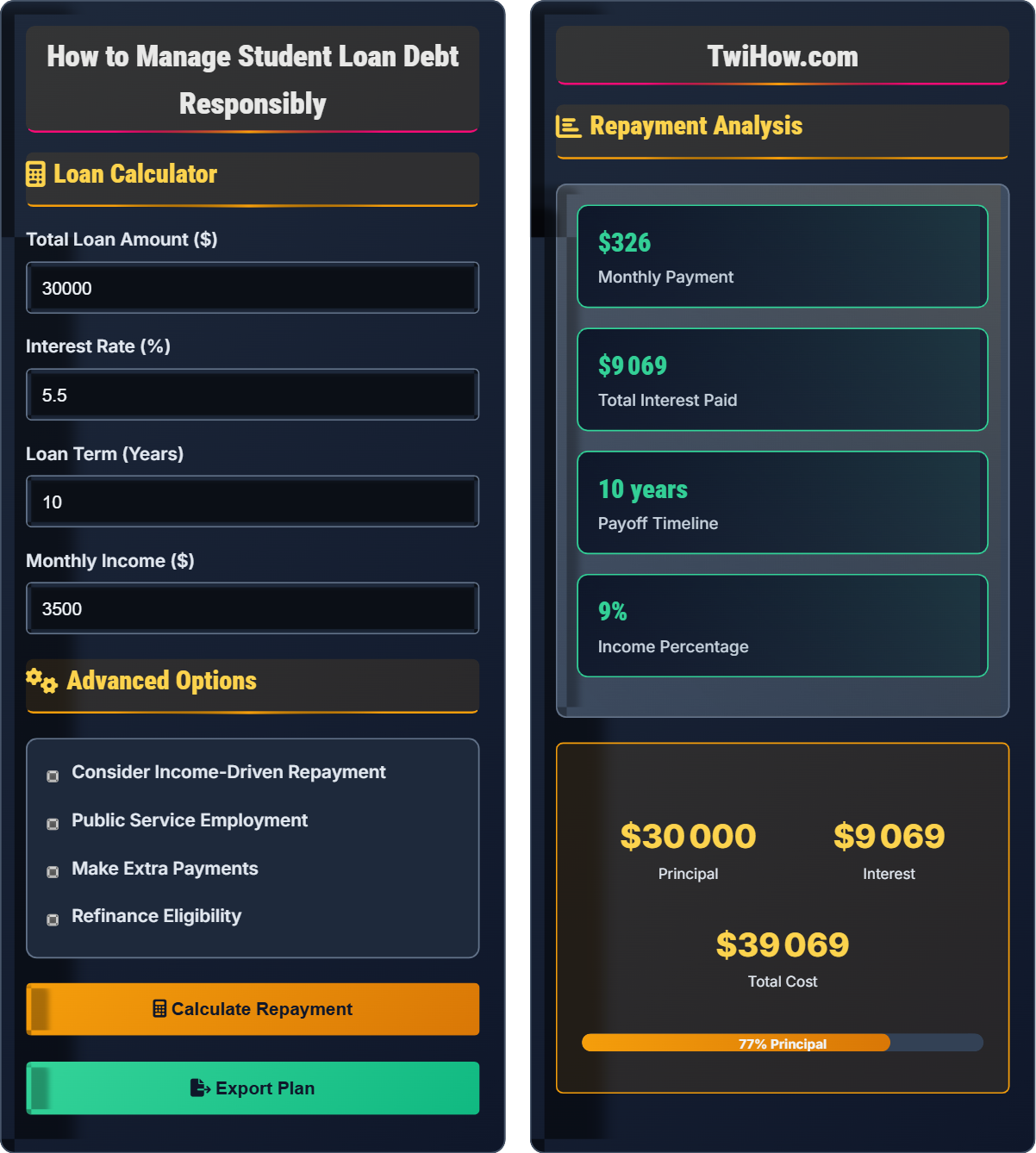
Loan Calculator
Advanced Options
Repayment Analysis
Understanding Student Loans
Federal student loans offer more flexibility and borrower protections compared to private loans. Federal loans have fixed interest rates set by Congress, income-driven repayment options, and forgiveness programs. Private loans are offered by banks, credit unions, and other lenders with variable or fixed rates based on creditworthiness.
- Income-driven repayment plans
- Loan forgiveness programs
- Deferment and forbearance options
- Fixed interest rates
- No cosigner required
Student loan interest compounds daily, meaning interest accrues on the outstanding balance every day. The interest rate is applied to the principal balance, and if not paid, gets added to the principal (capitalization). Understanding compound interest is crucial for minimizing total costs.
Without payments, interest compounds and increases the principal balance exponentially.
There are several federal repayment plans designed to meet different financial situations. The Standard Repayment Plan is the default with fixed payments over 10 years. Income-driven plans adjust payments based on income and family size, potentially offering forgiveness after 20-25 years.
- Standard (10 years)
- Graduated (starts low, increases over time)
- Extended (25 years for large balances)
- Income-Based Repayment (IBR)
- Pay As You Earn (PAYE)
- Revised Pay As You Earn (REPAYE)
- Income-Contingent Repayment (ICR)
Several programs forgive remaining loan balances after meeting specific requirements. The Public Service Loan Forgiveness (PSLF) program forgives balances after 120 qualifying payments while working full-time for qualifying employers. Other programs include Teacher Loan Forgiveness, Perkins Loan Cancellation, and forgiveness for borrowers with disabilities.
- Employment in qualifying public service jobs
- Direct federal loan or FFEL Program loans
- Enrollment in income-driven repayment plan
- 120 qualifying monthly payments
- Continuous employment during payment period
Loan consolidation combines multiple federal loans into one Direct Consolidation Loan with a weighted average interest rate. This simplifies payments but doesn't reduce total costs. Refinancing with a private lender can potentially lower interest rates but eliminates federal protections and forgiveness options.
- Multiple servicers making payments complex
- Eligibility for forgiveness programs
- Improved credit score for refinancing
- Stable income for refinancing
- Desire to simplify repayment
Repayment Timeline
Repayment Strategies
Pay minimums on all loans, then put extra money toward the smallest balance first. Once that's paid off, move to the next smallest. This creates momentum and motivation.
Pay minimums on all loans, then put extra money toward the loan with the highest interest rate. This saves the most money over time by reducing interest charges.
Pay private loans first (no protections), then unsubsidized federal loans (accrue interest), then subsidized federal loans (government pays interest while in school).
Student Loan Management Quiz
Which type of student loan typically offers more flexible repayment options and borrower protections?
Federal student loans offer significantly more flexible repayment options and borrower protections compared to private loans. These include income-driven repayment plans, loan forgiveness programs, deferment and forbearance options, and fixed interest rates. Private loans typically have stricter terms and fewer options for financial hardship.
The answer is B) Federal loans.
Understanding the differences between federal and private loans is crucial for effective debt management. Federal loans were designed to be accessible and manageable for students, while private loans are commercial products with profit motives. Borrowers should exhaust federal loan options before considering private loans.
Federal Loans: Government-funded loans with protections
Private Loans: Commercial loans with fewer protections
Income-Driven Repayment: Payments based on income and family size
• Maximize federal loans before private loans
• Understand loan terms before borrowing
• Exhaust federal protections before refinancing
• Always borrow federal loans first
• Keep federal loans separate from private
• Understand the difference in benefits
• Not understanding loan type differences
• Borrowing private loans unnecessarily
• Refinancing federal loans too early
Explain how compound interest works on student loans and why it's important to understand when managing debt.
Compound Interest: Interest on student loans typically compounds daily, meaning interest accrues on the outstanding balance every day. The formula is: Interest = Principal × (Annual Interest Rate ÷ 365) × Days.
How It Works: If you have a $10,000 loan at 5% annual interest, daily interest would be approximately $1.37. Over a year, this compounds to more than simple interest due to interest being charged on accumulated interest.
Impact on Debt: Compound interest causes debt to grow faster, especially when payments don't cover accruing interest (negative amortization). This is why paying only the minimum can result in increasing balances.
Management Strategies: Make payments larger than required to prevent negative amortization, pay during grace periods if possible, and choose plans that don't extend repayment unnecessarily.
Understanding compound interest helps borrowers make informed decisions about repayment timing and amount.
Compound interest is often called the "eighth wonder of the world" because of its exponential growth potential. On loans, this works against borrowers, making it crucial to understand how quickly debt can grow when not properly managed. The daily compounding means that even short delays in payment can have significant long-term consequences.
Compound Interest: Interest charged on principal plus accumulated interest
Simple Interest: Interest charged only on principal
Negative Amortization: When payments don't cover accruing interest
• Interest compounds daily on most student loans
• Payments typically go to interest first
• Unpaid interest can capitalize
• Make payments during grace periods
• Pay more than minimum when possible
• Understand how payments are allocated
• Assuming interest only accrues annually
• Not understanding payment allocation
• Delaying payments unnecessarily
Jennifer graduated with $45,000 in federal student loans at 6.5% interest. She expects to earn $42,000 annually starting next year. She's considering the Standard Repayment Plan but is concerned about monthly payments. Calculate her expected monthly payment and suggest an alternative plan that might be more affordable.
Standard Repayment Calculation:
Using the standard 10-year term: $45,000 at 6.5% interest over 120 months = approximately $508 per month.
Monthly Income: $42,000 ÷ 12 = $3,500 per month
Payment-to-Income Ratio: $508 ÷ $3,500 = 14.5% (above recommended 10-15%)
Alternative Recommendation: Income-Based Repayment (IBR) would cap payments at 10-15% of discretionary income, likely reducing monthly payments to around $260-$390, making them more manageable.
Trade-offs: IBR extends the repayment term (potentially 20-25 years) and may result in higher total interest, but offers forgiveness after 20-25 years and more affordable monthly payments.
Given her income level, an income-driven plan would be more appropriate.
Repayment planning requires balancing monthly affordability with total cost. The standard plan minimizes total interest but may be unaffordable for lower-income borrowers. Income-driven plans offer payment relief but extend repayment and increase total costs. Borrowers must evaluate their specific financial situation to choose appropriately.
Discretionary Income: Income minus 150% of poverty guideline
Payment-to-Income Ratio: Monthly payment as percentage of income
Forgiveness Timeline: Years required for loan forgiveness
• Monthly payments should not exceed 10-15% of income
• Consider total repayment cost, not just monthly payment
• Evaluate forgiveness eligibility
• Use Department of Education calculators
• Consider future income growth
• Evaluate forgiveness program eligibility
• Sticking with standard plan without evaluation
• Not considering income-driven options
• Ignoring forgiveness programs
Michael works as a public school teacher and has $65,000 in federal student loans. He wants to know if he qualifies for Public Service Loan Forgiveness (PSLF). What are the requirements, and how should he prepare to maximize his eligibility?
PSLF Requirements:
1. Employment: Full-time employment with qualifying public service organization (public schools qualify)
2. Loans: Direct federal loans (not FFEL or private loans)
3. Repayment Plan: Must be enrolled in an income-driven repayment plan
4. Payments: 120 qualifying monthly payments (10 years)
5. Documentation: Annual Employment Certification Form
Preparation Steps:
• Enroll in an income-driven repayment plan (IBR, PAYE, REPAYE, or ICR)
• Submit Employment Certification Form annually to verify qualifying employment
• Continue making payments while employed in public service
• Keep records of all payments and employment verification
• Ensure loans are Direct loans (consolidate if necessary)
With $65,000 in loans, Michael could potentially have the remaining balance forgiven after 120 qualifying payments, saving him thousands.
PSLF can provide substantial debt relief but requires careful planning and documentation. Many borrowers lose credit for payments due to administrative errors. Success requires proactive engagement with the process, not just making payments. Borrowers must take responsibility for documenting their eligibility.
Qualifying Employment: Full-time work for government/nonprofit
Direct Loans: Federal loans from Department of EducationQualifying Payments: Payments made while meeting all requirements
• Submit employment certification annually
• Stay in income-driven plans
• Maintain qualifying employment continuously
• Submit certification forms early
• Keep detailed records
• Verify qualifying payment count regularly
• Not submitting employment certification
• Changing repayment plans inappropriately
• Not tracking qualifying payments
Which repayment strategy typically results in paying the least total interest over the life of the loan?
The avalanche method results in paying the least total interest because it focuses extra payments on loans with the highest interest rates. By eliminating high-interest debt first, borrowers reduce the amount of interest that continues to accrue on their remaining debt. The snowball method provides psychological benefits but costs more in interest.
The answer is B) Avalanche method (pay highest interest first).
Mathematically, paying high-interest debt first minimizes total interest costs because interest accrues on the remaining balance. The avalanche method is financially optimal, while the snowball method provides psychological motivation. Borrowers should choose based on their financial priorities and behavioral tendencies.
Avalanche Method: Pay highest interest debt first
Snowball Method: Pay smallest balance first
Total Interest Cost: Cumulative interest paid over loan life
• Always pay minimums on all loans
• Focus extra payments on highest interest debt
• Consider psychological motivation needs
• Use the avalanche method for lowest cost
• Consider snowball for motivation
• Automate minimum payments
• Making only minimum payments
• Paying lowest interest first
• Not prioritizing payments strategically
Action Plan
Follow these steps to manage your student loans responsibly:
- Understand your loan types and terms
- Choose the right repayment plan for your situation
- Make payments on time every month
- Consider extra payments to reduce interest costs
- Explore forgiveness programs if eligible
- Monitor your loan balance and progress
- Stay informed about policy changes
Remember that responsible loan management is a long-term commitment that requires ongoing attention and adjustments as your financial situation changes.
FAQ
Q: Can I consolidate my federal and private loans together?
A: No, you cannot consolidate federal and private loans together. Federal consolidation (Direct Consolidation Loan) only includes federal loans. If you consolidate federal loans with private loans, you'll lose all federal protections, forgiveness programs, and income-driven repayment options. Keep federal and private loans separate to maintain federal benefits. You can refinance both together with a private lender, but this eliminates federal protections.
Q: What happens if I can't make my student loan payments?
A: If you can't make payments, contact your loan servicer immediately. For federal loans, you have options like deferment (temporary suspension of payments) and forbearance (temporary postponement). You can also switch to an income-driven repayment plan to lower your monthly payments. Don't ignore the problem - late payments hurt your credit and increase your debt. For private loans, contact the lender directly as they may offer temporary relief options.