How to Navigate Campus Life and Build Community?
Campus excellence guide • Community building
Campus Navigation:
Show Campus PlannerNavigating campus life successfully involves building meaningful connections, utilizing available resources, and participating in community activities. Building a strong campus community enhances academic success, personal growth, and overall college experience. This guide provides strategies for finding your place on campus, connecting with peers, and making the most of your university experience.
Key strategies:
- Resource Discovery: Identifying academic and support services
- Social Connections: Building friendships and professional networks
- Community Engagement: Participating in campus activities and organizations
- Personal Growth: Developing independence and life skills
Successful campus navigation requires intentional effort to explore opportunities, meet new people, and engage with campus resources. The connections and experiences formed during this time often become the foundation for lifelong relationships and career networks.
Campus Profile
Engagement Activities
Community Analysis
| Resource | Priority | Access Method | Frequency |
|---|---|---|---|
| Academic Advising | High | Appointment | Bi-weekly |
| Library | High | Walk-in | Daily |
| Career Center | Medium | Appointment | Monthly |
| Student Health | High | Appointment | As needed |
| Counseling Services | Medium | Appointment | Weekly |
Mastering Campus Life and Community Building
Campus life encompasses all aspects of the university experience beyond academics. It includes social interactions, extracurricular activities, residential life, dining experiences, and community engagement. Successful campus navigation involves finding your place within this ecosystem and building meaningful connections with peers, faculty, and staff. This holistic approach enhances both personal growth and academic success.
Effective campus community building can be understood through key components:
Where:
- Engagement: Active participation in campus activities
- Consistency: Regular involvement over time
- Authenticity: Genuine interactions and relationships
- Reciprocity: Mutual giving and receiving in relationships
Key campus resources for community building include:
- Academic Resources: Tutoring centers, study groups, academic advising
- Social Resources: Clubs, organizations, Greek life, dorm activities
- Health Resources: Student health center, counseling services, fitness facilities
- Professional Resources: Career center, internships, networking events
- Financial Resources: Financial aid office, work-study programs, scholarships
- Support Resources: Disability services, international student services, diversity centers
- Attend Orientation Events: Participate in welcome week activities
- Join Student Organizations: Find groups aligned with your interests
- Volunteer Locally: Give back to the surrounding community
- Study Abroad: Broaden perspectives and cultural connections
- Attend Campus Events: Sports, concerts, lectures, and festivals
- Live on Campus: Maximize opportunities for spontaneous interactions
Core Campus Concepts
Campus life, community building, social capital, engagement, networking, campus resources.
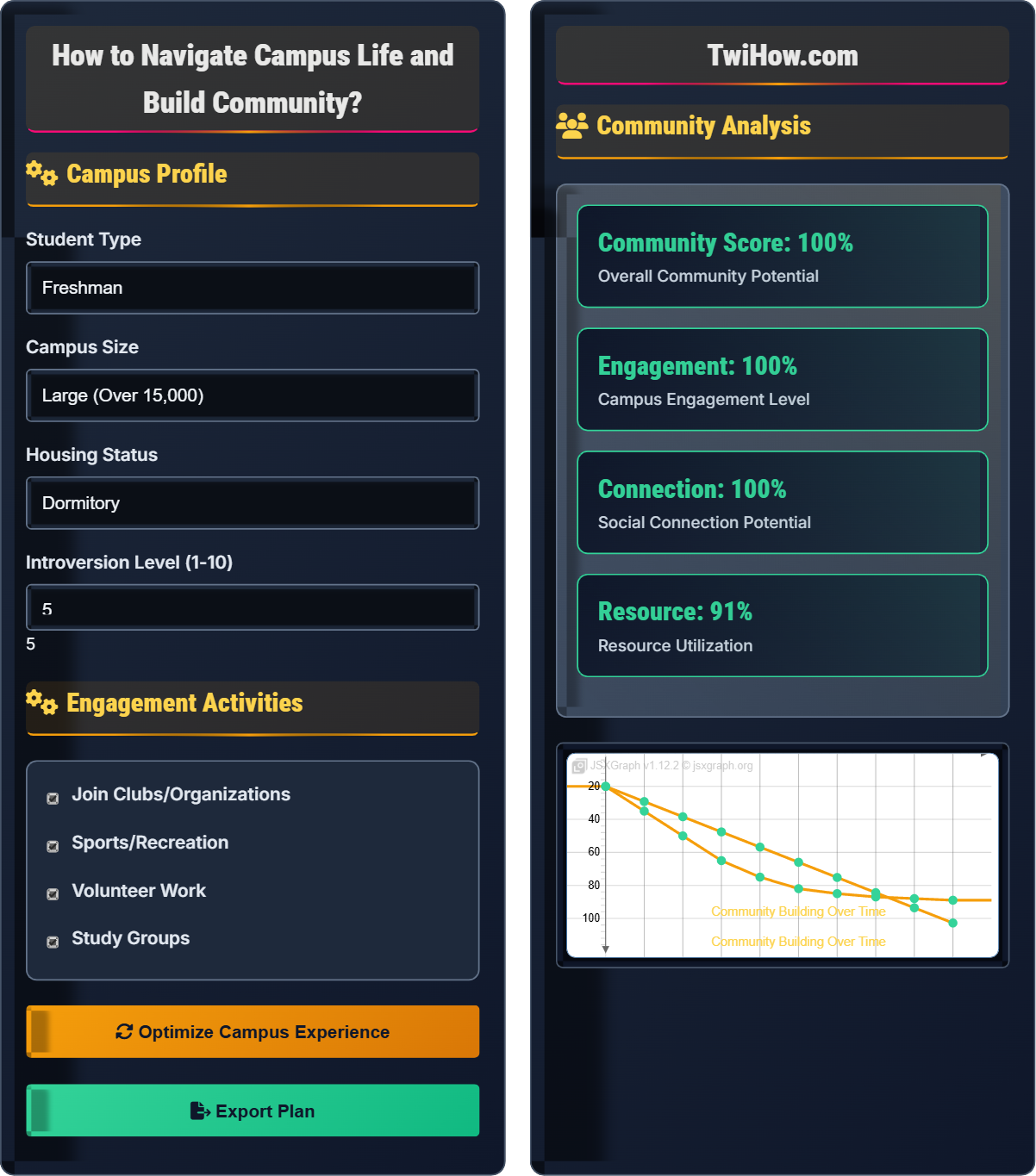
Community Strength = Engagement × Consistency × Authenticity × Reciprocity
Where Community Strength = overall quality of campus community connections.
- Be consistent in your involvement
- Engage authentically with others
- Give back to the community
Practical Applications
Freshman orientation, transfer student integration, international student adaptation, graduate student community building.
- Explore campus resources and opportunities
- Identify personal interests and goals
- Join relevant organizations and activities
- Build genuine relationships
- Take leadership roles when ready
- Give back to the community
- Balance social and academic commitments
- Respect cultural and personality differences
- Utilize available support services
- Maintain long-term perspective
Campus Life Quiz
Which campus resource is most important for academic success?
While all resources are important, academic advising is fundamental for academic success. Advisors help students plan their course schedules, select appropriate classes, and stay on track for graduation. They provide guidance on academic policies, major requirements, and academic support services.
The answer is B) Academic Advising Office.
Academic advisors serve as navigators for the complex academic landscape of university life. They help students understand degree requirements, choose appropriate courses, and develop academic plans that align with their goals. Regular meetings with advisors ensure students stay on track academically and can address any challenges early.
Academic Advising: Guidance on course selection and academic planning
Degree Requirements: Courses and credits needed for graduation
Academic Planning: Strategic approach to course scheduling
• Meet with advisor regularly
• Come prepared with questions
• Discuss academic goals
• Schedule appointments early in semester
• Bring transcript and questions
• Discuss career goals
• Not meeting with advisor regularly
• Not preparing for appointments
• Ignoring advisor recommendations
Explain strategies for building meaningful friendships during your first year of college. Why is it important to focus on quality over quantity in friendship building?
Strategies for Friendship Building:
1. Be Proactive: Attend social events, join clubs, initiate conversations.
2. Be Authentic: Present your genuine self rather than trying to impress.
3. Be Consistent: Follow up on initial meetings and maintain contact.
4. Be Vulnerable: Share appropriately to build trust and connection.
5. Be Supportive: Show interest in others' lives and challenges.
Quality vs. Quantity: Deep, meaningful friendships provide emotional support, accountability, and lasting connections. These relationships are more likely to endure beyond college and provide mutual benefits. Superficial relationships require more energy to maintain and offer less emotional support.
Long-term Impact: Quality friendships become part of your professional network, provide emotional stability, and contribute to overall well-being.
Friendship building is a skill that requires intentionality and patience. Quality friendships are built on mutual respect, shared interests, and emotional support. These relationships provide stability during challenging times and contribute to personal growth. The college environment offers numerous opportunities to meet like-minded individuals, but it requires effort to transform acquaintances into close friends.
Quality Friendships: Deep, meaningful relationships based on trust
Social Integration: Becoming part of campus social networks
Emotional Support: Psychological assistance from friends
• Be genuine in interactions
• Invest time in relationships
• Focus on mutual interests
• Attend club meetings regularly
• Study with classmates
• Participate in residence hall activities
• Trying to be friends with everyone
• Not being authentic
• Focusing only on party scene
You're a freshman with interests in environmental sustainability, leadership development, and community service. You have 10 hours per week available for extracurricular activities. How would you strategically select clubs and organizations that align with your interests while maximizing your community building potential?
Strategic Approach:
Option 1: Environmental Club (3 hours/week) + Student Government (4 hours/week) + Habitat for Humanity (3 hours/week)
Option 2: Sustainability Committee (4 hours/week) + Community Service Organization (4 hours/week) + Leadership Development Workshop (2 hours/week)
Recommendation: Choose 2-3 clubs that align with your core interests. Focus on organizations where you can take leadership roles. Consider joining clubs that complement each other (environmental advocacy and community service).
Community Building Strategy: Attend weekly meetings consistently, volunteer for organizing committees, and participate in club social events. Quality engagement in fewer organizations is better than spreading yourself thin.
Long-term Goal: Seek officer positions in your sophomore year to maximize impact and network building.
This example demonstrates the importance of strategic selection when choosing campus involvement. Rather than joining many organizations superficially, it's better to engage deeply in a few that align with your interests and goals. This approach allows for meaningful contribution and relationship building. The key is finding organizations that complement each other and provide opportunities for leadership growth.
Strategic Selection: Choosing organizations based on goals and interests
Leadership Opportunities: Positions that allow for influence and growth
Community Building: Creating meaningful connections with others
• Align clubs with your interests
• Consider time commitment
• Look for leadership potential
• Attend club fairs to explore options
• Talk to current members
• Start with one or two clubs
• Joining too many organizations
• Not considering time constraints
• Choosing clubs randomly
You're an international student from Japan beginning your studies at an American university. You're shy and have limited English speaking experience. How would you approach campus life and community building to overcome cultural and language barriers while building meaningful connections?
Initial Steps:
1. International Student Services: Connect immediately for support and orientation programs.
2. ESL Programs: Utilize language support services to improve communication skills.
3. Cultural Organizations: Join Japanese cultural club for initial support network.
4. Academic Integration: Sit near native speakers in classes and form study groups.
Community Building Strategy: Start with small group activities like study groups, volunteer work, or hobby clubs. Use written communication initially (emails, messaging) to build confidence before speaking.
Gradual Expansion: Once comfortable with a few American students, expand to larger social circles. Attend cultural events that celebrate diversity.
Value Proposition: Share Japanese culture and perspectives as a unique contribution to campus diversity.
This scenario illustrates how cultural and language barriers can be overcome through strategic approach. International students bring valuable perspectives and experiences to campus communities. The key is finding supportive resources first, then gradually expanding social circles. Language barriers can be overcome through practice and patience. Cultural differences can become assets rather than obstacles.
International Student Services: Support office for foreign students
Cultural Integration: Adapting to new cultural environment
Language Barriers: Communication challenges due to language differences
• Utilize support services
• Start small and expand gradually
• Share your cultural perspective
• Join international student organizations
• Practice English in low-pressure settings
• Share your culture with others
• Isolating with fellow countrymen only
• Not seeking available support
• Hiding cultural background
Which of the following is the most effective way to discover campus resources?
All of these methods are valuable, but attending orientation sessions and campus tours is most effective because it provides guided introduction to key resources. Orientation sessions are specifically designed to introduce new students to available services and opportunities. Tours provide physical familiarity with campus locations.
The answer is D) Attend orientation sessions and campus tours.
Orientation programs are specifically designed to help students discover campus resources systematically. They provide structured introductions to key services, locations, and opportunities. While other methods are also valuable, orientation provides the most comprehensive and guided approach to resource discovery. It's the foundation for all other campus navigation activities.
Orientation Sessions: Formal introduction to campus resources
Campus Resources: Services and opportunities available to students
Resource Discovery: Learning about available services
• Attend all orientation activities
• Ask questions during tours
• Take notes on resources
• Get a campus map during orientation
• Meet with resource representatives
• Follow up on promising resources
• Skipping orientation sessions
• Not asking questions during tours
• Forgetting about discovered resources
FAQ
Q: I'm an introvert and feel overwhelmed by all the social opportunities. How can I build community without feeling exhausted?
A: As an introvert, focus on quality over quantity. Choose 1-2 activities that genuinely interest you rather than trying to attend everything. Smaller groups and one-on-one interactions often work better for introverts. Consider joining clubs based on your interests rather than just social ones. It's perfectly fine to recharge alone after social activities. Quality friendships formed through shared interests tend to be more meaningful than large social circles.
Q: I transferred from community college and feel like I missed out on the "traditional" college experience. How can I catch up and build community as a transfer student?
A: Transfer students bring valuable life experience and perspective that upperclassmen appreciate. Join clubs that match your interests rather than focusing on age groups. Attend transfer-specific events and organizations. Consider becoming a mentor to other transfer students. Your maturity and life experience are assets that will help you form meaningful connections with both younger and older students. Focus on shared interests rather than shared history.