How to Prepare for Academic Presentations and Defenses?
Presentation excellence guide • Defense strategies
Academic Presentations:
Show Presentation PlannerPreparing for academic presentations and defenses requires strategic planning, thorough rehearsal, and confident delivery. Success depends on understanding your audience, mastering your content, anticipating questions, and managing presentation anxiety. This guide provides comprehensive strategies for developing compelling presentations and defending your work with confidence and authority.
Key preparation elements:
- Content Mastery: Deep understanding of your research or topic
- Audience Analysis: Understanding your audience's expectations and knowledge level
- Delivery Practice: Rehearsing presentation and defense scenarios
- Question Preparation: Anticipating and preparing for potential challenges
Effective academic presentations and defenses require a combination of subject expertise, communication skills, and confidence. The preparation process builds both your knowledge and your ability to communicate complex ideas clearly under pressure.
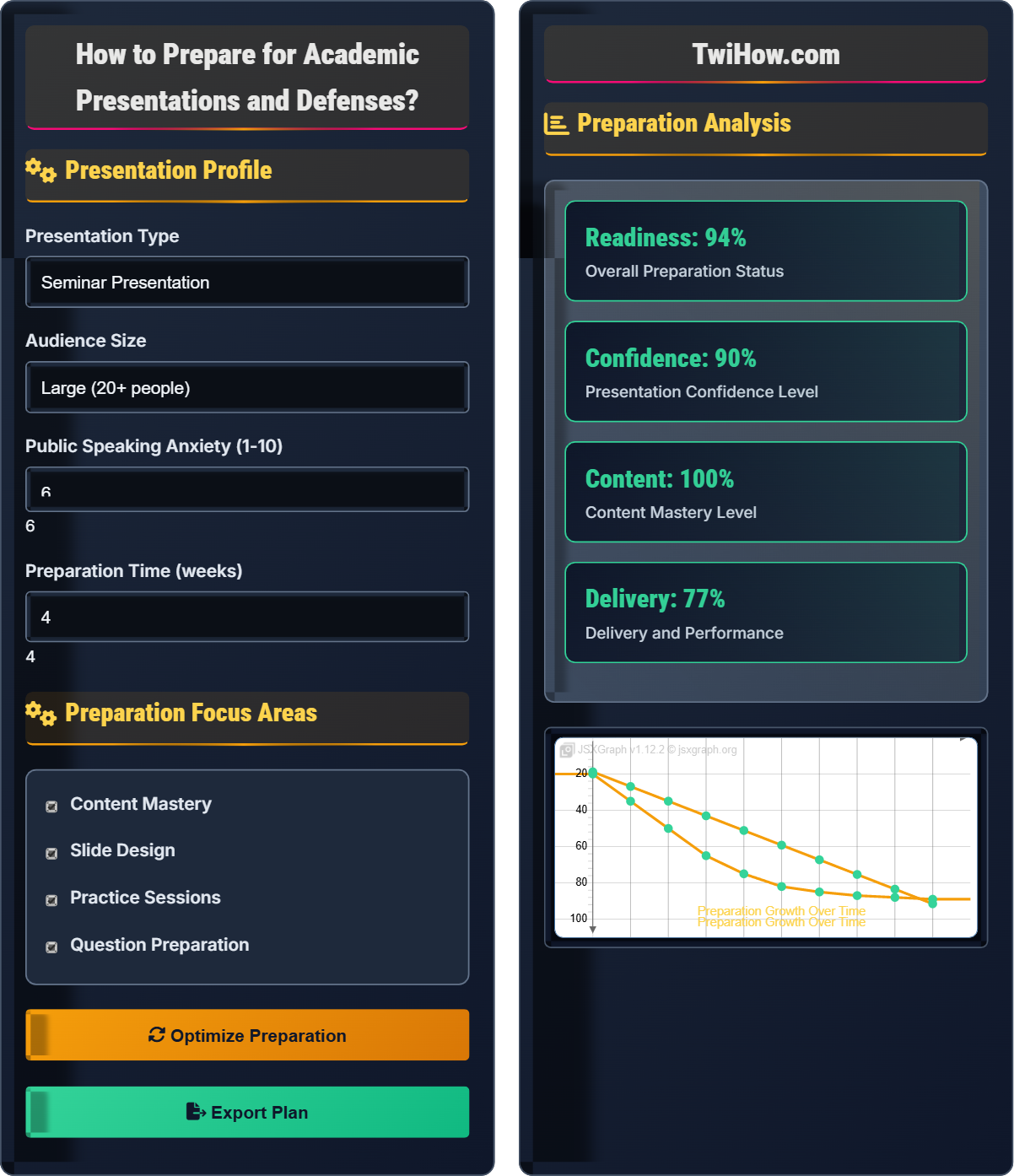
Presentation Profile
Preparation Focus Areas
Preparation Analysis
| Phase | Duration | Activities | Priority |
|---|---|---|---|
| Content Development | Weeks 1-2 | Outline, research, slides | High |
| Practice Sessions | Weeks 2-3 | Rehearse, get feedback | High |
| Question Prep | Weeks 3-4 | Anticipate queries | Medium |
| Final Rehearsal | Week 4 | Full run-throughs | High |
Mastering Academic Presentations and Defenses
Academic presentations and defenses require a unique combination of subject expertise, communication skills, and confidence. Unlike casual presentations, academic settings demand rigorous preparation, clear articulation of complex ideas, and the ability to defend your work under scrutiny. Success in these venues can significantly impact your academic and professional trajectory.
Effective presentation preparation follows a structured approach:
Where:
- Content Mastery: Thorough understanding of your material (0-1)
- Delivery Confidence: Assurance in your presentation skills (0-1)
- Audience Connection: Ability to engage and communicate with listeners (0-1)
Academic defenses require additional preparation beyond standard presentations:
- Counterargument Preparation: Anticipate challenges to your methodology
- Alternative Approaches: Be ready to discuss other methods
- Limitation Acknowledgment: Honestly address study limitations
- Future Directions: Articulate next steps for research
- Significance Communication: Clearly convey research impact
- Methodology Defense: Justify your chosen approaches
- Eye Contact: Engage with different sections of the audience
- Vocal Variety: Use changes in pitch, pace, and volume
- Body Language: Use open gestures and confident posture
- Pauses: Use strategic pauses for emphasis
- Transitions: Smooth movement between sections
- Engagement: Ask rhetorical questions or invite participation
Core Presentation Concepts
Academic presentation, thesis defense, public speaking, audience analysis, content mastery, delivery techniques.
Success = (Content + Confidence) × Audience Engagement
Where Success = overall effectiveness of the presentation or defense.
- Know your content inside and out
- Practice until delivery is natural
- Anticipate and prepare for questions
Practical Applications
Thesis defenses, conference presentations, research proposals, academic seminars, poster sessions.
- Define your core message
- Know your audience
- Create a structured outline
- Design effective visual aids
- Practice extensively
- Prepare for questions
- Time constraints and format requirements
- Expert audience expectations
- Technical complexity of content
- Defensive responses to criticism
Presentation Preparation Quiz
Which of the following best demonstrates content mastery for an academic defense?
Content mastery involves deep understanding of your research, including its strengths, limitations, and potential challenges. This allows you to respond thoughtfully to questions and defend your work intelligently. Memorization and scripts are insufficient for handling the unpredictable nature of academic defenses.
The answer is B) Understanding your research inside and out, including limitations.
Content mastery goes beyond memorization. It requires understanding the theoretical foundations, methodological choices, potential limitations, and broader implications of your work. This depth of understanding allows you to respond confidently to questions, acknowledge weaknesses, and articulate the significance of your research. Academic audiences value honest self-reflection and critical thinking about one's own work.
Content Mastery: Deep understanding of your subject matter
Research Limitations: Acknowledged weaknesses or constraints
Academic Defense: Justification of research methodology and findings
• Know your limitations as well as strengths
• Understand theoretical foundations
• Be prepared to justify methodology
• Create a list of potential criticisms
• Practice explaining complex concepts simply
• Know related literature thoroughly
• Only focusing on positive aspects
• Not knowing related research
• Memorizing without understanding
Explain strategies for preparing for potential questions during an academic defense. Why is this preparation crucial and what types of questions should you anticipate?
Preparation Strategies: Create a comprehensive list of potential questions based on your research. Practice responses with colleagues, advisors, and mock panels. Consider both technical and conceptual challenges.
Types of Questions:
Methodology: "Why did you choose this approach over alternatives?"
Limitations: "What are the limitations of your study?"
Significance: "What is the broader impact of your research?"
Future Work: "What are the next steps for this research?"
Technical Details: "Can you explain your experimental design?"
Alternative Interpretations: "Could your results be interpreted differently?"
Importance: Question preparation builds confidence, reveals gaps in your argument, and ensures you can articulate your research clearly under pressure.
Question preparation is crucial because academic defenses involve experts who will challenge your work. Preparing for questions helps you identify potential weaknesses in your argument and develop clear, confident responses. It also reduces anxiety by ensuring you're prepared for common challenges. The goal is not to predict every question but to develop the ability to think on your feet and respond thoughtfully to criticism.
Question Preparation: Anticipating and rehearsing responses
Methodology: Research approach and procedures
Academic Critique: Scholarly evaluation and challenge
• Prepare for methodological challenges
• Acknowledge limitations honestly
• Articulate broader significance
• Conduct mock defenses
• Prepare follow-up explanations
• Practice concise responses
• Not preparing for methodology questions
• Failing to acknowledge limitations
• Providing overly complex responses
You're extremely nervous about your thesis defense and have a history of freezing up when questioned. How should you prepare to manage anxiety and respond effectively during questioning? What techniques can help you stay composed under pressure?
Anxiety Management Strategies:
Preparation: Practice extensively with mock panels and trusted colleagues. The more familiar you are with your content, the more confident you'll feel.
Physical Techniques: Practice deep breathing exercises, progressive muscle relaxation, and visualization of successful outcomes.
Reframing: View the defense as a scholarly conversation rather than an examination. The committee wants you to succeed.
Response Techniques: If you freeze, pause, take a breath, and say "Let me think about that for a moment." This gives you time to compose your thoughts.
Preparation: Write down potential questions and practice responses. Have a colleague play devil's advocate during practice sessions.
Day-of Strategies: Arrive early, bring water, and have a few notes as backup references.
Long-term Approach: Start practicing presentations early in your program to build confidence gradually.
This scenario highlights the importance of both technical preparation and emotional management. Anxiety often stems from uncertainty, so thorough preparation is the best antidote. Physical techniques like breathing help manage the physiological response to stress. Reframing the situation as a scholarly exchange rather than a test can reduce pressure. The key is building confidence through practice and having strategies ready for moments of uncertainty.
Performance Anxiety: Nervousness about presenting or performing
Stress Management: Techniques to reduce anxiety
Response Techniques: Strategies for handling questions
• Practice until responses feel natural
• Use pauses strategically
• Focus on the scholarly exchange
• Practice in front of strangers
• Use physical relaxation techniques
• Have a colleague play devil's advocate
• Not practicing enough
• Avoiding challenging questions
• Not managing physical anxiety
You're presenting complex computational research to an interdisciplinary committee with varying technical backgrounds. How should you structure your presentation and defense strategy to ensure all committee members can follow your work and evaluate it fairly?
Structural Approach:
Opening: Start with the big picture and significance of your work. Explain why it matters to the broader field.
Progressive Disclosure: Introduce concepts gradually, starting with fundamentals before diving into technical details.
Multiple Explanations: Provide both high-level and technical explanations for key concepts.
Visual Aids: Use diagrams, flowcharts, and analogies to clarify complex processes.
Context Setting: Explain how your technical approach addresses the research problem.
Defense Strategy: Be prepared to adjust your explanations based on the questioner's background. If someone asks for more detail, provide it. If they seem lost, simplify.
Bridge Building: Connect your work to concepts the non-specialist members would understand.
Example: "In simple terms, my algorithm works like a smart sorting system. Technically, it uses a modified neural network architecture with attention mechanisms."
This scenario demonstrates the importance of audience awareness in academic presentations. Effective communication requires adapting your message to your audience's level of expertise. The key is providing multiple entry points to your research - from conceptual significance to technical details. This approach ensures that all committee members can appreciate the value and rigor of your work, regardless of their specific background.
Interdisciplinary Committee: Panel with diverse expertise areas
Progressive Disclosure: Revealing information gradually
Audience Adaptation: Adjusting explanations to listener background
• Start with significance, not details
• Provide multiple explanation levels
• Use analogies and visual aids
• Prepare both simple and technical explanations
• Use visual metaphors
• Connect to familiar concepts
• Using jargon without explanation
• Not considering audience backgrounds
• Failing to explain significance
Which slide design approach is most effective for academic presentations?
Visual-rich slides with minimal text are most effective. They support your verbal presentation without overwhelming the audience. Academic audiences appreciate clear figures, charts, and diagrams that illustrate complex concepts. Minimal text ensures the audience listens to you rather than reading slides.
The answer is B) Visual-rich slides with minimal text and clear figures.
Effective slide design supports rather than replaces your presentation. Academic audiences are sophisticated and can follow complex concepts when presented clearly. Visual elements help illustrate relationships, processes, and results more effectively than dense text. The slides should serve as prompts for your speaking points rather than scripts for the audience to read.
Visual-Rich Slides: Slides emphasizing graphics over text
Academic Audience: Scholars familiar with research conventions
Supporting Materials: Visuals that enhance verbal presentation
• Use visuals to illustrate concepts
• Keep text minimal and readable
• Ensure accessibility for all viewers
• Use high-contrast colors
• Include figure captions
• Test visibility from back of room
• Crowding slides with text
• Using distracting animations
• Poor color contrast
FAQ
Q: How long before my defense should I start preparing, and what's the most important aspect to focus on?
A: Start preparing at least 2-3 months before your defense. The most important aspect is content mastery - you need to understand every aspect of your research, including potential limitations and alternative interpretations. Practice explaining your work in multiple ways and be ready to discuss any part of your dissertation in detail. The defense is not about memorizing a presentation but about demonstrating deep understanding of your research.
Q: I have to present my senior thesis to faculty members. How is this different from regular class presentations?
A: Thesis presentations are more rigorous than class presentations. Faculty will ask deeper questions about methodology, significance, and implications. You need to demonstrate not just what you did, but why you made specific choices and how your work contributes to the field. Prepare to defend your approach and acknowledge limitations. The Q&A portion is often more substantial and challenging than in regular presentations.