How to Write a Strong College Application Essay
Complete guide • Proven strategies • Step-by-step instructions
A strong college application essay tells your unique story and demonstrates who you are beyond grades and test scores. It's your opportunity to showcase personality, values, and potential contributions to the campus community. The most effective essays are authentic, specific, and reveal growth or learning.
Essential elements include:
- Compelling Opening: Hook readers immediately with an engaging start
- Clear Theme: Central message that ties the entire essay together
- Vivid Details: Specific examples that bring your story to life
- Personal Growth: Reflection on lessons learned or challenges overcome
- Genuine Voice: Authentic expression that sounds like you
This guide provides comprehensive strategies and interactive tools to craft a memorable application essay.
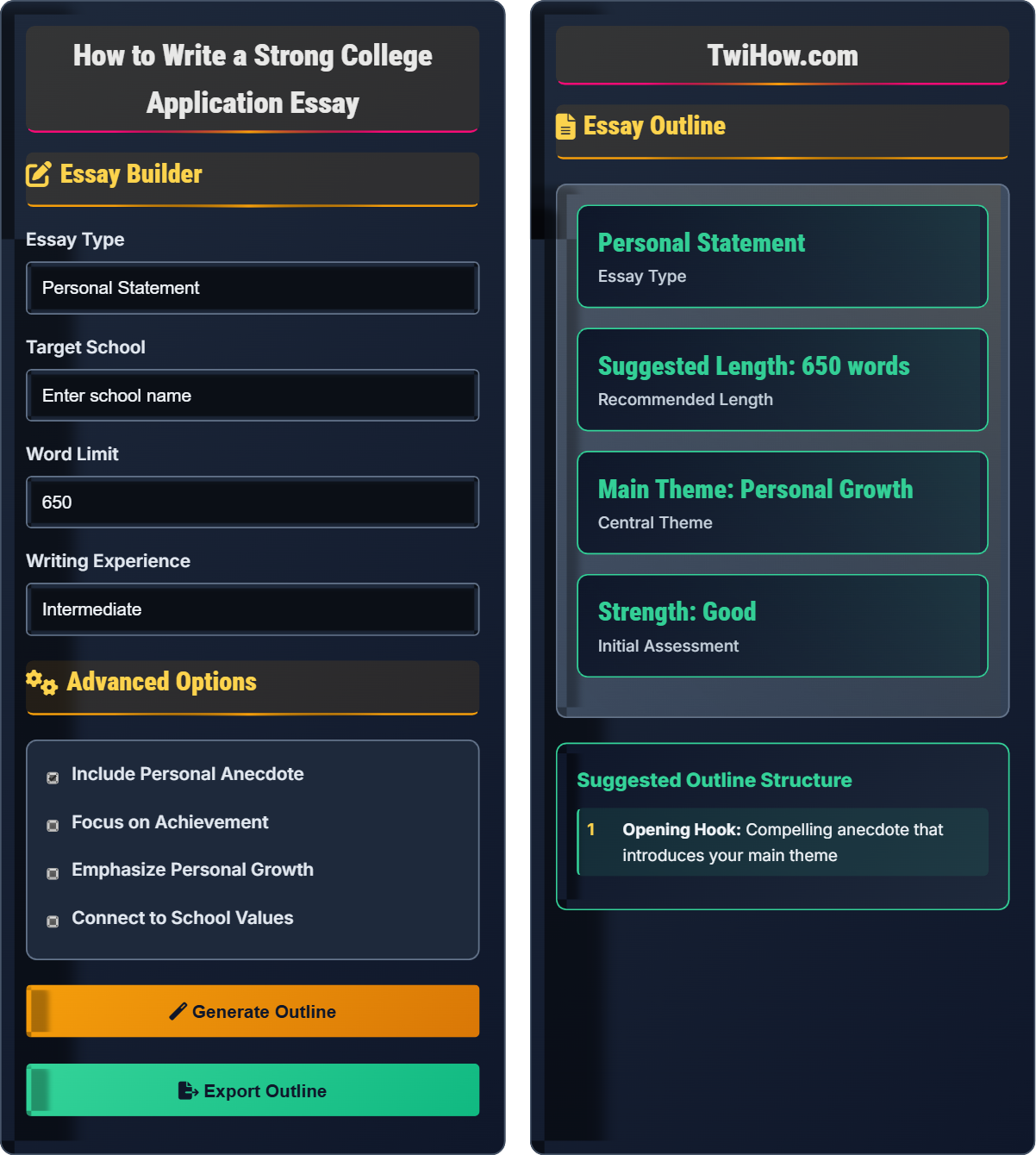
Essay Builder
Advanced Options
Essay Outline
• Start with a specific moment rather than general statements
• Show, don't tell - use vivid details and examples
• Be authentic and genuine in your voice
• Focus on what you learned, not just what happened
Essential Essay Components
The opening paragraph is crucial for capturing the reader's attention. Start with a specific scene, dialogue, or intriguing statement that draws the reader in. Avoid generic openings like "Since I was young..." Instead, begin with action, a vivid description, or an unexpected moment that reveals character.
- Start in the middle of an action
- Use a thought-provoking question
- Present a surprising fact or statistic
- Begin with dialogue
- Describe a pivotal moment
A strong college essay follows a clear structure that guides the reader through your story while maintaining engagement. The traditional five-paragraph structure works well for shorter essays, but longer pieces may require more nuanced organization.
Your essay should sound like you speak, not like a formal academic paper. Admissions officers want to get to know the real person behind the application. Use your natural tone, include your personality, and don't try to sound overly sophisticated. Authenticity resonates more than perfect prose.
- Read your essay aloud to check for natural flow
- Include specific details only you would know
- Share your genuine emotions and reactions
- Use concrete examples rather than abstract statements
- Be vulnerable when appropriate
Instead of simply stating qualities about yourself, demonstrate them through specific examples and actions. Rather than saying "I'm resilient," describe a specific situation where you showed resilience. Concrete details and vivid imagery create a stronger impression than general claims.
- Tell: "I'm passionate about helping others"
- Show: "Every Saturday morning, I helped Mrs. Johnson carry groceries up three flights of stairs..."
- Tell: "I learned the value of teamwork"
- Show: "When our project deadline loomed, I stayed late to help Sarah with her part..."
Strong essays are written through multiple drafts and revisions. Plan to write several versions, each focusing on different aspects: content, structure, clarity, and style. Seek feedback from trusted mentors, teachers, or counselors, but ensure the final voice remains authentically yours.
- Take a break before revising
- Focus on big-picture issues first (organization, argument)
- Address sentence-level concerns (grammar, word choice)
- Read aloud to catch awkward phrasing
- Have others read for clarity and impact
Essay Prompts Generator
Thesis Builder
Essay Writing Quiz
Which opening strategy is most effective for a college application essay?
Option B is most effective because it opens with a specific, vivid scene that immediately engages the reader. It shows action and creates curiosity about what happens next. Options A, C, and D are generic statements that don't engage the reader or reveal anything specific about the applicant's experience.
The answer is B) "The smell of burning toast filled the kitchen as I frantically tried to save breakfast before my first day of teaching kindergarteners."
Effective openings use specific details to create immediate engagement. Generic statements like "Since I was young" or universal truths don't distinguish the applicant or create interest. A strong opening should transport the reader into a specific moment that reveals character and sets up the essay's central theme.
Hook: Opening that captures reader attention
Vivid Detail: Specific sensory information that brings scenes to life
Generic Opening: Unspecific statement that could apply to anyone
• Start with action or specific moment
• Use sensory details
• Avoid clichés and generalizations
• Begin in the middle of a scene
• Use concrete rather than abstract language
• Create curiosity about what comes next
• Starting with general statements
• Using overused phrases
• Beginning too far in the past
Explain the difference between "showing" and "telling" in writing, and provide examples of how to transform telling into showing in a college essay.
"Telling": Making direct statements about qualities or characteristics without providing evidence. Example: "I am a dedicated student."
"Showing": Demonstrating qualities through specific actions, details, and examples. Example: "Every morning at 5 AM, I walked to the campus library before classes began, spending two hours researching for my independent study project."
Transformation Examples:
• Tell: "I care about my community." → Show: "I organized a neighborhood cleanup that attracted 40 volunteers and collected 15 bags of trash."
• Tell: "I am resilient." → Show: "When my research project failed twice, I redesigned my methodology and spent three extra months gathering new data."
• Tell: "I love learning." → Show: "I stayed after school daily to ask my teacher follow-up questions and borrowed advanced textbooks to explore topics beyond the curriculum."
Showing creates a stronger impression because readers can judge your character from your actions rather than taking your word for it.
The "show, don't tell" principle is fundamental to effective writing because it engages readers' imaginations and allows them to draw their own conclusions. When you show, you provide evidence that readers can evaluate. When you tell, you expect them to accept your claims without proof. Admissions officers are skilled at recognizing authentic evidence of character.
Show: Demonstrate through specific examples and actions
Tell: State qualities directly without evidence
Vivid Description: Detailed imagery that engages senses
• Use specific examples to prove general claims
• Include sensory details
• Let actions speak louder than adjectives
• Replace adjectives with concrete examples
• Use dialogue and action
• Include specific names, places, and details
• Relying on adjectives instead of examples
• Using vague, abstract language
• Making claims without supporting evidence
Marina is writing a 650-word college essay about how volunteering at an animal shelter taught her responsibility and compassion. She has three specific incidents to share: cleaning cages, socializing aggressive dogs, and helping with adoption events. How should she structure her essay to maintain focus and coherence while sharing all three experiences?
Recommended Structure:
Opening (100 words): Vivid scene from one of the experiences that captures the essence of her journey, perhaps beginning with a specific moment during an adoption event.
Development (450 words): Three paragraphs, each focusing on one experience but connecting to the overarching theme of growth in responsibility and compassion. Each paragraph should show progression in her skills and understanding.
Conclusion (100 words): Synthesize how these experiences collectively shaped her character and connect to her future goals.
Coherence Strategy: Use transitions that show progression ("This first experience taught me responsibility, but the second challenged me to develop patience..."), and return to the opening scene in the conclusion to create a circular structure.
This structure maintains focus on her growth while allowing space for each specific experience to contribute to the larger narrative.
When incorporating multiple experiences, it's crucial to maintain thematic unity rather than simply listing events. Each experience should contribute to the central message and show progressive development. The structure should feel organic rather than mechanical, with experiences building upon each other to create a cohesive narrative.
Thematic Unity: All parts of essay support central message
Circular Structure: Conclusion connects back to opening
Progressive Development: Ideas build upon each other
• Maintain central theme throughout
• Use experiences to support thesis
• Create smooth transitions between sections
• Use each experience to show different aspects of growth
• Connect experiences through common threads
• End each section with a forward-looking statement
• Listing experiences without connection
• Focusing on events rather than growth
• Inconsistent structure between paragraphs
David wants to write about his experience as a camp counselor but is worried his story won't sound impressive enough compared to other applicants who have published research or won major awards. How can he write authentically while still making his experience compelling?
Authenticity Over Prestige: David should focus on what the experience meant to him and how it changed him, rather than trying to inflate its significance. Authentic growth and learning from any experience is more compelling than exaggerated importance.
Specific Details: Instead of saying "I helped kids have fun," he could write: "When 8-year-old Maria refused to join activities, I spent three days sitting quietly beside her until she trusted me enough to whisper her fear of water."
Universal Themes: Even ordinary experiences can illuminate universal themes like empathy, leadership, or perseverance. David might explore how helping a shy child overcome fears parallels his own journey of building confidence.
Reflection: Focus on insights gained and personal growth rather than achievements. Admissions officers value self-awareness and emotional maturity over accolades.
Remember: depth of reflection matters more than breadth of achievement.
Admissions officers read thousands of essays and can easily detect authenticity. Genuine personal growth from any experience is more valuable than attempting to impress with grandiose accomplishments. The most memorable essays reveal character through how someone responds to their experiences, regardless of the experience's perceived prestige.
Authentic Voice: Natural expression that reflects true personality
Character Insight: Evidence of personal growth and values
Universal Themes: Concepts that resonate across experiences
• Focus on personal growth over achievement
• Use specific details to prove general points
• Be honest about your experience
• Choose experiences that genuinely mattered to you
• Focus on what you learned, not what you did
• Show vulnerability and growth
• Trying to sound more impressive than you are
• Focusing on events instead of personal impact
• Using overly formal language
What is the most important aspect of the revision process for a college essay?
While all aspects of revision are important, ensuring the essay conveys the intended message effectively is paramount. The purpose of the essay is to communicate who you are and what you would contribute to the campus community. If the core message is unclear or ineffective, technical perfection won't compensate. Grammar and word limits are important but secondary to the essay's fundamental purpose.
The answer is C) Confirming the essay conveys the intended message effectively.
Revision should prioritize content and communication over technical details. A well-structured essay with a clear message and authentic voice will be more impactful than a technically perfect essay that fails to connect with readers. Technical corrections come after ensuring the essay fulfills its primary purpose.
Revision: Process of improving content and clarity
Editing: Process of correcting technical errors
Message Clarity: How well ideas are communicated
• Focus on big picture before small details
• Ensure message matches intention
• Read for flow and coherence
• Take breaks between revisions
• Read essay aloud
• Get feedback from trusted readers
• Focusing only on grammar corrections
• Not addressing structural issues
• Overcomplicating simple ideas
Revision Checklist
FAQ
Q: Should I write about a failure or a success in my college essay?
A: Both can work well, but the key is focusing on growth and learning. A failure essay works if you show how you responded, what you learned, and how you grew. A success essay works if you show the journey, challenges overcome, and personal development. Admissions officers want to see self-awareness, resilience, and maturity regardless of the topic. Choose the story where you can best demonstrate meaningful growth and reflection.
Q: How much help should parents provide with the college essay?
A: Parents should act as supportive editors, not writers. You can help brainstorm topics, provide feedback on clarity and organization, and suggest revisions. However, the essay must sound authentically like the student. Admissions officers can easily detect when an adult has written the essay. The student should write multiple drafts independently and parents can offer constructive feedback on these drafts. The final product must reflect the student's voice and experiences.