What are Effective Study Techniques for Exams?
Complete guide • Proven methods • Step-by-step instructions
Effective study techniques are evidence-based methods that enhance learning, retention, and recall. These techniques leverage cognitive science principles to optimize how our brains process and store information. The most effective approaches combine active learning, spaced repetition, and strategic planning.
Key techniques include:
- Active Recall: Testing yourself instead of passively reading
- Spaced Repetition: Reviewing material at increasing intervals
- Pomodoro Technique: Breaking study into focused time blocks
- Elaborative Interrogation: Asking "why" and "how" questions
- Interleaving: Mixing different topics during study sessions
Mastering these techniques can significantly improve exam performance and long-term retention.
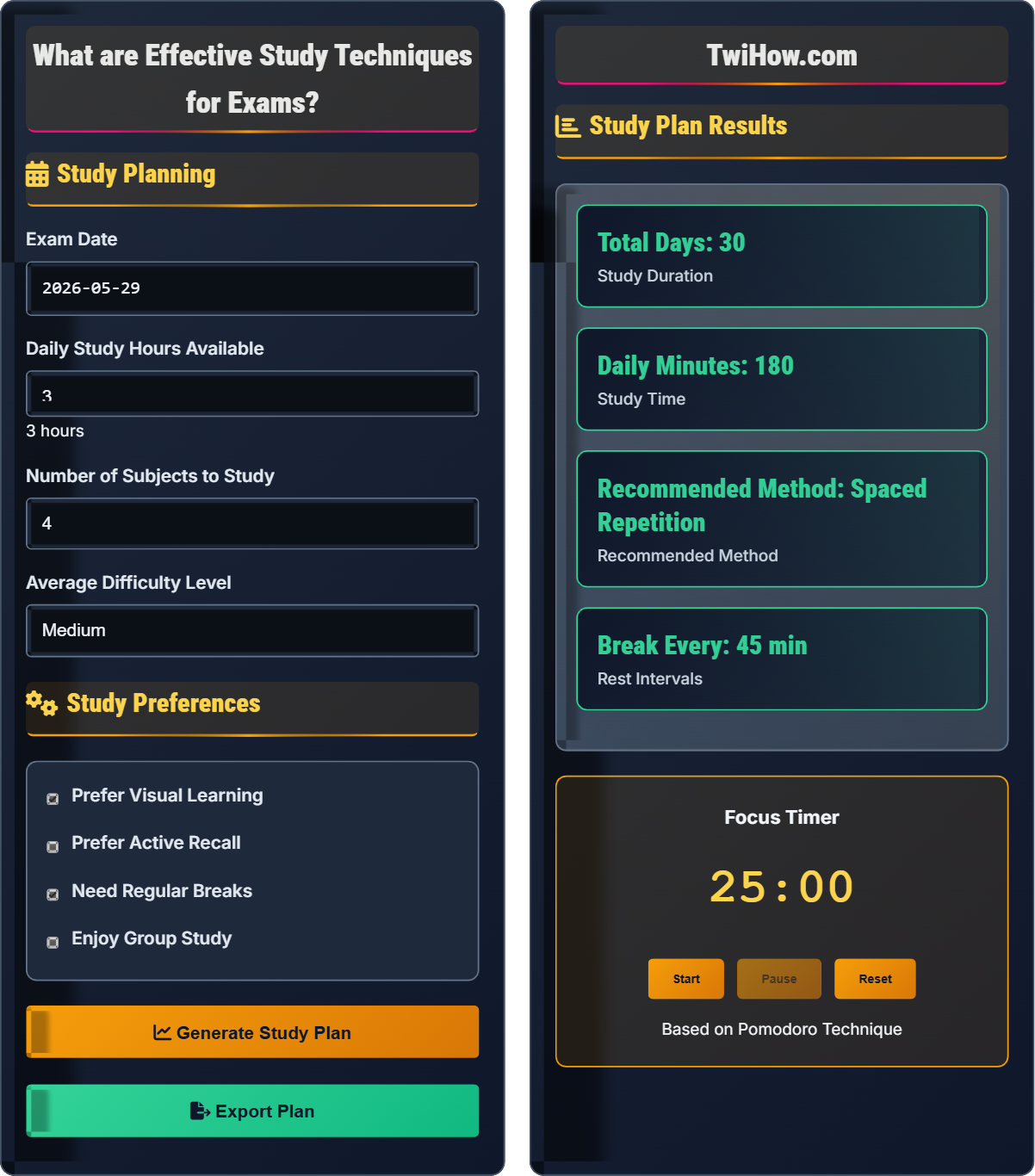
Study Planning
Study Preferences
Study Plan Results
Focus Timer
Based on Pomodoro Technique
| Day | Subject | Technique | Duration |
|---|---|---|---|
| 1-7 | Mathematics | Active Recall | 45 min |
| 1-7 | Science | Spaced Repetition | 45 min |
| 8-14 | History | Elaborative Interrogation | 45 min |
| 8-14 | English | Practice Testing | 45 min |
Review material at increasing intervals (1 day, 3 days, 1 week, 2 weeks) to strengthen long-term memory.
Test yourself without looking at notes. Close books and try to recall information from memory.
Proven Study Techniques
Spaced repetition is a learning technique that involves reviewing information at increasing intervals over time. This method leverages the psychological spacing effect, which demonstrates that we retain information better when exposure is distributed over time rather than massed together.
- First review: immediately after learning
- Second review: after 1 day
- Third review: after 3 days
- Fourth review: after 1 week
- Fifth review: after 2 weeks
- Final review: before exam
Next Review Date: Today
The Pomodoro Technique is a time management method developed by Francesco Cirillo. It uses a timer to break work into intervals, traditionally 25 minutes in length, separated by short breaks. This technique helps maintain focus and prevents mental fatigue.
- Choose a task to work on
- Set a timer for 25 minutes
- Work on the task until the timer rings
- Take a 5-minute break
- After 4 "pomodoros", take a longer 15-30 minute break
Interactive Pomodoro Timer
Active recall is a practice method where you actively stimulate your memory during the learning process. Instead of passively re-reading notes, you test yourself by trying to recall information without looking at your materials. This strengthens memory pathways and identifies knowledge gaps.
- Flashcards
- Practice tests
- Closing books and summarizing
- Teaching concepts to others
- Writing down what you remember
Elaborative interrogation involves asking "why" and "how" questions about the material you're studying. This technique helps you connect new information to what you already know, creating stronger memory associations and deeper understanding.
- Why is this true?
- How does this work?
- How is this related to...?
- Why does this make sense?
- How could I apply this?
Interleaving involves mixing different topics or types of problems within a single study session, rather than focusing on one topic at a time. This technique improves your ability to discriminate between different types of problems and enhances long-term retention.
- Improves problem-solving skills
- Enhances discrimination between concepts
- Boosts long-term retention
- Prepares for varied exam questions
Study Planning Framework
Early planning, intensive review, final preparation, post-exam reflection.
Study Time = (Total Material ÷ Retention Rate) × Difficulty Factor
Where Retention Rate accounts for technique effectiveness and Difficulty Factor adjusts for complexity.
- Start planning well before the exam
- Balance difficult and easy subjects
- Schedule regular breaks
- Include buffer time for unexpected delays
Exam Preparation Timeline
Comprehensive preparation schedule for optimal results.
- Week 1-2: Cover all material once
- Week 3-4: Focus on weak areas
- Week 5-6: Practice testing
- Week 7: Final review
- Week 8: Light review and rest
- Adjust timeline based on difficulty
- Account for other commitments
- Plan for review sessions
- Include contingency plans
Study Techniques Quiz
Which of the following best exemplifies the active recall study technique?
Active recall involves retrieving information from memory without cues. Option B exemplifies this by having the learner close the book and attempt to recall information from memory. This forces the brain to actively search for stored information, strengthening memory pathways. Options A, C, and D involve passive exposure to information rather than active retrieval.
The answer is B) Closing the book and trying to write down everything remembered.
Active recall is one of the most effective learning strategies because it mimics the process required during exams - retrieving information from memory. Passive techniques like re-reading create an illusion of competence without actually strengthening memory. Active recall forces the brain to reconstruct information, which strengthens neural pathways and improves long-term retention.
Active Recall: Retrieving information from memory without cues
Passive Learning: Receiving information without active engagement
Memory Consolidation: Strengthening memory traces through retrieval
• Test yourself regularly
• Don't look at answers first
• Focus on what you can't recall
• Use flashcards for active recall
• Explain concepts aloud
• Practice without notes
• Thinking re-reading is effective
• Looking at answers before trying
• Not identifying knowledge gaps
Explain the spaced repetition technique and why it's more effective than cramming for long-term retention.
Spaced Repetition: This technique involves reviewing information at increasing intervals over time. After initial learning, you review the material after 1 day, then 3 days, then 1 week, then 2 weeks, and finally before the exam.
Why It's More Effective Than Cramming:
1. Memory Consolidation: Spacing out reviews allows for memory consolidation between sessions, strengthening neural pathways.
2. Spacing Effect: Research shows that distributed practice leads to better long-term retention than massed practice.
3. Forgetting Curve: Hermann Ebbinghaus demonstrated that we rapidly forget information, but spaced reviews combat this decay.
4. Retrieval Strength: Each retrieval effort increases the strength of memory traces, making future recall easier.
Cramming Problems: Information is stored in short-term memory and quickly forgotten after the exam, with minimal long-term retention.
The effectiveness of spaced repetition lies in its alignment with how our brains naturally process and store memories. Each time we retrieve information after a period of forgetting, we strengthen the memory trace more than if we had reviewed it while it was still fresh. This creates more durable memories that persist over time.
Spacing Effect: Superior retention with distributed practice
Forgetting Curve: Graph showing rapid memory decay over time
Memory Consolidation: Process of stabilizing memory traces
• Review before complete forgetting
• Increase intervals gradually
• Focus on difficult items more
• Use spaced repetition apps
• Review difficult items more frequently
• Space reviews across days, not hours
• Reviewing too frequently
• Waiting too long between reviews
• Treating all items equally
Jennifer has 4 weeks to prepare for her final exams covering 5 subjects. She can study 4 hours per day but struggles with focus. Using effective study techniques, create a balanced study schedule that maximizes retention and minimizes burnout.
Daily Schedule (4 hours):
• 25-minute focused study blocks (Pomodoro) with 5-minute breaks
• 8 study blocks per day with 2 longer breaks (30 minutes each)
• Rotate subjects every 2-3 blocks to utilize interleaving
Weekly Distribution:
• Week 1-2: Cover all subjects, spending 20% more time on challenging ones
• Week 3: Focus on weak areas identified through practice tests
• Week 4: Final review and practice exams
Techniques to Use:
• Active recall during each study block
• Spaced repetition for difficult concepts
• Elaborative interrogation for complex topics
This schedule balances intensive preparation with adequate breaks, incorporates evidence-based techniques, and adapts to Jennifer's focus challenges.
Effective study schedules consider both cognitive load and attention span. The Pomodoro technique addresses Jennifer's focus challenges, while interleaving prevents monotony and improves discrimination between subjects. Balancing coverage with depth ensures comprehensive preparation without overwhelming cognitive resources.
Cognitive Load: Amount of mental effort required for learning
Attention Span: Duration of focused concentration
Metacognition: Awareness of one's own thinking
• Match schedule to attention capacity
• Include buffer time for difficulties
• Balance different subjects fairly
• Schedule difficult subjects during peak energy
• Use weekends for integrated review
• Plan rewards for meeting milestones
• Overloading daily schedule
• Neglecting break time
• Not adjusting for difficulty
A student is preparing for a history exam that requires memorizing dates, events, and understanding cause-and-effect relationships. Which combination of study techniques would be most effective, and why?
Recommended Combination:
1. Spaced Repetition: For memorizing dates and events. Create flashcards for specific dates and review at increasing intervals.
2. Elaborative Interrogation: For understanding cause-and-effect relationships. Ask "why did this event lead to that outcome?" and "how are these events connected?"
3. Active Recall: For testing knowledge without notes. Try to recreate timelines and explain connections from memory.
4. Concept Mapping: To visualize relationships between events and themes.
Implementation:
• Use spaced repetition for factual recall
• Apply elaborative interrogation to understand contexts
• Practice active recall through essay questions
• Create visual maps for complex relationships
This combination addresses both memorization and comprehension requirements of history exams.
History requires both factual knowledge and conceptual understanding. Different techniques address different cognitive demands: spaced repetition handles memorization, elaborative interrogation builds comprehension, and active recall tests overall mastery. Matching techniques to learning objectives maximizes effectiveness.
Concept Mapping: Visual representation of relationships between ideas
Elaborative Interrogation: Asking explanatory questions
Multi-modal Learning: Using different learning approaches
• Match techniques to content type
• Combine complementary methods
• Adapt to subject requirements
• Use timelines for chronological understanding
• Connect events to broader themes
• Practice explaining causation
• Treating all content equally
• Memorizing without understanding
• Not practicing explanation skills
Which environmental factor has the greatest impact on study effectiveness?
While all environmental factors contribute to study effectiveness, distraction elimination has the most significant impact. Research consistently shows that multitasking and interruptions severely impair focus and memory formation. A distraction-free environment allows for sustained attention, which is essential for encoding information into long-term memory. Without focus, even the best study techniques become ineffective.
The answer is B) Distraction elimination.
Attention is the gateway to learning. Cognitive load theory emphasizes that our working memory has limited capacity. When divided between studying and distractions, less cognitive resource is available for meaningful learning. Creating a focused environment amplifies the effectiveness of all study techniques by ensuring undivided attention.
Cognitive Load: Mental effort required for learning
Working Memory: Temporary storage for active informationDivided Attention: Splitting focus between tasks
• Eliminate digital distractions
• Choose consistent study location
• Control auditory environment
• Use website blockers
• Keep phone in another room
• Inform others of study times
• Studying with notifications on
• Multitasking during study
• Choosing distracting locations
Final Recommendations
To achieve optimal results, combine multiple evidence-based techniques:
- Start with spaced repetition for long-term retention
- Use active recall to strengthen memory pathways
- Apply the Pomodoro technique to maintain focus
- Ask explanatory questions using elaborative interrogation
- Mix topics using interleaving for better discrimination
Remember that individual learning preferences vary, so experiment with different combinations to find what works best for you. Consistency and persistence are more important than perfection.
FAQ
Q: I've been studying for hours but still don't retain information. What am I doing wrong?
A: Long study sessions without breaks often lead to diminishing returns. You're likely experiencing:
1. Cognitive Fatigue: Extended focus depletes mental resources
2. Passive Learning: Simply reading without active engagement
3. No Retrieval Practice: Not testing your memory
Try implementing the Pomodoro Technique with 25-minute focused sessions, use active recall instead of re-reading, and incorporate spaced repetition. Quality matters more than quantity in studying.
Q: How can I motivate students to use effective study techniques instead of cramming?
A: Help students understand the science behind effective techniques:
• Demonstrate the difference with before/after memory tests
• Show research comparing cramming vs. spaced repetition
• Have students track their own progress with different methods
• Provide templates and tools for spaced study schedules
• Share success stories from previous students
When students see tangible results from effective techniques, they naturally shift away from cramming.