Effective Ways to Participate in Class Discussions
Participation mastery guide • Communication strategies
Discussion Participation:
Show Participation PlannerEffective class discussion participation involves preparation, active listening, thoughtful contributions, and respectful engagement with peers. Successful participation enhances learning, builds communication skills, and demonstrates intellectual engagement. This guide provides evidence-based strategies to confidently contribute to discussions while respecting diverse perspectives and maintaining academic integrity.
Key participation elements:
- Preparation: Reviewing materials and formulating thoughts beforehand
- Active Listening: Paying attention to others' contributions
- Respectful Engagement: Building on others' ideas thoughtfully
- Confident Expression: Sharing ideas clearly and assertively
Effective participation requires balancing confidence with humility, contributing meaningfully while remaining open to new perspectives. The goal is to enhance collective learning while developing critical thinking and communication skills.
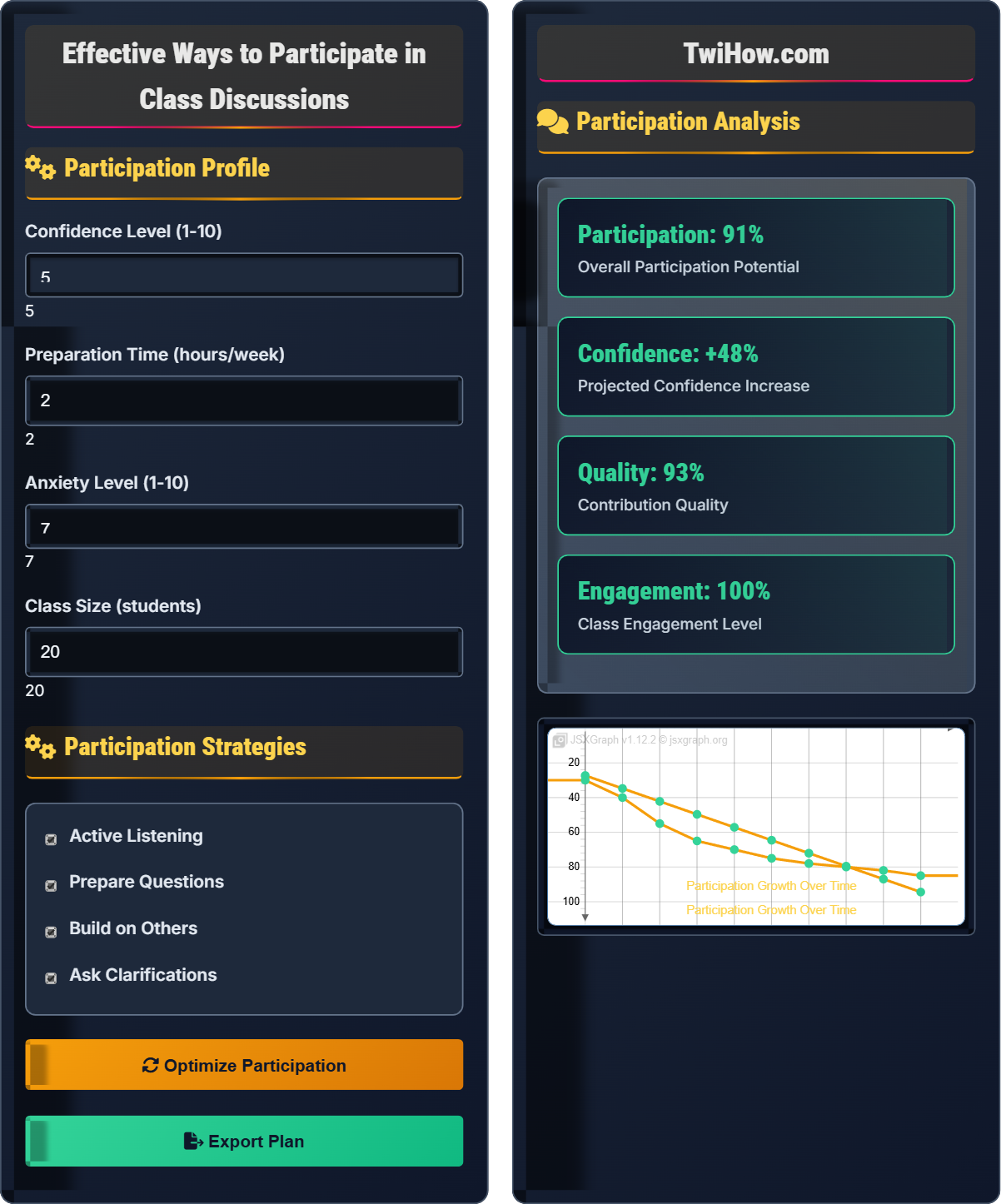
Participation Profile
Participation Strategies
Participation Analysis
| Strategy | Priority | Implementation | Timeline |
|---|---|---|---|
| Active Listening | High | Focus on others' points | Immediate |
| Prepare Questions | High | Read ahead and note questions | Daily |
| Build on Others | Medium | Connect to previous comments | Weekly |
| Ask Clarifications | Medium | Request clarification when needed | As needed |
| Share Insights | Low | Contribute original thoughts | Monthly |
Mastering Class Discussion Participation
Effective class discussion participation is a skill that combines preparation, active listening, and thoughtful contribution. It requires understanding the dynamics of group communication, respecting diverse perspectives, and expressing ideas clearly while remaining open to feedback. Successful participants enhance the learning environment for everyone while developing critical thinking and communication skills.
Participation effectiveness can be enhanced using a strategic approach:
Where:
- Preparation: Time spent reviewing materials beforehand (0-1)
- Confidence: Self-assurance in expressing ideas (0-1)
- Active Engagement: Quality of listening and responding (0-1)
Various techniques enhance class discussion participation:
- Questioning: Asking clarifying or probing questions
- Connecting: Linking concepts to previous discussions or readings
- Paraphrasing: Restating others' ideas to show understanding
- Challenging: Respectfully questioning assumptions or viewpoints
- Summarizing: Synthesizing key points from the discussion
- Applying: Relating concepts to real-world examples
- Speaking Anxiety: Practice in low-stakes settings
- Intimidating Peers: Focus on learning, not competition
- Unclear Topics: Ask for clarification rather than staying silent
- Time Constraints: Prepare key points in advance
- Cultural Differences: Respect diverse communication styles
- Power Dynamics: Value all voices equally
Core Participation Concepts
Active listening, respectful engagement, intellectual curiosity, critical thinking, collaborative learning.
Effective Participation = (Preparation + Confidence) × Active Engagement
Where Effective Participation = quality and frequency of meaningful contributions.
- Always listen before speaking
- Respect diverse perspectives
- Prepare thoughts in advance
Practical Applications
Seminars, workshops, group projects, case studies, debates, peer review sessions.
- Prepare by reviewing materials thoroughly
- Formulate questions and insights
- Listen actively to others' contributions
- Share thoughts respectfully and clearly
- Build on others' ideas when appropriate
- Reflect on the discussion afterward
- Individual comfort levels vary
- Cultural communication differences
- Class size and dynamics
- Topic sensitivity
Discussion Participation Quiz
Which behavior demonstrates the best active listening during a class discussion?
Taking notes on key points and asking follow-up questions demonstrates genuine engagement with others' ideas. This shows you're processing the information, looking for connections, and seeking to understand different perspectives. Active listening is essential for meaningful participation in discussions.
The answer is B) Taking notes on key points and asking follow-up questions.
Active listening is the foundation of effective participation. It involves fully concentrating on the speaker, understanding their message, responding thoughtfully, and remembering what was said. This creates a supportive environment where everyone feels heard and valued. Good listeners ask clarifying questions, make connections between ideas, and build upon others' contributions.
Active Listening: Fully concentrating on and understanding spoken information
Follow-up Questions: Questions that probe deeper into a topic
Meaningful Participation: Contributions that add value to the discussion
• Listen before speaking
• Focus on understanding, not just responding
• Show respect for others' ideas
• Take notes during others' contributions
• Paraphrase to confirm understanding
• Ask clarifying questions
• Interrupting speakers
• Not paying attention to others
• Focusing only on your own contributions
Explain how to effectively build on others' contributions in class discussions. Why is this technique important, and what are some specific ways to implement it?
Effective Building: Building on others' ideas involves acknowledging their contribution, connecting it to your thoughts, and extending the conversation. This creates a collaborative atmosphere where ideas build upon each other.
Importance: This technique demonstrates active listening, creates continuity in discussions, and shows respect for peers' contributions. It moves conversations forward and creates a more engaging learning environment.
Implementation: Use phrases like "Building on what Sarah mentioned about...", "That connects to my observation that...", or "I'd like to add to John's point...". Always acknowledge the original idea before adding your own.
Examples: "Sarah raised an interesting point about economic impacts. Adding to that, I think we should also consider the environmental implications..."
Building on others' contributions is a sophisticated participation technique that shows intellectual engagement. It demonstrates that you're processing others' ideas and making connections. This collaborative approach enriches discussions and helps develop critical thinking skills. It also creates a supportive environment where everyone feels their contributions are valued and built upon.
Building on Ideas: Extending and connecting to others' contributions
Collaborative Learning: Learning through group interaction and shared ideasIntellectual Engagement: Active participation in academic discourse
• Always acknowledge the original contributor
• Make genuine connections
• Add value to the discussion
• Use transition phrases to connect ideas
• Reference specific points made by others
• Ask follow-up questions based on others' points
• Taking credit for others' ideas
• Not acknowledging the original contributor
• Forcing artificial connections
You're enrolled in a philosophy seminar with 15 students where discussions are central to learning. You're naturally introverted and anxious about speaking up. The readings are dense and complex. Develop a preparation strategy that addresses your personality traits while maximizing your contribution quality.
Preparation Strategy: Create a structured approach that plays to your strengths as an introvert while addressing anxiety.
Reading Strategy: Read materials twice - first for general understanding, second for specific insights. Write down 2-3 discussion points per reading, including questions you'd like to explore.
Participation Plan: Aim for 1-2 meaningful contributions per class rather than frequent smaller ones. Prepare to ask clarifying questions or build on others' points.
Anxiety Management: Arrive early to sit where you feel comfortable. Bring prepared notes to reference. Start with less controversial points to build confidence.
Engagement Technique: Focus on active listening and taking notes. This provides content for later contributions and shows engagement.
This scenario recognizes that introversion isn't a barrier to effective participation but requires a different approach. Introverts often prepare more thoroughly and contribute higher-quality insights. The key is to leverage preparation and listening skills while gradually building comfort with speaking. Quality over quantity is often the best approach for introverted participants.
Introversion: Preference for solitary or small-group activities
Quality Contributions: Meaningful, well-thought-out participation
Preparation Strategy: Systematic approach to readying for discussions
• Prepare specific points in advance
• Focus on quality over quantity
• Leverage your listening skills
• Write down key points before class
• Practice your contributions mentally
• Start with questions rather than statements
• Trying to participate like an extrovert
• Not preparing enough to feel confident
• Withdrawing completely from discussions
During a political science discussion, a classmate makes a statement that contradicts your strongly held beliefs. How should you respond to maintain respectful dialogue while still expressing your perspective? What strategies ensure the discussion remains productive?
Initial Response: Listen fully to their statement without interrupting. Acknowledge the validity of their perspective: "I appreciate your viewpoint."
Constructive Disagreement: Express your different perspective respectfully: "I see this differently because..." or "I'd like to offer another perspective..."
Focus on Ideas: Address the argument, not the person. Use evidence and reasoning rather than emotion.
Productive Strategies: Ask clarifying questions about their reasoning. Find areas of agreement first. Use "I" statements to express your views.
De-escalation: If tension rises, suggest exploring the complexity of the issue together. Return to the learning objective of the discussion.
Example: "I understand your perspective on this issue. I see it differently based on my research, which suggests..."
Handling disagreement respectfully is a crucial discussion skill. Academic discussions should focus on ideas and evidence, not personal attacks. The goal is to explore different perspectives and deepen understanding. This requires emotional regulation, critical thinking, and communication skills. Respecting diverse viewpoints enriches the learning experience for everyone.
Respectful Disagreement: Expressing different views without hostility
Academic Discourse: Scholarly discussion based on evidence and reasoning
Constructive Dialogue: Conversation aimed at mutual understanding
• Focus on ideas, not individuals
• Use evidence and reasoning
• Maintain respect throughout
• Acknowledge valid points in opposing views
• Use "I" statements to express disagreement
• Ask questions to understand their reasoning
• Attacking the person rather than the idea
• Letting emotions override reason
• Shutting down productive dialogue
Which type of question is most effective for promoting deeper discussion in academic settings?
Open-ended questions encourage exploration, critical thinking, and diverse perspectives. They invite multiple viewpoints and promote deeper analysis rather than simple answers. These questions begin with "how," "why," "what if," or "what are the implications of..." and create space for meaningful discussion.
The answer is C) Open-ended questions that encourage exploration.
Questioning is a powerful tool for discussion leadership. Open-ended questions promote higher-order thinking and encourage participants to examine concepts from multiple angles. They create opportunities for debate, analysis, and synthesis. Closed questions limit discussion to simple responses, while open-ended questions invite exploration of complex ideas and relationships.
Open-Ended Questions: Questions that require more than yes/no answers
Critical Thinking: Analysis and evaluation of information
Discussion Leadership: Guiding conversations toward deeper understanding
• Ask questions that promote analysis
• Encourage multiple perspectives
• Focus on understanding rather than correctness
• Use "how" and "why" questions
• Ask about implications and consequences
• Encourage connections between ideas
• Asking leading questions that limit discussion
• Focusing only on factual recall
• Not allowing time for thoughtful responses
FAQ
Q: I'm naturally quiet and worry about being seen as disengaged if I don't speak up. How can I participate effectively without forcing myself to talk more than I'm comfortable with?
A: Quality over quantity is key. One thoughtful comment is better than multiple superficial ones. You can participate effectively by asking insightful questions, making connections between ideas, or summarizing key points. Consider sending follow-up emails with additional thoughts, or participating in online discussion boards. Your active listening and note-taking also demonstrate engagement. Faculty appreciate students who contribute meaningfully, regardless of frequency.
Q: How do I know if my contributions are appropriate for the class level and subject matter?
A: Start by listening to the tone and depth of others' contributions. Are they citing sources? Making analytical points? Consider the class level - introductory courses may welcome basic questions and observations, while advanced courses expect more sophisticated analysis. When in doubt, ask your instructor about expectations. It's better to ask for clarification than to remain silent. Your contributions should show you've done the reading and thought critically about the material.