What are the Benefits of Joining Student Organizations?
Student org excellence guide • Leadership development
Student Organizations:
Show Organization PlannerJoining student organizations provides invaluable opportunities for leadership development, networking, skill building, and community engagement. These groups offer platforms to develop professional skills, build lasting friendships, and enhance your college experience. Whether you're interested in academic, cultural, recreational, or service-oriented activities, student organizations provide structured environments for growth and achievement.
Key benefits:
- Leadership Development: Opportunities to hold positions and manage projects
- Professional Networking: Connections with peers, faculty, and industry professionals
- Skill Enhancement: Development of communication, teamwork, and project management skills
- Community Building: Formation of lasting friendships and support networks
Student organizations serve as practical laboratories where theoretical learning meets real-world application. The experiences gained through active participation often prove more valuable than classroom learning alone, providing hands-on experience in leadership, problem-solving, and collaboration.
Organization Profile
Organization Preferences
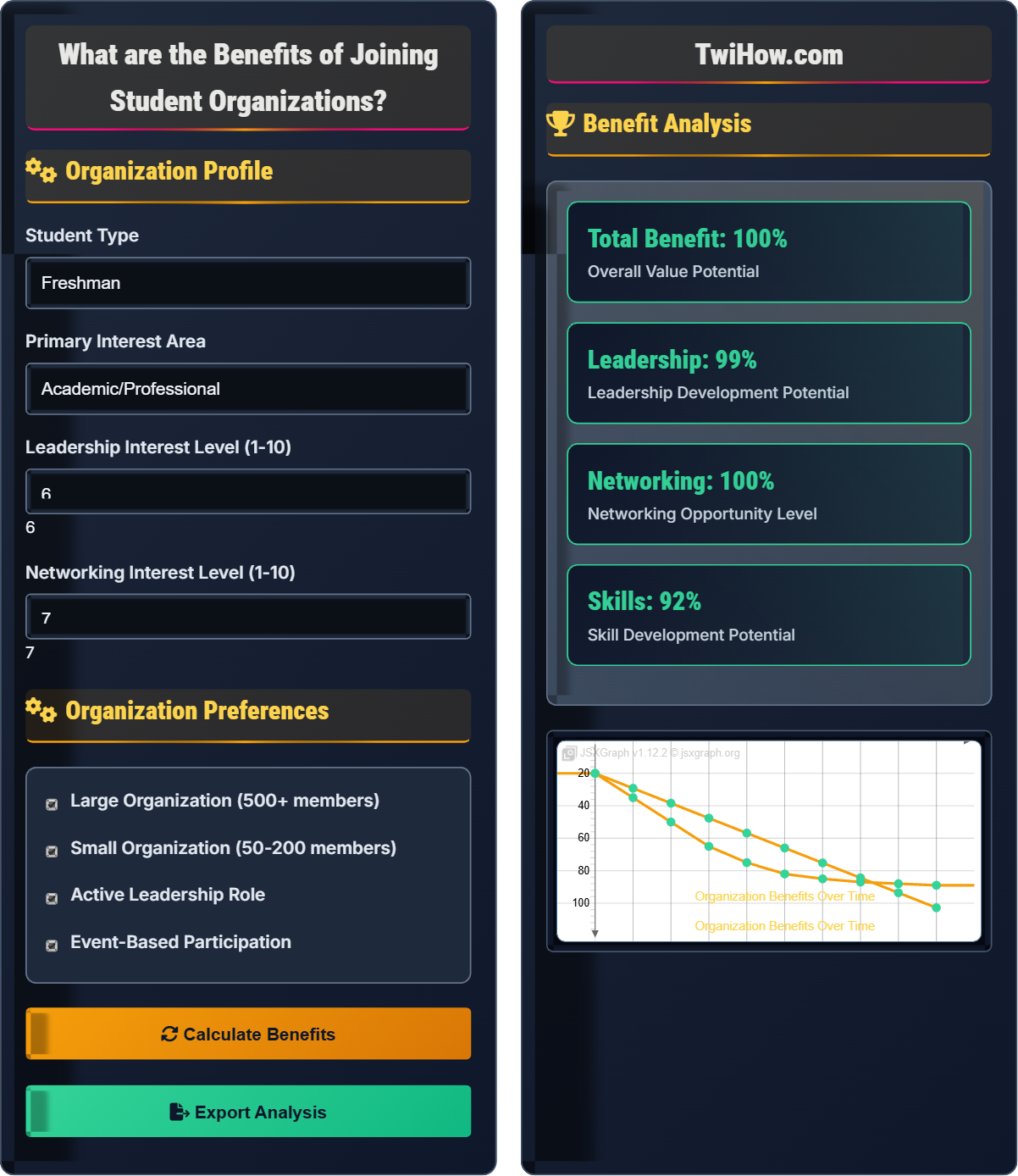
Benefit Analysis
| Benefit | Level | Impact | Timeline |
|---|---|---|---|
| Leadership Skills | High | Excellent | Immediate |
| Professional Network | High | Excellent | 3-6 months |
| Communication | Medium | Good | Immediate |
| Project Management | Medium | Good | 1-3 months |
| Career Preparation | High | Excellent | 6-12 months |
Understanding Student Organization Benefits
Student organizations provide structured environments for personal and professional development outside the classroom. They offer unique opportunities to develop leadership skills, build professional networks, and gain practical experience in teamwork and project management. The benefits extend far beyond college, often providing the foundation for lifelong friendships and career advancement.
Maximizing organization benefits requires strategic participation:
Where:
- Engagement Level: Active participation and commitment
- Leadership Opportunity: Chances to take on responsibilities
- Network Quality: Value of connections formed
- Skill Alignment: Match with career goals
Student organizations provide benefits across multiple domains:
- Leadership Development: Opportunities to lead projects, manage teams, and organize events
- Professional Networking: Connections with peers, faculty, alumni, and industry professionals
- Skill Enhancement: Development of communication, teamwork, problem-solving, and technical skills
- Resume Building: Concrete examples of leadership, initiative, and commitment
- Personal Growth: Increased confidence, cultural awareness, and emotional intelligence
- Career Advancement: Internship opportunities, job referrals, and career guidance
- Be Consistent: Attend meetings regularly and participate actively
- Take Initiative: Volunteer for projects and leadership positions
- Build Relationships: Connect with members, officers, and alumni
- Develop Skills: Focus on areas that align with career goals
- Document Experiences: Keep track of achievements and responsibilities
- Give Back: Mentor new members and contribute to organization success
Core Organization Concepts
Student organizations, leadership development, professional networking, skill building, community engagement.
Organization Value = (Engagement + Leadership + Networking) × Skill Development
Where Organization Value = overall benefit and impact of participation.
- Quality participation over quantity
- Align organizations with career goals
- Seek leadership opportunities
Practical Applications
Career preparation, leadership development, professional networking, personal growth, community service.
- Assess personal interests and goals
- Research compatible organizations
- Attend meetings and events
- Join and participate actively
- Seek leadership roles
- Build professional relationships
- Time commitment and academic balance
- Alignment with career objectives
- Personal comfort with networking
- Leadership opportunity availability
Organization Benefits Quiz
Which of the following best demonstrates how student organizations develop leadership skills?
Holding an officer position and organizing events provides hands-on leadership experience. This involves planning, delegation, team management, and problem-solving - all key leadership competencies. While other activities have value, actual leadership responsibilities provide the most direct skill development.
The answer is B) Holding an officer position and organizing events.
Leadership skills are best developed through practice and responsibility. Student organizations provide safe environments to experiment with leadership styles, make decisions, manage conflicts, and coordinate activities. The key is taking on actual responsibilities rather than just observing or participating passively.
Leadership Skills: Abilities to guide, inspire, and manage others
Hands-on Experience: Learning through direct practice
Leadership Responsibilities: Actual duties requiring leadership
• Seek actual leadership positions
• Take on organizational responsibilities
• Practice decision-making skills
• Start with committee chair positions
• Volunteer for event planning
• Assist current officers to learn
• Only attending meetings without participating
Explain how student organizations facilitate professional networking and why this is valuable for your career. What strategies should you use to build meaningful professional relationships?
Networking Through Organizations: Student organizations connect you with like-minded peers, faculty advisors, alumni members, and industry professionals who speak at events.
Value of Networking: Professional relationships can lead to internships, job opportunities, mentorship, career advice, and industry insights. Many career opportunities come through personal connections.
Effective Strategies:
• Be genuine and show interest in others
• Follow up after meetings with thank-you notes
• Offer to help others when possible
• Attend networking events and social gatherings
• Connect on LinkedIn and maintain relationships
Long-term Approach: Focus on building authentic relationships rather than just collecting contacts. Quality connections are more valuable than quantity.
Professional networking through student organizations is particularly effective because it creates natural opportunities for meaningful connections. Unlike cold outreach, relationships formed through shared activities have built-in common ground. The key is approaching networking as relationship-building rather than transactional opportunity-seeking.
Professional Networking: Building relationships for career advancement
Relationship-Building: Creating meaningful connections with others
Industry Professionals: Experts and leaders in your field
• Be authentic in interactions
• Follow up consistently
• Offer value to others
• Prepare elevator pitch about yourself
• Ask thoughtful questions
• Send personalized follow-ups
• Only contacting people when you need something
• Not following up after meetings
• Focusing only on senior professionals
You're a sophomore majoring in engineering with a heavy course load and a part-time job. You're interested in joining the Engineering Society but worry about time commitment. How should you approach this situation to maximize benefits while managing your academic and work responsibilities?
Strategic Approach:
1. Assess Commitment Levels: Research the Engineering Society's meeting frequency, event schedule, and leadership expectations.
2. Start Small: Attend general meetings and a few events before committing to leadership roles.
3. Focus on High-Impact Activities: Participate in professional development events, networking sessions, and competitions that align with career goals.
4. Time Blocking: Schedule organization activities just like classes and work shifts.
5. Leverage Synergies: Use organization projects to fulfill academic requirements when possible.
6. Evaluate Regularly: Assess whether the time investment is providing proportional benefits.
7. Consider Virtual Options: Participate in online meetings or committees when available.
Long-term Perspective: The professional network and leadership experience gained can enhance career prospects, potentially offsetting short-term time investments.
This scenario illustrates the importance of strategic organization participation. The key is finding the right balance between engagement and other responsibilities. Quality over quantity is often the best approach. Even limited participation can provide significant benefits if you're strategic about which activities to prioritize. The goal is to maximize return on investment of time while maintaining academic performance.
Strategic Participation: Selective involvement based on value and goals
Time Management: Efficient allocation of time resources
Return on Investment: Benefits relative to time invested
• Assess time commitments before joining
• Use organization events as study breaks
• Connect with members who share your schedule
• Look for flexible participation options
• Overcommitting initially
• Not communicating schedule constraints
• Participating in low-value activities
You're an international student from India studying business at an American university. You're interested in joining cultural organizations but wonder if this will limit your networking opportunities. How should you approach cultural organizations while still building a diverse professional network?
Strategic Approach:
1. Join Cultural Organization: Start with Indian Students Association for initial support and cultural connection.
2. Expand to Professional Organizations: Join business-related clubs like DECA, entrepreneurship club, or finance society.
3. Bridge Organizations: Participate in multicultural events and diversity committees.
4. Leverage Cultural Perspective: Share unique insights that add value to discussions.
5. Cross-Promote Events: Help organize collaborations between different organizations.
6. Professional Development: Attend career fairs and networking events hosted by various organizations.
7. Alumni Networks: Connect with international alumni who have succeeded in your field.
Value Proposition: Cultural organizations provide support, identity, and unique perspectives that enhance rather than limit professional networking. Your cultural background can be a significant asset in today's global economy.
This scenario demonstrates how cultural organizations can actually enhance rather than limit networking opportunities. Cultural backgrounds provide unique perspectives and connections that are valuable in diverse professional environments. The key is using cultural organizations as a foundation for broader engagement rather than a limiting factor. International students bring valuable global perspectives that are highly valued by employers.
Cultural Organizations: Groups celebrating specific cultural backgrounds
Global Perspective: Understanding of international markets and cultures
International Students: Students studying outside their home country
• Use culture as an asset, not a limitation
• Build bridges between different groups
• Share unique perspectives
• Organize cultural awareness events
• Share international business insights
• Connect with diaspora professionals
• Isolating within cultural groups only
• Not sharing cultural insights
• Viewing culture as a disadvantage
Which of the following organization experiences would be most impressive to employers?
Secretary of Student Government Association demonstrates high-level leadership responsibility in a prestigious organization. This position shows organizational skills, communication abilities, and leadership at the institutional level. However, any leadership role with measurable impact can be impressive if you can quantify achievements.
The answer is B) Secretary of Student Government Association.
Employers value leadership experience, especially in positions that involve managing people, budgets, or significant responsibilities. The most impressive experiences are those where you can demonstrate specific achievements and measurable outcomes. Quality of leadership role matters more than quantity of organizations joined.
Leadership Experience: Positions involving responsibility and decision-making
Measurable Outcomes: Quantifiable results from your efforts
Employer Value: Skills and experiences that benefit employers
• Focus on leadership roles with responsibility
• Document specific achievements
• Quantify your impact when possible
• Run for officer positions after establishing membership
• Volunteer for challenging projects
• Keep records of your contributions
• Joining many organizations without leadership
• Not documenting achievements
• Avoiding challenging leadership roles
FAQ
Q: I'm very introverted and nervous about joining organizations. How can I overcome social anxiety and still benefit from organizations?
A: Start with smaller, interest-based organizations where you can connect over shared passions. Consider roles that play to your strengths, such as treasurer, secretary, or committee member. Many organizations have behind-the-scenes roles that are crucial but less socially demanding. Focus on one organization initially rather than spreading yourself thin. Remember that many successful leaders started as quiet members who gradually took on responsibilities.
Q: I'm a transfer student with limited time remaining. Should I still join organizations?
A: Absolutely! Transfer students often bring valuable life experience and maturity that organizations appreciate. Focus on 1-2 organizations where you can make immediate impact. Many organizations value committed members over long-term members. Your unique perspective can enhance the organization while providing you with crucial networking opportunities before graduation. Consider joining organizations that align with your career goals.