What is the Best Way to Prepare for Standardized Tests?
Complete guide • Test strategies • Step-by-step instructions
Standardized test preparation requires a strategic approach combining content review, practice, and test-taking strategies. Effective preparation involves understanding test structure, identifying weaknesses, and building endurance. The most successful test-takers combine systematic study with regular practice and stress management.
Key preparation elements include:
- Diagnostic Assessment: Identify strengths and weaknesses
- Content Review: Master test-specific knowledge
- Practice Tests: Build familiarity and endurance
- Time Management: Develop pacing strategies
- Test-Taking Strategies: Learn efficient problem-solving
This guide provides comprehensive strategies for all major standardized tests.
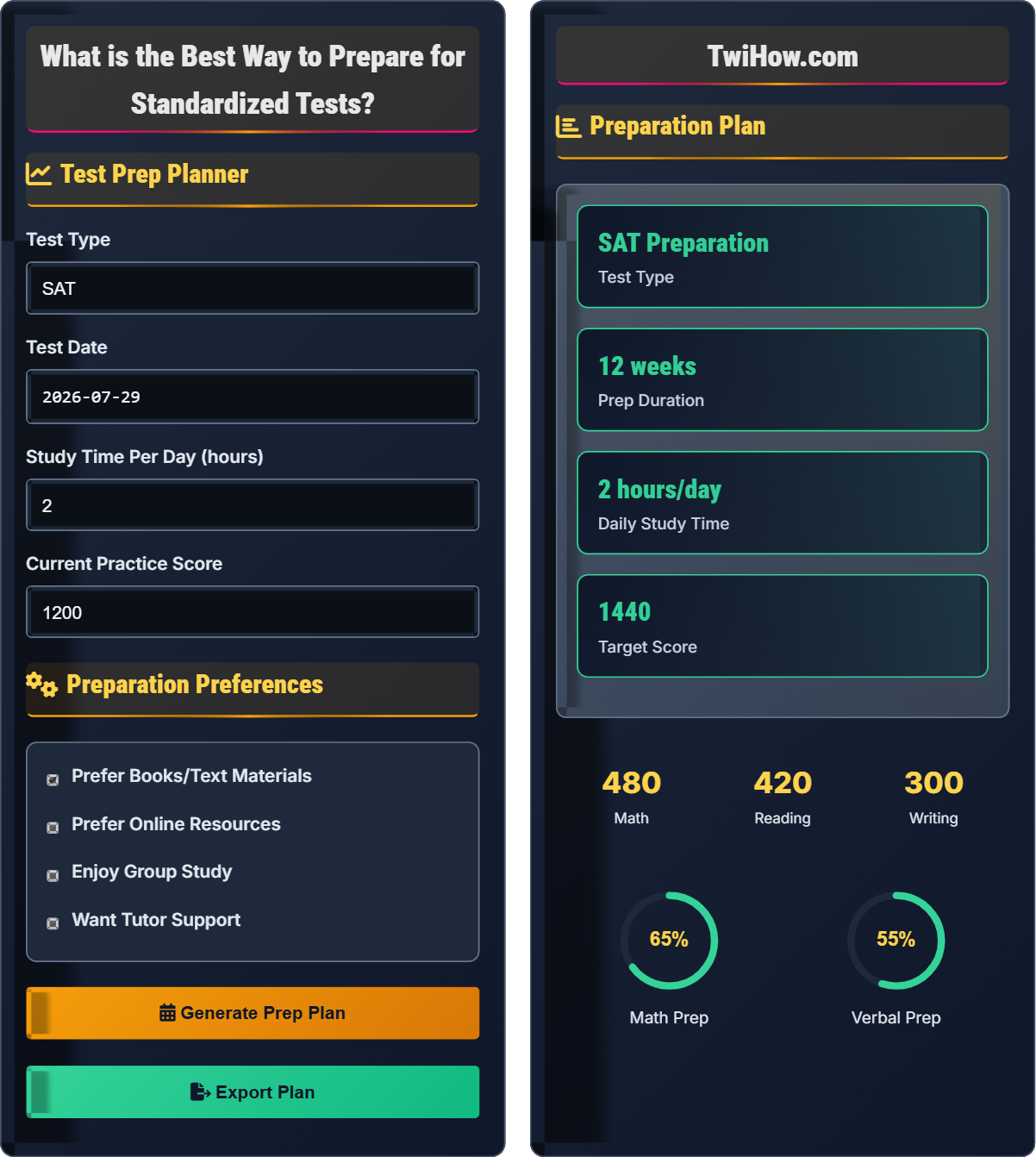
Test Prep Planner
Preparation Preferences
Preparation Plan
| Week | Focus Area | Materials | Practice Tests |
|---|---|---|---|
| 1-2 | Diagnostic & Weak Areas | Content Review | 1 Full Test |
| 3-4 | Math Foundations | Practice Problems | 2 Section Tests |
| 5-6 | Verbal Skills | Vocabulary Building | 2 Section Tests |
| 7-8 | Advanced Topics | Full-Length Tests | 2 Full Tests |
Allocate time wisely across sections. For SAT, spend ~1.25 minutes per math question, ~75 seconds per reading question.
Eliminate obviously incorrect answers to improve guessing odds, especially for multiple-choice sections.
Test Preparation Strategies
Begin preparation with a diagnostic test to establish a baseline score and identify strengths and weaknesses. This initial assessment guides your study plan and helps allocate time effectively. Take the diagnostic under realistic conditions to accurately measure current ability.
- Take a full-length practice test timed
- Review results by section and question type
- Identify specific weak areas
- Set realistic target scores
- Create targeted study plan
Standardized tests assess specific content knowledge and skills. Focus on test-specific content rather than general academic knowledge. For example, SAT Math emphasizes algebra and problem-solving, while ACT Math includes trigonometry and geometry.
Regular practice tests build endurance, improve time management, and familiarize you with test format. Take full-length, timed practice tests regularly to simulate actual test conditions. Analyze results thoroughly to identify patterns in errors.
- Take tests under realistic conditions
- Simulate test day environment
- Analyze results thoroughly
- Track progress over time
- Focus on weak areas identified
Effective time management is crucial for standardized tests. Develop pacing strategies for each section and practice them consistently. Learn to recognize when to move on from difficult questions to maximize points.
Learn and practice specific strategies for different question types. These include process of elimination, educated guessing, pattern recognition, and efficient problem-solving approaches. Strategies vary by test and section.
- Read questions carefully before passage (reading sections)
- Mark questions for review when uncertain
- Use scratch paper effectively
- Manage test anxiety through breathing
- Guess strategically when running out of time
Preparation Timeline
Focus Areas Tracker
Test Preparation Quiz
What should be the first step in standardized test preparation?
A diagnostic test establishes a baseline score and identifies strengths and weaknesses, which guides the entire preparation strategy. Without knowing your current level, you cannot create an effective study plan. This initial assessment helps allocate study time appropriately and set realistic goals.
The answer is B) Take a diagnostic test to assess current level.
Effective test preparation begins with self-assessment. A diagnostic test provides objective data about your current abilities, allowing you to focus your efforts where they're most needed. This prevents wasting time on already-mastered concepts while ensuring adequate attention to weak areas.
Diagnostic Assessment: Initial test to establish baseline performance
Baseline Score: Starting point for measuring improvement
Self-Assessment: Evaluating one's own abilities objectively
• Take diagnostic under test conditions
• Analyze results thoroughly
• Use results to guide study plan
• Use official practice tests
• Time yourself strictly
• Review all answers carefully
• Starting prep without baseline assessment
• Not analyzing diagnostic results
• Assuming you know your weaknesses
Explain the importance of time management during standardized tests and provide strategies for pacing yourself effectively.
Importance of Time Management: Standardized tests are designed to challenge time management skills. Poor pacing can result in unanswered questions or rushed responses, both of which significantly impact scores.
Effective Pacing Strategies:
1. Know the Format: Understand how many questions are in each section and the time allowed.
2. Calculate Average Time: For example, SAT Math gives ~1.25 minutes per question (80 minutes ÷ 64 questions).
3. Set Milestones: Know how many questions you should complete by the halfway point.
4. Move On Strategy: Spend 30 seconds more than average on difficult questions, then mark and return.
5. Review Time: Reserve 2-3 minutes at the end to fill in unanswered bubbles.
Section-Specific Tips: Reading sections benefit from reading questions first, while math sections often require careful calculation time.
Time management is a critical test-taking skill that often determines performance more than content knowledge. Students who master pacing can maximize their score potential by ensuring they attempt all questions and avoid the penalty of leaving questions blank. Practice under timed conditions develops this essential skill.
Pacing: Managing time allocation across questions
Time Pressure: Stress caused by limited time
Test Endurance: Ability to maintain focus throughout test
• Know exact time limits
• Practice with time pressure
• Develop move-on criteria
• Use watch to track progress
• Set halfway checkpoints
• Practice time allocation
• Spending too much time on early questions
• Not reserving time for bubbling
• Failing to adapt when behind pace
Sarah has 10 weeks to prepare for the SAT. She can study 3 hours per day on weekdays and 5 hours per day on weekends. She estimates she needs 100 hours for math review, 80 hours for reading, and 60 hours for writing. How should she distribute her study time to complete all review before the test?
Calculate Total Available Study Time:
Weekdays: 5 days × 3 hours × 10 weeks = 150 hours
Weekends: 2 days × 5 hours × 10 weeks = 100 hours
Total: 250 hours available
Total Required Time:
Math: 100 hours
Reading: 80 hours
Writing: 60 hours
Total: 240 hours needed
Weekly Distribution:
Math: 10 hours per week (100 ÷ 10)
Reading: 8 hours per week (80 ÷ 10)
Writing: 6 hours per week (60 ÷ 10)
Strategy: Sarah should allocate 2-3 hours on weekdays and 4-5 hours on weekends to each subject, rotating focus areas to maintain engagement and prevent burnout. She should prioritize weaker areas initially and transition to practice tests in the final weeks.
Effective study scheduling requires balancing available time with required content coverage. Sarah's situation demonstrates how to proportionally allocate time based on content requirements while accounting for available study time. The key is to ensure adequate coverage of all areas while allowing for practice and review.
Study Allocation: Distributing time across different subjects
Time Proportionality: Allocating time based on importance
Study Balance: Equal attention to all test areas
• Calculate available vs. required time
• Prioritize weak areas
• Include practice in schedule
• Use weekend time for full-length tests
• Rotate subjects to maintain focus
• Build in buffer time for review
• Not calculating actual available time
• Overestimating study efficiency
• Ignoring practice test time
Michael experiences significant test anxiety that affects his performance on standardized tests. Despite knowing the material, he often blanks out during tests and makes careless mistakes. What strategies can he implement to manage his anxiety and improve his performance?
Preparation-Based Strategies:
• Take numerous practice tests under realistic conditions to build familiarity and confidence
• Master content thoroughly to reduce uncertainty
• Develop consistent test-taking routines
Physical Techniques:
• Practice deep breathing exercises before and during the test
• Use positive self-talk and affirmations
• Arrive early to settle in comfortably
During the Test:
• Start with easier questions to build confidence
• Take brief mental breaks between sections
• Use relaxation techniques when feeling overwhelmed
Mental Preparation:
• Visualize successful test completion
• Focus on the process, not just the outcome
• Remind yourself that it's just one test
Consistent practice under test-like conditions is the most effective long-term strategy for reducing anxiety.
Test anxiety is common and manageable with proper preparation and techniques. The key is to address both the cognitive and physical aspects of anxiety. Familiarity with the test format and thorough preparation build confidence, while relaxation techniques help manage the physical symptoms of anxiety.
Test Anxiety: Nervousness affecting test performance
Performance Pressure: Stress from high-stakes testing
Confidence Building: Increasing self-assurance
• Practice under realistic conditions
• Use relaxation techniques
• Focus on preparation, not outcomes
• Practice breathing exercises daily
• Use visualization techniques
• Arrive prepared and rested
• Not preparing adequately
• Focusing too much on results
• Ignoring physical preparation
How often should you take full-length practice tests during preparation?
Taking full-length practice tests every 2-3 weeks allows you to measure progress, build endurance, and adjust strategies without overwhelming your study schedule. This frequency provides sufficient data points to track improvement while leaving time for focused content review between tests.
The answer is C) Once every 2-3 weeks during active prep.
Practice tests serve dual purposes: measuring progress and building test-taking stamina. Too frequent testing can interfere with content learning, while infrequent testing doesn't provide adequate progress tracking. The 2-3 week interval strikes the right balance between assessment and preparation.
Practice Testing: Taking tests to prepare for actual exam
Test Endurance: Ability to maintain focus throughout test
Progress Tracking: Monitoring improvement over time
• Take tests under realistic conditions
• Analyze results thoroughly
• Balance testing with content review
• Use official practice tests
• Simulate test day conditions
• Review all answers carefully
• Taking tests without analyzing results
• Not simulating test conditions
• Over-testing and burnout
Success Strategies
To maximize your standardized test preparation:
- Start preparation early (3-6 months before test)
- Take diagnostic test to establish baseline
- Create realistic study schedule
- Focus on weak areas while maintaining strengths
- Take regular practice tests under timed conditions
- Develop and practice test-taking strategies
- Manage stress and maintain physical health
Remember that consistent, focused preparation is more effective than last-minute cramming.
FAQ
Q: How many hours should I study for standardized tests?
A: Most students benefit from 100-150 hours of preparation spread over 2-4 months. This averages to 8-15 hours per week. The key is consistency rather than intensity. Shorter, regular study sessions are more effective than long, infrequent ones. Focus on quality over quantity - make sure you're actively learning and practicing rather than just spending time with materials.
Q: Should my child take a prep course or study independently?
A: This depends on your child's learning style and motivation. Prep courses provide structure, accountability, and expert guidance, which benefit students who struggle with self-direction. Independent study works well for disciplined students who can create and follow their own plans. Consider your child's personality, budget, and time constraints. Many families combine both approaches - using courses for structure and independent study for additional practice.