What is the Best Way to Review and Retain Course Material?
Study mastery guide • Evidence-based techniques
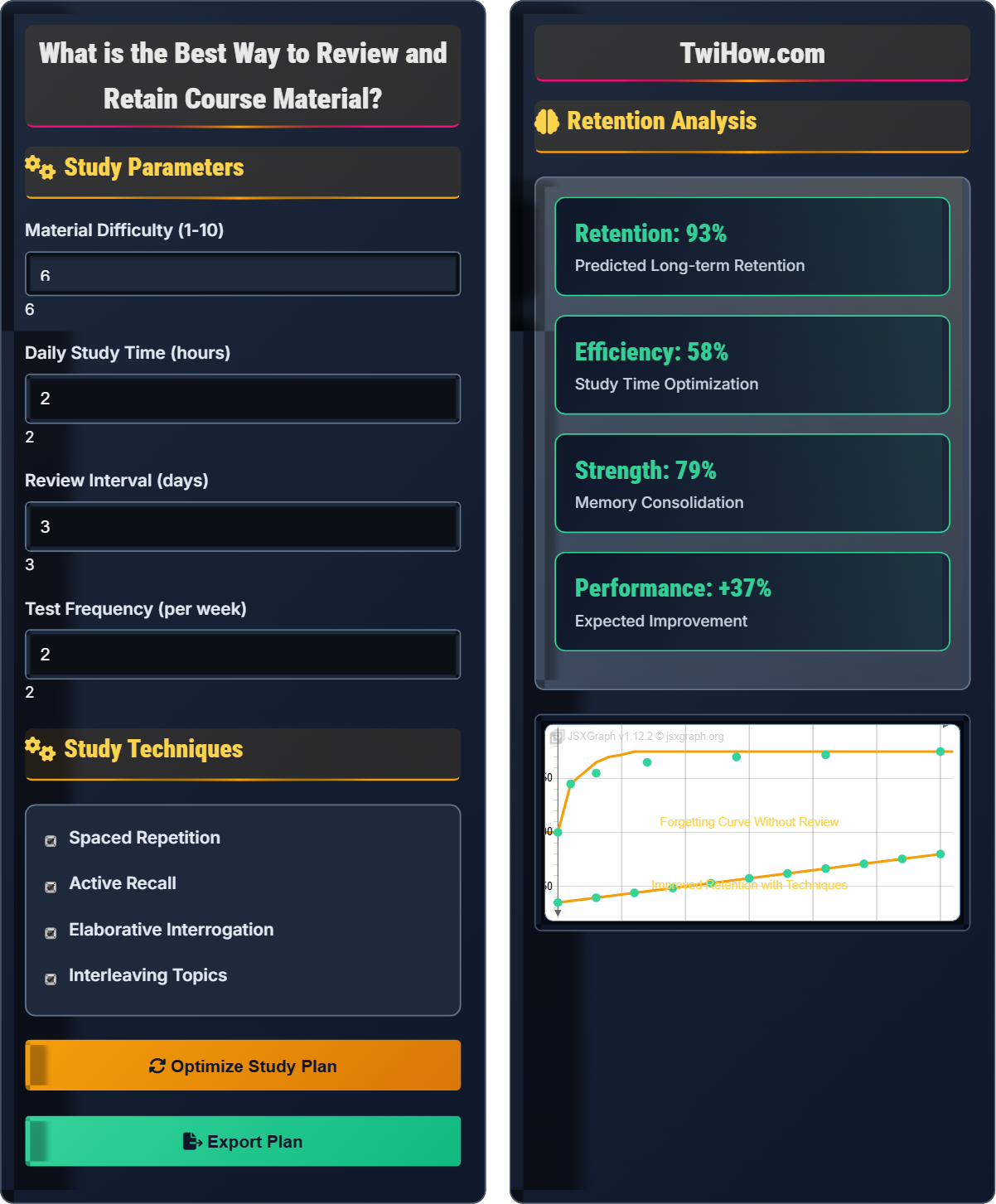
Memory Retention:
Show Study PlannerEffective review and retention of course material relies on scientifically-proven techniques like spaced repetition, active recall, and elaborative interrogation. These methods work with how memory naturally forms and consolidates, significantly improving long-term retention compared to passive reading. This guide presents evidence-based strategies that maximize learning efficiency and retention.
Key retention factors:
- Active Recall: Testing yourself on material without looking
- Spaced Repetition: Reviewing material at increasing intervals
- Elaborative Interrogation: Asking "why" and "how" questions
- Retrieval Practice: Actively retrieving information from memory
These evidence-based techniques have been shown to dramatically improve long-term retention and comprehension. The forgetting curve can be overcome through strategic review timing and active engagement with material.
Study Parameters
Study Techniques
Retention Analysis
| Day | Retention | Review Type | Duration |
|---|---|---|---|
| 1 | 100% | Initial | 2h |
| 3 | 85% | Review | 45m |
| 7 | 78% | Review | 30m |
| 14 | 72% | Test | 60m |
| 21 | 68% | Review | 45m |
Understanding Memory and Retention
Memory formation involves encoding, storage, and retrieval processes. The forgetting curve, discovered by Hermann Ebbinghaus, shows that we rapidly lose newly acquired information without reinforcement. However, strategic review at specific intervals can dramatically improve long-term retention. Effective study techniques work with our brain's natural processes rather than against them.
Memory retention follows a predictable pattern that can be optimized:
Where:
- Encoding Quality: How deeply information is processed initially
- Spacing Effect: Benefits of reviewing material at intervals
- Review Frequency: How often material is revisited
- Retrieval Strength: How easily information can be recalled
Students often engage in ineffective study practices:
- Passive Reading: Simply re-reading notes without engagement
- Cramming: Studying all material in one session
- Highlighting: Marking text without processing meaning
- Massed Practice: Repeating same material consecutively
- Multitasking: Dividing attention during study
- Illusion of Knowing: Feeling confident without testing
- Flashcards: Create cards with questions and answers
- Practice Tests: Use past exams or create your own
- Study Schedules: Plan review sessions in advance
- Concept Maps: Visualize relationships between ideas
- Peer Teaching: Explain concepts to others
- Reflection: Assess what you know and don't know
Core Retention Concepts
Active recall, spaced repetition, elaborative interrogation, interleaving, retrieval practice, forgetting curve.
Optimal Retention = (Active Engagement × Spaced Practice) + Retrieval Strength
Where Optimal Retention = percentage of material retained after extended period.
- Testing strengthens memory more than re-reading
- Spacing reviews improves long-term retention
- Challenging retrieval strengthens memory traces
Practical Applications
Exam preparation, course material review, skill development, language learning, professional development.
- Assess material difficulty and importance
- Create active recall materials
- Establish spaced review schedule
- Integrate testing into study routine
- Monitor and adjust based on results
- Individual differences in learning styles
- Subject matter complexity variations
- Time constraints and scheduling needs
- Motivation and consistency challenges
Study Retention Quiz
Which of the following best exemplifies active recall?
Active recall involves retrieving information from memory without cues. Saying answers aloud from flashcards requires you to actively retrieve information, strengthening memory traces. The other options involve passive exposure to information rather than active retrieval.
The answer is B) Looking at flashcards and saying the answers aloud.
Active recall is one of the most effective study techniques because it forces your brain to work harder to retrieve information, strengthening neural pathways. When you simply re-read or look at highlighted text, you're not actively retrieving the information from memory. The act of forcing yourself to recall information creates stronger memories than passively consuming the same information again.
Active Recall: Retrieving information from memory without cues
Passive Review: Receiving information without effortful retrieval
Memory Trace: Neural pathway formed during learning
• Always test yourself without looking at materials
• Focus on what you can't remember
• Challenge yourself with difficult questions
• Create questions from your notes
• Explain concepts without notes
• Use practice tests regularly
• Re-reading instead of testing
• Only practicing easy material
• Not varying the order of practice
Explain the concept of spaced repetition and why it's more effective than massed practice (cramming) for long-term retention. Include the underlying psychological principles.
Spaced Repetition: A learning technique that involves reviewing material at increasing intervals over time. Instead of cramming all review into one session, spaced repetition schedules reviews when you're about to forget the material.
Why It Works: The spacing effect occurs because each retrieval attempt strengthens memory traces. When you're about to forget something, the effort to retrieve it strengthens the memory more than retrieving something you just reviewed. This creates more durable and accessible memories.
Psychological Principles: The forgetting curve (Ebbinghaus), testing effect (retrieval strengthens memory), and desirable difficulties (challenging retrieval improves retention).
Example Schedule: Day 1, Day 3, Day 7, Day 14, Day 30.
Spaced repetition works with our brain's natural forgetting process rather than against it. When we're about to forget something, the brain has to work harder to retrieve it, which strengthens the memory trace. This is why reviewing material just before you're about to forget it is so effective. Massed practice creates an illusion of competence but doesn't strengthen long-term retention.
Spaced Repetition: Reviewing material at increasing intervals
Massed Practice: Concentrated practice in one session
Forgetting Curve: Pattern of memory decay over time
• Review material before complete forgetting
• Increase intervals gradually
• Focus on difficult items more frequently
• Use spaced repetition apps
• Track your forgetting intervals
• Adjust schedule based on difficulty
• Cramming before exams
• Reviewing too frequently
• Not varying the schedule
You have a biology exam in 30 days covering 10 chapters. Using evidence-based retention techniques, create a study plan that maximizes long-term retention. Include active recall, spaced repetition, and testing strategies.
Days 1-3: Initial learning of first 3 chapters. Create active recall materials (flashcards, practice questions).
Days 4-6: Learn chapters 4-6 while reviewing chapters 1-3 using active recall.
Days 7-9: Learn chapters 7-10 while reviewing earlier chapters with increasing intervals.
Days 10-15: Comprehensive review using spaced repetition. Focus on difficult concepts identified through testing.
Days 16-25: Weekly comprehensive reviews with practice tests. Adjust schedule based on performance.
Days 26-30: Final reviews focusing on weak areas. Use active recall and testing strategies.
Ongoing: Daily 15-minute active recall sessions for previously covered material.
This plan integrates multiple evidence-based techniques. Active recall is used throughout to strengthen memory. Spaced repetition ensures material is reviewed at optimal intervals. Testing identifies knowledge gaps. The plan balances new learning with review, preventing forgetting of earlier material while progressing through content.
Comprehensive Review: Reviewing all previously learned material
Knowledge Gaps: Areas where understanding is weak
Optimal Intervals: Timing that maximizes retention
• Balance new learning with review
• Test yourself regularly
• Adjust based on performance
• Use spaced repetition software
• Create practice exams
• Track your retention rates
• Focusing only on new material
• Not testing knowledge
• Following rigid schedule inflexibly
You're studying for a psychology exam and encounter the concept of "classical conditioning." Demonstrate elaborative interrogation by generating "why" and "how" questions about this concept and answering them. How does this technique improve retention?
Classical Conditioning Concept: Learning through association between stimuli.
"Why" Questions:
• Why does classical conditioning work? Because the brain forms associations between stimuli that occur together.
• Why is the temporal relationship important? Because timing affects the strength of the association.
"How" Questions:
• How does Pavlov's dog experiment demonstrate this? The bell became associated with food through pairing.
• How does this apply to phobias? Fear responses can become associated with neutral stimuli.
Benefits: Elaborative interrogation creates deeper processing, connects new information to prior knowledge, and creates multiple retrieval paths.
Elaborative interrogation forces you to think deeply about material, creating stronger memory connections. By asking "why" and "how," you're explaining the mechanisms behind concepts, which creates richer understanding. This technique also helps identify gaps in knowledge where you can't answer these questions.
Elaborative Interrogation: Generating explanations for why facts are true
Classical Conditioning: Learning through stimulus association
Deeper Processing: More meaningful engagement with material
• Ask questions that require explanation
• Connect to prior knowledge
• Seek to understand mechanisms
• Turn headings into questions
• Explain to yourself as you read
• Use the "five whys" technique
• Asking superficial questions
• Not answering the questions
• Stopping at surface-level explanations
Which study schedule best demonstrates the principle of interleaving?
Interleaving involves mixing different topics or types of problems within a single study session. This technique forces your brain to constantly switch between different types of thinking, which strengthens discrimination between concepts and improves learning. Alternating between subjects every 15 minutes provides the optimal mix of variety and focus.
The answer is B) Alternate between algebra and geometry problems every 15 minutes.
Interleaving is counterintuitive but highly effective. While blocked practice (focusing on one topic) feels easier and gives an illusion of learning, interleaving creates more durable learning. The difficulty of switching between topics actually strengthens memory and improves problem-solving skills by requiring you to select the appropriate strategy for each problem.
Interleaving: Mixing different topics during study sessions
Blocked Practice: Focusing on one topic at a time
Discrimination Learning: Identifying which strategy to use
• Mix related but distinct topics
• Space out practice sessions
• Focus on differences between concepts
• Create mixed practice sets
• Vary the order of problems
• Practice identifying problem types
• Only using blocked practice
• Mixing unrelated topics
• Not spacing out sessions
FAQ
Q: I feel like I understand the material when I'm studying, but I blank out during exams. What's going wrong?
A: You're likely experiencing the "illusion of knowing" - feeling familiar with material without truly being able to retrieve it. This happens when you study passively (re-reading, highlighting) instead of actively testing yourself. To fix this, incorporate active recall into your study routine: close your books and try to write down or explain what you've learned. Use practice tests regularly. The gap between recognition (feeling familiar) and retrieval (actually remembering) is often larger than students realize.
Q: How much time should I spend reviewing versus learning new material?
A: The optimal ratio depends on your goals and timeline, but a good starting point is 60% review/40% new material when preparing for cumulative exams. For ongoing learning, spend about 20-30% of study time on review of previously learned material. As you get closer to an exam, increase the review proportion. The key is consistency - regular brief reviews are more effective than occasional lengthy sessions. Use the forgetting curve as a guide: review material at increasing intervals (1 day, 3 days, 1 week, 2 weeks).