What is the Value of a Gap Year and How to Plan One?
Gap year planning guide • Strategic planning
Gap Year Planning:
Show Gap Year PlannerA gap year is a structured period of time when students take a break from formal education to pursue experiential learning opportunities. It offers valuable time for personal growth, skill development, cultural immersion, and career exploration. When planned strategically, a gap year can enhance academic performance, provide clarity about career goals, and develop independence and global awareness.
Key benefits:
- Personal Growth: Increased self-awareness and maturity
- Skill Development: Leadership, communication, and problem-solving
- Cultural Awareness: Exposure to diverse perspectives and experiences
- Academic Clarity: Better understanding of career and academic goals
Successful gap years require careful planning, clear objectives, and structured activities that align with personal and professional development goals. The investment in a well-planned gap year often pays dividends in future academic and career success.
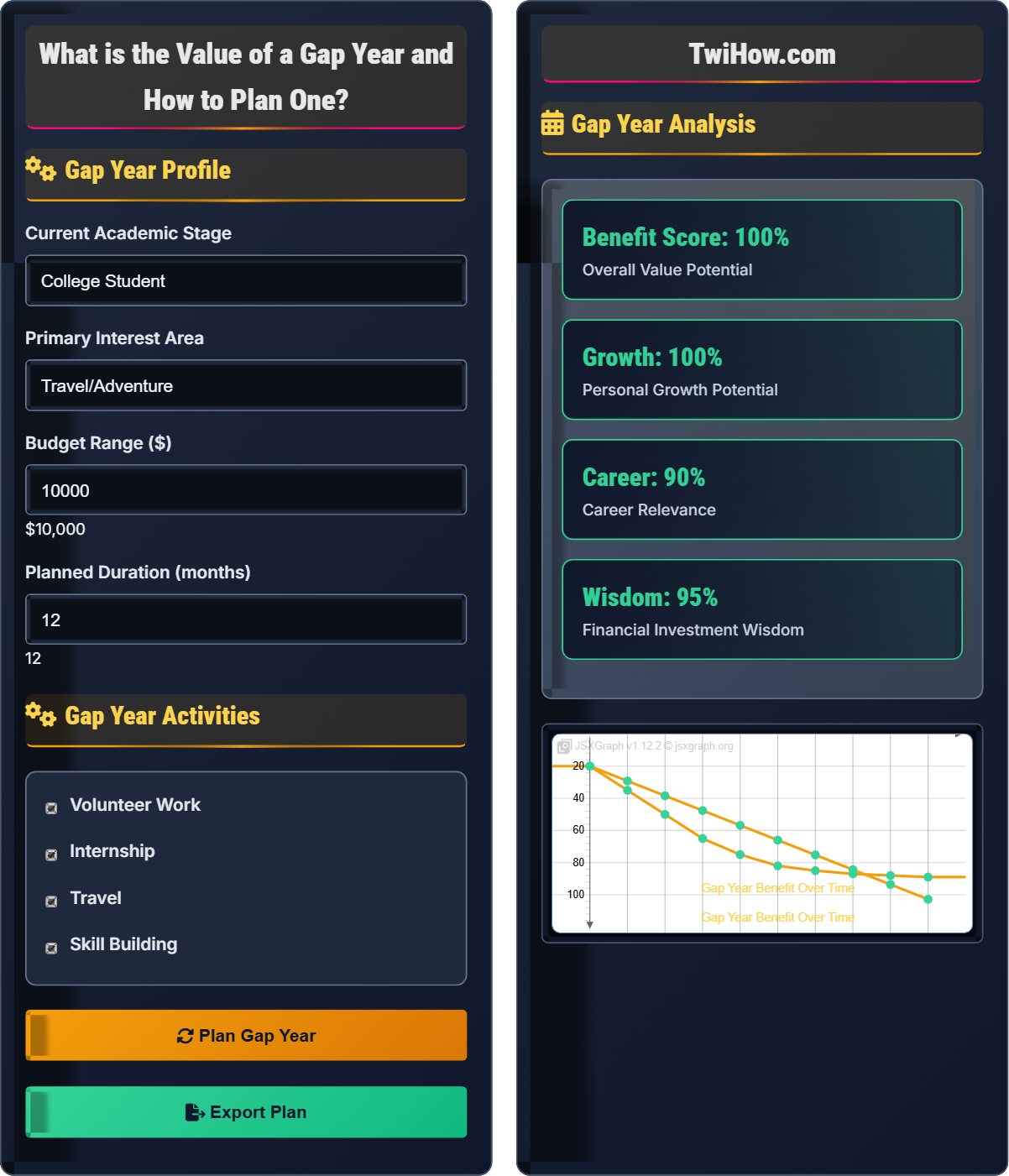
Gap Year Profile
Gap Year Activities
Gap Year Analysis
| Phase | Duration | Activities | Goals |
|---|---|---|---|
| Preparation | 3 months | Research, planning, applications | Secure opportunities |
| Early Phase | 3 months | Orientation, initial activities | Adjustment period |
| Main Phase | 6 months | Core activities | Maximize learning |
| Transition | 3 months | Wrap-up, reflection | Prepare return |
Understanding and Planning a Gap Year
A gap year is a structured period of time when students take a break from formal education to pursue experiential learning opportunities. Rather than being idle, a well-planned gap year involves intentional activities that promote personal growth, skill development, and career exploration. Gap years can occur before college, during college, or after graduation, and can last anywhere from a few months to a year or more.
The value of a gap year can be understood through multiple dimensions:
Where:
- Personal Growth: Increased self-awareness and maturity
- Skill Development: Acquired competencies and capabilities
- Career Clarity: Better understanding of professional goals
- Cultural Awareness: Exposure to diverse perspectives and experiences
Common gap year activities include:
- Travel: Cultural immersion, language learning, adventure
- Volunteer Work: Community service, NGOs, social impact
- Internships: Professional experience in chosen field
- Education: Courses, certifications, skill development
- Research: Independent projects, field studies
- Work: Paid employment, entrepreneurship, career exploration
- Set Clear Goals: Define specific outcomes you want to achieve
- Maintain Documentation: Journal, blog, portfolio development
- Build Networks: Connect with professionals and peers
- Develop Skills: Focus on competencies relevant to future goals
- Stay Connected: Maintain academic and professional relationships
- Plan for Integration: Consider how experiences will inform future decisions
Core Gap Year Concepts
Gap year, experiential learning, personal development, career exploration, cultural immersion, structured break.
Gap Year Value = (Personal Growth + Skill Development) × (Career Clarity + Cultural Awareness)
Where Gap Year Value = overall benefit and impact of the experience.
- Plan with intentionality and purpose
- Maintain focus on development goals
- Document experiences for future reference
Practical Applications
College preparation, career exploration, personal development, academic break, professional growth.
- Assess personal goals and development needs
- Research appropriate opportunities
- Create detailed planning timeline
- Secure funding and logistics
- Execute planned activities
- Reflect and integrate experiences
- Financial planning and budgeting
- Academic and career timing
- Personal safety and security
- Family and social expectations
Gap Year Planning Quiz
Which of the following is NOT typically considered a primary benefit of a well-planned gap year?
While gap years can enhance college applications and demonstrate maturity, they do not guarantee acceptance to top-tier universities. Universities consider gap years favorably when they are well-planned and demonstrate growth, but admission decisions depend on many factors. The other options represent documented benefits of gap years.
The answer is C) Guaranteed acceptance to top-tier universities.
Gap years offer many documented benefits including increased maturity, better academic focus upon return, enhanced cultural awareness, and clearer career direction. However, they are not a guaranteed path to elite university admission. Universities value gap year experiences when they demonstrate intentionality, growth, and learning, but admission remains competitive based on multiple criteria.
Gap Year: Structured break from formal education for experiential learning
Experiential Learning: Learning through direct experience
Personal Growth: Development of maturity and self-awareness
• Gap years require intentional planning
• Benefits are realized through structured activities
• Outcomes depend on execution quality
• Document experiences and learning
• Maintain academic connections
• Focus on skill development
• Viewing as extended vacation
• Not planning structured activities
• Disconnecting from academic goals
Explain the recommended timeline for planning a gap year, including key milestones and activities for each phase. Why is advance planning crucial for a successful gap year?
Planning Timeline:
12-18 months before: Self-assessment, goal setting, research opportunities, budget planning.
6-12 months before: Application processes, securing funding, logistics planning, visa arrangements.
3-6 months before: Confirmations, preparations, pre-departure orientations, documentation.
1-3 months before: Final preparations, travel arrangements, health checks, insurance.
During gap year: Engagement, documentation, networking, skill building.
Before return: Reflection, integration planning, academic re-entry.
Advance Planning Importance: Many opportunities require early applications, funding may need time to secure, and competitive programs fill quickly. Advance planning allows for thorough research and preparation.
Gap year planning requires advance preparation because many opportunities have early deadlines, funding sources need time to process, and competitive programs fill up quickly. The timeline allows for proper research, application, and preparation. Without adequate planning time, you may miss opportunities or make rushed decisions that don't align with your goals.
Advance Planning: Preparation well before departure
Opportunity Application: Securing spots in programs
Logistics Planning: Arranging practical details
• Start planning early
• Research thoroughly
• Budget realistically
• Create planning checklist
• Set application deadlines
• Research visa requirements
• Starting planning too late
• Underestimating costs
• Not researching visa requirements
You want to take a 6-month gap year focused on volunteer work and cultural immersion in Southeast Asia. You have $8,000 saved, and estimate living expenses at $800/month. You also need $500 for flights and $300 for visas. How much additional funding do you need, and what funding strategies could you implement to bridge the gap?
Expense Calculation:
Living expenses: $800/month × 6 months = $4,800
Flights: $500
Visas: $300
Total expenses: $4,800 + $500 + $300 = $5,600
Funding Needed: $5,600 - $8,000 = -$2,400 (You have $2,400 extra!)
Funding Strategies: If expenses were higher, you could: apply for gap year scholarships, fundraise through crowdfunding, work part-time before departure, seek sponsored opportunities, or adjust destination/costs.
Financial Planning: Always budget conservatively and include a contingency fund of 10-15% for unexpected expenses.
This example shows the importance of detailed financial planning for gap years. Living expenses can vary significantly by destination, and it's crucial to research costs accurately. The calculation demonstrates how to budget for a gap year and plan for contingencies. Financial security allows you to focus on your development goals rather than worrying about money.
Financial Planning: Calculating and arranging funding needs
Contingency Fund: Extra money for unexpected expenses
Gap Year Budget: Planned expenses and income
• Calculate all expenses accurately
• Include contingency funds
• Research destination costs
• Use budget tracking apps
• Research cost-effective destinations
• Look for work-exchange opportunities
• Underestimating living costs
• Not including emergency funds
• Ignoring currency exchange rates
You're a pre-med student considering a gap year to gain experience and clarity about your career path. You're interested in healthcare but also want to develop leadership skills and cultural awareness. Design a 12-month gap year plan that addresses these goals and explain how each component contributes to your medical school preparation.
12-Month Plan:
Months 1-3: Medical volunteer work in underserved community (healthcare experience, empathy development)
Months 4-6: Research project at medical institution (critical thinking, research skills)
Months 7-9: International medical mission trip (cultural awareness, global health perspective)
Months 10-12: Leadership role in health-focused NGO (management, advocacy)
Contribution to Medical School: Demonstrates commitment to service, shows cultural competency, provides research experience, develops leadership skills, and confirms career choice through real-world exposure.
Documentation: Maintain journal, collect letters of recommendation, document hours and achievements.
This example demonstrates how to align gap year activities with specific career goals. For pre-med students, gap year activities should demonstrate commitment to healthcare, expose them to diverse populations, and develop relevant skills. The plan shows progression from direct patient care to research to global health to leadership, providing a comprehensive foundation for medical school.
Medical Mission: Healthcare service in underserved areas
Global Health: Healthcare challenges across cultures
Cultural Competency: Understanding diverse patient populations
• Align activities with career goals
• Document experiences
• Gain diverse perspectives
• Connect with medical professionals
• Keep detailed records
• Seek research opportunities
• Not documenting experiences
• Choosing activities unrelated to goals
• Not gaining patient exposure
What is the most important consideration when planning your return from a gap year?
While all options have merit, integrating gap year experiences into your academic and career planning is most important for realizing the long-term value of your gap year. This includes reflecting on lessons learned, updating your resume and applications, and applying insights to future decisions.
The answer is B) Integrating experiences into your academic and career planning.
The return phase is crucial for maximizing gap year value. Reflection helps consolidate learning and growth. Updating your academic and career plans ensures you apply insights gained. Sharing experiences with others amplifies the impact. The integration process transforms the gap year from a break into a meaningful component of your ongoing development.
Integration: Applying gap year learning to future plans
Reflection: Analyzing experiences and growthAcademic Planning: Using insights for educational decisions
• Document throughout the experience
• Reflect on learning and growth
• Apply insights to future decisions
• Keep a journal throughout
• Collect feedback from others
• Update your resume and portfolio
• Not reflecting on experiences
• Failing to document achievements
• Not applying insights to future planning
FAQ
Q: Will taking a gap year hurt my chances of getting into college?
A: Not if it's well-planned and purposeful. Many colleges actually prefer gap year students who have gained real-world experience and clarity about their goals. The key is demonstrating growth, learning, and intentionality. Document your experiences, reflect on your growth, and articulate how the gap year enhances your college readiness. Many top universities support gap years and even offer structured programs.
Q: How do I afford a gap year without going into debt?
A: Plan ahead and save money during your working time. Consider work-exchange programs, teaching English abroad, or volunteer opportunities that provide room and board. Look for programs that offer stipends or scholarships. You can also work part-time during your gap year. Choose cost-effective destinations, and consider shorter gap periods if finances are tight. Many successful gap years are funded through creative combinations of savings, work, and supported programs.