What is the Value of Internships and How to Find Them?
Complete guide • Career development • Step-by-step instructions
Internships provide invaluable professional experience that bridges the gap between academic learning and real-world application. They offer hands-on experience in your field, networking opportunities, and often lead to full-time employment. Internships allow you to apply theoretical knowledge, develop professional skills, and gain industry insights while building your resume.
Key benefits include:
- Practical Experience: Apply classroom knowledge in real-world settings
- Networking: Build professional relationships and connections
- Skill Development: Gain industry-specific and soft skills
- Career Clarity: Explore career paths and confirm interests
- Resume Enhancement: Stand out to future employers
This guide provides comprehensive strategies for finding and securing valuable internship opportunities.
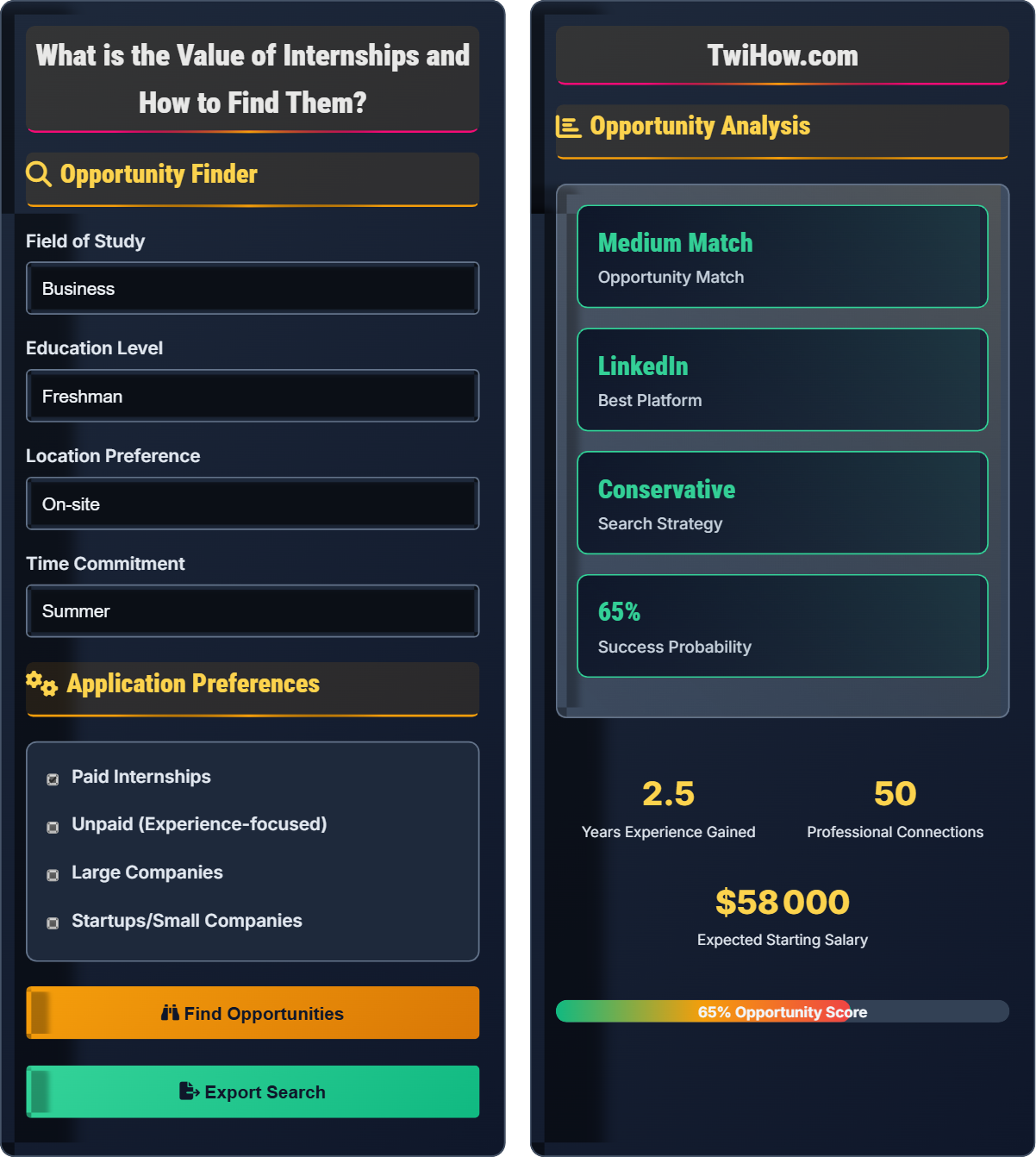
Opportunity Finder
Application Preferences
Opportunity Analysis
LinkedIn, Indeed, Glassdoor, and company websites are the best platforms for finding internships in your field.
Start searching 3-6 months before your desired start date. Many companies begin posting positions early in the semester.
| Benefit | Description | Value |
|---|---|---|
| Experience | Real-world application of skills | High |
| Networking | Professional relationship building | High |
| Resume | Enhancement of credentials | High |
| Skills | Technical and soft skill development | Medium |
Value of Internships
Internships provide hands-on experience in your chosen field, allowing you to apply theoretical knowledge in real-world settings. This experience is invaluable for understanding industry practices, workplace dynamics, and professional expectations. Employers consistently rank internship experience as one of the most important factors in hiring decisions.
Internships allow you to explore different career paths and confirm your interests before committing to a specific field. This exploration helps you make informed decisions about your future and can prevent costly career changes later. Many interns receive full-time job offers from their internship companies.
- Discover your true interests and strengths
- Understand industry culture and expectations
- Gain clarity on career direction
- Experience different roles within organizations
- Build confidence in professional settings
Employers increasingly expect candidates to have relevant work experience. According to studies, students with internship experience are significantly more likely to receive job offers and command higher starting salaries. Internships provide concrete examples of your abilities and achievements to discuss in interviews.
Internships provide access to professional networks that can benefit your entire career. Colleagues, supervisors, and other interns become valuable contacts for job referrals, recommendations, and industry insights. These relationships often extend far beyond the internship period.
- Supervisor mentorship
- Colleague relationships
- Industry event attendance
- Professional association memberships
- Alumni network connections
Finding Internships
Application Timeline
Internship Value and Finding Quiz
Which of the following is the most significant benefit of internships?
Gaining practical experience is the most significant benefit of internships. While compensation and networking are important, the hands-on application of academic knowledge in real-world settings provides invaluable learning that cannot be replicated in classrooms. This experience demonstrates to future employers that you can apply theoretical knowledge to practical problems.
The answer is B) Gaining practical experience.
Internships bridge the gap between academic learning and professional practice. The experience gained through internships allows students to understand how theoretical concepts are applied in actual work environments, develop industry-specific skills, and gain insights into professional expectations and workplace culture.
Practical Experience: Hands-on application of knowledge in real settings
Theory-Practice Gap: Difference between academic knowledge and real-world application
Industry-Specific Skills: Technical abilities required for specific professions
• Focus on learning and skill development
• Apply classroom knowledge practically
• Understand industry expectations
• Seek challenging assignments
• Ask questions and seek feedback
• Document your experiences
• Focusing only on compensation
• Not taking initiative
• Failing to document experiences
Explain the key components of a successful internship application and how to tailor it to specific opportunities.
Resume:
• Highlight relevant coursework, projects, and skills
• Quantify achievements when possible
• Customize for each application
• Keep it concise and professional
Cover Letter:
• Address specific company and position
• Demonstrate knowledge of the company
• Connect your skills to the job requirements
• Show enthusiasm for the opportunity
Portfolio/Work Samples:
• Include relevant projects or academic work
• Showcase your best work
• Provide context for each piece
Tailoring Strategy:
• Research the company's mission and values
• Match keywords from the job description
• Highlight relevant experiences and skills
• Address specific requirements mentioned in the posting
Each application should be customized to show genuine interest in the specific opportunity.
Successful internship applications require customization and attention to detail. Generic applications are easily identified and often rejected. Tailoring each application demonstrates genuine interest and increases the likelihood of standing out among other candidates. The goal is to show how your unique qualifications align with the company's needs.
Customization: Adapting application materials to specific opportunities
Keyword Matching: Using terms from job postings in applications
Relevant Experience: Past experiences that relate to the position
• Research each company thoroughly
• Customize every application
• Proofread all materials
• Create templates but customize each version
• Use company-specific language
• Highlight mutual interests/values
• Using generic cover letters
• Not researching the company
• Failing to proofread
Sarah is a junior computer science major looking for summer internships. She's unsure how to approach her search and feels overwhelmed by the number of options. What strategy should she use to find and apply to internships effectively?
Initial Research:
• Identify preferred company types (tech giants, startups, consulting firms)
• Determine location preferences (local, national, remote)
• Consider specific areas of interest (web development, cybersecurity, data science)
Search Strategy:
• Start with 3-4 major platforms (LinkedIn, company websites, Handshake)
• Set up job alerts for relevant positions
• Attend virtual career fairs and networking events
• Leverage alumni networks and professor connections
Application Timeline:
• Begin searching in October for summer positions
• Apply to 10-15 positions per week
• Track applications and follow up appropriately
• Prepare for interviews while continuing to apply
Application Quality:
• Tailor each application to the specific role
• Highlight relevant projects and coursework
• Include GitHub portfolio or coding samples
• Practice technical interview questions
Sarah should focus on quality applications to well-researched opportunities rather than quantity alone.
Effective internship searching requires a strategic approach that balances breadth and focus. Students should research opportunities thoroughly, apply to positions that align with their interests and skills, and maintain organization throughout the process. The goal is to maximize the probability of success while minimizing stress and confusion.
Search Strategy: Planned approach to finding opportunities
Application Quality: Thoroughness and relevance of materials
Strategic Approach: Deliberate planning to achieve goals
• Start searching early
• Focus on quality over quantity
• Research each opportunity
• Create an application tracker spreadsheet
• Practice interview questions
• Join professional organizations
• Starting too late
• Using generic applications
• Not tracking applications
David has been applying to internships but hasn't received many responses. He realizes networking might be important but doesn't know how to start. What networking strategies can he use to improve his internship search?
Academic Networking:
• Connect with professors who have industry experience
• Attend guest speaker events and industry presentations
• Join academic clubs and professional organizations
• Participate in career fairs and networking events
Online Networking:
• Optimize LinkedIn profile with professional photo and detailed experience
• Connect with alumni from your school working in target companies
• Engage with company content and posts
• Join industry-specific groups and forums
Informational Interviews:
• Reach out to professionals for brief conversations
• Prepare thoughtful questions about their career paths
• Express genuine interest in their work
• Follow up with thank-you notes
Professional Events:
• Attend industry conferences and workshops
• Participate in company-hosted events and webinars
• Volunteer for professional organizations
• Join local chapter meetings
David should focus on building genuine relationships rather than just asking for favors. Networking is about mutual benefit and long-term relationship building.
Networking is a critical component of successful internship searches. Many opportunities are never publicly posted and are filled through referrals and recommendations. Effective networking involves building genuine relationships with professionals in your field, showing interest in their work, and providing value when possible. The key is to approach networking as relationship building rather than transactional requests.
Networking: Building professional relationships
Informational Interviews: Conversations to learn about careers
Professional Relationships: Work-related connections
• Focus on giving as much as receiving
• Be genuine and authentic
• Follow up appropriately
• Prepare thoughtful questions
• Listen actively
• Send timely thank-you notes
• Only contacting people when desperate
• Not following up appropriately
• Focusing only on personal gain
What is the most important aspect of preparing for internship interviews?
While all aspects of interview preparation are important, researching the company thoroughly is the most critical. This demonstrates genuine interest, allows you to ask thoughtful questions, and helps you articulate why you want to work there. Company research also enables you to connect your experiences to the organization's goals and values.
The answer is A) Researching the company thoroughly.
Company research demonstrates preparation and genuine interest in the position. It allows candidates to understand the organization's mission, values, recent news, and challenges. This knowledge enables meaningful conversations during interviews and helps candidates articulate how they can contribute to the company's success.
Company Research: Investigating an organization's background
Interview Preparation: Getting ready for job interviews
Meaningful Conversation: Substantive dialogue during interviews
• Research company mission and values
• Know recent news and developments
• Understand the role and team
• Review company website and social media
• Read recent press releases
• Research interviewers on LinkedIn
• Not researching the company
• Asking generic questions
• Not understanding the role
Application Tips
FAQ
Q: Should I apply for internships even if I don't meet all the requirements?
A: Yes, apply for internships even if you don't meet all requirements. Many employers expect interns to be learning and developing skills. Focus on highlighting your eagerness to learn, relevant coursework, and transferable skills. If you meet 60-70% of the requirements and have a compelling reason for why you'd be a good fit, definitely apply.
Q: Are unpaid internships worth it?
A: Unpaid internships can be extremely valuable if they provide meaningful work experience and professional development. Focus on whether the internship offers learning opportunities, mentorship, and networking potential. Some unpaid internships at prestigious organizations can open doors that lead to higher-paying opportunities later. Evaluate the experience value against the compensation.