What Resources Are Available for Students with Learning Differences?
Complete guide • Support services • Step-by-step instructions
Students with learning differences have access to a wide range of resources designed to support their unique learning needs. These resources include academic accommodations, assistive technologies, specialized support services, and legal protections. Understanding and accessing these resources is crucial for academic success and personal growth.
Common learning differences include:
- Dyslexia: Difficulties with reading and language processing
- ADHD: Attention and executive function challenges
- Dyscalculia: Difficulties with math concepts
- Dysgraphia: Writing and fine motor challenges
- Autism Spectrum: Communication and social interaction differences
This guide provides comprehensive information about available resources and how to access them.
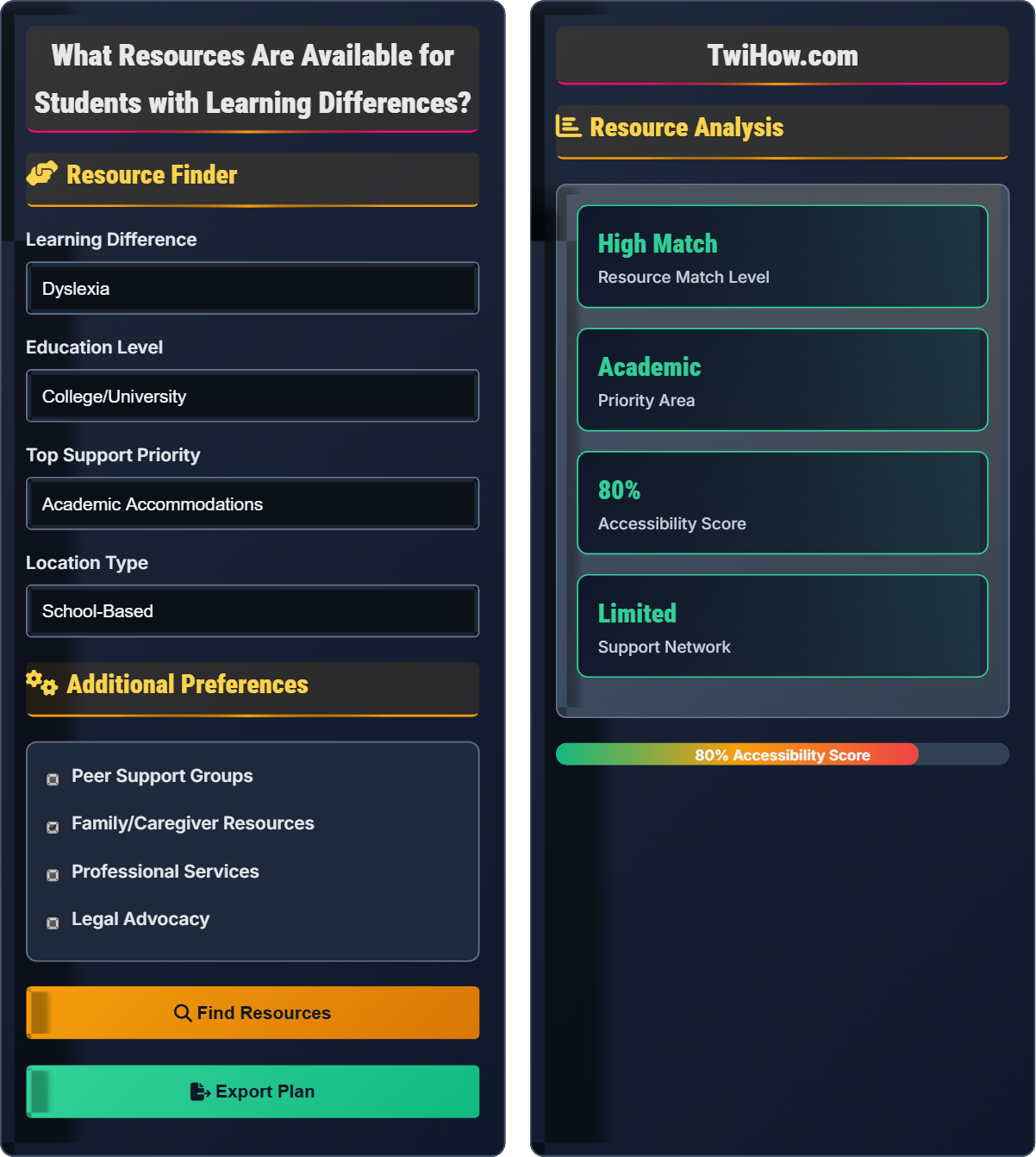
Resource Finder
Additional Preferences
Resource Analysis
Students with learning differences are protected by laws including Section 504, IDEA, and ADA. These laws guarantee equal access to education and reasonable accommodations.
Most institutions provide academic support services including tutoring, study skills workshops, and learning centers specifically designed for students with learning differences.
| Type | Accommodation | Availability |
|---|---|---|
| Testing | Extended time | High |
| Technology | Screen readers | High |
| Environment | Quiet room | Medium |
| Instruction | Alternative formats | High |
Types of Resources Available
Students with learning differences are protected by several federal laws including Section 504 of the Rehabilitation Act, the Individuals with Disabilities Education Act (IDEA), and the Americans with Disabilities Act (ADA). These laws ensure equal access to education and guarantee reasonable accommodations.
Most educational institutions provide academic support services specifically designed for students with learning differences. These services may include tutoring, study skills workshops, learning centers, and specialized instruction.
- Disability services office
- Academic coaching
- Tutoring services
- Study skills workshops
- Learning strategy instruction
- Note-taking assistance
Assistive technology tools can significantly enhance learning for students with learning differences. These tools range from simple accommodations to sophisticated software that supports various learning needs.
Many institutions offer specialized programs designed specifically for students with learning differences. These programs provide additional support, advocacy, and resources.
- Learning differences support centers
- Peer mentoring programs
- Executive function coaching
- Social skills groups
- Transition support services
- Self-advocacy training
Common Accommodations
Additional time for tests, assignments, and other academic activities to accommodate processing differences.
Access to materials in different formats such as audio, large print, or electronic text.
Separate testing rooms or quiet study spaces to reduce distractions.
Support Network
Learning Differences Resources Quiz
Which law guarantees equal access to education for students with learning differences?
Section 504 of the Rehabilitation Act is the federal law that prohibits discrimination based on disability and guarantees equal access to education for students with learning differences. This law ensures that students with disabilities receive reasonable accommodations in educational settings.
The answer is B) Section 504 of the Rehabilitation Act.
Section 504 is a civil rights law that protects students with disabilities from discrimination in federally funded programs. It requires schools to provide reasonable accommodations to ensure equal access to education. Understanding these legal protections is crucial for advocating for appropriate support services.
Section 504: Civil rights law prohibiting disability discrimination
Reasonable Accommodations: Modifications to ensure equal access
Equal Access: Same educational opportunities as peers
• Schools must provide reasonable accommodations
• Students have the right to equal access
• Discrimination based on disability is illegal
• Know your legal rights
• Document all requests and responses
• Seek legal advocacy if needed
• Not understanding legal protections
• Failing to document accommodation requests
• Accepting inadequate support without advocacy
Explain the process for requesting academic accommodations for students with learning differences.
Documentation Requirements:
Students must provide current documentation of their learning difference from a qualified professional. This typically includes a psychoeducational evaluation completed within the past 3-5 years that clearly diagnoses the condition and describes its impact on academic functioning.
Request Process:
1. Contact Disability Services: Reach out to the institution's disability services office to initiate the process.
2. Submit Documentation: Provide required documentation of the learning difference.
3. Intake Interview: Meet with a disability services coordinator to discuss needs and appropriate accommodations.
4. Accommodation Plan: Develop an individualized accommodation plan based on documented needs.
5. Faculty Notification: Receive letters to provide to professors explaining approved accommodations.
6. Implementation: Implement accommodations with faculty cooperation.
Ongoing Process:
Accommodations are typically reviewed annually, and students must re-request accommodations each semester. Communication with faculty and disability services staff is essential for successful implementation.
The accommodation process is designed to ensure that students with learning differences receive appropriate support while maintaining academic integrity. The documentation requirement ensures that accommodations are based on actual needs rather than preferences. The collaborative approach involving the student, disability services, and faculty ensures effective implementation.
Documentation: Professional evaluation proving disability
Disability Services: Office providing accommodations
Individualized Plan: Customized accommodations based on needs
• Provide current, comprehensive documentation
• Request accommodations proactively
• Maintain open communication
• Start the process early in the semester
• Keep copies of all documentation
• Build relationships with support staff
• Waiting until mid-semester to request accommodations
• Providing outdated documentation
• Not communicating with faculty
Emma has dyslexia and struggles with reading and writing. She's considering assistive technology tools to help with her studies. What types of technology would be most beneficial for her, and how should she evaluate which tools to use?
Recommended Technology Solutions:
• Text-to-Speech Software: Tools like Kurzweil 3000, Read&Write, or built-in screen readers can help Emma access text more easily.
• Speech-to-Text Software: Dragon NaturallySpeaking or built-in dictation tools can help with writing assignments.
• Digital Highlighting Tools: Tools that allow for electronic highlighting and note-taking can improve organization.
• Reading Apps: Applications with adjustable fonts, spacing, and background colors can make reading more comfortable.
Evaluation Process:
1. Assess Specific Needs: Identify which aspects of reading and writing are most challenging.
2. Try Free Trials: Many software companies offer free trials to test effectiveness.
3. Consult Disability Services: Many institutions provide access to assistive technology.
4. Consider Integration: Choose tools that work well with existing devices and software.
5. Allow Learning Time: Factor in time needed to learn new tools effectively.
Emma should work with her institution's disability services office to identify the most appropriate and effective tools for her specific needs.
Assistive technology can be transformative for students with learning differences, but selection should be thoughtful and based on individual needs. The technology should address specific challenges rather than being adopted simply because it's available. Proper training and support are essential for successful implementation.
Assistive Technology: Devices that support learning and academic tasks
Text-to-Speech: Software that reads text aloud
Speech-to-Text: Software that converts speech to text
• Match technology to specific challenges
• Try before committing to purchase
• Ensure compatibility with academic systems
• Start with built-in accessibility features
• Seek training on new tools
• Consider cloud-based solutions for portability
• Choosing technology without trying first
• Not learning to use tools effectively
• Selecting incompatible software
David has ADHD and is starting college. He's nervous about advocating for himself and requesting accommodations. What strategies can he use to become an effective self-advocate and ensure his needs are met?
Knowledge Building:
• Understand Rights: Learn about legal protections under Section 504 and ADA.
• Know Specific Needs: Clearly articulate how ADHD affects academic performance.
• Research Accommodations: Understand which accommodations are appropriate for ADHD.
Communication Strategies:
• Initiate Contact: Reach out to disability services early in the semester.
• Be Specific: Clearly explain how accommodations will help academic success.
• Maintain Professionalism: Communicate respectfully and professionally with staff and faculty.
Documentation and Follow-Up:
• Keep Records: Document all interactions and accommodation agreements.
• Follow Up: Check in regularly to ensure accommodations are implemented.
• Problem-Solve: Address any issues with accommodations promptly.
Building Relationships:
• Connect Early: Build relationships with disability services staff.
• Seek Mentors: Connect with other students who have successfully advocated.
• Join Support Groups: Participate in student organizations for students with learning differences.
Effective self-advocacy is a skill that develops with practice and knowledge.
Self-advocacy is a critical skill for students with learning differences, especially as they transition to college where parental advocacy decreases. Successful self-advocacy requires both knowledge of rights and practical communication skills. Students must learn to articulate their needs clearly and work collaboratively with support staff and faculty.
Self-Advocacy: Speaking up for one's own needs and rights
Collaborative Approach: Working together with support staff
Documentation: Recording important information and interactions
• Start advocacy early in the semester
• Be prepared with specific examples
• Maintain respectful communication
• Practice explaining your needs
• Prepare examples of how accommodations help
• Build a support network early
• Waiting until problems occur to request help
• Not understanding specific accommodation needs
• Being too passive or too aggressive in requests
Which of the following is NOT typically provided as a support service for students with learning differences?
Modified curriculum standards are not typically provided as an accommodation for students with learning differences. Accommodations level the playing field by providing equal access to the same curriculum, but they do not alter the fundamental academic standards or requirements. Students with learning differences are held to the same academic standards as their peers.
The answer is B) Modified curriculum standards.
It's important to understand the difference between accommodations and modifications. Accommodations provide equal access to the same curriculum (like extended time or alternative formats), while modifications change what is taught or expected (like simplified assignments). Students with learning differences typically receive accommodations, not modifications, to maintain academic rigor while ensuring equal access.
Accommodations: Changes in how learning occurs without changing content
Modifications: Changes in what is taught or expected
Academic Standards: Expected learning outcomes and requirements
• Accommodations don't change academic standards
• Students must meet the same learning objectives
• Accommodations level the playing field, not outcomes
• Understand the difference between accommodations and modifications
• Focus on equal access rather than easier requirements
• Maintain academic integrity while seeking support
• Expecting modifications instead of accommodations
• Not understanding the purpose of accommodations
• Confusing equal access with equal outcomes
Advocacy Timeline
Self-Advocacy Tips
FAQ
Q: Do I have to disclose my learning difference to my professors?
A: You are not required to disclose your learning difference, but you must disclose your need for accommodations to receive them. Most institutions require you to provide a letter from disability services to your professors explaining approved accommodations. The letter does not necessarily need to disclose your specific diagnosis. You control how much information you share about your learning difference.
Q: How can I support my child's transition to college with learning differences?
A: Support your child's transition by gradually shifting advocacy responsibilities to them, helping them understand their rights and accommodations, encouraging them to build relationships with disability services staff, and maintaining open communication while allowing them to take the lead. Focus on developing their self-advocacy skills before they leave for college.