What Resources Help with Academic Writing and Research?
Academic excellence guide • Research tools
Academic Resources:
Show Resource FinderAcademic writing and research require a comprehensive toolkit of resources including databases, citation managers, writing centers, and digital tools. Success in academic work depends on knowing which resources are available and how to use them effectively. This guide provides an overview of essential resources for conducting quality research and producing polished academic writing.
Key resource categories:
- Research Databases: Academic journals, articles, and primary sources
- Citation Tools: Software for managing and formatting citations
- Writing Centers: Support services for improving writing skills
- Reference Managers: Tools for organizing sources and notes
Effective use of these resources can significantly enhance the quality of your academic work while reducing the time and effort required. The key is to identify which resources best suit your specific needs and learning style.
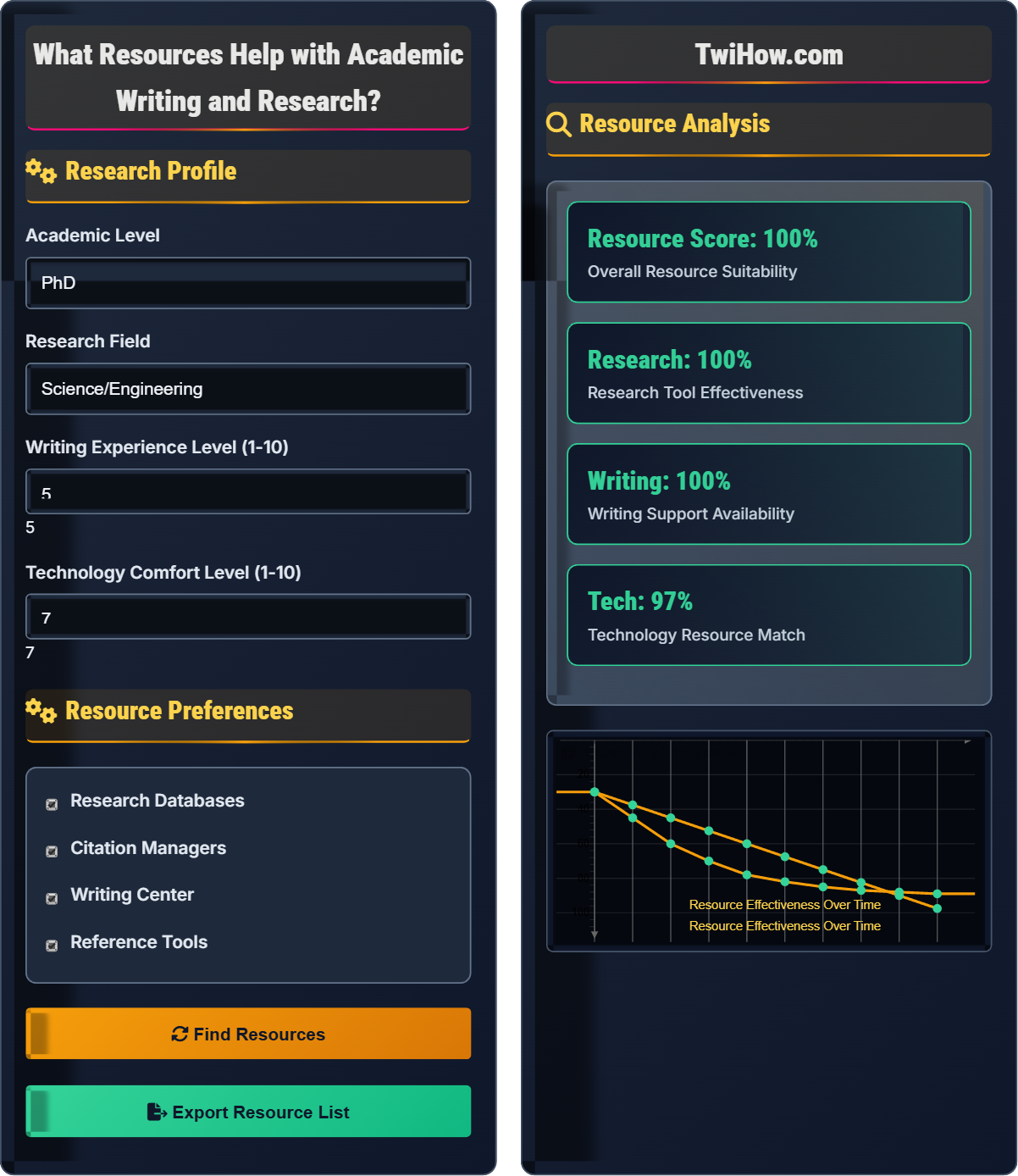
Research Profile
Resource Preferences
Resource Analysis
| Resource | Type | Relevance | Implementation |
|---|---|---|---|
| PubMed | Database | High | Beginner |
| Zotero | Citation Manager | High | Intermediate |
| Google Scholar | Search Engine | Medium | Beginner |
| EndNote | Citation Manager | Medium | Advanced |
| Writing Center | Service | High | Any Level |
Academic Writing and Research Resources
Academic writing and research require a diverse set of resources spanning databases, citation tools, writing support services, and reference management systems. These resources form an interconnected ecosystem that supports every stage of the research process from initial inquiry to final publication. Understanding which resources are available and how to use them effectively is crucial for academic success.
The effectiveness of academic resources can be understood through:
Where:
- Accessibility: Ease of access and availability
- Quality: Accuracy and reliability of information
- Usability: User-friendliness and interface design
- Relevance: Appropriateness for research needs
Academic resources fall into several key categories:
- Research Databases: JSTOR, PubMed, IEEE Xplore, Web of Science
- Citation Managers: Zotero, Mendeley, EndNote, RefWorks
- Writing Centers: Institutional support services for writing improvement
- Reference Tools: Dictionary, thesaurus, grammar checkers
- Statistical Software: SPSS, R, SAS for data analysis
- Publication Platforms: arXiv, SSRN, institutional repositories
- Training: Attend workshops to learn advanced features
- Integration: Connect tools to work seamlessly together
- Customization: Configure settings for your workflow
- Backup: Regularly save and sync your data
- Updates: Stay current with new features and versions
- Feedback: Seek help when facing challenges
Core Resource Concepts
Academic databases, citation managers, research methodology, peer review, plagiarism detection, reference management.
Resource Effectiveness = (Accessibility × Quality) + (Usability × Relevance)
Where Resource Effectiveness = overall utility of the resource for academic work.
- Always verify source credibility
- Use proper citation formats
- Keep detailed research notes
Practical Applications
Thesis writing, research papers, literature reviews, conference presentations, academic publishing.
- Identify your research needs
- Research available resources
- Compare features and costs
- Choose appropriate tools
- Learn to use them effectively
- Integrate into your workflow
- Access restrictions and licensing
- Learning curve and time investment
- Compatibility with other tools
- Cost and institutional support
Academic Resource Quiz
Which research database is most appropriate for finding peer-reviewed articles in psychology?
PsycINFO is the premier database for psychology research, containing over 4 million records from over 2,500 journals. While other databases may contain some psychology content, PsycINFO specializes in psychological and behavioral sciences, making it the most comprehensive and relevant choice for psychology research.
The answer is B) PsycINFO.
Specialized databases like PsycINFO offer superior coverage of specific disciplines compared to general databases. When selecting databases, consider the subject focus, coverage dates, and types of publications indexed. Academic librarians can provide guidance on which databases are most appropriate for specific research areas.
Research Database: Organized collection of academic publications
Peer-Reviewed: Articles evaluated by experts in the field
PsycINFO: Psychology-specific academic database
• Use discipline-specific databases
• Verify peer-review status
• Check database coverage dates
• Consult with academic librarians
• Use multiple databases
• Check database subject coverage
• Using general databases for specialized research
• Not verifying peer-review status
• Ignoring database search features
Compare the main citation management tools (Zotero, Mendeley, EndNote) and explain which would be most appropriate for a graduate student working on a thesis with 100+ sources.
Zotero: Free, open-source, easy to use, excellent browser integration. Great for students, integrates well with word processors, has good collaborative features. Best for moderate number of sources.
Mendeley: Free, good for PDF annotation, cloud storage, social networking features. Good for collaborative research, decent citation management.
EndNote: Paid, most robust feature set, handles large libraries well, excellent for complex citation styles. Best for large projects, but expensive.
Recommendation: For 100+ sources, EndNote offers the most robust management capabilities, though Zotero is a strong free alternative. EndNote's superior organization features and ability to handle large libraries make it ideal for thesis work.
Considerations: Cost, learning curve, institutional support, collaboration needs.
Citation managers are essential for academic writing with many sources. They automate citation formatting, store bibliographic information, and integrate with word processors. For large projects, the tool's ability to handle many sources, organize them effectively, and maintain accuracy becomes critical. The choice depends on budget, collaboration needs, and feature requirements.
Citation Manager: Software for organizing and formatting citations
PDF Annotation: Adding notes and highlights to documents
Word Processor Integration: Connecting citation tools with writing software
• Choose early in your project
• Back up your library regularly
• Learn the tool thoroughly
• Import citations directly from databases
• Use PDF annotation features
• Sync across devices
• Switching tools mid-project
• Not backing up citation libraries
• Manual citation formatting
You're writing a research paper and have found a paragraph from a journal article that perfectly expresses your idea. How should you properly incorporate this content into your paper to avoid plagiarism? What tools can help ensure you're citing correctly?
Proper Incorporation:
Quotation: Use exact words in quotation marks and cite properly. Example: "The concept of academic integrity is fundamental to scholarly work" (Smith, 2023, p. 45).
Paraphrasing: Restate the idea in your own words while maintaining the original meaning and citing the source.
Summarizing: Condense the main ideas in your own words with proper citation.
Tools for Verification:
• Grammarly: Checks for plagiarism and citation issues
• Turnitin: Institutional plagiarism detection
• Citation managers: Ensure proper formatting
• Style guides: APA, MLA, Chicago for proper citation
Best Practices: Always cite sources, use quotation marks for direct quotes, and verify citations match style guidelines.
This scenario illustrates the importance of understanding academic integrity principles. Plagiarism isn't just copying text; it includes misrepresenting others' ideas as your own. Academic institutions have strict policies, and plagiarism detection tools are sophisticated. The key is always acknowledging sources properly and understanding that even paraphrased ideas require attribution.
Plagiarism: Using others' work without proper attribution
Academic Integrity: Ethical conduct in academic work
Paraphrasing: Restating ideas in your own words
• Always cite sources
• Use quotation marks for direct quotes
• Paraphrase in your own words
• Take detailed notes with source info
• Use citation managers
• Run papers through plagiarism checkers
• Paraphrasing too closely to original
• Forgetting to cite common knowledge
• Self-plagiarism from previous work
You're conducting a literature review on climate change impacts for your dissertation. You've found 150 relevant articles. Describe a systematic approach using academic resources to manage, analyze, and synthesize this information effectively.
Systematic Approach:
1. Organization: Import all 150 articles into a citation manager (Zotero/EndNote). Create folders by themes/subtopics.
2. Screening: Read titles and abstracts to identify most relevant articles (typically 30-50% of initial results).
3. Analysis: Create spreadsheets to track key information: authors, year, methodology, findings, themes.
4. Synthesis: Group articles by themes, identify gaps, contradictions, and trends in literature.
5. Writing: Structure review chronologically, thematically, or methodologically. Use writing center for feedback.
6. Tools: Use NVivo or Atlas.ti for qualitative analysis, citation manager for organization, writing center for review.
7. Verification: Check for comprehensiveness and proper citation format.
Literature reviews require systematic organization and critical analysis of sources. The key is not just gathering articles but synthesizing them to identify patterns, gaps, and contradictions. Citation managers are essential for organizing large numbers of sources. Academic writing centers can provide feedback on structure and clarity. The process should be iterative, refining your understanding as you read more widely.
Literature Review: Systematic survey of scholarly sources
Thematic Analysis: Grouping sources by themes
Synthesis: Combining information from multiple sources
• Systematically organize sources
• Identify patterns and gaps
• Synthesize rather than summarize
• Use tags to categorize articles
• Create visual maps of relationships
• Keep detailed notes with source info
• Not organizing sources systematically
• Summarizing rather than analyzing
• Missing important sources
Which of the following is the most appropriate time to visit your institution's writing center?
After completing a draft but before final submission is ideal. This allows sufficient time to implement feedback and revise. Writing centers provide comprehensive support including organization, argumentation, and critical thinking, not just grammar. Early consultation helps improve the overall quality of your work.
The answer is B) After completing a draft but before final submission.
Writing centers offer much more than grammar correction. They provide feedback on organization, argumentation, evidence use, and overall writing effectiveness. The goal is to improve your writing skills for future work, not just fix one paper. Multiple visits throughout a project can be beneficial, but at minimum, visiting with a complete draft allows for comprehensive feedback.
Writing Center: Academic support service for writing improvement
Comprehensive Feedback: Reviews organization, argument, and evidenceWriting Skills: Abilities that improve with practice and feedback
• Visit early in the writing process
• Bring a complete draft
• Be open to feedback
• Schedule appointments in advance
• Come prepared with specific questions
• Follow up on recommendations
• Waiting until the last minute
• Only focusing on grammar
• Not implementing feedback
FAQ
Q: I'm overwhelmed by the number of research databases available. How do I know which ones to use for my papers?
A: Start with your library's subject guides, which recommend databases by discipline. For general research, begin with JSTOR or Google Scholar. For specific fields, use specialized databases like PubMed for medicine, ERIC for education, or IEEE Xplore for engineering. Consult with your academic librarian who can provide personalized recommendations based on your research topic. Many libraries offer database training sessions that are very helpful for beginners.
Q: Should I pay for premium citation management software or stick with free options?
A: For most students, free options like Zotero or Mendeley are sufficient and offer robust features. Premium options like EndNote provide more advanced features for large projects (theses, dissertations, multi-author papers). Consider your project scope, collaboration needs, and budget. Many institutions provide free access to premium tools, so check with your library first. Start with free tools and upgrade only if you need specific advanced features.