What Scholarships are Available and How to Apply?
Complete guide • Application strategies • Step-by-step instructions
Scholarships are financial awards given to students based on various criteria such as academic merit, financial need, special talents, or demographic characteristics. They provide essential financial support for education without requiring repayment. Understanding the scholarship landscape and application process can significantly reduce the cost of higher education.
Major scholarship categories include:
- Merit-Based: Academic excellence, leadership, or special talents
- Need-Based: Financial circumstances and family income
- Demographic-Specific: Race, gender, ethnicity, or other characteristics
- Field-Specific: Particular majors or career paths
- Location-Based: Geographic residence or school attendance
Successful scholarship seekers combine multiple sources and maintain organized application strategies.
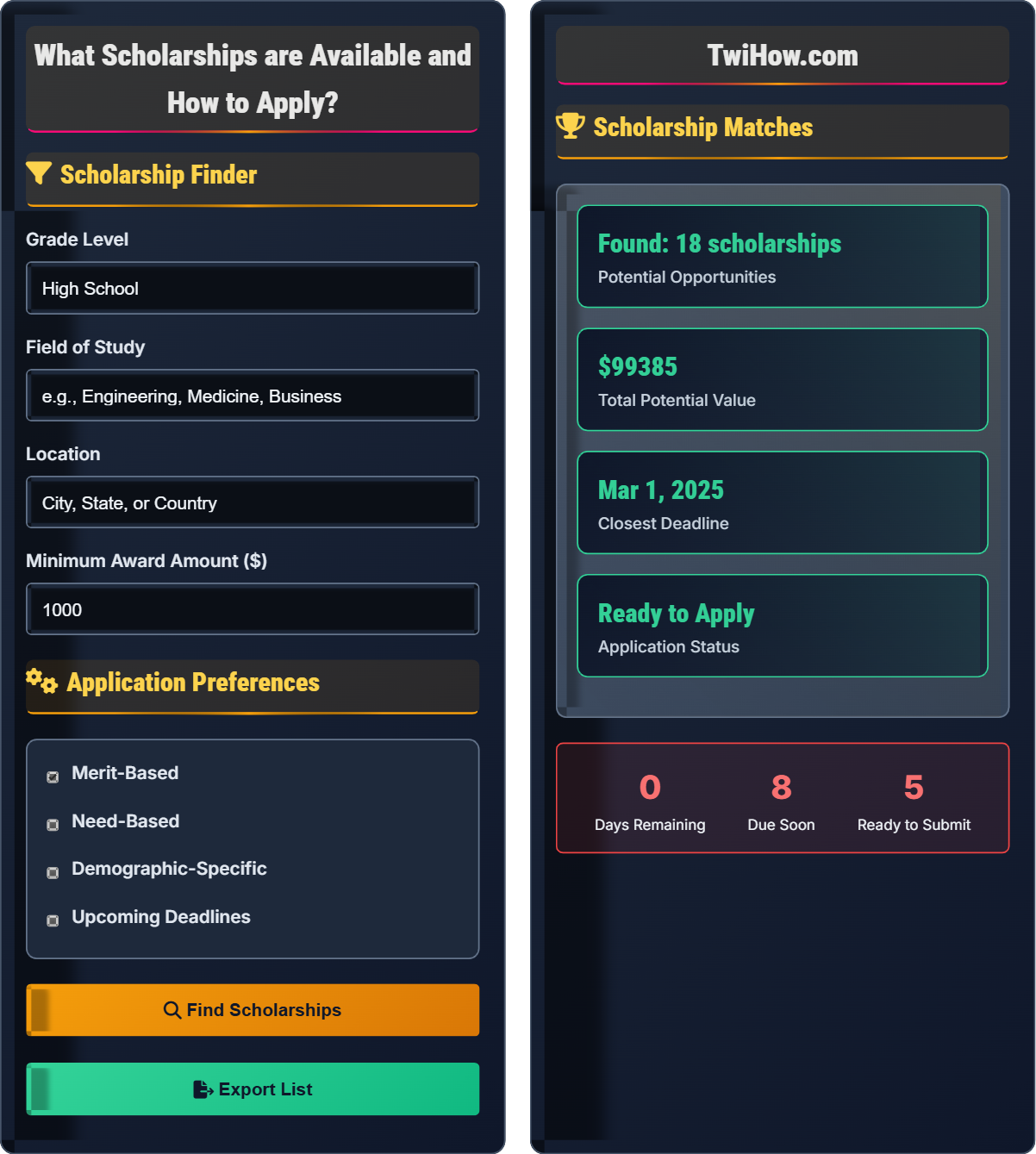
Scholarship Finder
Application Preferences
Scholarship Matches
For high-achieving students based on PSAT/NMSQT scores. Requires exceptional academic performance and leadership potential.
Supporting underrepresented students pursuing degrees in Science, Technology, Engineering, and Mathematics fields.
Available to residents of our local area pursuing higher education. Requires community service documentation.
| Scholarship | Amount | Deadline | Status |
|---|---|---|---|
| National Merit | $2,500 | Jan 15, 2025 | Pending |
| STEM Diversity | $5,000 | Dec 30, 2024 | Applied |
| Community Foundation | $1,000 | Feb 1, 2025 | Preparing |
Types of Scholarships
Merit-based scholarships reward academic excellence, leadership qualities, special talents, or other achievements. These scholarships typically consider GPA, standardized test scores, extracurricular activities, and community involvement. Recipients are selected based on their demonstrated abilities and potential.
- Academic performance (GPA, test scores)
- Leadership roles and achievements
- Artistic or athletic talents
- Community service and volunteer work
- Special projects or research
Need-based scholarships are awarded primarily on financial circumstances. These scholarships help students who demonstrate significant financial need attend college. Applications typically require detailed financial information, including tax returns and family income documentation.
- Family tax returns
- Income verification
- Asset information
- Family size and composition
- Other financial obligations
These scholarships target students from specific demographic groups, including minorities, women in STEM fields, first-generation college students, or students from particular geographic regions. They aim to promote diversity and inclusion in higher education.
- Race and ethnicity
- Gender
- First-generation college students
- Students with disabilities
- LGBTQ+ students
Field-specific scholarships support students pursuing particular majors or career paths. These scholarships often come from professional organizations, companies, or educational institutions seeking to attract students to specific fields that may be underserved or growing.
- Science, Technology, Engineering, and Mathematics (STEM)
- Education and teaching
- Medicine and healthcare
- Business and entrepreneurship
- Arts and humanities
Location-based scholarships are available to students from specific geographic areas, whether cities, states, or countries. These scholarships often support local students or attract students to particular regions. Many states offer scholarships to residents attending in-state institutions.
- State resident scholarships
- Local community scholarships
- Regional university scholarships
- International student scholarships
- Rural and urban-specific grants
Application Timeline
Application Requirements
Scholarship Application Quiz
Which type of scholarship is primarily based on financial need rather than academic achievement?
Need-based scholarships are awarded primarily on financial circumstances and family income rather than academic performance or other achievements. These scholarships help students who demonstrate significant financial need attend college. They typically require detailed documentation of family income, assets, and other financial information.
The answer is B) Need-Based.
Understanding scholarship categories is crucial for targeted searching. Need-based scholarships focus on economic circumstances, while merit-based scholarships emphasize achievements. Some scholarships consider both need and merit. Students should identify which categories match their qualifications and circumstances.
Need-Based: Awarded based on financial circumstances
Merit-Based: Awarded based on achievements and potential
Financial Documentation: Proof of income and assets
• Apply for both need and merit scholarships
• Prepare financial documents early
• Verify income requirements
• Complete FAFSA for federal aid
• Gather tax documents early
• Look for state-specific programs
• Not applying for need-based scholarships
• Missing financial aid deadlines
What are the most important documents required for scholarship applications, and how should students prepare them effectively?
Essential Documents:
1. Academic Transcripts: Request official transcripts early from your school. Ensure they're current and reflect all coursework. Some scholarships require mid-year updates.
2. Personal Essays: Craft unique, compelling essays for each application. Tailor them to the scholarship's mission and requirements. Have multiple people review for clarity and impact.
3. Letters of Recommendation: Approach teachers, counselors, or employers well in advance. Provide recommenders with your resume and information about the scholarship. Choose people who know you well.
4. Standardized Test Scores: Send official scores to scholarship organizations. Ensure scores meet minimum requirements and are from recent tests.
5. Financial Documentation: For need-based scholarships, gather tax returns, income verification, and asset information. Organize documents systematically.
Preparation Tips: Create a master folder with all documents. Prepare multiple versions of essays for different scholarship types. Keep copies of everything submitted.
Successful scholarship applications require careful preparation and organization. Each document serves a specific purpose in demonstrating qualifications. Students should view the application process as a project requiring systematic preparation and attention to detail.
Official Transcript: Certified academic record from school
Personal Essay: Narrative demonstrating character and goals
Recommendation Letter: Third-party endorsement of qualifications
• Request materials well in advance
• Verify document authenticity
• Follow submission guidelines exactly
• Create a scholarship application calendar
• Prepare template essays for customization
• Keep organized records of submissions
• Submitting expired test scores
• Forgetting to sign applications
• Missing required documents
Sarah is a high school senior with a 3.8 GPA and strong leadership experience. She wants to apply for scholarships but feels overwhelmed by the number of options and deadlines. She has 3 months before college starts and has only applied to 2 scholarships. How should she prioritize her scholarship search and application strategy?
Immediate Action Plan (Week 1):
• Create a comprehensive scholarship database with deadlines, requirements, and award amounts
• Prioritize scholarships with upcoming deadlines (within 2 weeks)
• Prepare standard application materials (essays, letters, transcripts)
Application Strategy:
• Focus on scholarships that match her profile (leadership, GPA)
• Apply for smaller, local scholarships with fewer applicants
• Target merit-based scholarships that align with her strengths
Material Preparation:
• Draft a versatile personal essay that can be adapted for different scholarships
• Secure 2-3 strong letters of recommendation
• Organize academic records and leadership documentation
Efficiency Tips:
• Use scholarship search engines and school resources
• Apply to 5-10 scholarships per week
• Set up a tracking system for applications and deadlines
Even with limited time, a systematic approach can yield significant results.
Effective scholarship searching requires strategic prioritization and efficient use of time. Students should focus on opportunities that match their qualifications and have the best chance of success. Organization and systematic application are key to managing multiple deadlines and requirements.
Scholarship Database: Organized record of opportunities
Application Calendar: Schedule of deadlines and requirements
Targeted Search: Focused on matching qualifications
• Prioritize based on deadlines and fit
• Apply to multiple scholarships
• Track all submissions systematically
• Use scholarship matching websites
• Check with local organizations
• Only applying for large national scholarships
• Procrastinating on applications
• Not tailoring applications
Michael has strong academics and leadership experience but struggles with writing scholarship essays. He tends to write generic responses that don't stand out. How can he craft compelling scholarship essays that effectively showcase his qualifications?
Essay Structure Strategy:
• Open with a specific, engaging anecdote that demonstrates your qualification
• Use concrete examples to illustrate abstract qualities
• Connect your experiences to your future goals and the scholarship's mission
• End with a forward-looking statement that reinforces your commitment
Specificity Techniques:
• Replace general statements with specific details ("I led a team" becomes "I managed a 12-person volunteer team that raised $5,000")
• Include dialogue and scene-setting to bring experiences to life
• Mention specific names, places, and outcomes
Authentic Voice:
• Write in your natural voice, not formal academic language
• Share genuine emotions and reflections
• Be vulnerable when appropriate
Tailoring Approach:
• Research the organization's mission and values
• Connect your experiences directly to their goals
• Demonstrate knowledge of their work
Remember: Specific, authentic stories are more compelling than generic statements.
Effective scholarship essays transform generic qualifications into memorable stories. The key is showing rather than telling, using specific examples that demonstrate character and potential. Students should view essays as opportunities to share their authentic experiences and connect with reviewers.
Show vs. Tell: Demonstrate through examples rather than claims
Authentic Voice: Natural writing style that reflects personality
Tailored Essay: Customized to specific scholarship
• Use specific examples to prove general points
• Connect to scholarship mission
• Be authentic and genuine
• Start with a compelling scene
• Use dialogue and sensory details
• Read essays aloud for flow
• Writing generic, interchangeable essays
• Focusing only on achievements
• Not connecting to scholarship mission
Which source typically offers the least competitive scholarships with the highest likelihood of winning?
Local community foundations typically offer scholarships with smaller applicant pools, making them less competitive than national programs. These scholarships often have specific geographic requirements but may have fewer applicants per award, increasing the likelihood of winning. National and corporate scholarships often receive tens of thousands of applications, while local scholarships might only receive hundreds.
The answer is B) Local Community Foundation.
Smart scholarship searching involves balancing award amount with competition level. While large national scholarships offer substantial funds, local scholarships provide better odds of winning. Students should diversify their applications across different competitiveness levels and award amounts.
Competition Level: Number of applicants per award
Application Pool: Total number of applicants
Odds of Winning: Probability based on pool size
• Apply to both local and national scholarships
• Balance competitiveness with award size
• Diversify application portfolio
• Search local newspapers for scholarship announcements
• Contact local businesses and organizations
• Check with your high school counselor
• Only applying to major national scholarships
• Ignoring local opportunities
• Not diversifying application strategy
Application Success Strategies
To maximize your scholarship opportunities:
- Start searching and applying early (ideally junior year)
- Organize a comprehensive application system
- Tailor each application to the specific scholarship
- Focus on showcasing unique experiences and perspectives
- Meet all deadlines well in advance
- Follow up appropriately after submission
Remember that scholarship success often comes from volume and persistence. Even with a low success rate, applying to multiple scholarships can yield significant financial support.
FAQ
Q: Do I need perfect grades to win scholarships?
A: No, you don't need perfect grades to win scholarships. Many scholarships consider factors beyond grades, including leadership, community service, unique talents, or personal circumstances. Some scholarships are specifically for students who have overcome challenges. While academic performance is important for many scholarships, it's just one of many criteria. Focus on presenting a well-rounded application that showcases your unique strengths and experiences.
Q: Can students apply for multiple scholarships?
A: Yes, students can and should apply for multiple scholarships. There are usually no restrictions on receiving multiple awards from different sources. However, some schools may adjust other aid if you receive significant outside scholarships. Always report outside scholarships to your school's financial aid office. The more scholarships you apply for, the greater your chances of receiving financial support. Just ensure you meet all application requirements and deadlines for each scholarship.