Best Apps to Learn Languages
Complete language learning guide • Step-by-step comparisons
Language Learning Apps Overview:
Compare AppsLanguage learning apps have revolutionized how people acquire new languages. These digital platforms offer interactive lessons, gamified experiences, and personalized learning paths that make language acquisition more accessible than ever before.
Popular language learning apps include Duolingo, Babbel, Rosetta Stone, Busuu, Memrise, and many others. Each offers unique approaches to language learning with different strengths and methodologies.
Key features of language learning apps:
- Interactive Lessons: Bite-sized lessons that focus on vocabulary, grammar, and pronunciation
- Gamification: Points, streaks, and rewards to maintain motivation
- Speech Recognition: Tools to practice pronunciation
- Adaptive Learning: AI-powered systems that adjust to your pace
- Offline Access: Download lessons for learning anywhere
Choosing the right app depends on your learning goals, preferred methodology, budget, and target language availability.
Language Learning Preferences
Feature Priorities
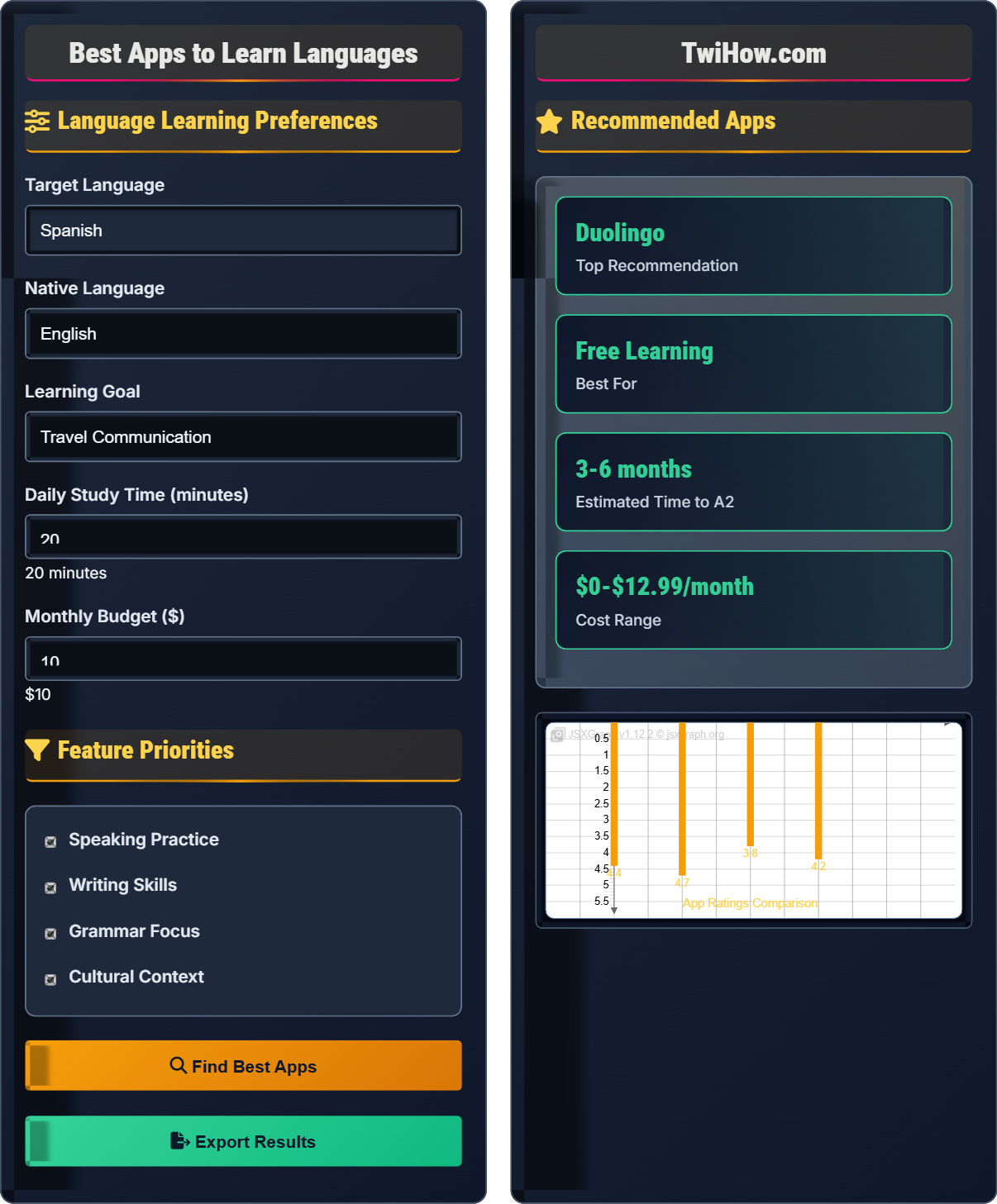
Recommended Apps
| App | Rating | Price | Effectiveness |
|---|---|---|---|
| Duolingo | ★★★★☆ | Free/$12.99 | Good |
| Babbel | ★★★★★ | $12.95/month | Excellent |
| Rosetta Stone | ★★★☆☆ | $11.99/month | Good |
| Busuu | ★★★★☆ | $9.99/month | Very Good |
Free, gamified approach to language learning with bite-sized lessons.
Pros
- Completely free
- Engaging game mechanics
- Lots of language options
- Mobile-first design
Cons
- Limited grammar explanations
- Less focus on speaking
- Can be repetitive
Language Learning Apps Explained
Language learning apps are digital platforms designed to teach foreign languages through interactive exercises, games, and structured curricula. They utilize various methodologies including spaced repetition, immersion techniques, and adaptive learning to optimize language acquisition.
Different apps employ distinct approaches to language learning:
Where:
- Methodology: Approach (gamified, immersion, grammar-focused)
- Consistency: Daily practice frequency
- Practice Time: Minutes per day spent learning
Leading platforms in the language learning space:
- Duolingo: Gamified learning with free access to many languages
- Babbel: Focus on conversation skills and practical vocabulary
- Rosetta Stone: Immersive method using pictures and audio
- Busuu: Structured curriculum with speech recognition
- Memrise: Video-based learning with native speakers
- Pimsleur: Audio-focused approach emphasizing listening and speaking
- Learning Goals: Casual learner vs. fluency seeker
- Learning Style: Visual, auditory, or kinesthetic preferences
- Budget: Free options vs. premium subscriptions
- Time Commitment: Daily minutes available for study
- Target Language: Availability of specific languages
- Features: Speaking practice, offline access, cultural content
App Comparisons
Free, gamified approach with over 40 languages available. Great for beginners and maintaining daily practice.
Pros
- Completely free to use
- Wide variety of languages
- Engaging game mechanics
- Mobile and web accessibility
Cons
- Limited grammar explanations
- Less focus on speaking skills
- Repetitive lesson structures
Free Tier: Full access to all courses
Premium ($6.99/month): Ad-free, offline access, progress quizzes
Focuses on conversation skills and practical vocabulary. Designed by language experts for real-world communication.
Pros
- Emphasis on speaking skills
- Practical, everyday vocabulary
- Cultural context included
- Review manager for retention
Cons
- Paid subscription required
- Fewer language options
- Less gamified than competitors
Monthly: $12.95/month
Yearly: $6.95/month (billed annually)
Quarterly: $10.95/month (billed quarterly)
Learning Path Recommendations
Interactive Learning Demo
Experience a sample lesson from our recommended apps:
Select a category above to start a demo lesson!
Language Learning Apps Quiz
Which language learning app is known for its gamified approach and completely free access?
Duolingo is renowned for its gamified approach to language learning with features like streaks, leaderboards, and bite-sized lessons. It offers completely free access to all its language courses, supported by ads and an optional premium subscription.
The answer is B) Duolingo.
Duolingo's success lies in its use of gamification principles to maintain learner engagement. By turning language learning into a game with points, levels, and streaks, it addresses one of the biggest challenges in language learning: consistency. The app uses spaced repetition and adaptive learning to optimize retention while keeping the experience fun and engaging.
Gamification: Applying game-design elements in non-game contexts to increase engagement
Spaced Repetition: Learning technique that involves reviewing material at increasing intervals
Streak: Consecutive days of completing lessons, used as a motivational tool
• Consistency is more important than intensity in language learning
• Gamification helps maintain motivation over time
• Free apps often have premium features available
• Set a daily reminder to maintain your streak
• Use the app consistently for short periods rather than long sessions
• Supplement with other resources for comprehensive learning
• Expecting fluency from just using the app alone
• Neglecting speaking practice in favor of other skills
• Getting discouraged by difficult lessons
Compare and contrast the learning methodologies of Duolingo and Babbel. Which approach is better for achieving conversational fluency?
Duolingo Methodology: Gamified approach focusing on vocabulary and basic grammar through bite-sized lessons. Uses spaced repetition and adaptive learning to reinforce concepts. Strengths include accessibility, engagement, and wide language selection.
Babbel Methodology: Conversation-focused approach emphasizing practical vocabulary and real-world scenarios. Designed by language experts with structured lessons that build conversational skills. Includes speech recognition for pronunciation practice.
Conversational Fluency: Babbel is generally better for achieving conversational fluency due to its focus on practical communication skills, speech recognition features, and emphasis on speaking from the beginning. While Duolingo is excellent for building vocabulary and basic grammar, Babbel's structured approach to conversation skills provides a stronger foundation for real-world communication.
Language learning methodologies significantly impact the effectiveness of different apps for specific goals. Duolingo's approach is ideal for building foundational vocabulary and maintaining consistent practice, while Babbel's method is designed for learners who prioritize practical communication skills. The choice between them should align with your specific learning objectives and preferred learning style.
Conversational Fluency: Ability to communicate effectively in spoken language
Practical Vocabulary: Words and phrases used in everyday communication
Speech Recognition: Technology that analyzes and evaluates pronunciation
• Match app methodology to your learning goals
• Different approaches work better for different skills
• Consistency is crucial regardless of methodology
• Use multiple apps to cover different aspects of language learning
• Focus on speaking practice for conversational fluency
• Supplement app learning with real conversations
• Using only one app for comprehensive language learning
• Neglecting speaking practice in favor of other skills
• Not practicing outside of app environments
You want to learn Spanish for business meetings in 6 months. You can dedicate 30 minutes per day and have a budget of $15/month. Based on these constraints, which app would be most suitable and why? Calculate your expected progress timeline.
Recommended App: Babbel, because it emphasizes practical vocabulary and conversation skills relevant to business contexts. The structured curriculum and speech recognition features align well with your goal of business proficiency.
Progress Timeline:
With 30 minutes daily commitment:
- Month 1-2: Basic greetings, introductions, and common business terms
- Month 3-4: Presentations, meetings, and negotiation vocabulary
- Month 5-6: Complex discussions, cultural nuances, and fluency practice
Expected Outcome: A2-B1 level proficiency suitable for conducting business meetings in Spanish. This includes the ability to participate in discussions, ask clarifying questions, and express opinions professionally.
Successful language learning requires aligning your learning method with your specific goals. Business Spanish requires different vocabulary and skills than travel Spanish. Babbel's structured approach to practical communication, combined with your dedicated time investment, creates an optimal path toward business proficiency.
A2 Level: Elementary proficiency able to communicate in simple, routine tasks
B1 Level: Intermediate proficiency able to handle most travel situations and workplace communicationBusiness Vocabulary: Terms and expressions used in professional contexts
• Align learning goals with app features
• Consistent daily practice beats sporadic intensive sessions
• Target specific proficiency levels for measurable progress
• Focus on industry-specific vocabulary relevant to your field
• Practice pronunciation of business terminology
• Supplement with business Spanish podcasts or videos
• Underestimating the time needed for business proficiency
• Not practicing pronunciation enough for professional settings
• Focusing only on grammar without practical application
Design a multi-app learning strategy that combines Duolingo for vocabulary building, Babbel for conversation practice, and another resource for cultural context. How would you allocate 45 minutes of daily study time across these resources?
Multi-App Strategy:
15 minutes - Duolingo: Build vocabulary foundation and maintain streaks. Use for quick review of words and basic grammar concepts.
20 minutes - Babbel: Focus on conversation skills, pronunciation, and practical phrases. Emphasize speaking exercises and real-world scenarios.
10 minutes - Cultural Resource: Use YouTube videos, news articles, or podcasts in the target language to gain cultural context and exposure to native speakers.
Benefits: This combination leverages the strengths of each resource while addressing different aspects of language learning. Duolingo maintains vocabulary retention, Babbel builds conversational skills, and cultural exposure provides context and motivation.
Effective language learning often requires a combination of resources that address different skills. A multi-app strategy allows learners to benefit from the unique strengths of each platform while creating a comprehensive learning experience. This approach addresses vocabulary, grammar, pronunciation, and cultural understanding simultaneously.
Multi-App Strategy: Using multiple learning resources to address different language skills
Cultural Context: Understanding of customs, values, and social norms of target language culture
Skill Integration: Combining different language skills for comprehensive learning
• Balance different skills (vocabulary, grammar, speaking, listening)
• Maintain consistency across all resources
• Track progress in each skill area separately
• Schedule specific times for each app to maintain routine
• Use one app for warm-up and another for focused practice
• Integrate all skills through real-world application
• Spreading time too thin across too many resources
• Not tracking progress across different apps
• Focusing on one skill at the expense of others
What is a significant limitation of relying solely on language learning apps for achieving fluency?
While language learning apps provide excellent foundational learning and practice opportunities, they cannot fully replicate real conversational practice with native speakers. Apps typically involve predetermined dialogues and limited response options, which don't prepare learners for the unpredictability and complexity of real conversations.
Real fluency requires spontaneous communication, cultural nuance understanding, and the ability to handle miscommunication or unexpected topics - skills that are best developed through actual conversations with native speakers.
The answer is B) Lack of real conversational practice.
Language learning apps serve as excellent tools for building foundational skills, but achieving true fluency requires additional practice in authentic contexts. Apps provide structure and safety for beginners, but real language use involves unpredictability, cultural context, and dynamic interaction that only comes through genuine communication experiences.
Fluency: Ability to speak a language smoothly and easily without hesitation
Authentic Communication: Real-world language use with native speakers
Cultural Nuance: Subtle meanings and context-dependent language use
• Apps are tools, not complete solutions
• Real practice is essential for fluency
• Combine app learning with other resources
• Join online conversation exchanges
• Watch native content without subtitles
• Practice thinking in the target language
• Thinking apps alone can achieve fluency
• Not seeking real conversation opportunities
• Focusing only on app scores and metrics
FAQ
Q: How long does it take to become conversational in a new language using these apps?
A: The time to achieve conversational proficiency varies significantly based on several factors:
1. Time Investment: 15-20 minutes daily with consistent practice typically yields noticeable progress in 2-3 months
2. Language Difficulty: Similar languages (Spanish for English speakers) may take 3-6 months, while distant languages (Chinese for English speakers) may take 6-12 months
3. Learning Intensity: Daily practice is more effective than weekly intensive sessions
4. Supplementary Activities: Combining apps with media consumption, conversation practice, and cultural exposure accelerates progress
Generally, reaching A2-B1 level (conversational proficiency) requires 3-6 months of consistent daily practice with 20-30 minutes per day. However, individual results vary significantly based on learning style, prior language experience, and dedication.
Q: Should I start with one language app or try multiple simultaneously?
A: For beginners, I strongly recommend starting with a single language app to establish a consistent routine and foundational understanding. Here's why:
Single App Benefits:
1. Consistency: One routine is easier to maintain than multiple schedules
2. Progress Tracking: Easier to measure improvement and stay motivated
3. Foundation Building: Establishes core vocabulary and grammar patterns
4. Habit Formation: Creates a sustainable daily practice
Advanced Strategy: Once you've established a routine (typically after 1-2 months), you can supplement with additional resources like podcasts, YouTube videos, or complementary apps that focus on different skills (e.g., pronunciation, writing).
Remember: Consistency trumps variety for beginners. Master the fundamentals first, then expand your resources.